
Ever wondered why you can't have everything you want? Welcome... Show more
 English Literature
 Sociology
 Biology
Sign up to see the contentIt's free!
Access to all documents
Improve your grades
Join milions of students
Knowunity AI
Subjects
Triangle Congruence and Similarity Theorems
Triangle Properties and Classification
Linear Equations and Graphs
Geometric Angle Relationships
Trigonometric Functions and Identities
Equation Solving Techniques
Circle Geometry Fundamentals
Division Operations and Methods
Basic Differentiation Rules
Exponent and Logarithm Properties
Show all topics
Human Organ Systems
Reproductive Cell Cycles
Biological Sciences Subdisciplines
Cellular Energy Metabolism
Autotrophic Energy Processes
Inheritance Patterns and Principles
Biomolecular Structure and Organization
Cell Cycle and Division Mechanics
Cellular Organization and Development
Biological Structural Organization
Show all topics
Chemical Sciences and Applications
Atomic Structure and Composition
Molecular Electron Structure Representation
Atomic Electron Behavior
Matter Properties and Water
Mole Concept and Calculations
Gas Laws and Behavior
Periodic Table Organization
Chemical Thermodynamics Fundamentals
Chemical Bond Types and Properties
Show all topics
European Renaissance and Enlightenment
European Cultural Movements 800-1920
American Revolution Era 1763-1797
American Civil War 1861-1865
Global Imperial Systems
Mongol and Chinese Dynasties
U.S. Presidents and World Leaders
Historical Sources and Documentation
World Wars Era and Impact
World Religious Systems
Show all topics
Classic and Contemporary Novels
Literary Character Analysis
Rhetorical Theory and Practice
Classic Literary Narratives
Reading Analysis and Interpretation
Narrative Structure and Techniques
English Language Components
Influential English-Language Authors
Basic Sentence Structure
Narrative Voice and Perspective
Show all topics
247
•
Updated Mar 18, 2026
•

Michelle Bali
@k3miiii
Ever wondered why you can't have everything you want? Welcome... Show more


This page contains no content to summarise.
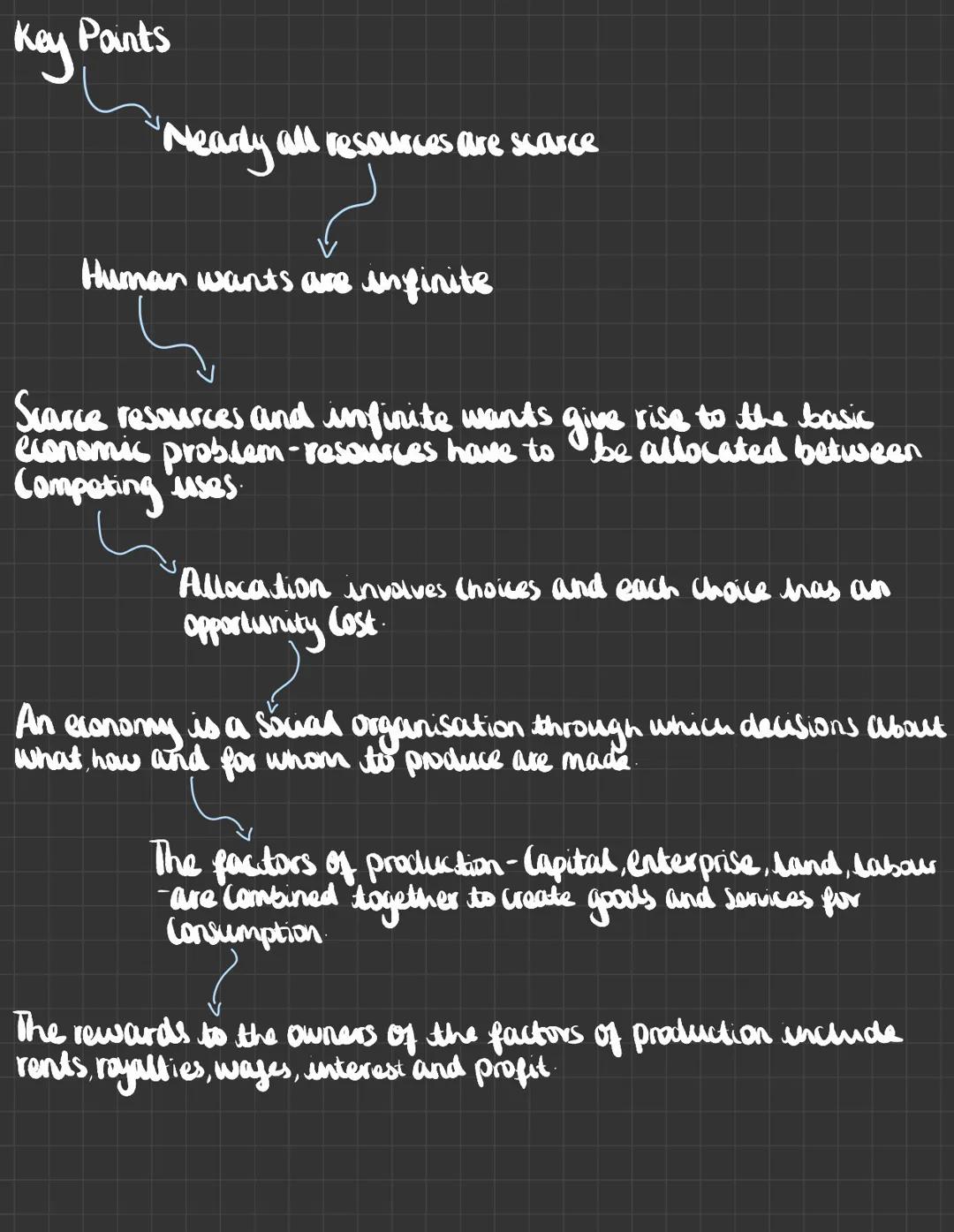
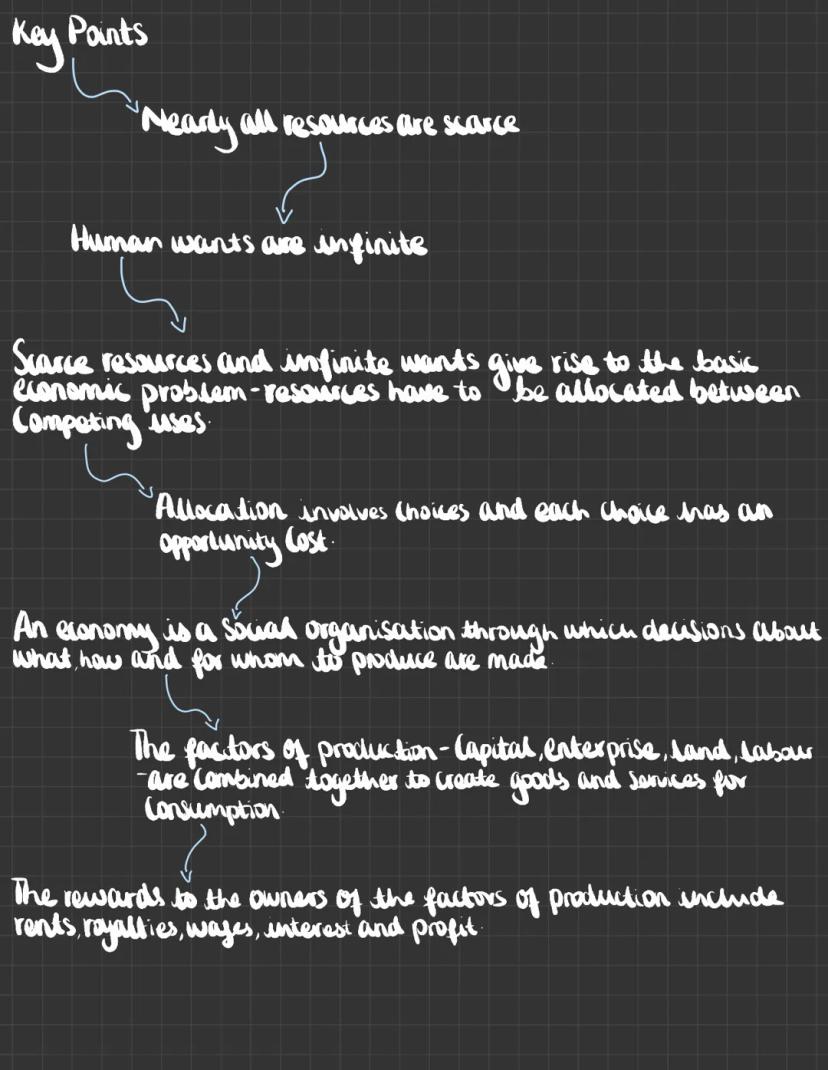
Think about this: there's literally not enough stuff in the world for everyone to have everything they want. That's the heart of economics right there. Nearly all resources are scarce, but human wants are infinite - you'll always find something new you'd like to have.
This creates what economists call the basic economic problem. Since we can't have everything, we need to make choices about how to use our limited resources. Every choice means giving up something else, which economists call opportunity cost.
An economy is basically society's way of organising these tough decisions. It determines what gets produced, how it's made, and who gets what. The building blocks are the factors of production - land, labour, capital, and enterprise - which combine to create all the goods and services we use.
Key Insight: The owners of these factors of production earn rewards like wages (for labour), rent (for land), interest (for capital), and profit (for enterprise).
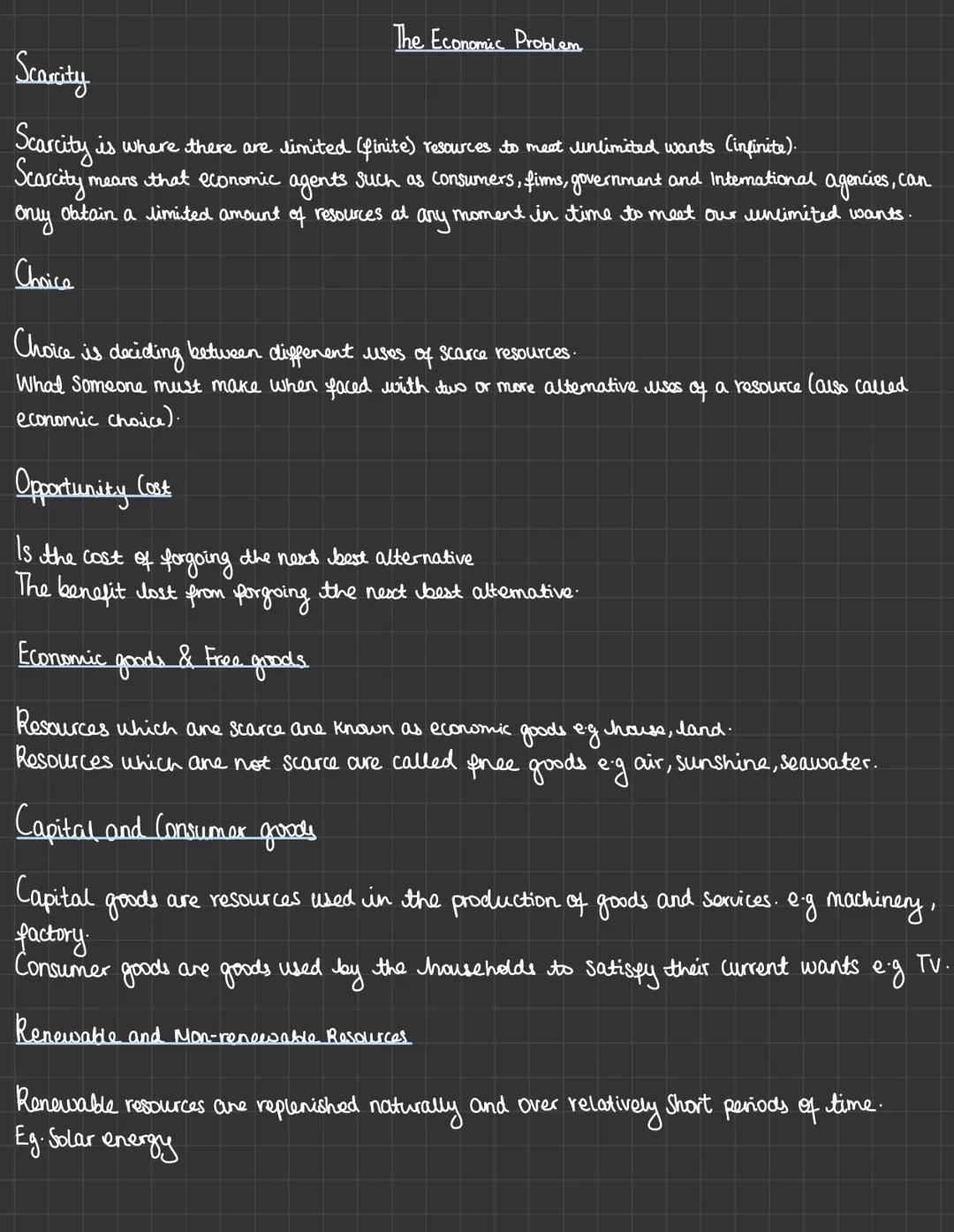
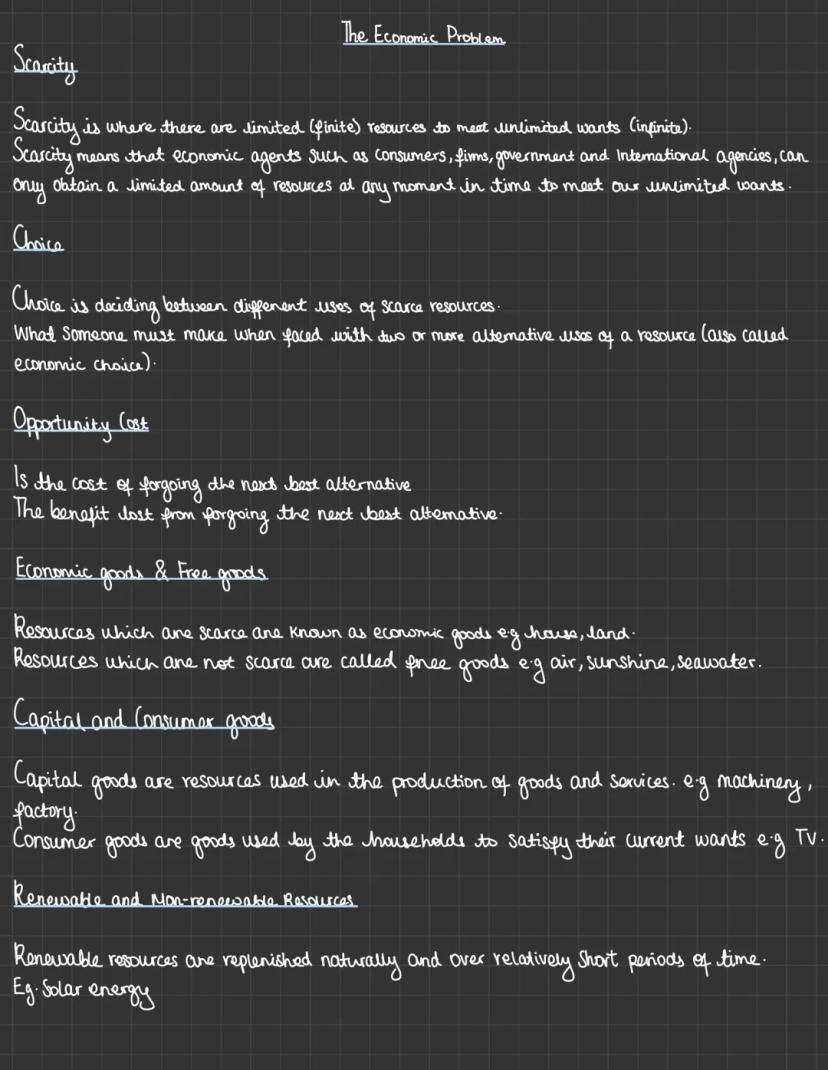
Scarcity isn't just about running out of things - it's about having finite resources to meet infinite wants. Whether you're a consumer deciding what to buy, or a government choosing where to spend money, everyone faces this challenge.
When resources are limited, you're forced to make economic choices. Every time you pick one option, you're giving up the benefits of the next best alternative - that's your opportunity cost. For instance, if you spend your Saturday job money on trainers, the opportunity cost might be the video game you can't afford now.
Not all resources face this problem though. Economic goods like houses and cars are scarce, but free goods like air and sunshine aren't (at least not yet). There's also a crucial difference between consumer goods (things you buy for yourself, like a phone) and capital goods (things used to make other things, like factory machinery).
Renewable resources like solar energy replenish naturally, whilst non-renewable resources like oil take millions of years to form. This leads us to sustainability - using resources at a rate that doesn't compromise future generations' ability to meet their needs.
Remember: The three basic economic questions every society must answer are: What to produce? How to produce it? For whom to produce it?
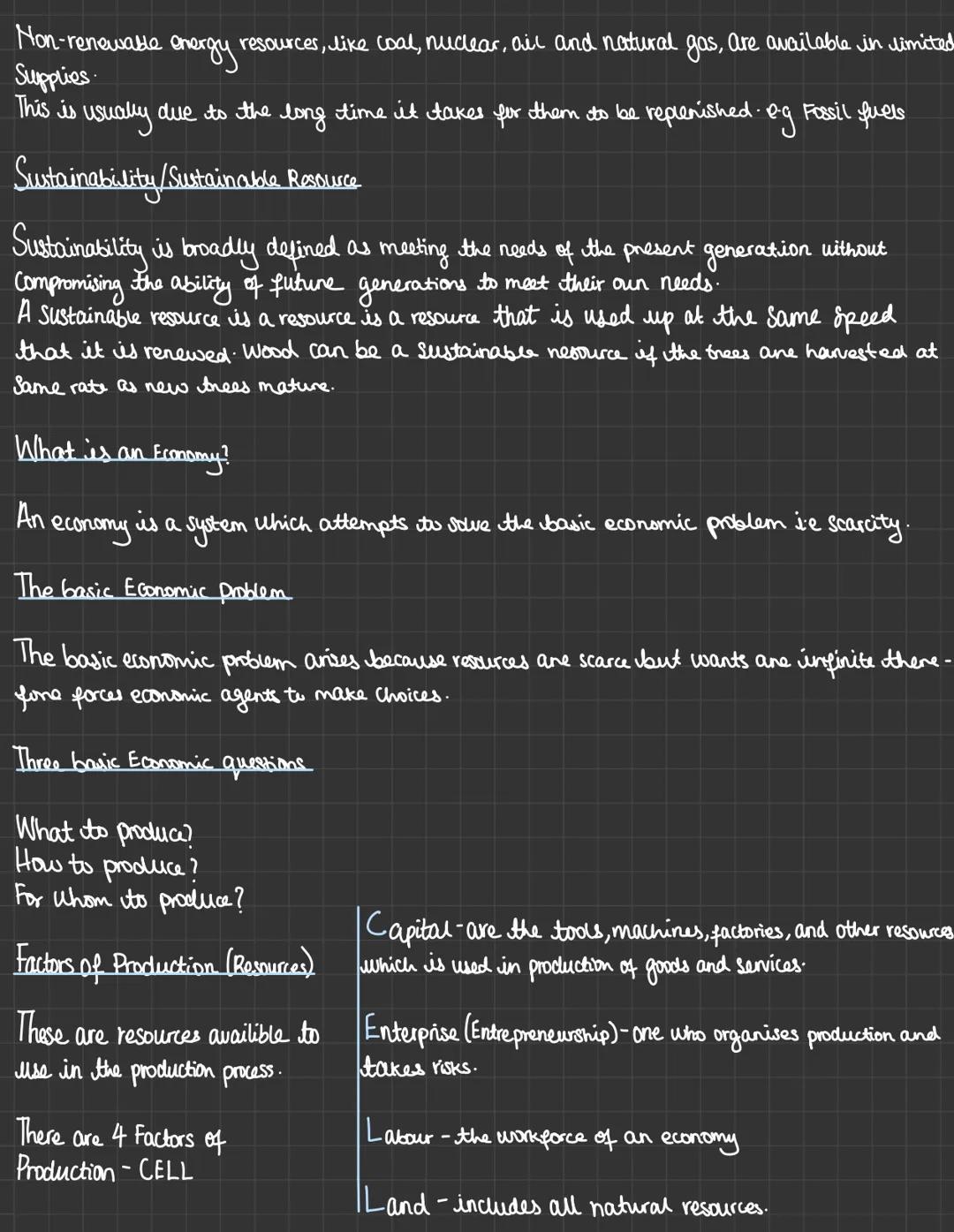
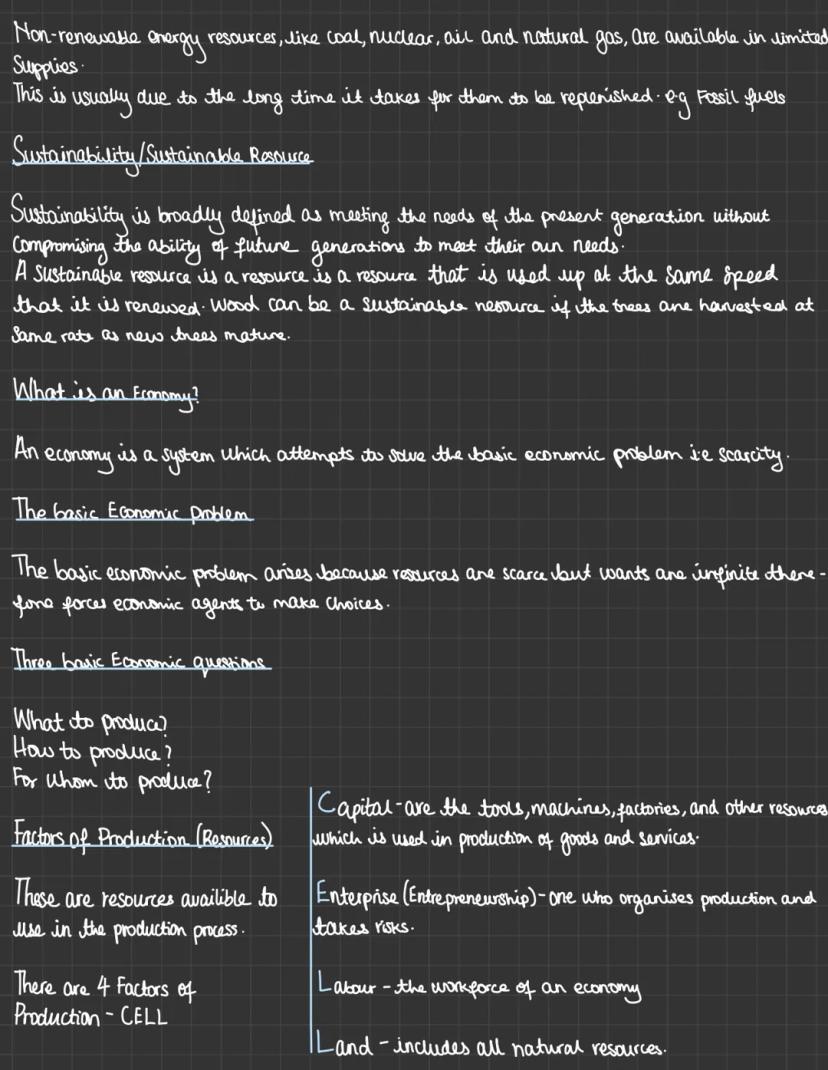
Every economy is essentially a system trying to solve the basic economic problem - dealing with scarcity. Since we can't produce everything everyone wants, societies must answer three fundamental questions about production and distribution.
The factors of production work together to create goods and services. Land includes all natural resources, labour represents the workforce, capital covers tools and machinery, and enterprise involves the risk-taking entrepreneurs who organise everything. You can remember these as "CELL" - a handy way to recall all four factors.
These factors don't work in isolation - they're combined in different ways depending on what's being produced. A bakery needs land (for the shop), labour (bakers and shop assistants), capital (ovens and equipment), and enterprise (someone willing to take the risk of running the business).
Think About It: Every business you see combines these four factors of production - from your local café to massive tech companies like Apple.
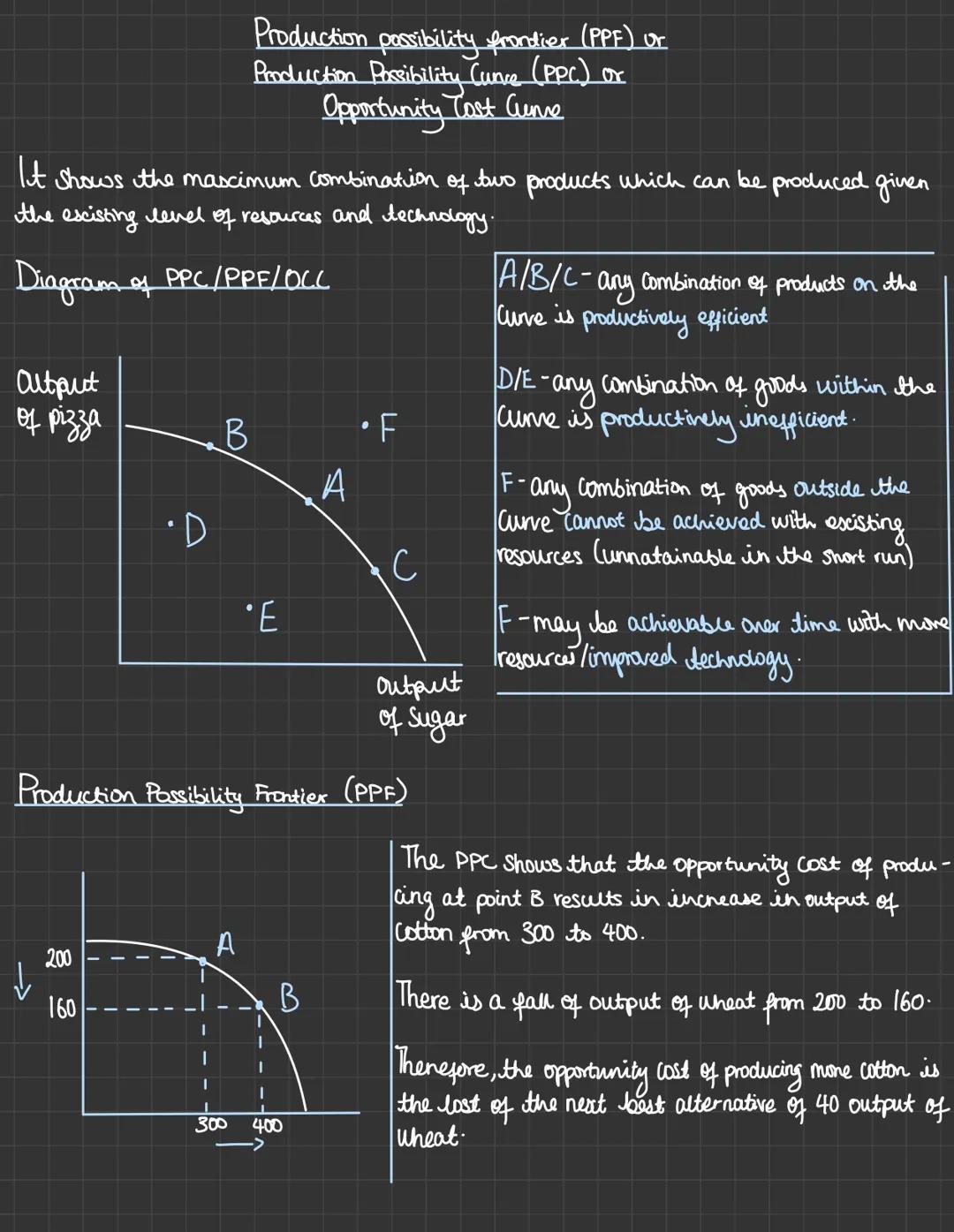
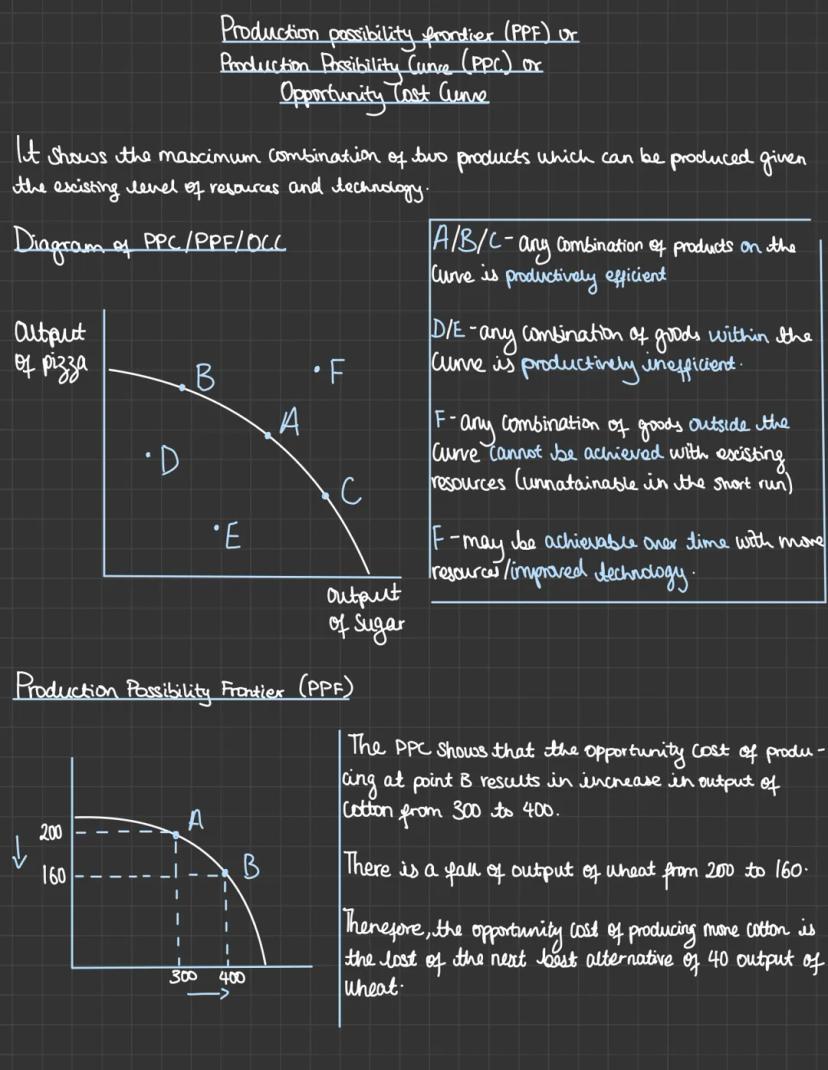
The Production Possibility Frontier (PPF) is like a reality check for any economy. It shows the maximum combinations of two goods you can produce with your current resources and technology - think of it as your economy's potential.
Any point on the curve represents productive efficiency - you're getting the most out of your resources. Points inside the curve show productive inefficiency - you're wasting resources somehow. Points outside the curve are currently impossible to achieve, though they might become possible with better technology or more resources.
The PPF brilliantly demonstrates opportunity cost in action. If you want to produce more of one good, you must produce less of another. The curve shows exactly how much you'll have to give up. For example, if moving from point A to point B increases cotton output from 300 to 400 units, but decreases wheat from 200 to 160 units, the opportunity cost of those extra 100 cotton units is 40 wheat units.
Key Point: The shape of the PPF (usually curved outward) reflects the fact that resources aren't equally suited to producing different goods.
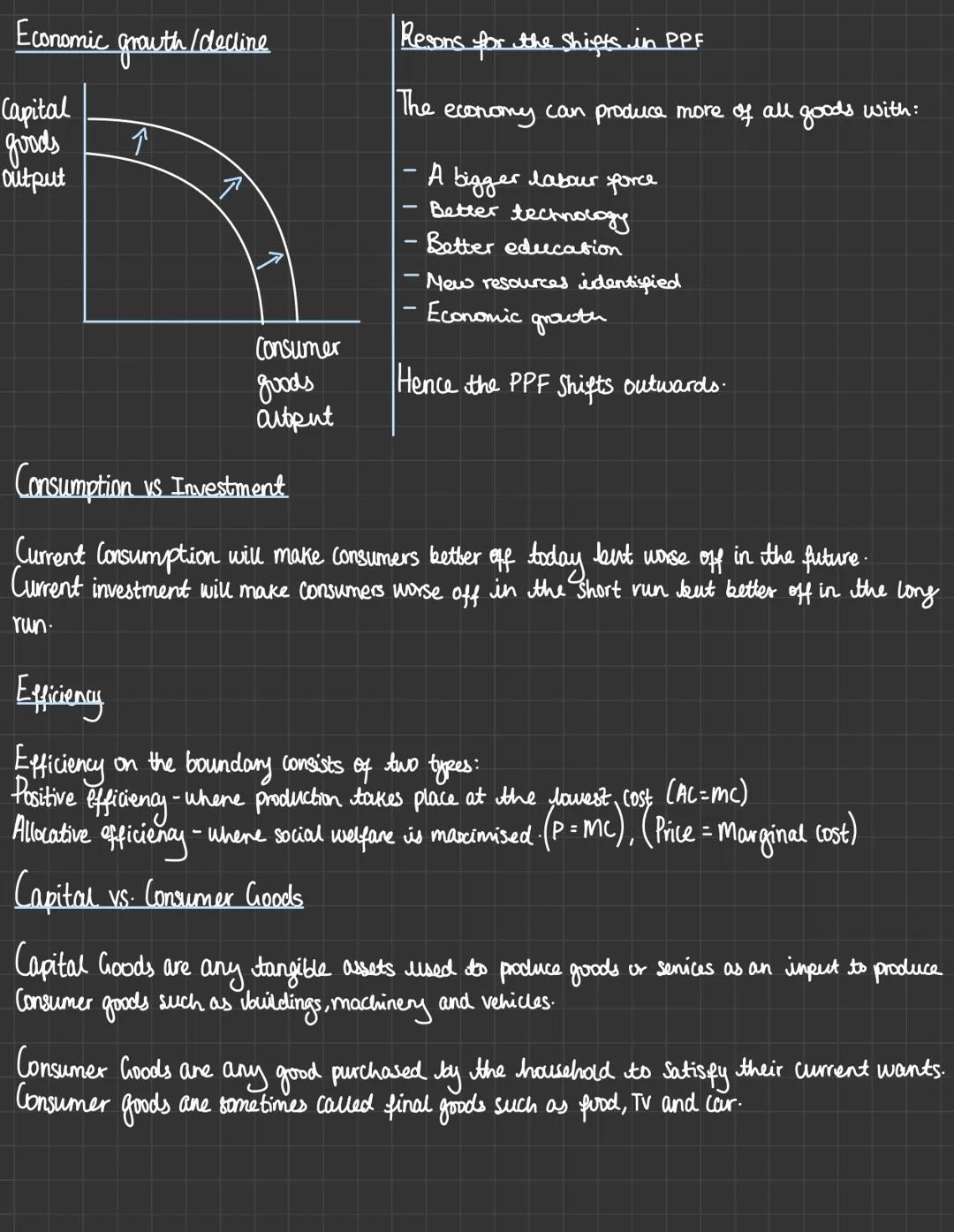
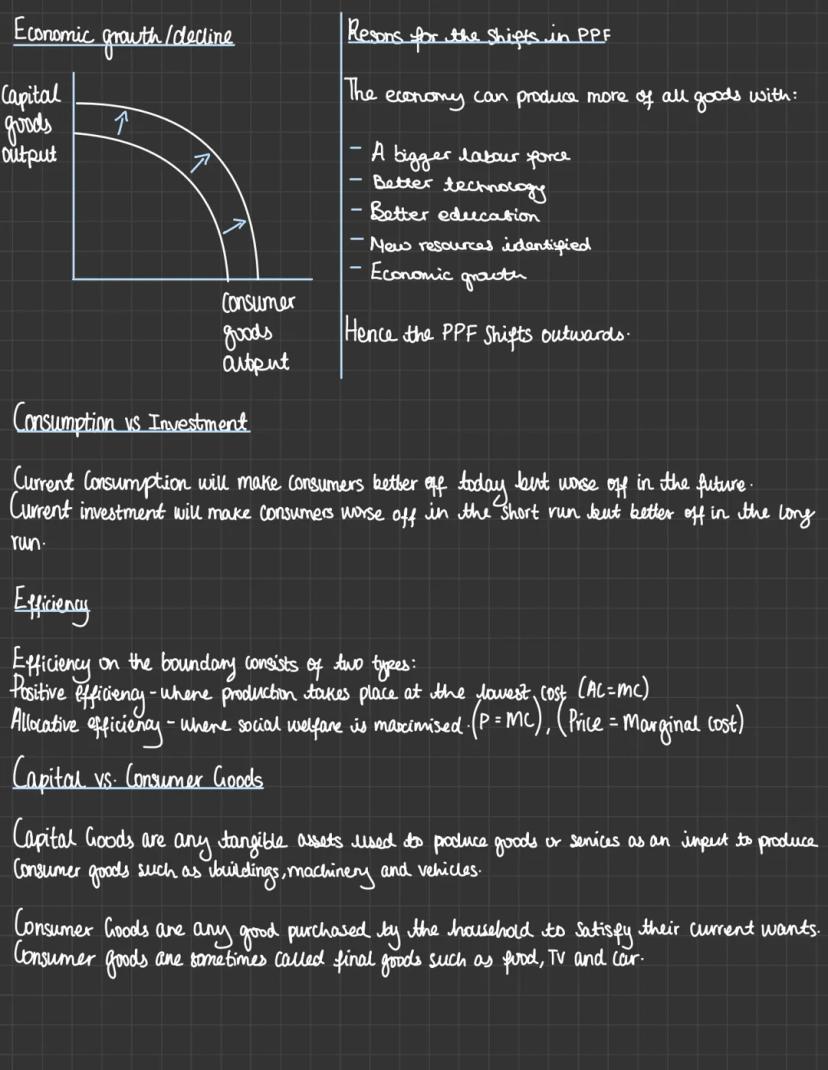
Economic growth happens when the entire PPF shifts outward, meaning you can produce more of everything. This occurs through factors like a bigger workforce, better technology, improved education, or discovering new resources.
There's a crucial trade-off between present and future prosperity. Focusing on current consumption makes people better off today but limits future growth. Investing in capital goods now might mean less consumption today, but it enables much higher living standards later.
Efficiency has two important dimensions. Productive efficiency means producing at the lowest possible cost, while allocative efficiency means producing the right mix of goods that society actually wants. Both are essential for a well-functioning economy.
The distinction between consumer goods and capital goods is vital for understanding economic growth. Consumer goods like food and entertainment satisfy immediate wants, whilst capital goods like machinery and buildings help produce more goods in the future.
Real-World Example: Countries that invest heavily in education and infrastructure (capital goods) often see faster economic growth than those focused only on immediate consumption.
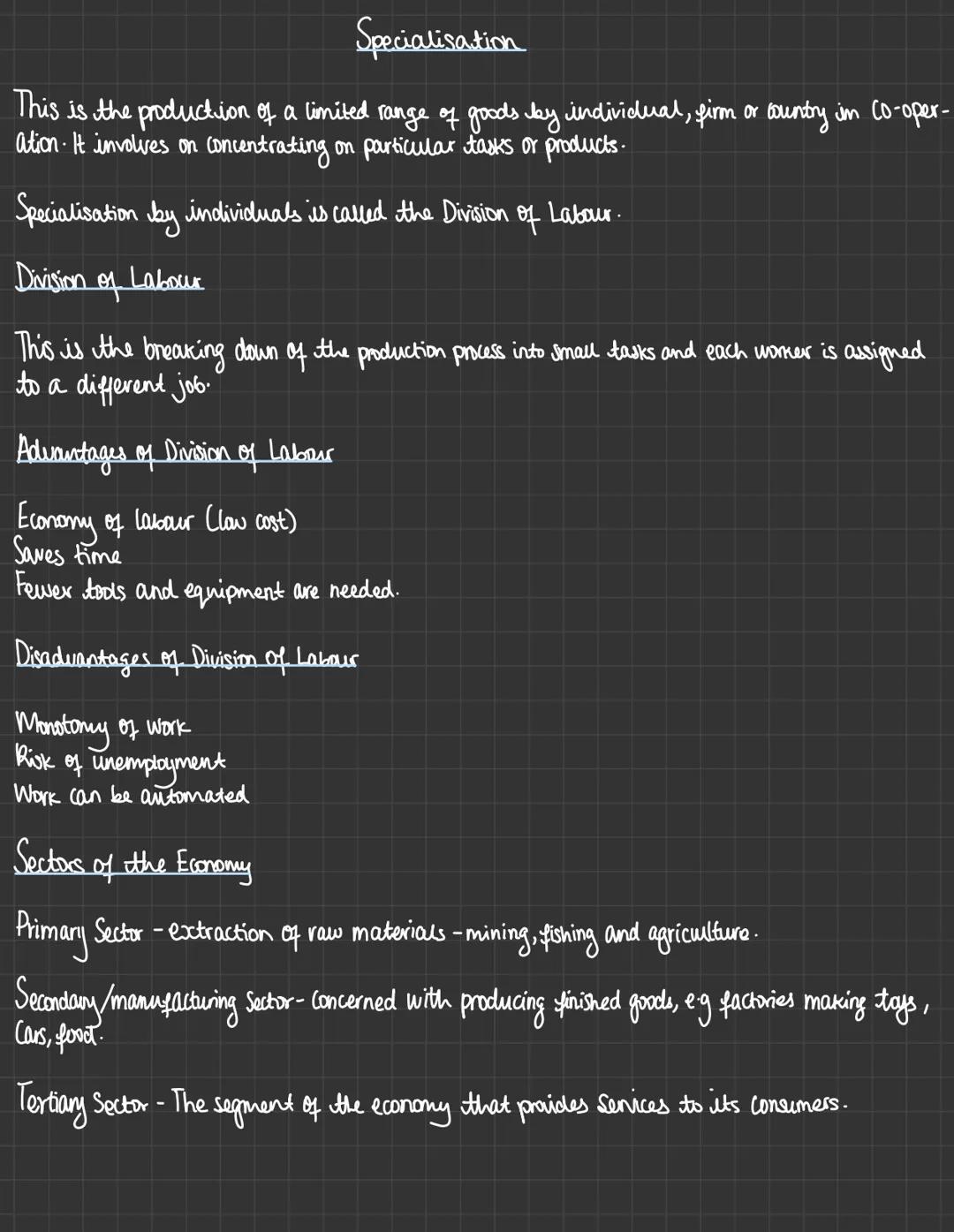
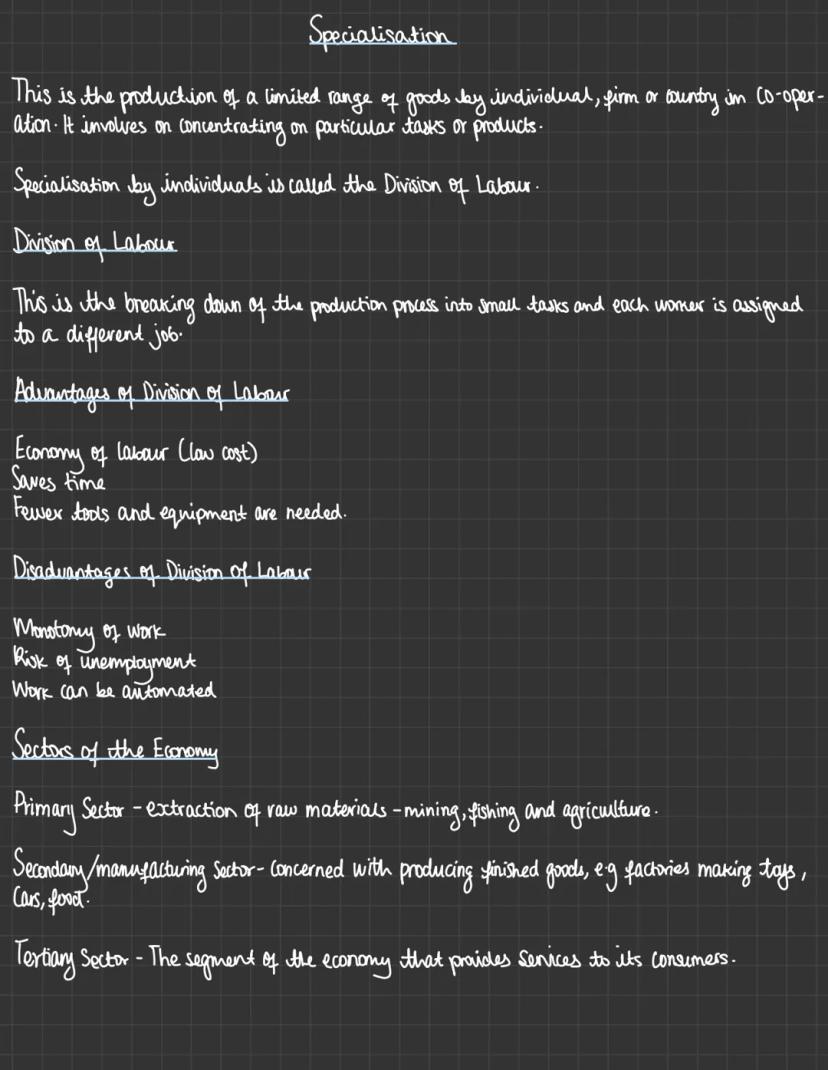
Specialisation is a game-changer for productivity - instead of everyone trying to do everything, people focus on what they do best. When individuals specialise, it's called the division of labour, and it's revolutionised how we work.
The benefits are impressive: lower costs, time savings, and less equipment needed since workers aren't constantly switching tasks. However, there are downsides too - work can become monotonous, workers risk unemployment if their specific skill becomes obsolete, and jobs might be automated.
Modern economies are typically divided into three sectors. The primary sector extracts raw materials through activities like mining and farming. The secondary sector manufactures finished goods in factories. The tertiary sector provides services like healthcare, education, and entertainment.
As countries develop, they typically shift from primary to secondary to tertiary sectors. The UK, for instance, now has a service-dominated economy, whilst many developing countries still rely heavily on primary industries.
Did You Know: In the UK, about 80% of the economy is now tertiary sector - that's everything from your local barber to international banking.
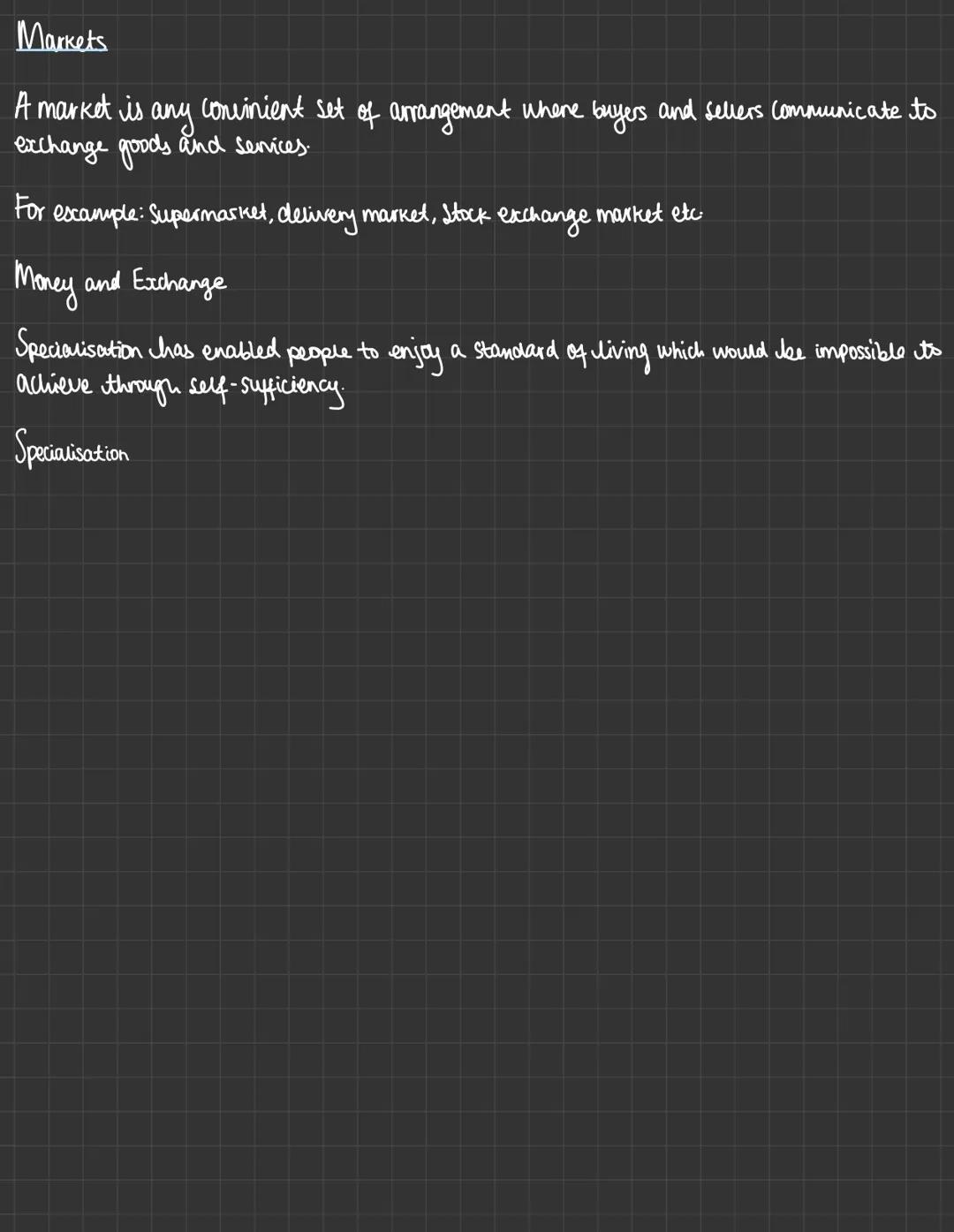
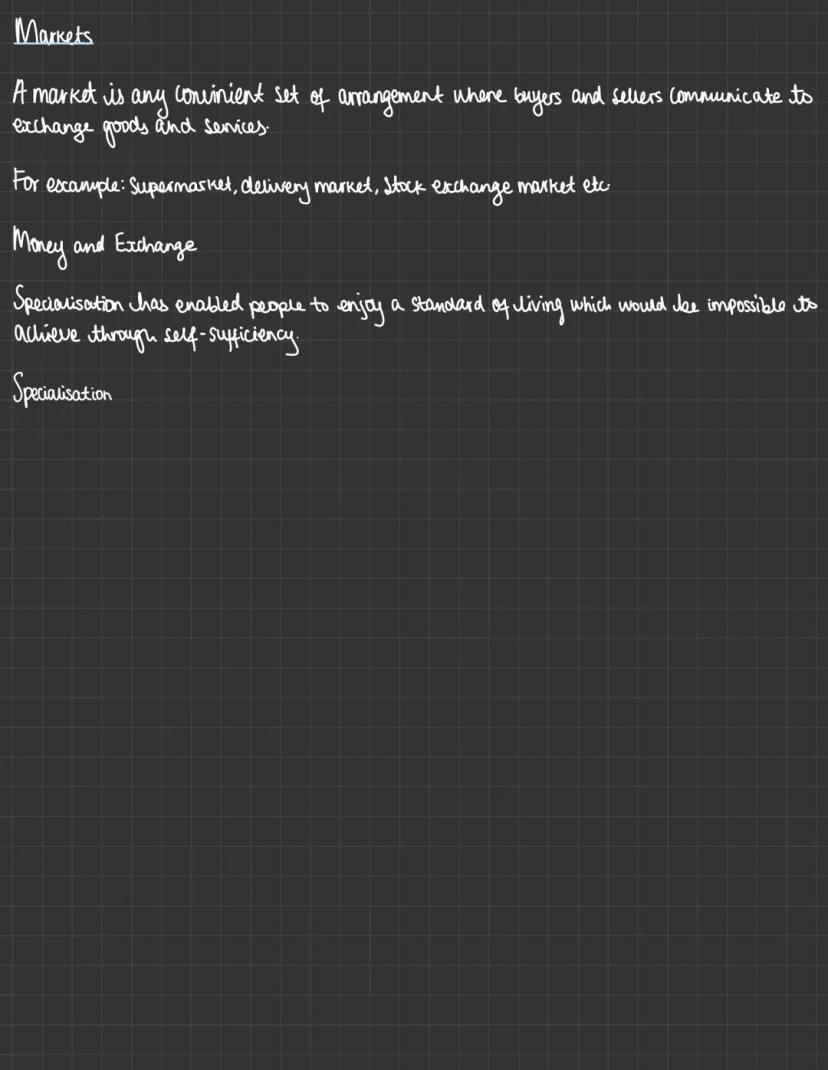
A market isn't necessarily a physical place - it's any arrangement where buyers and sellers come together to trade. This could be a traditional marketplace, an online platform, or even the stock exchange where company shares are bought and sold.
Specialisation has dramatically improved our living standards compared to self-sufficiency. Imagine trying to grow your own food, make your own clothes, build your own house, and provide your own entertainment - it would be impossible to achieve the quality of life most people enjoy today.
Money makes this specialisation possible by providing a common medium of exchange. Without money, we'd need a barter system where you'd have to find someone who has what you want and wants what you have - incredibly inefficient compared to modern markets.
Bottom Line: Markets and money work together to make specialisation possible, which in turn makes everyone better off than they could be on their own.
Our AI Companion is a student-focused AI tool that offers more than just answers. Built on millions of Knowunity resources, it provides relevant information, personalised study plans, quizzes, and content directly in the chat, adapting to your individual learning journey.
You can download the app from Google Play Store and Apple App Store.
That's right! Enjoy free access to study content, connect with fellow students, and get instant help – all at your fingertips.
Full notes for market failure for AS/A-Level Economics (Edexcel)
 Economics
App Store
Google Play
The app is very easy to use and well designed. I have found everything I was looking for so far and have been able to learn a lot from the presentations! I will definitely use the app for a class assignment! And of course it also helps a lot as an inspiration.
Stefan S
iOS user
This app is really great. There are so many study notes and help [...]. My problem subject is French, for example, and the app has so many options for help. Thanks to this app, I have improved my French. I would recommend it to anyone.
Samantha Klich
Android user
Wow, I am really amazed. I just tried the app because I've seen it advertised many times and was absolutely stunned. This app is THE HELP you want for school and above all, it offers so many things, such as workouts and fact sheets, which have been VERY helpful to me personally.
Anna
iOS user
Best app on earth! no words because it’s too good
Thomas R
iOS user
Just amazing. Let's me revise 10x better, this app is a quick 10/10. I highly recommend it to anyone. I can watch and search for notes. I can save them in the subject folder. I can revise it any time when I come back. If you haven't tried this app, you're really missing out.
Basil
Android user
This app has made me feel so much more confident in my exam prep, not only through boosting my own self confidence through the features that allow you to connect with others and feel less alone, but also through the way the app itself is centred around making you feel better. It is easy to navigate, fun to use, and helpful to anyone struggling in absolutely any way.
David K
iOS user
The app's just great! All I have to do is enter the topic in the search bar and I get the response real fast. I don't have to watch 10 YouTube videos to understand something, so I'm saving my time. Highly recommended!
Sudenaz Ocak
Android user
In school I was really bad at maths but thanks to the app, I am doing better now. I am so grateful that you made the app.
Greenlight Bonnie
Android user
very reliable app to help and grow your ideas of Maths, English and other related topics in your works. please use this app if your struggling in areas, this app is key for that. wish I'd of done a review before. and it's also free so don't worry about that.
Rohan U
Android user
I know a lot of apps use fake accounts to boost their reviews but this app deserves it all. Originally I was getting 4 in my English exams and this time I got a grade 7. I didn’t even know about this app three days until the exam and it has helped A LOT. Please actually trust me and use it as I’m sure you too will see developments.
Xander S
iOS user
THE QUIZES AND FLASHCARDS ARE SO USEFUL AND I LOVE Knowunity AI. IT ALSO IS LITREALLY LIKE CHATGPT BUT SMARTER!! HELPED ME WITH MY MASCARA PROBLEMS TOO!! AS WELL AS MY REAL SUBJECTS ! DUHHH 😍😁😲🤑💗✨🎀😮
Elisha
iOS user
This apps acc the goat. I find revision so boring but this app makes it so easy to organize it all and then you can ask the freeeee ai to test yourself so good and you can easily upload your own stuff. highly recommend as someone taking mocks now
Paul T
iOS user
The app is very easy to use and well designed. I have found everything I was looking for so far and have been able to learn a lot from the presentations! I will definitely use the app for a class assignment! And of course it also helps a lot as an inspiration.
Stefan S
iOS user
This app is really great. There are so many study notes and help [...]. My problem subject is French, for example, and the app has so many options for help. Thanks to this app, I have improved my French. I would recommend it to anyone.
Samantha Klich
Android user
Wow, I am really amazed. I just tried the app because I've seen it advertised many times and was absolutely stunned. This app is THE HELP you want for school and above all, it offers so many things, such as workouts and fact sheets, which have been VERY helpful to me personally.
Anna
iOS user
Best app on earth! no words because it’s too good
Thomas R
iOS user
Just amazing. Let's me revise 10x better, this app is a quick 10/10. I highly recommend it to anyone. I can watch and search for notes. I can save them in the subject folder. I can revise it any time when I come back. If you haven't tried this app, you're really missing out.
Basil
Android user
This app has made me feel so much more confident in my exam prep, not only through boosting my own self confidence through the features that allow you to connect with others and feel less alone, but also through the way the app itself is centred around making you feel better. It is easy to navigate, fun to use, and helpful to anyone struggling in absolutely any way.
David K
iOS user
The app's just great! All I have to do is enter the topic in the search bar and I get the response real fast. I don't have to watch 10 YouTube videos to understand something, so I'm saving my time. Highly recommended!
Sudenaz Ocak
Android user
In school I was really bad at maths but thanks to the app, I am doing better now. I am so grateful that you made the app.
Greenlight Bonnie
Android user
very reliable app to help and grow your ideas of Maths, English and other related topics in your works. please use this app if your struggling in areas, this app is key for that. wish I'd of done a review before. and it's also free so don't worry about that.
Rohan U
Android user
I know a lot of apps use fake accounts to boost their reviews but this app deserves it all. Originally I was getting 4 in my English exams and this time I got a grade 7. I didn’t even know about this app three days until the exam and it has helped A LOT. Please actually trust me and use it as I’m sure you too will see developments.
Xander S
iOS user
THE QUIZES AND FLASHCARDS ARE SO USEFUL AND I LOVE Knowunity AI. IT ALSO IS LITREALLY LIKE CHATGPT BUT SMARTER!! HELPED ME WITH MY MASCARA PROBLEMS TOO!! AS WELL AS MY REAL SUBJECTS ! DUHHH 😍😁😲🤑💗✨🎀😮
Elisha
iOS user
This apps acc the goat. I find revision so boring but this app makes it so easy to organize it all and then you can ask the freeeee ai to test yourself so good and you can easily upload your own stuff. highly recommend as someone taking mocks now
Paul T
iOS user
Michelle Bali
@k3miiii
Ever wondered why you can't have everything you want? Welcome to economics - the study of how we deal with having limited resources but unlimited wants. This fundamental challenge shapes every decision we make, from what to buy with your... Show more
Access to all documents
Improve your grades
Join milions of students
This page contains no content to summarise.
Access to all documents
Improve your grades
Join milions of students
Think about this: there's literally not enough stuff in the world for everyone to have everything they want. That's the heart of economics right there. Nearly all resources are scarce, but human wants are infinite - you'll always find something new you'd like to have.
This creates what economists call the basic economic problem. Since we can't have everything, we need to make choices about how to use our limited resources. Every choice means giving up something else, which economists call opportunity cost.
An economy is basically society's way of organising these tough decisions. It determines what gets produced, how it's made, and who gets what. The building blocks are the factors of production - land, labour, capital, and enterprise - which combine to create all the goods and services we use.
Key Insight: The owners of these factors of production earn rewards like wages (for labour), rent (for land), interest (for capital), and profit (for enterprise).
Access to all documents
Improve your grades
Join milions of students
Scarcity isn't just about running out of things - it's about having finite resources to meet infinite wants. Whether you're a consumer deciding what to buy, or a government choosing where to spend money, everyone faces this challenge.
When resources are limited, you're forced to make economic choices. Every time you pick one option, you're giving up the benefits of the next best alternative - that's your opportunity cost. For instance, if you spend your Saturday job money on trainers, the opportunity cost might be the video game you can't afford now.
Not all resources face this problem though. Economic goods like houses and cars are scarce, but free goods like air and sunshine aren't (at least not yet). There's also a crucial difference between consumer goods (things you buy for yourself, like a phone) and capital goods (things used to make other things, like factory machinery).
Renewable resources like solar energy replenish naturally, whilst non-renewable resources like oil take millions of years to form. This leads us to sustainability - using resources at a rate that doesn't compromise future generations' ability to meet their needs.
Remember: The three basic economic questions every society must answer are: What to produce? How to produce it? For whom to produce it?
Access to all documents
Improve your grades
Join milions of students
Every economy is essentially a system trying to solve the basic economic problem - dealing with scarcity. Since we can't produce everything everyone wants, societies must answer three fundamental questions about production and distribution.
The factors of production work together to create goods and services. Land includes all natural resources, labour represents the workforce, capital covers tools and machinery, and enterprise involves the risk-taking entrepreneurs who organise everything. You can remember these as "CELL" - a handy way to recall all four factors.
These factors don't work in isolation - they're combined in different ways depending on what's being produced. A bakery needs land (for the shop), labour (bakers and shop assistants), capital (ovens and equipment), and enterprise (someone willing to take the risk of running the business).
Think About It: Every business you see combines these four factors of production - from your local café to massive tech companies like Apple.
Access to all documents
Improve your grades
Join milions of students
The Production Possibility Frontier (PPF) is like a reality check for any economy. It shows the maximum combinations of two goods you can produce with your current resources and technology - think of it as your economy's potential.
Any point on the curve represents productive efficiency - you're getting the most out of your resources. Points inside the curve show productive inefficiency - you're wasting resources somehow. Points outside the curve are currently impossible to achieve, though they might become possible with better technology or more resources.
The PPF brilliantly demonstrates opportunity cost in action. If you want to produce more of one good, you must produce less of another. The curve shows exactly how much you'll have to give up. For example, if moving from point A to point B increases cotton output from 300 to 400 units, but decreases wheat from 200 to 160 units, the opportunity cost of those extra 100 cotton units is 40 wheat units.
Key Point: The shape of the PPF (usually curved outward) reflects the fact that resources aren't equally suited to producing different goods.
Access to all documents
Improve your grades
Join milions of students
Economic growth happens when the entire PPF shifts outward, meaning you can produce more of everything. This occurs through factors like a bigger workforce, better technology, improved education, or discovering new resources.
There's a crucial trade-off between present and future prosperity. Focusing on current consumption makes people better off today but limits future growth. Investing in capital goods now might mean less consumption today, but it enables much higher living standards later.
Efficiency has two important dimensions. Productive efficiency means producing at the lowest possible cost, while allocative efficiency means producing the right mix of goods that society actually wants. Both are essential for a well-functioning economy.
The distinction between consumer goods and capital goods is vital for understanding economic growth. Consumer goods like food and entertainment satisfy immediate wants, whilst capital goods like machinery and buildings help produce more goods in the future.
Real-World Example: Countries that invest heavily in education and infrastructure (capital goods) often see faster economic growth than those focused only on immediate consumption.
Access to all documents
Improve your grades
Join milions of students
Specialisation is a game-changer for productivity - instead of everyone trying to do everything, people focus on what they do best. When individuals specialise, it's called the division of labour, and it's revolutionised how we work.
The benefits are impressive: lower costs, time savings, and less equipment needed since workers aren't constantly switching tasks. However, there are downsides too - work can become monotonous, workers risk unemployment if their specific skill becomes obsolete, and jobs might be automated.
Modern economies are typically divided into three sectors. The primary sector extracts raw materials through activities like mining and farming. The secondary sector manufactures finished goods in factories. The tertiary sector provides services like healthcare, education, and entertainment.
As countries develop, they typically shift from primary to secondary to tertiary sectors. The UK, for instance, now has a service-dominated economy, whilst many developing countries still rely heavily on primary industries.
Did You Know: In the UK, about 80% of the economy is now tertiary sector - that's everything from your local barber to international banking.
Access to all documents
Improve your grades
Join milions of students
A market isn't necessarily a physical place - it's any arrangement where buyers and sellers come together to trade. This could be a traditional marketplace, an online platform, or even the stock exchange where company shares are bought and sold.
Specialisation has dramatically improved our living standards compared to self-sufficiency. Imagine trying to grow your own food, make your own clothes, build your own house, and provide your own entertainment - it would be impossible to achieve the quality of life most people enjoy today.
Money makes this specialisation possible by providing a common medium of exchange. Without money, we'd need a barter system where you'd have to find someone who has what you want and wants what you have - incredibly inefficient compared to modern markets.
Bottom Line: Markets and money work together to make specialisation possible, which in turn makes everyone better off than they could be on their own.
Our AI Companion is a student-focused AI tool that offers more than just answers. Built on millions of Knowunity resources, it provides relevant information, personalised study plans, quizzes, and content directly in the chat, adapting to your individual learning journey.
You can download the app from Google Play Store and Apple App Store.
That's right! Enjoy free access to study content, connect with fellow students, and get instant help – all at your fingertips.
11
Smart Tools NEW
Transform this note into: ✓ 50+ Practice Questions ✓ Interactive Flashcards ✓ Full Mock Exam ✓ Essay Outlines
Explore the key concepts of economic systems, including mixed, command, and market economies. This summary covers the roles of government intervention, supply and demand, and the importance of specialization and trade. Ideal for students preparing for exams or seeking to deepen their understanding of economics. Type: Summary.
EconomicsExplore the concepts of economies and diseconomies of scale in this detailed summary for CCEA A2 Business Studies. Understand how production scale affects costs, the benefits of growth, and the challenges faced by large firms. Key topics include internal and external economies of scale, managerial complexities, and the impact on communication and motivation. Ideal for exam preparation and enhancing your understanding of business growth dynamics.
EconomicsExplore key concepts of production and productivity in microeconomics, including factors of production, productive efficiency, and the impact of labor productivity on economic growth. This summary provides a comprehensive overview for AQA AS Level students, highlighting essential definitions and relationships between output and efficiency.
EconomicsExplore key concepts of firm profits in economics, including normal profit, supernormal profit, and the shut-down rule. This summary covers short-run and long-run equilibrium, profit maximization, and the implications of total revenue versus total costs. Ideal for A-level Economics students seeking to grasp essential profit theories.
EconomicsExplore the key concepts of fixed and variable costs in microeconomics, focusing on their roles in short-run and long-run production. This summary covers how to calculate total costs, average fixed costs, and the implications of cost curves, providing essential insights for economics students.
EconomicsExplore key concepts from the Edexcel Level 3 GCE Economics A Paper 1, focusing on market behavior, equilibrium price, price elasticity of demand, and competition. This comprehensive summary covers essential topics such as supply and demand dynamics, market structures, and government intervention, providing valuable insights for exam preparation.
EconomicsFull notes for market failure for AS/A-Level Economics (Edexcel)
EconomicsApp Store
Google Play
The app is very easy to use and well designed. I have found everything I was looking for so far and have been able to learn a lot from the presentations! I will definitely use the app for a class assignment! And of course it also helps a lot as an inspiration.
Stefan S
iOS user
This app is really great. There are so many study notes and help [...]. My problem subject is French, for example, and the app has so many options for help. Thanks to this app, I have improved my French. I would recommend it to anyone.
Samantha Klich
Android user
Wow, I am really amazed. I just tried the app because I've seen it advertised many times and was absolutely stunned. This app is THE HELP you want for school and above all, it offers so many things, such as workouts and fact sheets, which have been VERY helpful to me personally.
Anna
iOS user
Best app on earth! no words because it’s too good
Thomas R
iOS user
Just amazing. Let's me revise 10x better, this app is a quick 10/10. I highly recommend it to anyone. I can watch and search for notes. I can save them in the subject folder. I can revise it any time when I come back. If you haven't tried this app, you're really missing out.
Basil
Android user
This app has made me feel so much more confident in my exam prep, not only through boosting my own self confidence through the features that allow you to connect with others and feel less alone, but also through the way the app itself is centred around making you feel better. It is easy to navigate, fun to use, and helpful to anyone struggling in absolutely any way.
David K
iOS user
The app's just great! All I have to do is enter the topic in the search bar and I get the response real fast. I don't have to watch 10 YouTube videos to understand something, so I'm saving my time. Highly recommended!
Sudenaz Ocak
Android user
In school I was really bad at maths but thanks to the app, I am doing better now. I am so grateful that you made the app.
Greenlight Bonnie
Android user
very reliable app to help and grow your ideas of Maths, English and other related topics in your works. please use this app if your struggling in areas, this app is key for that. wish I'd of done a review before. and it's also free so don't worry about that.
Rohan U
Android user
I know a lot of apps use fake accounts to boost their reviews but this app deserves it all. Originally I was getting 4 in my English exams and this time I got a grade 7. I didn’t even know about this app three days until the exam and it has helped A LOT. Please actually trust me and use it as I’m sure you too will see developments.
Xander S
iOS user
THE QUIZES AND FLASHCARDS ARE SO USEFUL AND I LOVE Knowunity AI. IT ALSO IS LITREALLY LIKE CHATGPT BUT SMARTER!! HELPED ME WITH MY MASCARA PROBLEMS TOO!! AS WELL AS MY REAL SUBJECTS ! DUHHH 😍😁😲🤑💗✨🎀😮
Elisha
iOS user
This apps acc the goat. I find revision so boring but this app makes it so easy to organize it all and then you can ask the freeeee ai to test yourself so good and you can easily upload your own stuff. highly recommend as someone taking mocks now
Paul T
iOS user
The app is very easy to use and well designed. I have found everything I was looking for so far and have been able to learn a lot from the presentations! I will definitely use the app for a class assignment! And of course it also helps a lot as an inspiration.
Stefan S
iOS user
This app is really great. There are so many study notes and help [...]. My problem subject is French, for example, and the app has so many options for help. Thanks to this app, I have improved my French. I would recommend it to anyone.
Samantha Klich
Android user
Wow, I am really amazed. I just tried the app because I've seen it advertised many times and was absolutely stunned. This app is THE HELP you want for school and above all, it offers so many things, such as workouts and fact sheets, which have been VERY helpful to me personally.
Anna
iOS user
Best app on earth! no words because it’s too good
Thomas R
iOS user
Just amazing. Let's me revise 10x better, this app is a quick 10/10. I highly recommend it to anyone. I can watch and search for notes. I can save them in the subject folder. I can revise it any time when I come back. If you haven't tried this app, you're really missing out.
Basil
Android user
This app has made me feel so much more confident in my exam prep, not only through boosting my own self confidence through the features that allow you to connect with others and feel less alone, but also through the way the app itself is centred around making you feel better. It is easy to navigate, fun to use, and helpful to anyone struggling in absolutely any way.
David K
iOS user
The app's just great! All I have to do is enter the topic in the search bar and I get the response real fast. I don't have to watch 10 YouTube videos to understand something, so I'm saving my time. Highly recommended!
Sudenaz Ocak
Android user
In school I was really bad at maths but thanks to the app, I am doing better now. I am so grateful that you made the app.
Greenlight Bonnie
Android user
very reliable app to help and grow your ideas of Maths, English and other related topics in your works. please use this app if your struggling in areas, this app is key for that. wish I'd of done a review before. and it's also free so don't worry about that.
Rohan U
Android user
I know a lot of apps use fake accounts to boost their reviews but this app deserves it all. Originally I was getting 4 in my English exams and this time I got a grade 7. I didn’t even know about this app three days until the exam and it has helped A LOT. Please actually trust me and use it as I’m sure you too will see developments.
Xander S
iOS user
THE QUIZES AND FLASHCARDS ARE SO USEFUL AND I LOVE Knowunity AI. IT ALSO IS LITREALLY LIKE CHATGPT BUT SMARTER!! HELPED ME WITH MY MASCARA PROBLEMS TOO!! AS WELL AS MY REAL SUBJECTS ! DUHHH 😍😁😲🤑💗✨🎀😮
Elisha
iOS user
This apps acc the goat. I find revision so boring but this app makes it so easy to organize it all and then you can ask the freeeee ai to test yourself so good and you can easily upload your own stuff. highly recommend as someone taking mocks now
Paul T
iOS user