Radioactivity and Radiation Types
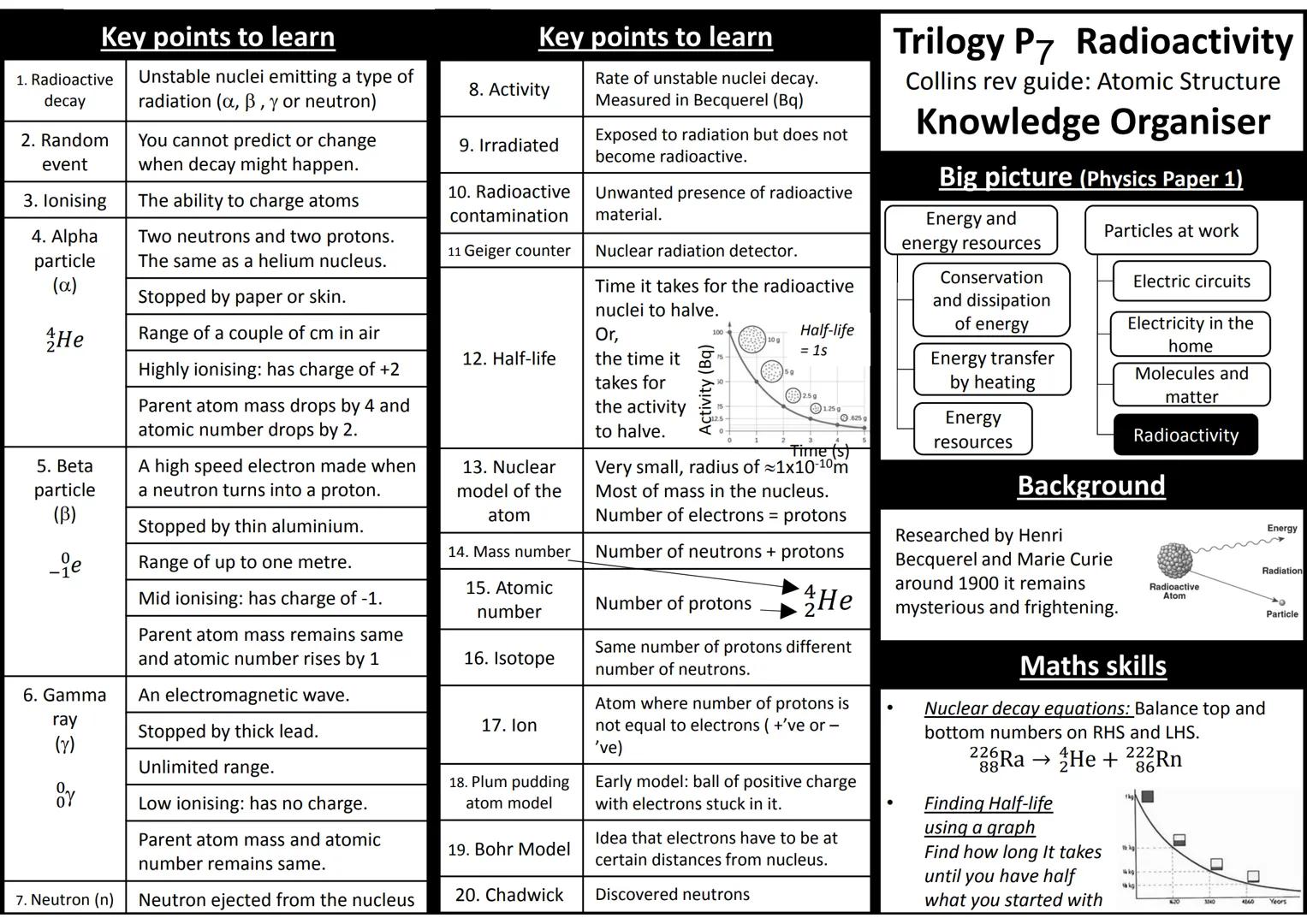
Radioactive decay is when unstable atomic nuclei randomly emit radiation to become more stable. The key word here is "random" - you can't predict exactly when an individual atom will decay, making it a completely chance event that scientists can only describe statistically.
There are four main types of radiation to master. Alpha particles are the heaviest, consisting of two protons and two neutrons (basically a helium nucleus), and they're easily stopped by paper or even your skin. Beta particles are high-speed electrons created when neutrons transform into protons inside the nucleus - they can travel about a metre through air but are stopped by thin aluminium.
Gamma rays are electromagnetic waves with no mass or charge, making them the most penetrating type of radiation. They have unlimited range and require thick lead to stop them. Finally, neutron radiation occurs when neutrons are ejected directly from the nucleus.
Quick Tip: Remember the stopping power using "PAL" - Paper stops Alpha, ALuminium stops beta, Lead stops gamma!
The ionising ability of radiation refers to how well it can knock electrons off atoms, creating charged particles called ions. Alpha radiation is highly ionising charge+2, beta is moderately ionising charge−1, and gamma is weakly ionising (no charge).

 Biology
 Chemistry
 Physics
 Combined Science
 English Literature
 Sociology