Programming Building Blocks
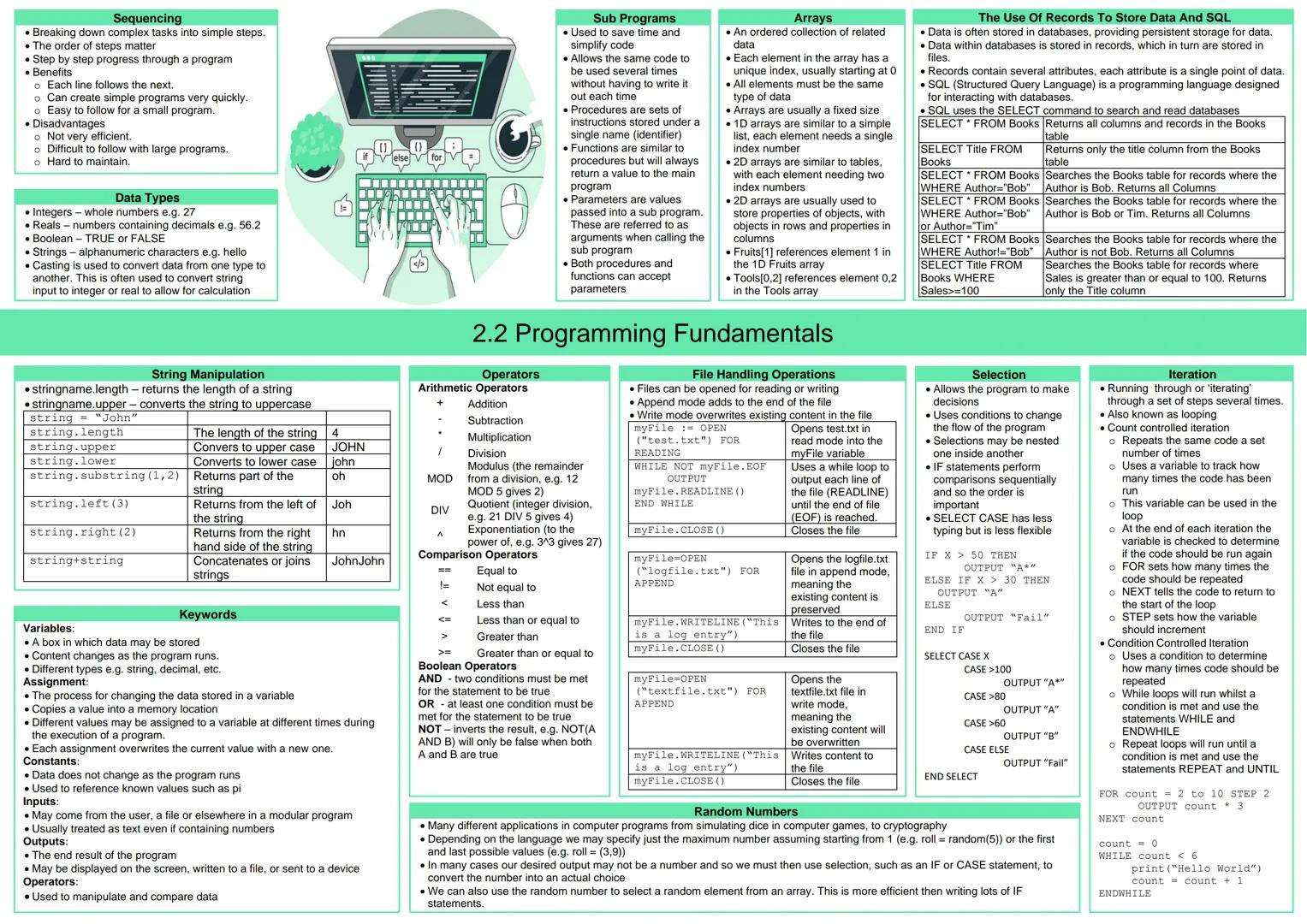
Sequencing is like following a recipe - each instruction must happen in the right order for your program to work properly. It's brilliant for simple programs because you can see exactly what happens step by step, but it gets messy quickly when your code becomes more complex.
Programming uses different data types to handle information. Integers are whole numbers (like 42), reals include decimals (like 3.14), booleans are simply true or false, and strings are text (like "hello"). When you need to change one type to another, you use casting - think of it as translating between different languages your computer understands.
Variables act like labelled boxes where you store information that can change as your program runs. Constants are the opposite - they hold values that never change, like the value of pi. Assignment is simply the process of putting new data into these boxes, overwriting whatever was there before.
Quick Tip: Think of variables as your phone contacts - you can update them anytime, whilst constants are like your birthday - they never change!
Your programs need inputs (data coming in from users or files) and outputs (results going out to screens or files). Operators let you manipulate and compare this data using symbols like + for addition or == to check if two things are equal.


 Other
Other Biology
 Chemistry
 Physics
 Combined Science
 English Literature
 Sociology