
The nervous system is your body's incredible control centre, managing... Show more
 Biology
 Physics
 Chemistry
 Sociology
 English Literature
Sign up to see the contentIt's free!
Access to all documents
Improve your grades
Join milions of students
Knowunity AI
Subjects
Triangle Congruence and Similarity Theorems
Triangle Properties and Classification
Linear Equations and Graphs
Geometric Angle Relationships
Trigonometric Functions and Identities
Equation Solving Techniques
Circle Geometry Fundamentals
Division Operations and Methods
Basic Differentiation Rules
Exponent and Logarithm Properties
Show all topics
Human Organ Systems
Reproductive Cell Cycles
Biological Sciences Subdisciplines
Cellular Energy Metabolism
Autotrophic Energy Processes
Inheritance Patterns and Principles
Biomolecular Structure and Organization
Cell Cycle and Division Mechanics
Cellular Organization and Development
Biological Structural Organization
Show all topics
Chemical Sciences and Applications
Atomic Structure and Composition
Molecular Electron Structure Representation
Atomic Electron Behavior
Matter Properties and Water
Mole Concept and Calculations
Gas Laws and Behavior
Periodic Table Organization
Chemical Thermodynamics Fundamentals
Chemical Bond Types and Properties
Show all topics
European Renaissance and Enlightenment
European Cultural Movements 800-1920
American Revolution Era 1763-1797
American Civil War 1861-1865
Global Imperial Systems
Mongol and Chinese Dynasties
U.S. Presidents and World Leaders
Historical Sources and Documentation
World Wars Era and Impact
World Religious Systems
Show all topics
Classic and Contemporary Novels
Literary Character Analysis
Rhetorical Theory and Practice
Classic Literary Narratives
Reading Analysis and Interpretation
Narrative Structure and Techniques
English Language Components
Influential English-Language Authors
Basic Sentence Structure
Narrative Voice and Perspective
Show all topics
124
•
Updated Apr 4, 2026
•
knoxx Lim
@knoxxlim
The nervous system is your body's incredible control centre, managing... Show more
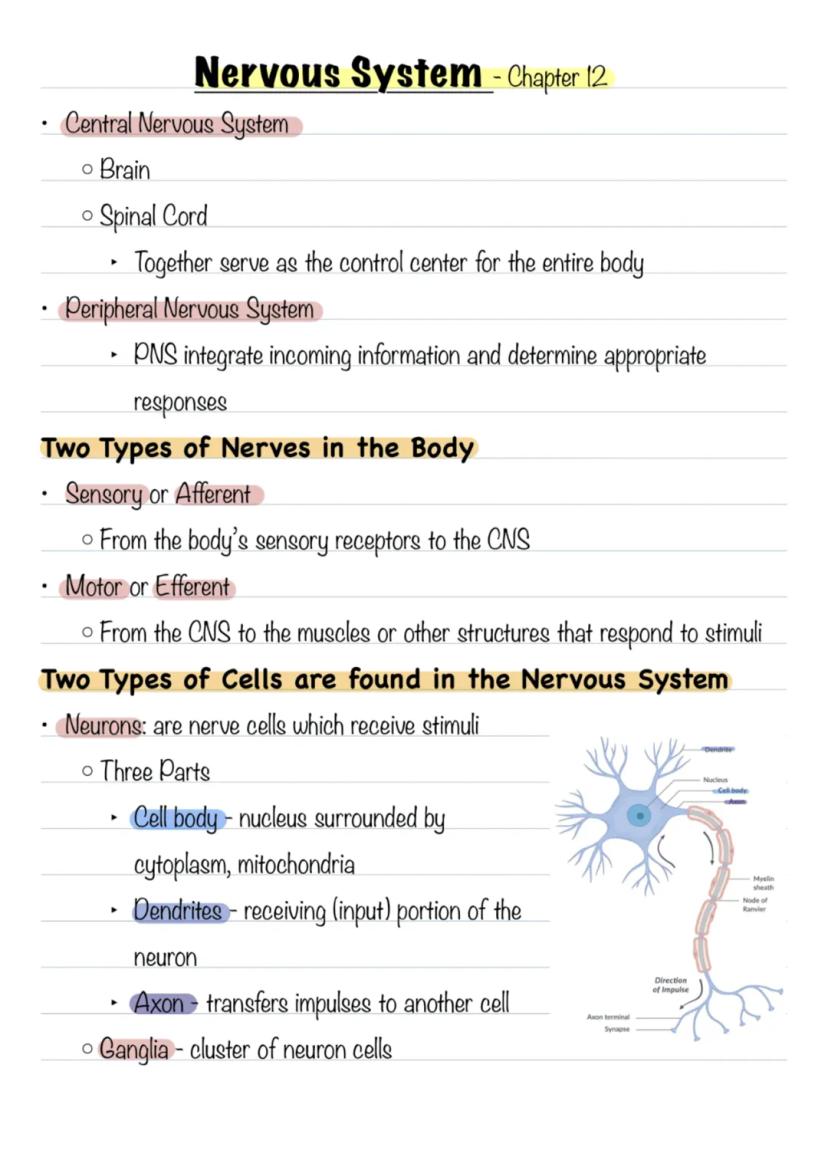
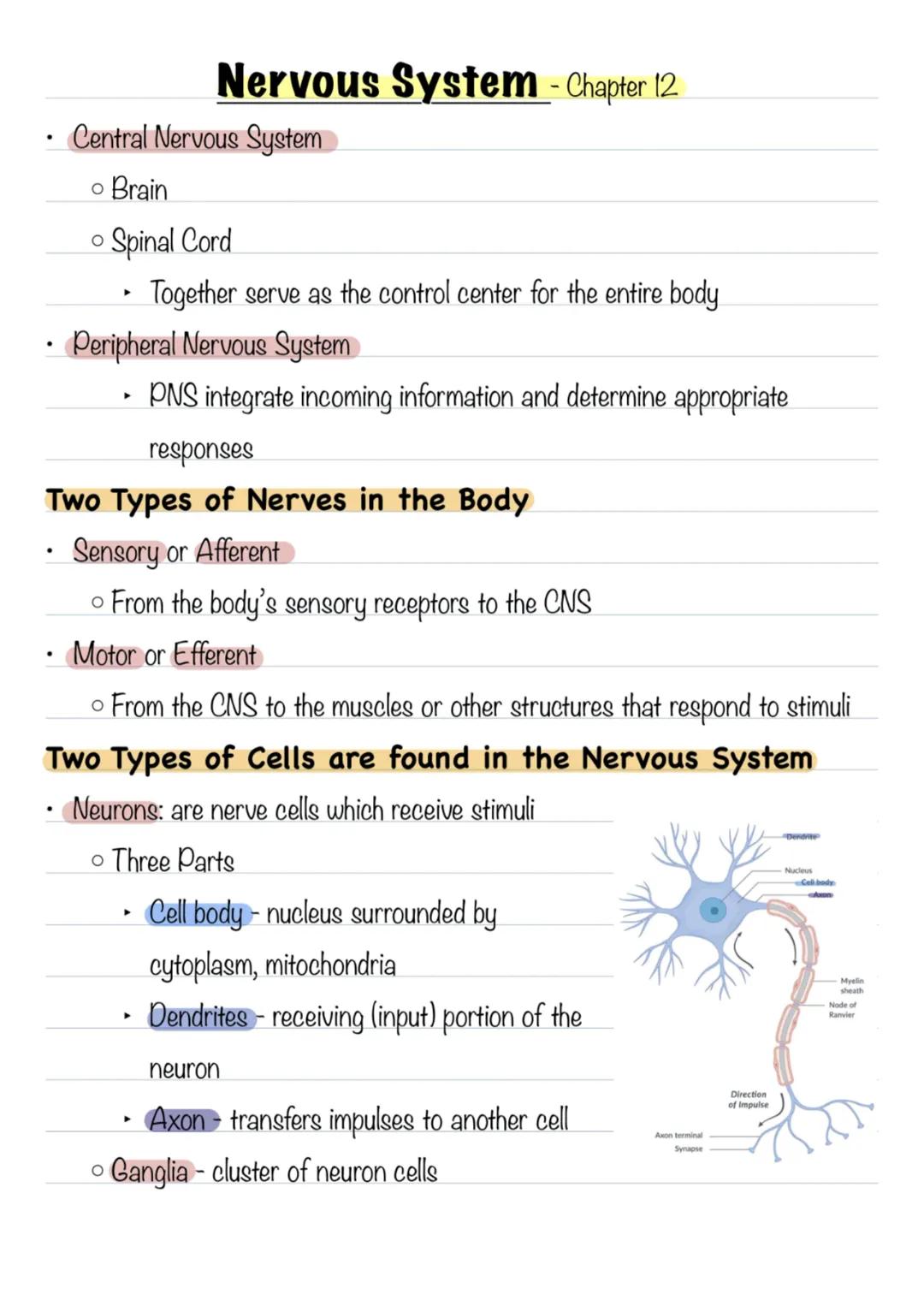
Your nervous system consists of two main parts working in perfect harmony. The Central Nervous System (CNS) includes your brain and spinal cord, acting as the control centre for your entire body. The Peripheral Nervous System (PNS) connects your CNS to the rest of your body, helping integrate incoming information and determine appropriate responses.
Your body has two types of nerves with different jobs. Sensory nerves (afferent) carry information from your body's sensory receptors to your CNS, telling you what's happening in your environment. Motor nerves (efferent) carry commands from your CNS to muscles or other structures that need to respond.
The nervous system contains two primary cell types. Neurons are specialized nerve cells that receive and transmit stimuli, consisting of three important parts: the cell body (contains the nucleus), dendrites (receive input), and axons (transfer impulses to other cells). Groups of neuron cells clustered together form ganglia.
Did you know? Your nervous system is like a complex electrical circuit - neurons can transmit signals at speeds up to 120 metres per second, faster than a Formula 1 racing car!
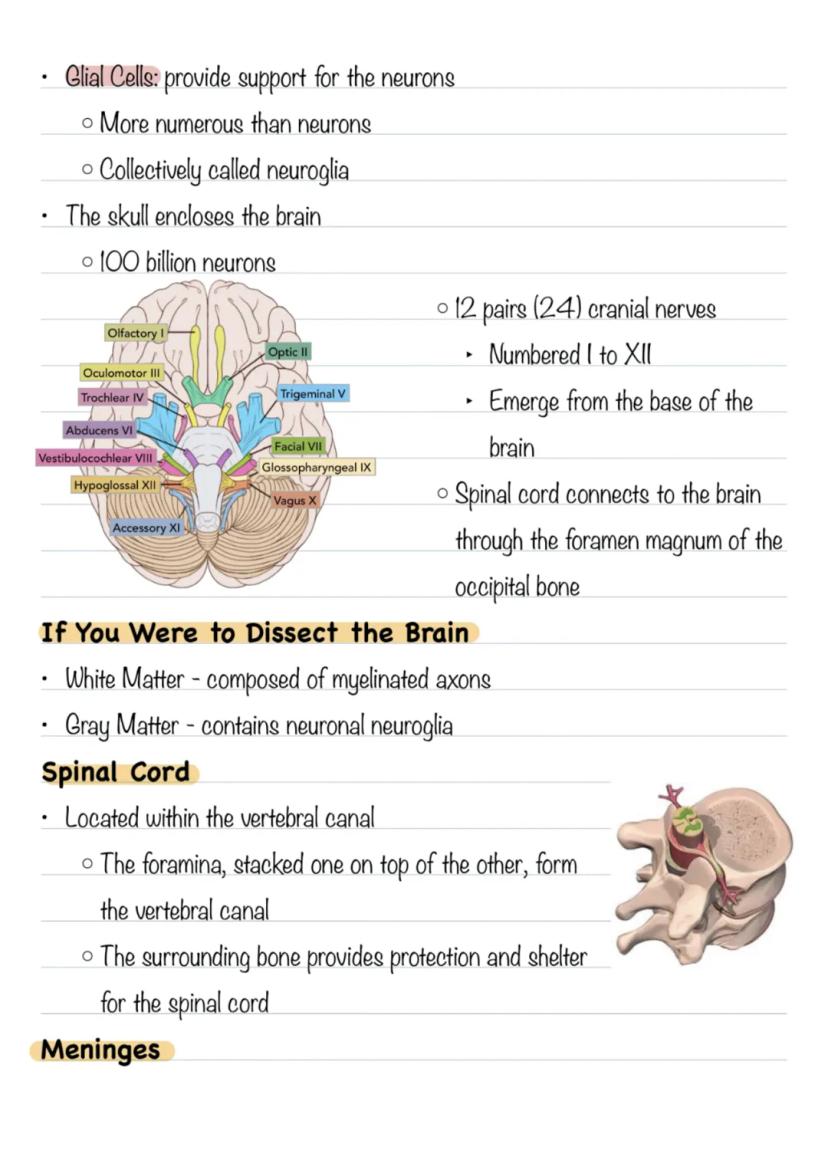
Your nervous system contains billions of glial cells that support and protect neurons. These cells, collectively called neuroglia, actually outnumber neurons and play crucial roles in maintaining brain health.
If you were to look at brain tissue, you'd notice two distinct areas. White matter consists of myelinated axons (nerve fibres covered in a protective sheath), while grey matter contains neuronal cell bodies and neuroglia. This different colouration helps scientists identify different brain regions.
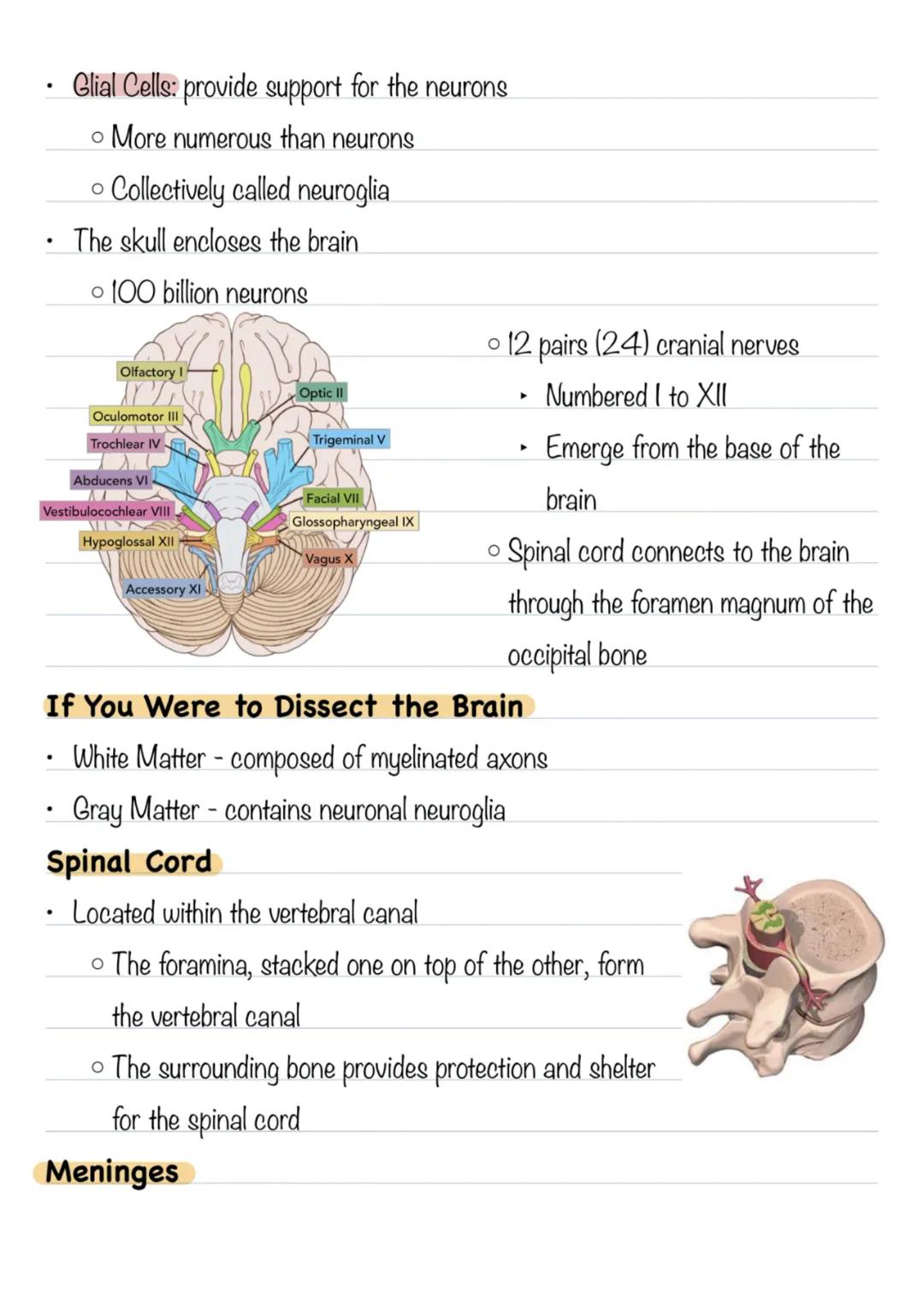
Your brain is protected by the skull and connects to your spinal cord through the foramen magnum, a large opening at the base of your occipital bone. The brain itself contains approximately 100 billion neurons and has 12 pairs of cranial nerves that emerge from its base.
Fascinating fact: Your spinal cord is shorter than your vertebral column! It typically ends around the second lumbar vertebra (L2), while the protective vertebral canal continues all the way down to your sacrum.
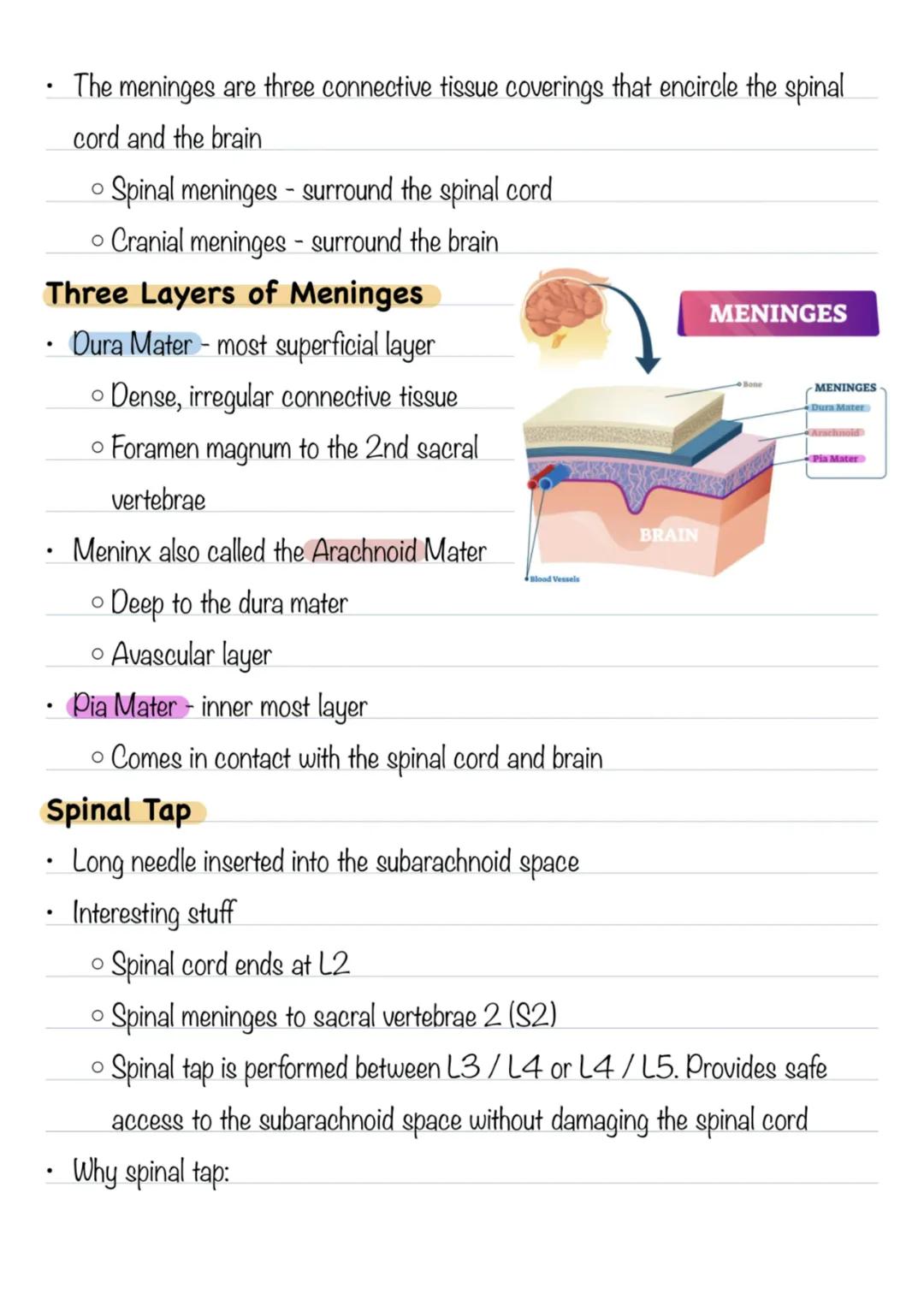
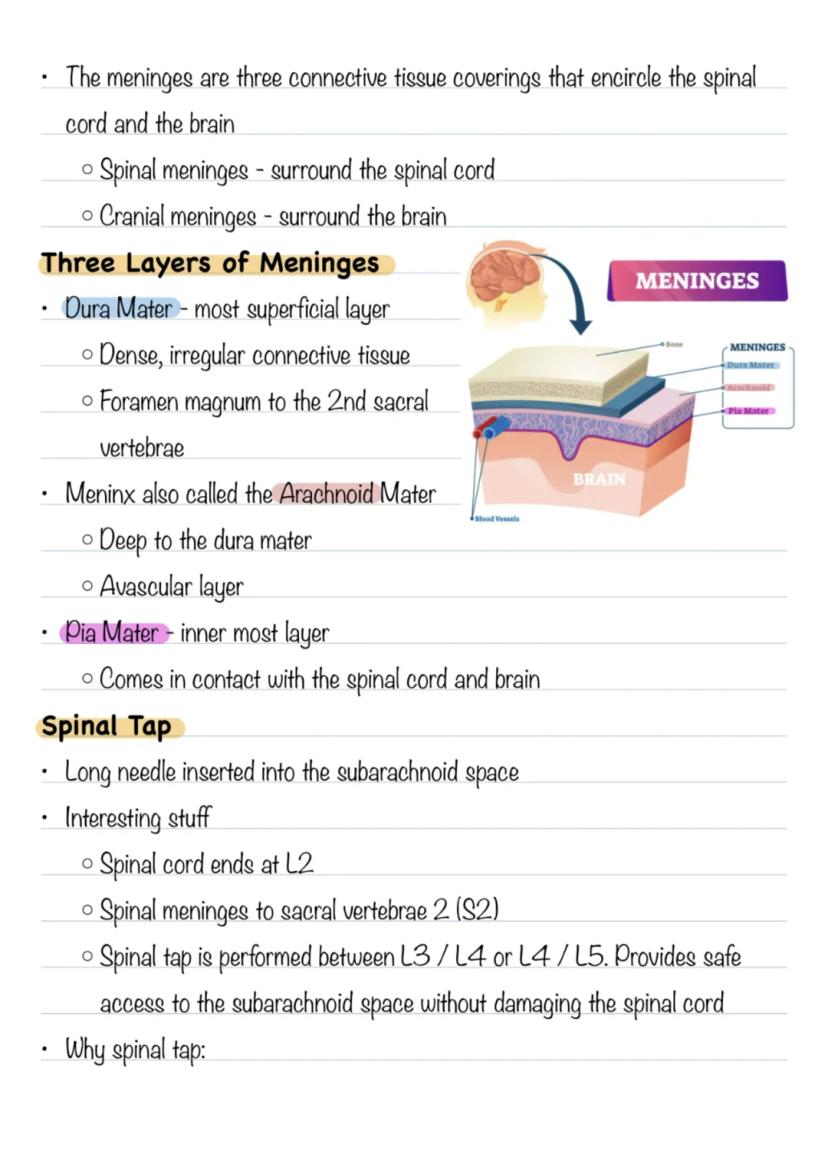
Your brain and spinal cord are wrapped in three layers of protective tissue called the meninges. These layers serve as a crucial defence system for your delicate neural tissues. Spinal meninges surround your spinal cord, while cranial meninges protect your brain.
The outermost layer is the dura mater, made of dense, irregular connective tissue that runs from the foramen magnum to the second sacral vertebra. Beneath it lies the arachnoid mater (also called meninx), an avascular middle layer. The innermost layer, the pia mater, makes direct contact with both the brain and spinal cord.
A spinal tap is a procedure where a long needle is inserted into the subarachnoid space (the area between the arachnoid and pia mater). Because your spinal cord ends at L2 but your meninges continue to S2, doctors typically perform spinal taps between vertebrae L3/L4 or L4/L5. This provides safe access without damaging the spinal cord.
Remember this: Spinal taps are performed in the lower back because your spinal cord doesn't extend the entire length of your spine! This clever positioning allows doctors to access the cerebrospinal fluid safely.
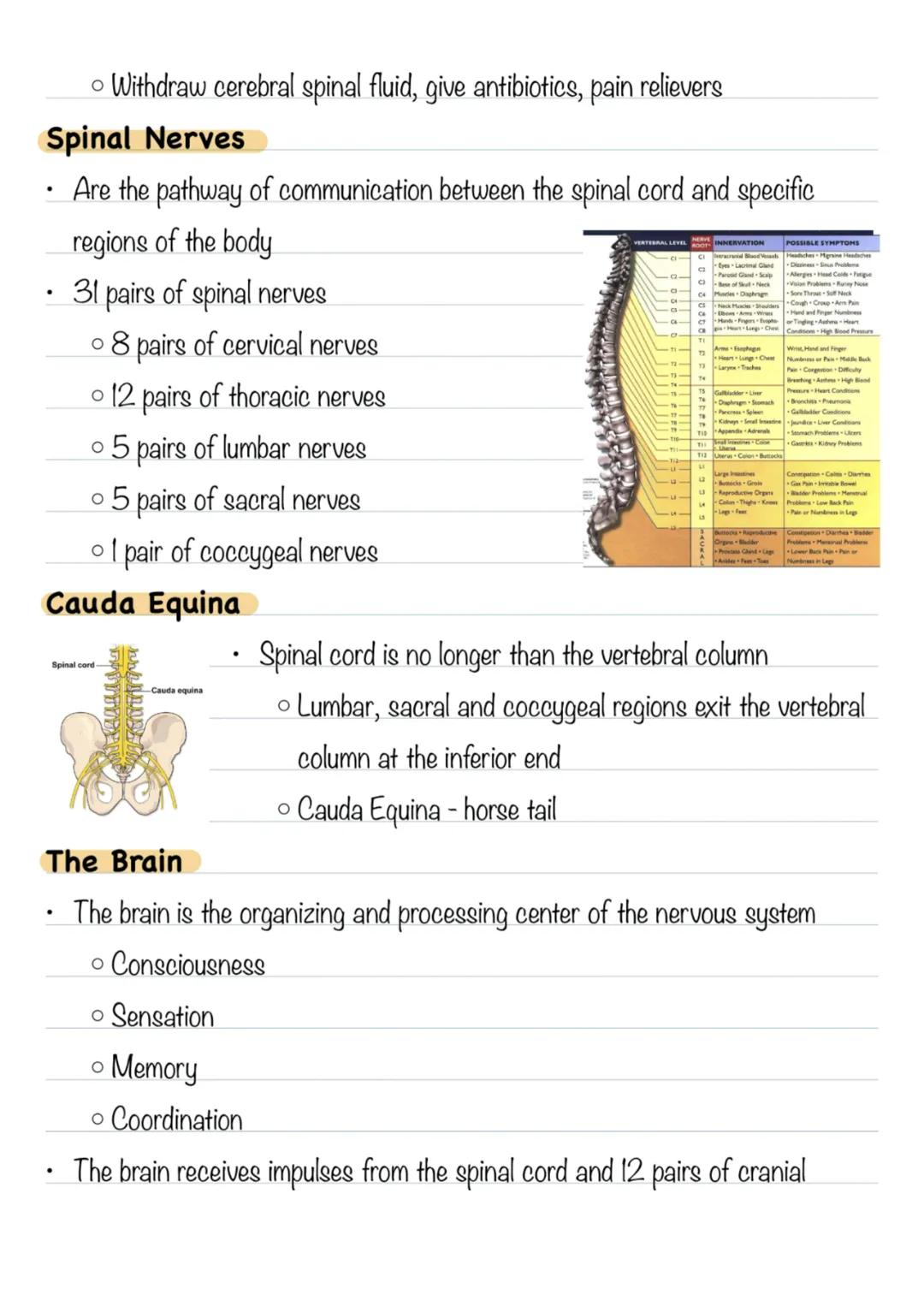
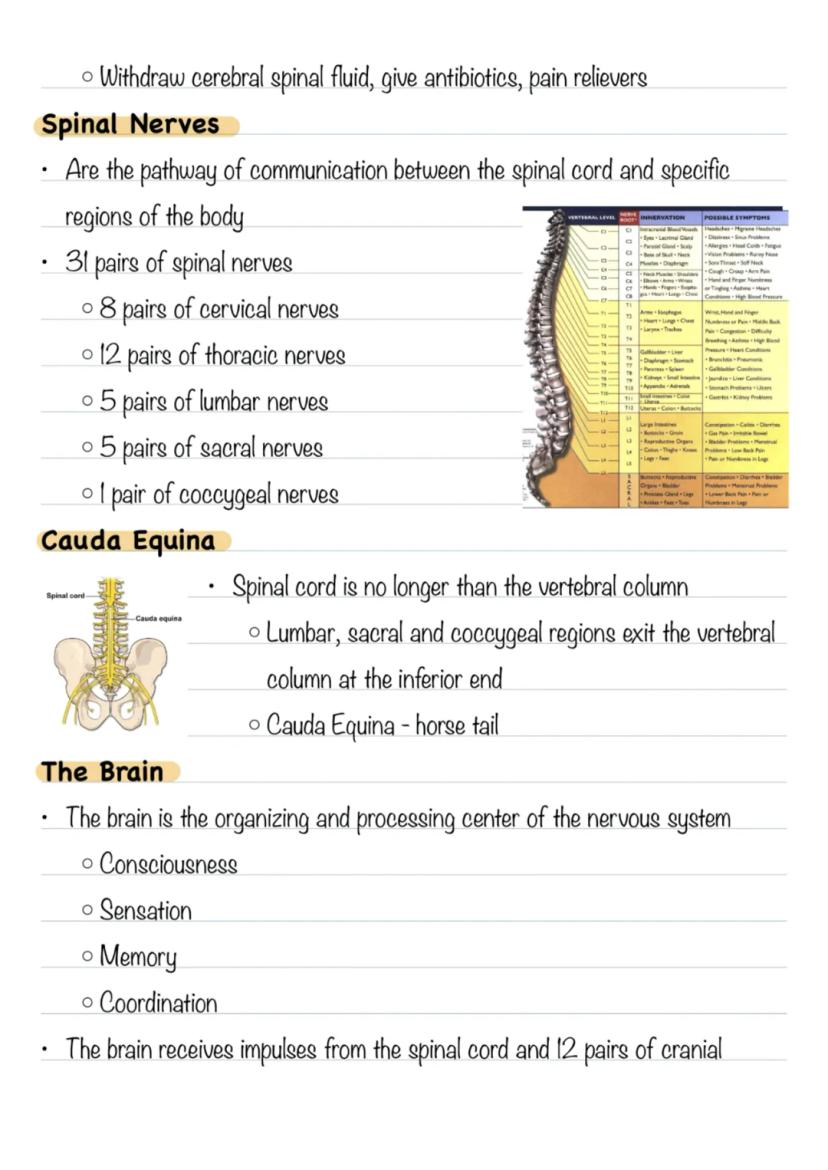
Spinal nerves are your communication pathways between the spinal cord and specific body regions. Your body has 31 pairs of these nerves: 8 cervical, 12 thoracic, 5 lumbar, 5 sacral, and 1 coccygeal. They branch out from your spine to innervate different areas.
Since your spinal cord ends around the L2 vertebra but your spine continues lower, the nerve roots for your lumbar, sacral and coccygeal regions must travel downward before exiting the vertebral column. This bundle of nerve roots at the inferior end forms the cauda equina, which resembles a horse's tail.
Your brain serves as the grand organising and processing centre of your nervous system. It manages consciousness, sensation, memory, and coordination by receiving impulses from both the spinal cord and 12 pairs of cranial nerves.
Think about this: Your brain accounts for only 2% of your body weight but uses about 20% of your body's oxygen and energy! This remarkable organ contains more connections than there are stars in our galaxy.
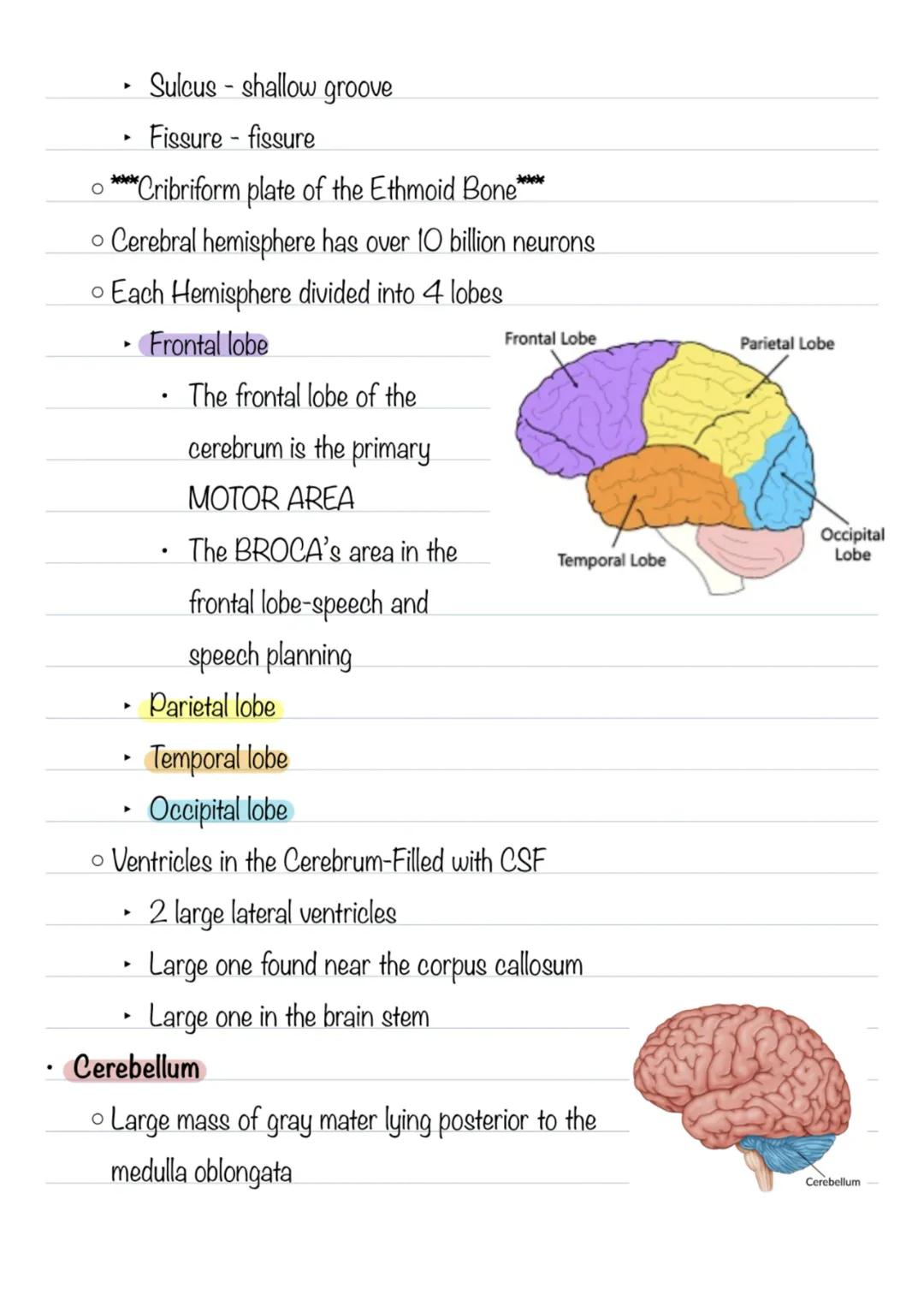
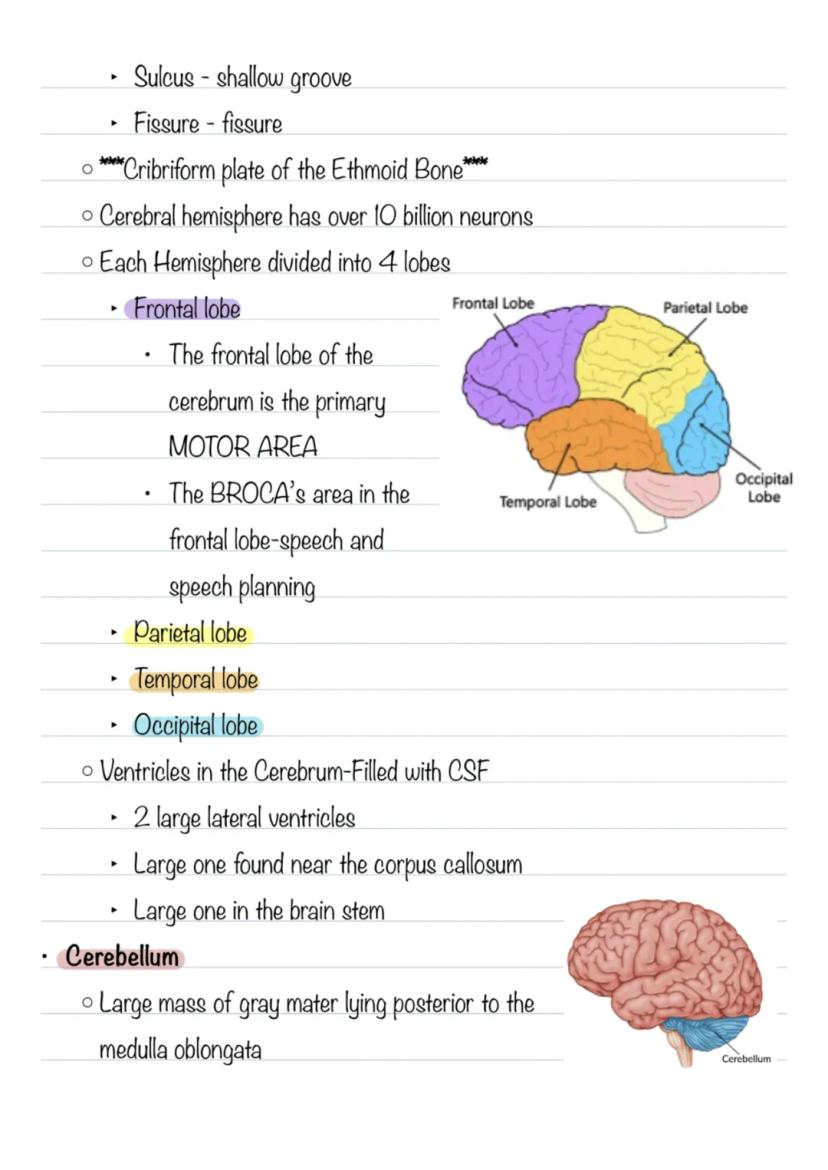
Your cerebrum is divided by shallow grooves called sulci and deeper indentations called fissures. Each cerebral hemisphere contains over 10 billion neurons and is divided into four main lobes, each with specialised functions.
The frontal lobe serves as the primary motor area, controlling voluntary movements. It also contains Broca's area, which is crucial for speech and speech planning. The other lobes—parietal, temporal, and occipital—manage different sensory processing, memory, and visual information.
Inside your cerebrum are fluid-filled spaces called ventricles. These include two large lateral ventricles, one near the corpus callosum (the bridge connecting your brain's hemispheres), and another in the brain stem. All ventricles contain cerebrospinal fluid (CSF), which cushions and protects your brain.
Cool brain fact: Your cerebellum might be small (just 10% of brain volume), but it contains over 50% of all your brain's neurons! This dense packing helps it coordinate complex movements with incredible precision.
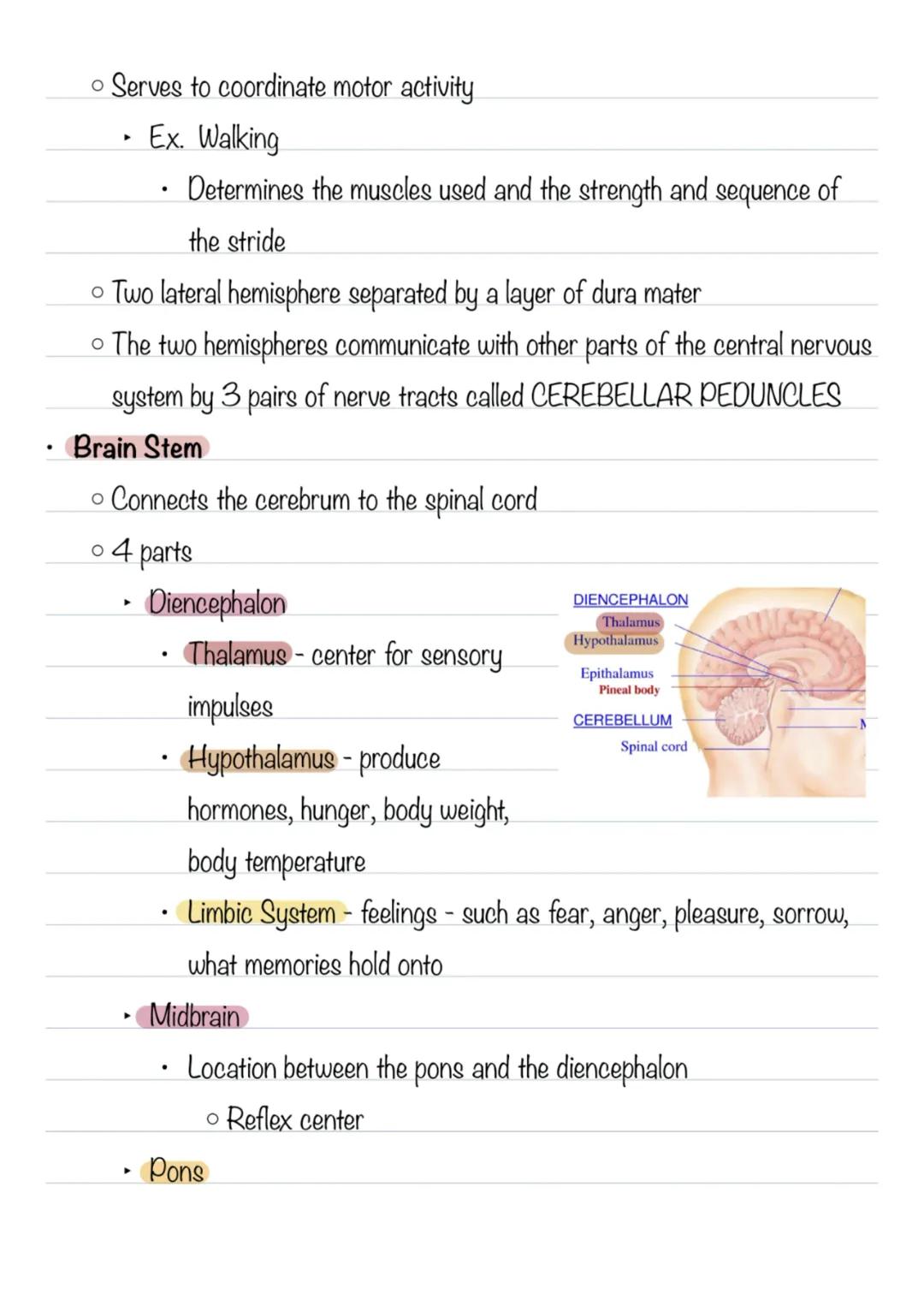
The cerebellum is a large mass of grey matter located behind the medulla oblongata. It plays a vital role in coordinating your motor activities like walking by determining which muscles to use and controlling the strength and sequence of your movements. Though smaller than the cerebrum, it's crucial for smooth, coordinated actions.
Your cerebellum consists of two lateral hemispheres separated by a layer of dura mater. These hemispheres communicate with other parts of the central nervous system through three pairs of nerve tracts called cerebellar peduncles.
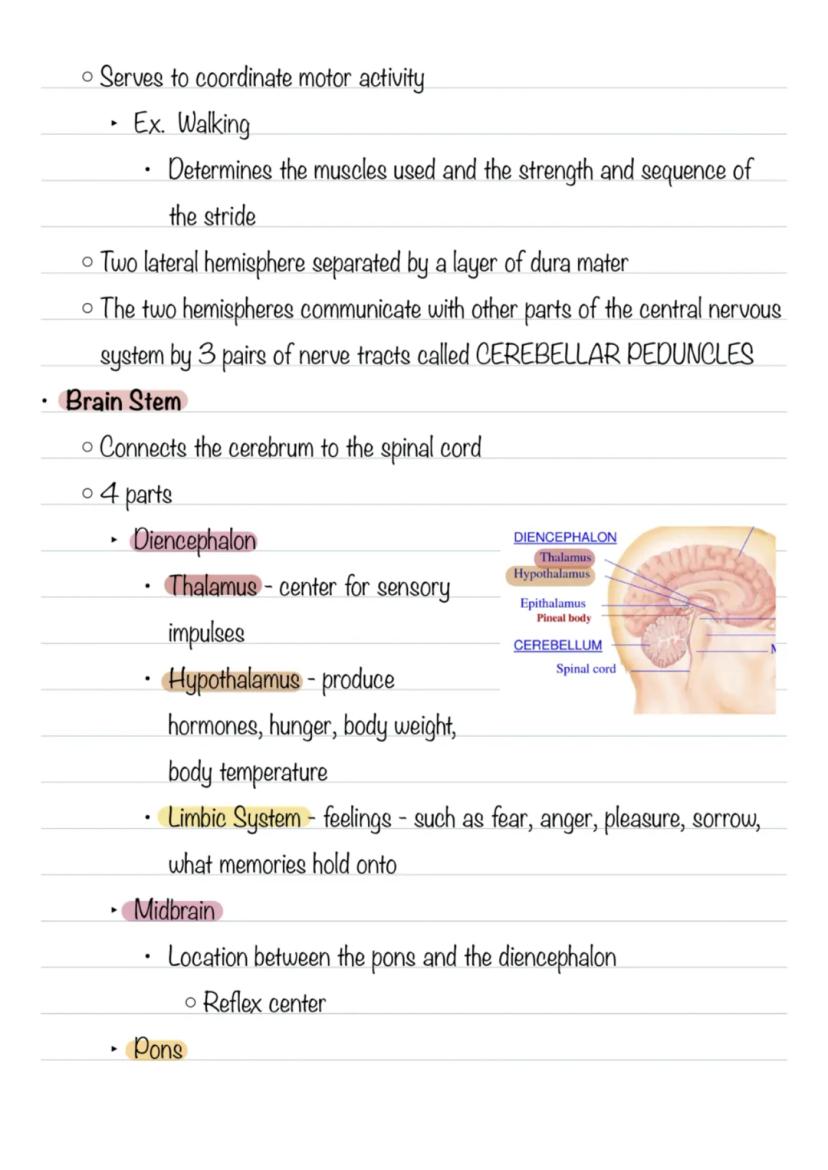
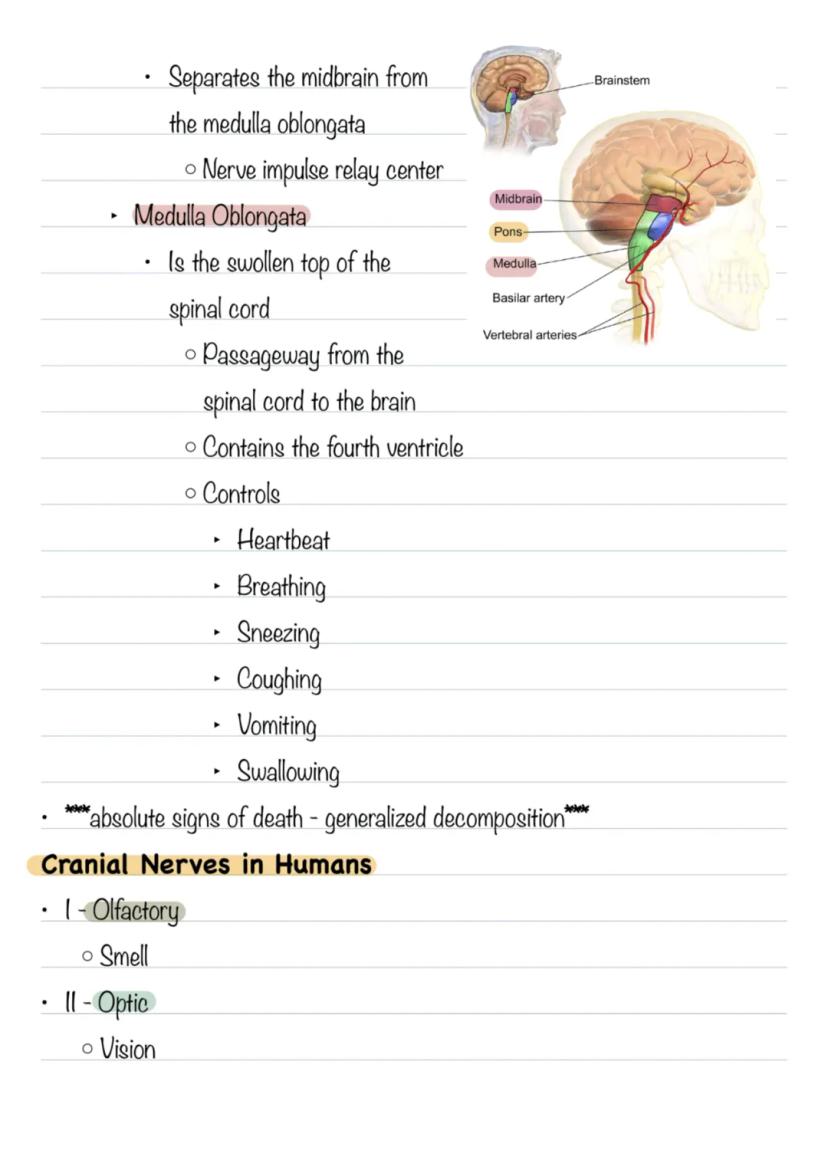
The brain stem connects your cerebrum to your spinal cord and consists of four parts. The diencephalon includes the thalamus (sensory processing centre) and hypothalamus (regulates hormones, hunger, body temperature). The limbic system manages emotions like fear, anger, pleasure and sorrow, influencing which memories you retain. The midbrain acts as a reflex centre, while the pons serves as a nerve impulse relay station.
Remember this: Your brain stem controls vital functions you never think about! This small but mighty structure keeps you breathing, maintains your heartbeat, and enables reflexes like coughing and sneezing without any conscious effort.
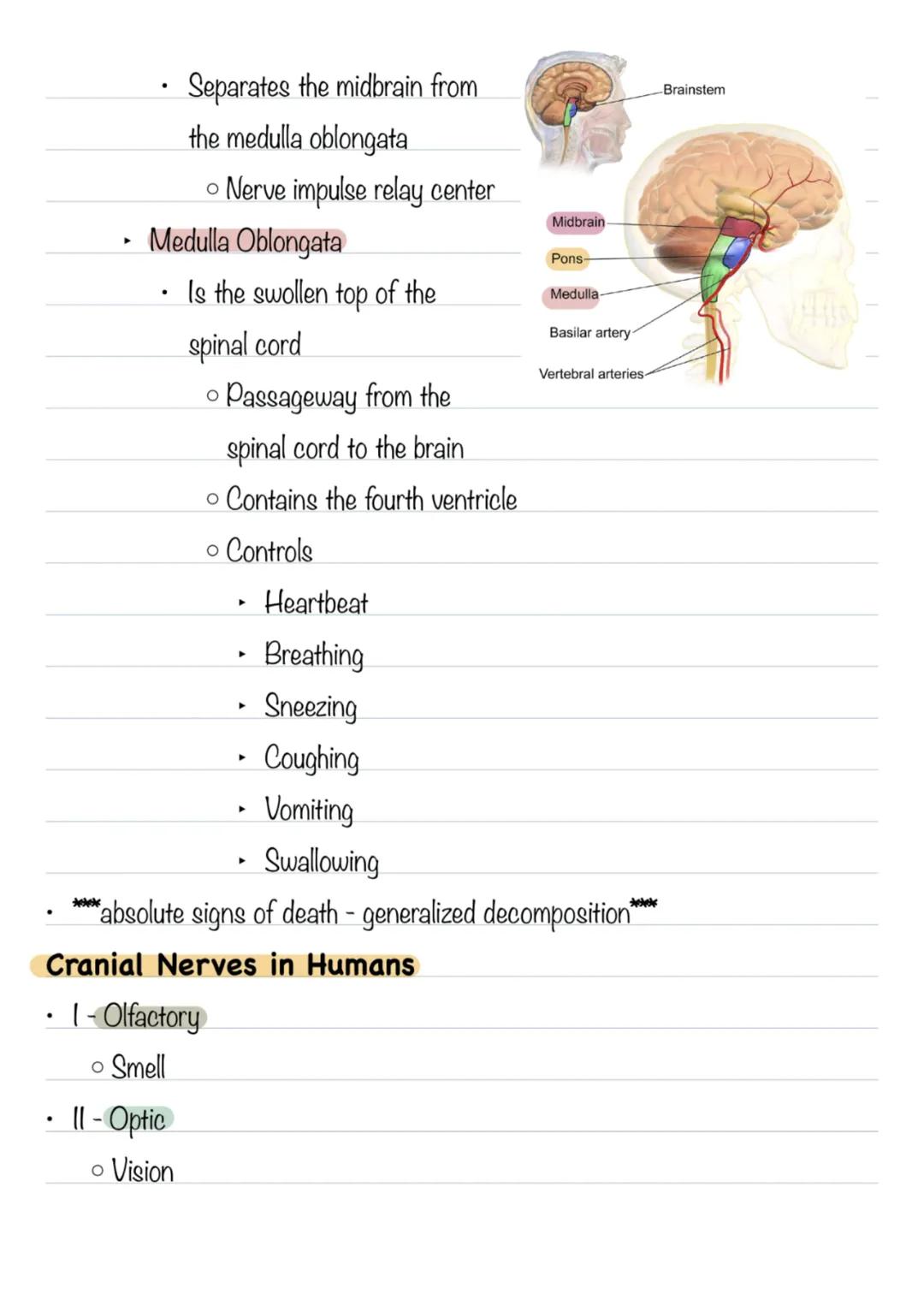
The medulla oblongata is the swollen top portion of your spinal cord and forms the lowest part of your brain stem. This critical structure serves as the passageway for signals traveling between your brain and spinal cord, and contains the fourth ventricle filled with cerebrospinal fluid.
Your medulla controls many vital automatic functions including your heartbeat, breathing, sneezing, coughing, vomiting, and swallowing. When these functions permanently cease, it's considered an absolute sign of death (alongside generalised decomposition).
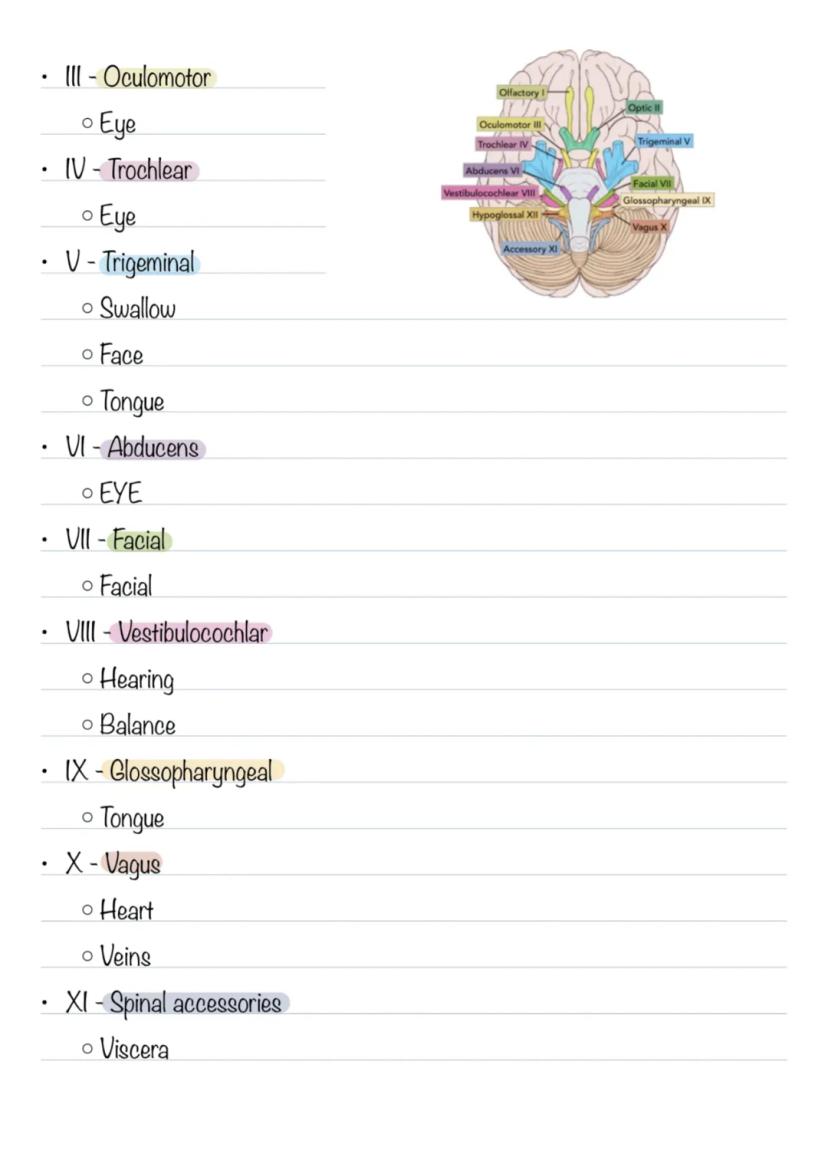
Your brain connects directly to sensory organs and muscles through 12 pairs of cranial nerves. The first two are responsible for special senses: the olfactory nerve (I) handles smell, while the optic nerve (II) manages vision. These nerves emerge directly from your brain rather than your spinal cord.
Try this mnemonic: "Oh Once One Takes The Anatomy Final Very Good Vacation Super Heavenly" can help you remember the order of cranial nerves (Olfactory, Optic, Oculomotor, Trochlear, Trigeminal, Abducens, Facial, Vestibulocochlear, Glossopharyngeal, Vagus, Spinal accessory, Hypoglossal).
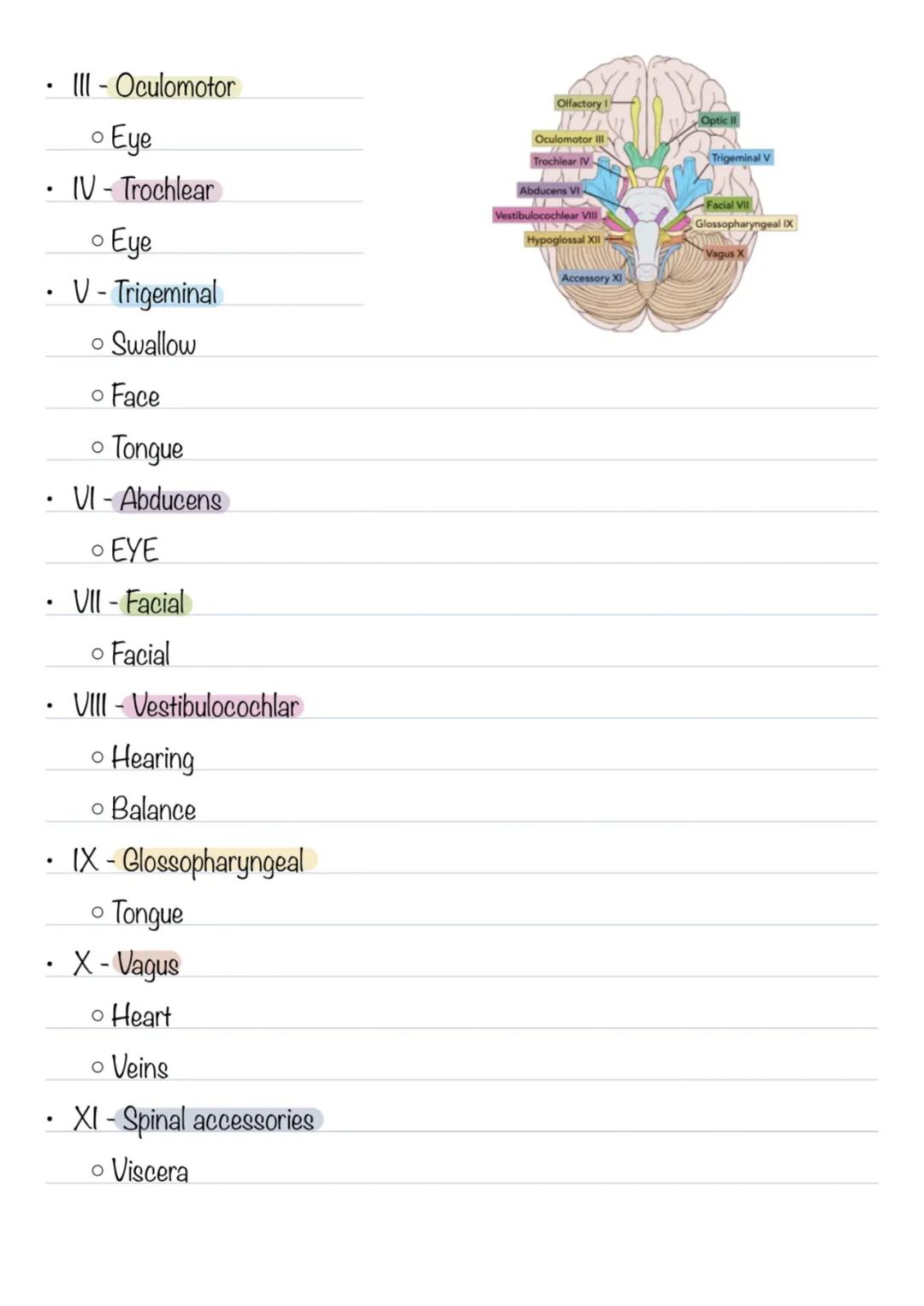
Cranial nerves III to XII control various functions throughout your head, face and body. The oculomotor (III), trochlear (IV), and abducens (VI) nerves all control different eye movements, allowing you to look in different directions.
The trigeminal nerve (V) has multiple functions including controlling swallowing and providing sensation to your face and tongue. The facial nerve (VII) manages your facial expressions, while the vestibulocochlear nerve (VIII) is responsible for both hearing and balance.
The glossopharyngeal nerve (IX) primarily serves your tongue, while the vagus nerve (X) has extensive functions including regulating your heart and blood vessels. The spinal accessory nerve (XI) controls various visceral functions, and finally, the hypoglossal nerve (XII) controls tongue movements essential for speech and swallowing.
Fascinating fact: Your vagus nerve (X) is the longest cranial nerve and the main component of your parasympathetic nervous system. It helps you relax after stress and explains why deep breathing can calm you down!
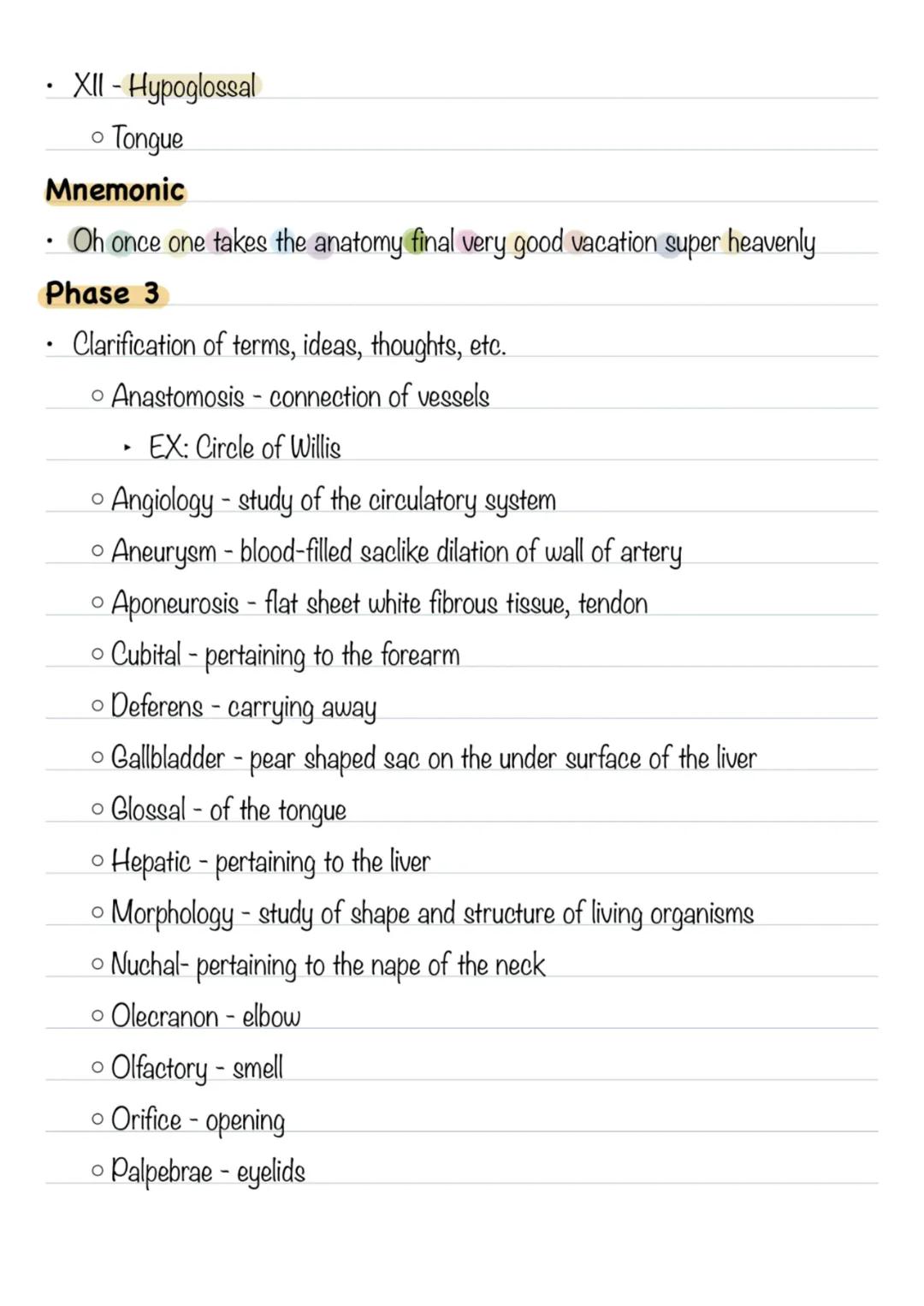
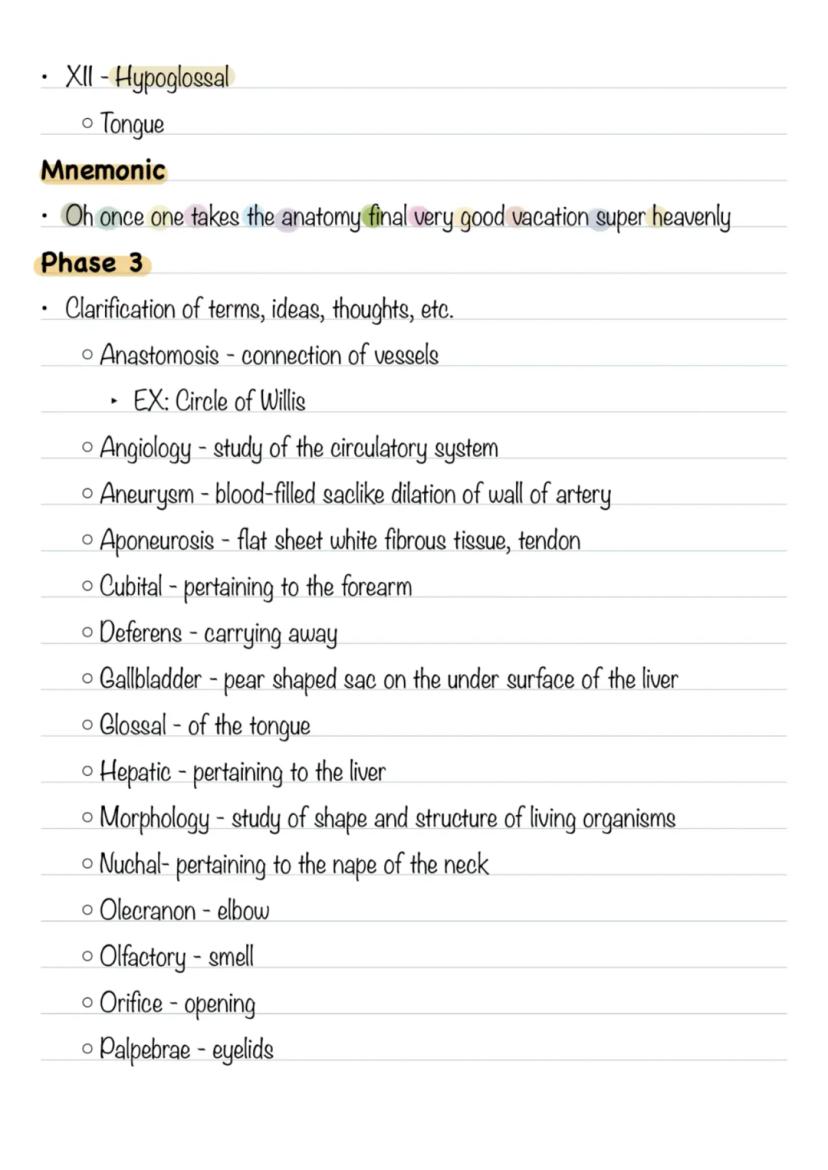
Understanding anatomical terminology helps you navigate discussions about the nervous system. Anastomosis refers to a connection between vessels, like the Circle of Willis in your brain. Angiology is the study of the circulatory system, while an aneurysm is a blood-filled saclike dilation in an artery wall that can be dangerous.
Terms related to body regions include cubital (forearm), glossal (tongue), hepatic (liver), and nuchal (nape of the neck). Olecranon refers to your elbow, while olfactory relates to your sense of smell.
Other important terms include aponeurosis (a flat sheet of white fibrous tissue similar to a tendon), deferens (carrying away), and morphology (the study of the shape and structure of living organisms). The term orifice simply means an opening, while palpebrae refers to your eyelids.
Study tip: Learning anatomical terminology is like learning a new language! Break words down into their roots - for example, "glosso-" always relates to the tongue, while "-palpebra" refers to eyelids. This makes memorizing much easier.
Our AI Companion is a student-focused AI tool that offers more than just answers. Built on millions of Knowunity resources, it provides relevant information, personalised study plans, quizzes, and content directly in the chat, adapting to your individual learning journey.
You can download the app from Google Play Store and Apple App Store.
That's right! Enjoy free access to study content, connect with fellow students, and get instant help – all at your fingertips.
App Store
Google Play
The app is very easy to use and well designed. I have found everything I was looking for so far and have been able to learn a lot from the presentations! I will definitely use the app for a class assignment! And of course it also helps a lot as an inspiration.
Stefan S
iOS user
This app is really great. There are so many study notes and help [...]. My problem subject is French, for example, and the app has so many options for help. Thanks to this app, I have improved my French. I would recommend it to anyone.
Samantha Klich
Android user
Wow, I am really amazed. I just tried the app because I've seen it advertised many times and was absolutely stunned. This app is THE HELP you want for school and above all, it offers so many things, such as workouts and fact sheets, which have been VERY helpful to me personally.
Anna
iOS user
Best app on earth! no words because it’s too good
Thomas R
iOS user
Just amazing. Let's me revise 10x better, this app is a quick 10/10. I highly recommend it to anyone. I can watch and search for notes. I can save them in the subject folder. I can revise it any time when I come back. If you haven't tried this app, you're really missing out.
Basil
Android user
This app has made me feel so much more confident in my exam prep, not only through boosting my own self confidence through the features that allow you to connect with others and feel less alone, but also through the way the app itself is centred around making you feel better. It is easy to navigate, fun to use, and helpful to anyone struggling in absolutely any way.
David K
iOS user
The app's just great! All I have to do is enter the topic in the search bar and I get the response real fast. I don't have to watch 10 YouTube videos to understand something, so I'm saving my time. Highly recommended!
Sudenaz Ocak
Android user
In school I was really bad at maths but thanks to the app, I am doing better now. I am so grateful that you made the app.
Greenlight Bonnie
Android user
very reliable app to help and grow your ideas of Maths, English and other related topics in your works. please use this app if your struggling in areas, this app is key for that. wish I'd of done a review before. and it's also free so don't worry about that.
Rohan U
Android user
I know a lot of apps use fake accounts to boost their reviews but this app deserves it all. Originally I was getting 4 in my English exams and this time I got a grade 7. I didn’t even know about this app three days until the exam and it has helped A LOT. Please actually trust me and use it as I’m sure you too will see developments.
Xander S
iOS user
THE QUIZES AND FLASHCARDS ARE SO USEFUL AND I LOVE Knowunity AI. IT ALSO IS LITREALLY LIKE CHATGPT BUT SMARTER!! HELPED ME WITH MY MASCARA PROBLEMS TOO!! AS WELL AS MY REAL SUBJECTS ! DUHHH 😍😁😲🤑💗✨🎀😮
Elisha
iOS user
This apps acc the goat. I find revision so boring but this app makes it so easy to organize it all and then you can ask the freeeee ai to test yourself so good and you can easily upload your own stuff. highly recommend as someone taking mocks now
Paul T
iOS user
The app is very easy to use and well designed. I have found everything I was looking for so far and have been able to learn a lot from the presentations! I will definitely use the app for a class assignment! And of course it also helps a lot as an inspiration.
Stefan S
iOS user
This app is really great. There are so many study notes and help [...]. My problem subject is French, for example, and the app has so many options for help. Thanks to this app, I have improved my French. I would recommend it to anyone.
Samantha Klich
Android user
Wow, I am really amazed. I just tried the app because I've seen it advertised many times and was absolutely stunned. This app is THE HELP you want for school and above all, it offers so many things, such as workouts and fact sheets, which have been VERY helpful to me personally.
Anna
iOS user
Best app on earth! no words because it’s too good
Thomas R
iOS user
Just amazing. Let's me revise 10x better, this app is a quick 10/10. I highly recommend it to anyone. I can watch and search for notes. I can save them in the subject folder. I can revise it any time when I come back. If you haven't tried this app, you're really missing out.
Basil
Android user
This app has made me feel so much more confident in my exam prep, not only through boosting my own self confidence through the features that allow you to connect with others and feel less alone, but also through the way the app itself is centred around making you feel better. It is easy to navigate, fun to use, and helpful to anyone struggling in absolutely any way.
David K
iOS user
The app's just great! All I have to do is enter the topic in the search bar and I get the response real fast. I don't have to watch 10 YouTube videos to understand something, so I'm saving my time. Highly recommended!
Sudenaz Ocak
Android user
In school I was really bad at maths but thanks to the app, I am doing better now. I am so grateful that you made the app.
Greenlight Bonnie
Android user
very reliable app to help and grow your ideas of Maths, English and other related topics in your works. please use this app if your struggling in areas, this app is key for that. wish I'd of done a review before. and it's also free so don't worry about that.
Rohan U
Android user
I know a lot of apps use fake accounts to boost their reviews but this app deserves it all. Originally I was getting 4 in my English exams and this time I got a grade 7. I didn’t even know about this app three days until the exam and it has helped A LOT. Please actually trust me and use it as I’m sure you too will see developments.
Xander S
iOS user
THE QUIZES AND FLASHCARDS ARE SO USEFUL AND I LOVE Knowunity AI. IT ALSO IS LITREALLY LIKE CHATGPT BUT SMARTER!! HELPED ME WITH MY MASCARA PROBLEMS TOO!! AS WELL AS MY REAL SUBJECTS ! DUHHH 😍😁😲🤑💗✨🎀😮
Elisha
iOS user
This apps acc the goat. I find revision so boring but this app makes it so easy to organize it all and then you can ask the freeeee ai to test yourself so good and you can easily upload your own stuff. highly recommend as someone taking mocks now
Paul T
iOS user
knoxx Lim
@knoxxlim
The nervous system is your body's incredible control centre, managing everything from conscious movements to automatic functions like breathing. This chapter explores how your brain, spinal cord, and network of nerves work together to control your entire body, enabling you... Show more
Access to all documents
Improve your grades
Join milions of students
Your nervous system consists of two main parts working in perfect harmony. The Central Nervous System (CNS) includes your brain and spinal cord, acting as the control centre for your entire body. The Peripheral Nervous System (PNS) connects your CNS to the rest of your body, helping integrate incoming information and determine appropriate responses.
Your body has two types of nerves with different jobs. Sensory nerves (afferent) carry information from your body's sensory receptors to your CNS, telling you what's happening in your environment. Motor nerves (efferent) carry commands from your CNS to muscles or other structures that need to respond.
The nervous system contains two primary cell types. Neurons are specialized nerve cells that receive and transmit stimuli, consisting of three important parts: the cell body (contains the nucleus), dendrites (receive input), and axons (transfer impulses to other cells). Groups of neuron cells clustered together form ganglia.
Did you know? Your nervous system is like a complex electrical circuit - neurons can transmit signals at speeds up to 120 metres per second, faster than a Formula 1 racing car!
Access to all documents
Improve your grades
Join milions of students
Your nervous system contains billions of glial cells that support and protect neurons. These cells, collectively called neuroglia, actually outnumber neurons and play crucial roles in maintaining brain health.
If you were to look at brain tissue, you'd notice two distinct areas. White matter consists of myelinated axons (nerve fibres covered in a protective sheath), while grey matter contains neuronal cell bodies and neuroglia. This different colouration helps scientists identify different brain regions.
Your brain is protected by the skull and connects to your spinal cord through the foramen magnum, a large opening at the base of your occipital bone. The brain itself contains approximately 100 billion neurons and has 12 pairs of cranial nerves that emerge from its base.
Fascinating fact: Your spinal cord is shorter than your vertebral column! It typically ends around the second lumbar vertebra (L2), while the protective vertebral canal continues all the way down to your sacrum.
Access to all documents
Improve your grades
Join milions of students
Your brain and spinal cord are wrapped in three layers of protective tissue called the meninges. These layers serve as a crucial defence system for your delicate neural tissues. Spinal meninges surround your spinal cord, while cranial meninges protect your brain.
The outermost layer is the dura mater, made of dense, irregular connective tissue that runs from the foramen magnum to the second sacral vertebra. Beneath it lies the arachnoid mater (also called meninx), an avascular middle layer. The innermost layer, the pia mater, makes direct contact with both the brain and spinal cord.
A spinal tap is a procedure where a long needle is inserted into the subarachnoid space (the area between the arachnoid and pia mater). Because your spinal cord ends at L2 but your meninges continue to S2, doctors typically perform spinal taps between vertebrae L3/L4 or L4/L5. This provides safe access without damaging the spinal cord.
Remember this: Spinal taps are performed in the lower back because your spinal cord doesn't extend the entire length of your spine! This clever positioning allows doctors to access the cerebrospinal fluid safely.
Access to all documents
Improve your grades
Join milions of students
Spinal nerves are your communication pathways between the spinal cord and specific body regions. Your body has 31 pairs of these nerves: 8 cervical, 12 thoracic, 5 lumbar, 5 sacral, and 1 coccygeal. They branch out from your spine to innervate different areas.
Since your spinal cord ends around the L2 vertebra but your spine continues lower, the nerve roots for your lumbar, sacral and coccygeal regions must travel downward before exiting the vertebral column. This bundle of nerve roots at the inferior end forms the cauda equina, which resembles a horse's tail.
Your brain serves as the grand organising and processing centre of your nervous system. It manages consciousness, sensation, memory, and coordination by receiving impulses from both the spinal cord and 12 pairs of cranial nerves.
Think about this: Your brain accounts for only 2% of your body weight but uses about 20% of your body's oxygen and energy! This remarkable organ contains more connections than there are stars in our galaxy.
Access to all documents
Improve your grades
Join milions of students
Your cerebrum is divided by shallow grooves called sulci and deeper indentations called fissures. Each cerebral hemisphere contains over 10 billion neurons and is divided into four main lobes, each with specialised functions.
The frontal lobe serves as the primary motor area, controlling voluntary movements. It also contains Broca's area, which is crucial for speech and speech planning. The other lobes—parietal, temporal, and occipital—manage different sensory processing, memory, and visual information.
Inside your cerebrum are fluid-filled spaces called ventricles. These include two large lateral ventricles, one near the corpus callosum (the bridge connecting your brain's hemispheres), and another in the brain stem. All ventricles contain cerebrospinal fluid (CSF), which cushions and protects your brain.
Cool brain fact: Your cerebellum might be small (just 10% of brain volume), but it contains over 50% of all your brain's neurons! This dense packing helps it coordinate complex movements with incredible precision.
Access to all documents
Improve your grades
Join milions of students
The cerebellum is a large mass of grey matter located behind the medulla oblongata. It plays a vital role in coordinating your motor activities like walking by determining which muscles to use and controlling the strength and sequence of your movements. Though smaller than the cerebrum, it's crucial for smooth, coordinated actions.
Your cerebellum consists of two lateral hemispheres separated by a layer of dura mater. These hemispheres communicate with other parts of the central nervous system through three pairs of nerve tracts called cerebellar peduncles.
The brain stem connects your cerebrum to your spinal cord and consists of four parts. The diencephalon includes the thalamus (sensory processing centre) and hypothalamus (regulates hormones, hunger, body temperature). The limbic system manages emotions like fear, anger, pleasure and sorrow, influencing which memories you retain. The midbrain acts as a reflex centre, while the pons serves as a nerve impulse relay station.
Remember this: Your brain stem controls vital functions you never think about! This small but mighty structure keeps you breathing, maintains your heartbeat, and enables reflexes like coughing and sneezing without any conscious effort.
Access to all documents
Improve your grades
Join milions of students
The medulla oblongata is the swollen top portion of your spinal cord and forms the lowest part of your brain stem. This critical structure serves as the passageway for signals traveling between your brain and spinal cord, and contains the fourth ventricle filled with cerebrospinal fluid.
Your medulla controls many vital automatic functions including your heartbeat, breathing, sneezing, coughing, vomiting, and swallowing. When these functions permanently cease, it's considered an absolute sign of death (alongside generalised decomposition).
Your brain connects directly to sensory organs and muscles through 12 pairs of cranial nerves. The first two are responsible for special senses: the olfactory nerve (I) handles smell, while the optic nerve (II) manages vision. These nerves emerge directly from your brain rather than your spinal cord.
Try this mnemonic: "Oh Once One Takes The Anatomy Final Very Good Vacation Super Heavenly" can help you remember the order of cranial nerves (Olfactory, Optic, Oculomotor, Trochlear, Trigeminal, Abducens, Facial, Vestibulocochlear, Glossopharyngeal, Vagus, Spinal accessory, Hypoglossal).
Access to all documents
Improve your grades
Join milions of students
Cranial nerves III to XII control various functions throughout your head, face and body. The oculomotor (III), trochlear (IV), and abducens (VI) nerves all control different eye movements, allowing you to look in different directions.
The trigeminal nerve (V) has multiple functions including controlling swallowing and providing sensation to your face and tongue. The facial nerve (VII) manages your facial expressions, while the vestibulocochlear nerve (VIII) is responsible for both hearing and balance.
The glossopharyngeal nerve (IX) primarily serves your tongue, while the vagus nerve (X) has extensive functions including regulating your heart and blood vessels. The spinal accessory nerve (XI) controls various visceral functions, and finally, the hypoglossal nerve (XII) controls tongue movements essential for speech and swallowing.
Fascinating fact: Your vagus nerve (X) is the longest cranial nerve and the main component of your parasympathetic nervous system. It helps you relax after stress and explains why deep breathing can calm you down!
Access to all documents
Improve your grades
Join milions of students
Understanding anatomical terminology helps you navigate discussions about the nervous system. Anastomosis refers to a connection between vessels, like the Circle of Willis in your brain. Angiology is the study of the circulatory system, while an aneurysm is a blood-filled saclike dilation in an artery wall that can be dangerous.
Terms related to body regions include cubital (forearm), glossal (tongue), hepatic (liver), and nuchal (nape of the neck). Olecranon refers to your elbow, while olfactory relates to your sense of smell.
Other important terms include aponeurosis (a flat sheet of white fibrous tissue similar to a tendon), deferens (carrying away), and morphology (the study of the shape and structure of living organisms). The term orifice simply means an opening, while palpebrae refers to your eyelids.
Study tip: Learning anatomical terminology is like learning a new language! Break words down into their roots - for example, "glosso-" always relates to the tongue, while "-palpebra" refers to eyelids. This makes memorizing much easier.
Our AI Companion is a student-focused AI tool that offers more than just answers. Built on millions of Knowunity resources, it provides relevant information, personalised study plans, quizzes, and content directly in the chat, adapting to your individual learning journey.
You can download the app from Google Play Store and Apple App Store.
That's right! Enjoy free access to study content, connect with fellow students, and get instant help – all at your fingertips.
3
Smart Tools NEW
Transform this note into: ✓ 50+ Practice Questions ✓ Interactive Flashcards ✓ Full Mock Exam ✓ Essay Outlines
App Store
Google Play
The app is very easy to use and well designed. I have found everything I was looking for so far and have been able to learn a lot from the presentations! I will definitely use the app for a class assignment! And of course it also helps a lot as an inspiration.
Stefan S
iOS user
This app is really great. There are so many study notes and help [...]. My problem subject is French, for example, and the app has so many options for help. Thanks to this app, I have improved my French. I would recommend it to anyone.
Samantha Klich
Android user
Wow, I am really amazed. I just tried the app because I've seen it advertised many times and was absolutely stunned. This app is THE HELP you want for school and above all, it offers so many things, such as workouts and fact sheets, which have been VERY helpful to me personally.
Anna
iOS user
Best app on earth! no words because it’s too good
Thomas R
iOS user
Just amazing. Let's me revise 10x better, this app is a quick 10/10. I highly recommend it to anyone. I can watch and search for notes. I can save them in the subject folder. I can revise it any time when I come back. If you haven't tried this app, you're really missing out.
Basil
Android user
This app has made me feel so much more confident in my exam prep, not only through boosting my own self confidence through the features that allow you to connect with others and feel less alone, but also through the way the app itself is centred around making you feel better. It is easy to navigate, fun to use, and helpful to anyone struggling in absolutely any way.
David K
iOS user
The app's just great! All I have to do is enter the topic in the search bar and I get the response real fast. I don't have to watch 10 YouTube videos to understand something, so I'm saving my time. Highly recommended!
Sudenaz Ocak
Android user
In school I was really bad at maths but thanks to the app, I am doing better now. I am so grateful that you made the app.
Greenlight Bonnie
Android user
very reliable app to help and grow your ideas of Maths, English and other related topics in your works. please use this app if your struggling in areas, this app is key for that. wish I'd of done a review before. and it's also free so don't worry about that.
Rohan U
Android user
I know a lot of apps use fake accounts to boost their reviews but this app deserves it all. Originally I was getting 4 in my English exams and this time I got a grade 7. I didn’t even know about this app three days until the exam and it has helped A LOT. Please actually trust me and use it as I’m sure you too will see developments.
Xander S
iOS user
THE QUIZES AND FLASHCARDS ARE SO USEFUL AND I LOVE Knowunity AI. IT ALSO IS LITREALLY LIKE CHATGPT BUT SMARTER!! HELPED ME WITH MY MASCARA PROBLEMS TOO!! AS WELL AS MY REAL SUBJECTS ! DUHHH 😍😁😲🤑💗✨🎀😮
Elisha
iOS user
This apps acc the goat. I find revision so boring but this app makes it so easy to organize it all and then you can ask the freeeee ai to test yourself so good and you can easily upload your own stuff. highly recommend as someone taking mocks now
Paul T
iOS user
The app is very easy to use and well designed. I have found everything I was looking for so far and have been able to learn a lot from the presentations! I will definitely use the app for a class assignment! And of course it also helps a lot as an inspiration.
Stefan S
iOS user
This app is really great. There are so many study notes and help [...]. My problem subject is French, for example, and the app has so many options for help. Thanks to this app, I have improved my French. I would recommend it to anyone.
Samantha Klich
Android user
Wow, I am really amazed. I just tried the app because I've seen it advertised many times and was absolutely stunned. This app is THE HELP you want for school and above all, it offers so many things, such as workouts and fact sheets, which have been VERY helpful to me personally.
Anna
iOS user
Best app on earth! no words because it’s too good
Thomas R
iOS user
Just amazing. Let's me revise 10x better, this app is a quick 10/10. I highly recommend it to anyone. I can watch and search for notes. I can save them in the subject folder. I can revise it any time when I come back. If you haven't tried this app, you're really missing out.
Basil
Android user
This app has made me feel so much more confident in my exam prep, not only through boosting my own self confidence through the features that allow you to connect with others and feel less alone, but also through the way the app itself is centred around making you feel better. It is easy to navigate, fun to use, and helpful to anyone struggling in absolutely any way.
David K
iOS user
The app's just great! All I have to do is enter the topic in the search bar and I get the response real fast. I don't have to watch 10 YouTube videos to understand something, so I'm saving my time. Highly recommended!
Sudenaz Ocak
Android user
In school I was really bad at maths but thanks to the app, I am doing better now. I am so grateful that you made the app.
Greenlight Bonnie
Android user
very reliable app to help and grow your ideas of Maths, English and other related topics in your works. please use this app if your struggling in areas, this app is key for that. wish I'd of done a review before. and it's also free so don't worry about that.
Rohan U
Android user
I know a lot of apps use fake accounts to boost their reviews but this app deserves it all. Originally I was getting 4 in my English exams and this time I got a grade 7. I didn’t even know about this app three days until the exam and it has helped A LOT. Please actually trust me and use it as I’m sure you too will see developments.
Xander S
iOS user
THE QUIZES AND FLASHCARDS ARE SO USEFUL AND I LOVE Knowunity AI. IT ALSO IS LITREALLY LIKE CHATGPT BUT SMARTER!! HELPED ME WITH MY MASCARA PROBLEMS TOO!! AS WELL AS MY REAL SUBJECTS ! DUHHH 😍😁😲🤑💗✨🎀😮
Elisha
iOS user
This apps acc the goat. I find revision so boring but this app makes it so easy to organize it all and then you can ask the freeeee ai to test yourself so good and you can easily upload your own stuff. highly recommend as someone taking mocks now
Paul T
iOS user