
Light is everywhere around us, but have you ever wondered...
 Combined Science133 views·Updated 10 Jul 2026·2 pages
Organizador de Conocimientos de Física - La Luz
Olamide@olamide_26
1
of 2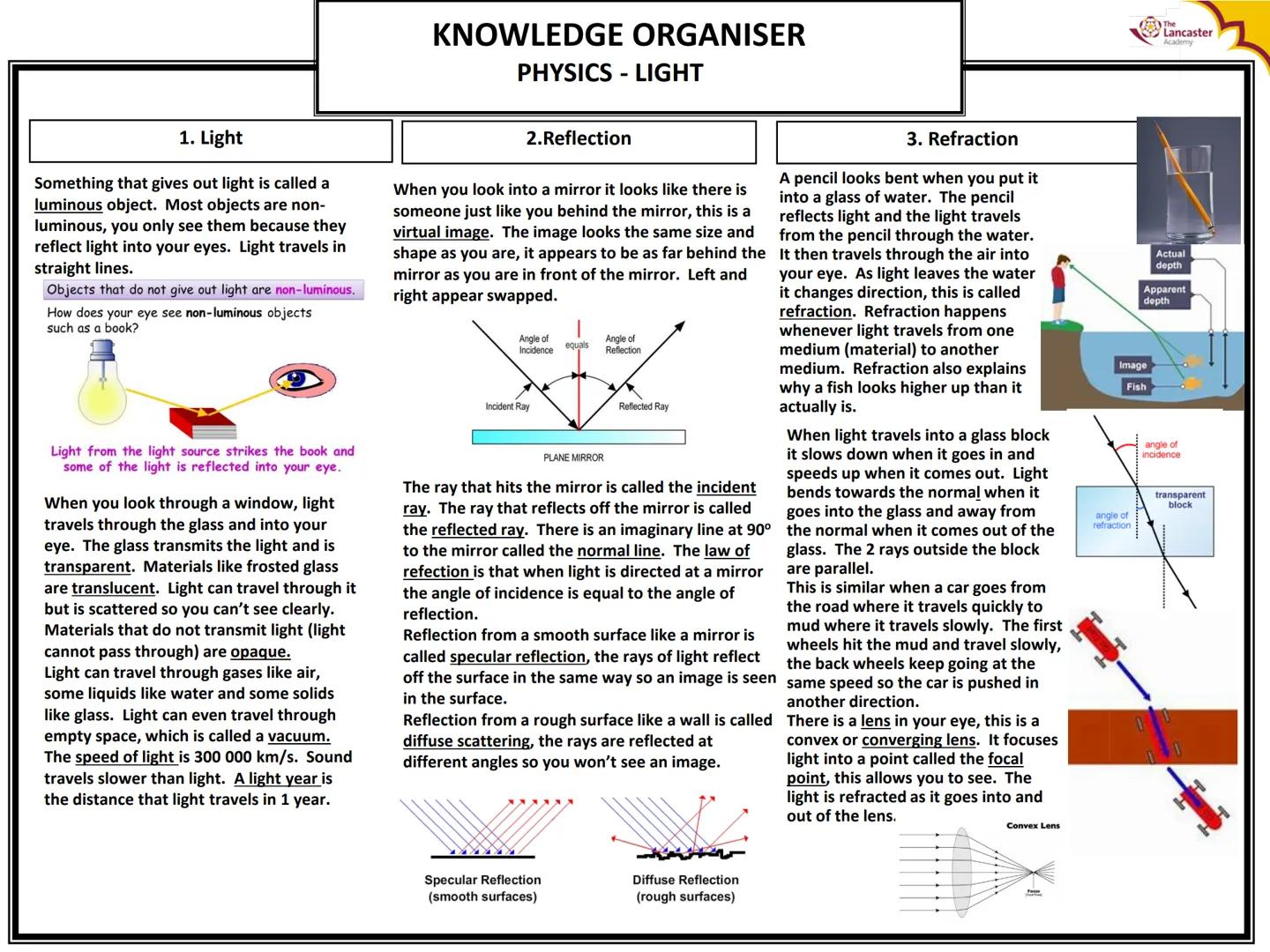
Light Basics and Behaviour
Ever noticed how you can't see anything in a completely dark room? That's because most objects are non-luminous - they don't produce their own light. You only see them because they reflect light from luminous objects like the sun or a lamp into your eyes.
Light travels in straight lines at an incredible speed of 300,000 km/s through space. It can pass through transparent materials like glass, translucent ones like frosted glass (though it gets scattered), but stops completely at opaque materials like walls.
When light hits a smooth surface like a mirror, it creates specular reflection - this is why you see a clear image. The law of reflection states that the angle of incidence equals the angle of reflection. Rough surfaces cause diffuse scattering, spreading light in all directions.
Quick Tip: Remember that light always reflects off surfaces at the same angle it hits them - just like a ball bouncing off a wall!
Refraction happens when light changes direction as it moves between different materials. That bent-looking pencil in water? Light slows down in water and bends towards the normal line, then speeds up and bends away when it exits back into air.
2
of 2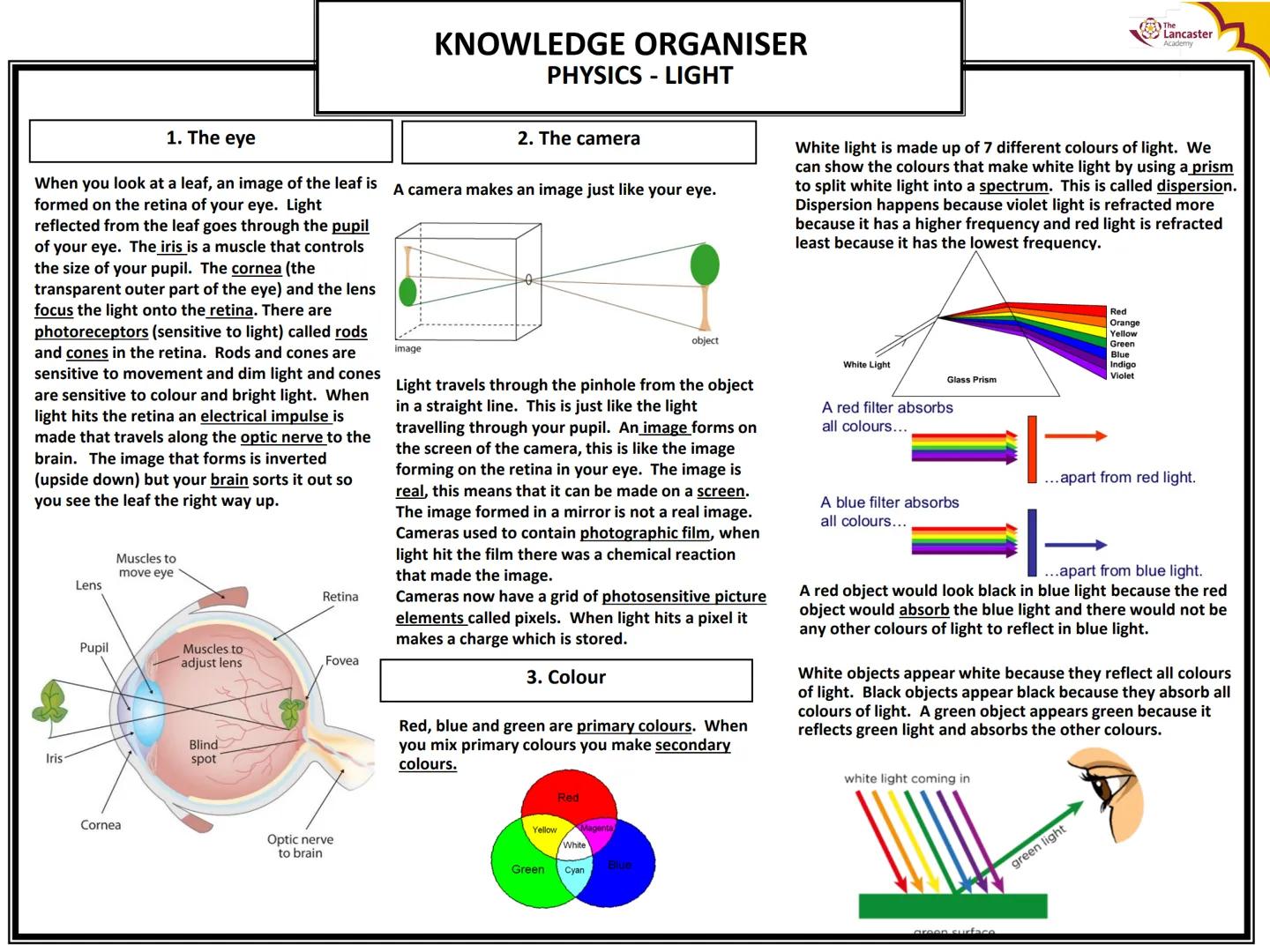
How We See: Eyes, Cameras and Colour
Your eye works like a brilliant natural camera. Light enters through the pupil (controlled by the iris muscle), gets focused by the cornea and lens onto the retina. The retina contains photoreceptors - rods for movement and dim light, cones for colour and bright light.
Modern cameras work similarly to your eyes. Light passes through an opening onto pixels (photosensitive picture elements) that convert light into electrical charges. Both eyes and cameras create real, inverted images that get flipped the right way by your brain or camera software.
White light contains all colours of the rainbow. A prism can split white light into its spectrum through dispersion - this happens because different colours refract by different amounts. Red bends least, violet bends most.
Colour Rule: Objects appear coloured because they reflect certain colours and absorb others - a red apple reflects red light but absorbs all other colours.
Filters work by absorbing certain colours whilst letting others through. This is why a red object looks black under blue light - there's no red light to reflect back to your eyes!
We thought you’d never ask...
Our AI Companion is a student-focused AI tool that offers more than just answers. Built on millions of Knowunity resources, it provides relevant information, personalised study plans, quizzes, and content directly in the chat, adapting to your individual learning journey.
You can download the app from Google Play Store and Apple App Store.
That's right! Enjoy free access to study content, connect with fellow students, and get instant help – all at your fingertips.
Similar content
Most popular content in Biology
9C
 Biology
Cell Biology and Cell structure
cell structures
93,2810
T
BiologyThe functions of subcellular structures - B1 Biology
Flashcards on the different functions of subcellular structures: cell membrane, nucleus, mitochondria, ribosomes, cytoplasm, permant vacuole, chloroplasts and cell wall.
102,8215
BiologyAQA Biology: Key Concepts
Explore essential AQA Biology topics including Photosynthesis, Respiration, Homeostasis, Genetics, and Ecology. This comprehensive knowledge organizer covers key concepts such as energy transfer, hormonal control, and genetic variation, providing a solid foundation for your studies. Ideal for exam preparation and understanding biological processes.
108,878308
C
Combined ScienceComparing Eukaryotic and Prokaryotic Structures
Compare animal and plant cells with bacterial cells, focusing on size differences, organelle presence, and genetic material storage.
S39540
A
Combined ScienceAtomic Mass and Number Calculations
Calculate the number of protons, neutrons, and electrons for different elements using atomic and mass numbers.
S39920
 Physics
Forces and Motion Overview
Explore key concepts in Forces and Motion, including Hooke's Law, velocity, acceleration, and the principles of moments. This summary covers essential topics such as the relationship between force and extension, terminal velocity, and the impact of safety devices in physics. Ideal for AQA Physics Unit 5 revision.
109,211872
 Chemistry
Chemistry paper 2
Chem paper 2 notes
1172714
BiologyBiology paper 1 Summary
Notes for Biology paper 1 contains the full course for AQA higher combined!
104,140106
ChemistryEssential Chemistry Practicals
Explore key AQA GCSE Chemistry practicals, including flame tests, titration, and gas identification. This resource covers essential techniques for analyzing ions, making salts, and understanding reaction kinetics. Perfect for students preparing for exams and practical assessments.
1011,973902
Most popular content
9 Sociology
Sociology of Education Overview
Explore comprehensive A-Level Sociology notes on the education system, covering key theories, policies, and sociological perspectives. This resource includes insights on marketisation, gender roles, cultural deprivation, and educational inequalities, providing a thorough understanding of how education shapes social stratification and individual achievement. Ideal for exam preparation and in-depth study.
12102,9583,041
SociologySociology of Families: Comprehensive Revision
Dive into an extensive overview of family dynamics, perspectives, and patterns in sociology. This resource covers key concepts such as family diversity, gender roles, marriage, and the impact of social policies on family structures. Perfect for A-Level Sociology students preparing for Paper 2.
1273,7532,307
CriminologyCriminology: Crime & Punishment Overview
Comprehensive mindmaps covering key concepts in the Crime and Punishment topic for WJEC Criminology Unit 4. This resource includes detailed insights into the Criminal Justice System, crime prevention strategies, sentencing models, and the roles of various agencies. Ideal for A-Level revision, ensuring you grasp essential theories and legislative processes to excel in your exams.
1254,8941,060
SociologyComprehensive Crime & Deviance Overview
Explore an extensive revision of crime and deviance topics, including theories, types of crime, and the impact of media. This resource covers key concepts such as Marxism, functionalism, gender and crime, and the influence of globalization on criminal behavior. Ideal for students seeking a thorough understanding of criminology and its various theories. Type: Full Topic Revision.
1251,6691,400
C
BiologyCell Biology and Cell structure
cell structures
93,2810
CriminologyWJEC Unit 4 Criminology
Criminology unit 4 detailed revision note
127,176125
SociologySociological Theories Overview
Comprehensive revision of key sociological theories including Functionalism, Marxism, Feminism, and Interpretivism. Explore concepts like value freedom, identity formation, and the critique of social control. Ideal for AQA A-Level Sociology students preparing for exams. This summary covers essential theories and their implications in sociology, providing a clear understanding of each perspective.
1231,480846
T
BiologyThe functions of subcellular structures - B1 Biology
Flashcards on the different functions of subcellular structures: cell membrane, nucleus, mitochondria, ribosomes, cytoplasm, permant vacuole, chloroplasts and cell wall.
102,8215
1
Biology1.cells Gcse biology question cards
combined science higher biology
92,3644
Students love us — and so will you.
4.6/5App Store
4.7/5Google Play
The app is very easy to use and well designed. I have found everything I was looking for so far and have been able to learn a lot from the presentations! I will definitely use the app for a class assignment! And of course it also helps a lot as an inspiration.
Stefan SiOS user
This app is really great. There are so many study notes and help [...]. My problem subject is French, for example, and the app has so many options for help. Thanks to this app, I have improved my French. I would recommend it to anyone.
Samantha KlichAndroid user
Wow, I am really amazed. I just tried the app because I've seen it advertised many times and was absolutely stunned. This app is THE HELP you want for school and above all, it offers so many things, such as workouts and fact sheets, which have been VERY helpful to me personally.
AnnaiOS user
Combined Science133 views·Updated 10 Jul 2026·2 pagesOrganizador de Conocimientos de Física - La Luz
Olamide@olamide_26
Light is everywhere around us, but have you ever wondered why you can see yourself in a mirror or why a pencil looks bent in water? Understanding how light behaves helps explain everything from how your eyes work to why...
1
of 2
Sign up to see the content. It's free!
- Access to all documents
- Improve your grades
- Join milions of students
By signing up you accept Terms of Service and Privacy Policy
Light Basics and Behaviour
Ever noticed how you can't see anything in a completely dark room? That's because most objects are non-luminous - they don't produce their own light. You only see them because they reflect light from luminous objects like the sun or a lamp into your eyes.
Light travels in straight lines at an incredible speed of 300,000 km/s through space. It can pass through transparent materials like glass, translucent ones like frosted glass (though it gets scattered), but stops completely at opaque materials like walls.
When light hits a smooth surface like a mirror, it creates specular reflection - this is why you see a clear image. The law of reflection states that the angle of incidence equals the angle of reflection. Rough surfaces cause diffuse scattering, spreading light in all directions.
Quick Tip: Remember that light always reflects off surfaces at the same angle it hits them - just like a ball bouncing off a wall!
Refraction happens when light changes direction as it moves between different materials. That bent-looking pencil in water? Light slows down in water and bends towards the normal line, then speeds up and bends away when it exits back into air.
2
of 2Sign up to see the content. It's free!
- Access to all documents
- Improve your grades
- Join milions of students
By signing up you accept Terms of Service and Privacy Policy
How We See: Eyes, Cameras and Colour
Your eye works like a brilliant natural camera. Light enters through the pupil (controlled by the iris muscle), gets focused by the cornea and lens onto the retina. The retina contains photoreceptors - rods for movement and dim light, cones for colour and bright light.
Modern cameras work similarly to your eyes. Light passes through an opening onto pixels (photosensitive picture elements) that convert light into electrical charges. Both eyes and cameras create real, inverted images that get flipped the right way by your brain or camera software.
White light contains all colours of the rainbow. A prism can split white light into its spectrum through dispersion - this happens because different colours refract by different amounts. Red bends least, violet bends most.
Colour Rule: Objects appear coloured because they reflect certain colours and absorb others - a red apple reflects red light but absorbs all other colours.
Filters work by absorbing certain colours whilst letting others through. This is why a red object looks black under blue light - there's no red light to reflect back to your eyes!
We thought you’d never ask...
Our AI Companion is a student-focused AI tool that offers more than just answers. Built on millions of Knowunity resources, it provides relevant information, personalised study plans, quizzes, and content directly in the chat, adapting to your individual learning journey.
You can download the app from Google Play Store and Apple App Store.
That's right! Enjoy free access to study content, connect with fellow students, and get instant help – all at your fingertips.
Similar content
Most popular content in Biology
9C
BiologyCell Biology and Cell structure
cell structures
93,2810
T
BiologyThe functions of subcellular structures - B1 Biology
Flashcards on the different functions of subcellular structures: cell membrane, nucleus, mitochondria, ribosomes, cytoplasm, permant vacuole, chloroplasts and cell wall.
102,8215
BiologyAQA Biology: Key Concepts
Explore essential AQA Biology topics including Photosynthesis, Respiration, Homeostasis, Genetics, and Ecology. This comprehensive knowledge organizer covers key concepts such as energy transfer, hormonal control, and genetic variation, providing a solid foundation for your studies. Ideal for exam preparation and understanding biological processes.
108,878308
C
Combined ScienceComparing Eukaryotic and Prokaryotic Structures
Compare animal and plant cells with bacterial cells, focusing on size differences, organelle presence, and genetic material storage.
S39540
A
Combined ScienceAtomic Mass and Number Calculations
Calculate the number of protons, neutrons, and electrons for different elements using atomic and mass numbers.
S39920
PhysicsForces and Motion Overview
Explore key concepts in Forces and Motion, including Hooke's Law, velocity, acceleration, and the principles of moments. This summary covers essential topics such as the relationship between force and extension, terminal velocity, and the impact of safety devices in physics. Ideal for AQA Physics Unit 5 revision.
109,211872
ChemistryChemistry paper 2
Chem paper 2 notes
1172714
BiologyBiology paper 1 Summary
Notes for Biology paper 1 contains the full course for AQA higher combined!
104,140106
ChemistryEssential Chemistry Practicals
Explore key AQA GCSE Chemistry practicals, including flame tests, titration, and gas identification. This resource covers essential techniques for analyzing ions, making salts, and understanding reaction kinetics. Perfect for students preparing for exams and practical assessments.
1011,973902
Most popular content
9SociologySociology of Education Overview
Explore comprehensive A-Level Sociology notes on the education system, covering key theories, policies, and sociological perspectives. This resource includes insights on marketisation, gender roles, cultural deprivation, and educational inequalities, providing a thorough understanding of how education shapes social stratification and individual achievement. Ideal for exam preparation and in-depth study.
12102,9583,041
SociologySociology of Families: Comprehensive Revision
Dive into an extensive overview of family dynamics, perspectives, and patterns in sociology. This resource covers key concepts such as family diversity, gender roles, marriage, and the impact of social policies on family structures. Perfect for A-Level Sociology students preparing for Paper 2.
1273,7532,307
CriminologyCriminology: Crime & Punishment Overview
Comprehensive mindmaps covering key concepts in the Crime and Punishment topic for WJEC Criminology Unit 4. This resource includes detailed insights into the Criminal Justice System, crime prevention strategies, sentencing models, and the roles of various agencies. Ideal for A-Level revision, ensuring you grasp essential theories and legislative processes to excel in your exams.
1254,8941,060
SociologyComprehensive Crime & Deviance Overview
Explore an extensive revision of crime and deviance topics, including theories, types of crime, and the impact of media. This resource covers key concepts such as Marxism, functionalism, gender and crime, and the influence of globalization on criminal behavior. Ideal for students seeking a thorough understanding of criminology and its various theories. Type: Full Topic Revision.
1251,6691,400
C
BiologyCell Biology and Cell structure
cell structures
93,2810
CriminologyWJEC Unit 4 Criminology
Criminology unit 4 detailed revision note
127,176125
SociologySociological Theories Overview
Comprehensive revision of key sociological theories including Functionalism, Marxism, Feminism, and Interpretivism. Explore concepts like value freedom, identity formation, and the critique of social control. Ideal for AQA A-Level Sociology students preparing for exams. This summary covers essential theories and their implications in sociology, providing a clear understanding of each perspective.
1231,480846
T
BiologyThe functions of subcellular structures - B1 Biology
Flashcards on the different functions of subcellular structures: cell membrane, nucleus, mitochondria, ribosomes, cytoplasm, permant vacuole, chloroplasts and cell wall.
102,8215
1
Biology1.cells Gcse biology question cards
combined science higher biology
92,3644
Students love us — and so will you.
4.6/5App Store
4.7/5Google Play
The app is very easy to use and well designed. I have found everything I was looking for so far and have been able to learn a lot from the presentations! I will definitely use the app for a class assignment! And of course it also helps a lot as an inspiration.
Stefan SiOS user
This app is really great. There are so many study notes and help [...]. My problem subject is French, for example, and the app has so many options for help. Thanks to this app, I have improved my French. I would recommend it to anyone.
Samantha KlichAndroid user
Wow, I am really amazed. I just tried the app because I've seen it advertised many times and was absolutely stunned. This app is THE HELP you want for school and above all, it offers so many things, such as workouts and fact sheets, which have been VERY helpful to me personally.
AnnaiOS user