Women of Legend in Greece and Rome
This page delves into the portrayal of legendary women in Greek and Roman mythology, highlighting their complex roles and the varying interpretations of their stories across different sources.
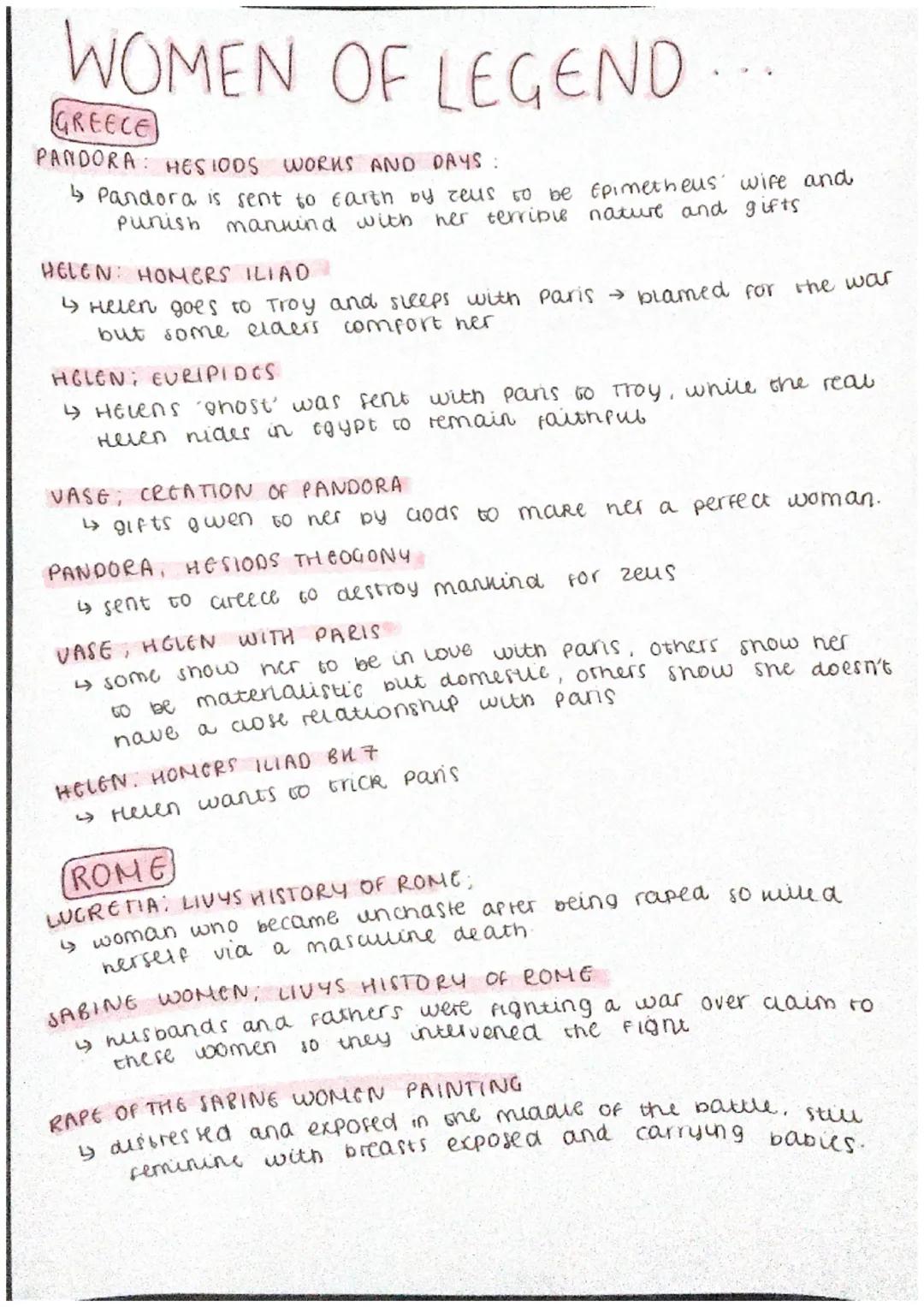
Pandora in Greek Mythology
Pandora, a central figure in Greek mythology, is presented in two main contexts:
-
In Hesiod's "Works and Days":
- Zeus sends Pandora to Earth as Epimetheus' wife.
- Her purpose is to punish mankind with her nature and gifts.
-
In Hesiod's "Theogony":
- Pandora is sent to Greece specifically to destroy mankind for Zeus.
Example: A vase depicting the creation of Pandora shows the gifts given to her by the gods to make her the "perfect woman," illustrating the complex nature of her character in Greek mythology.
Helen of Troy
Helen's story is portrayed differently across various sources:
-
In Homer's "Iliad":
- Helen goes to Troy and sleeps with Paris.
- She is blamed for the Trojan War.
- Some elders comfort her, suggesting a more sympathetic view.
-
In Euripides' version:
- A 'ghost' of Helen is sent to Troy.
- The real Helen hides in Egypt, remaining faithful to her husband.
Highlight: The varying portrayals of Helen across different sources reflect the complex attitudes towards women in ancient Greece, as seen through mythological evidence.
Example: Vase paintings of Helen with Paris show different interpretations:
- Some depict her in love with Paris.
- Others portray her as materialistic but domestic.
- Some suggest a distant relationship with Paris.
In Homer's "Iliad" Book 7, Helen is shown attempting to trick Paris, adding another layer to her character.
Roman Legends
-
Lucretia (from Livy's "History of Rome"):
- After being raped, Lucretia considers herself unchaste.
- She chooses to die in a "masculine" way by killing herself.
-
The Sabine Women (from Livy's "History of Rome"):
- Caught between warring husbands and fathers.
- They intervene in the fight, showing agency.
Quote: A painting of the Rape of the Sabine Women depicts them as "distressed and exposed in the middle of the battle, still feminine with breasts exposed and carrying babies."
This summary highlights the complex and often contradictory portrayals of women in ancient Greek and Roman mythology, reflecting the societal views and ideologies regarding the status of women in ancient Greece and Rome. These stories of strong females in Greek mythology continue to be studied and analyzed, offering insights into ancient attitudes towards women and their roles in society.