Quantitative Chemistry Fundamentals
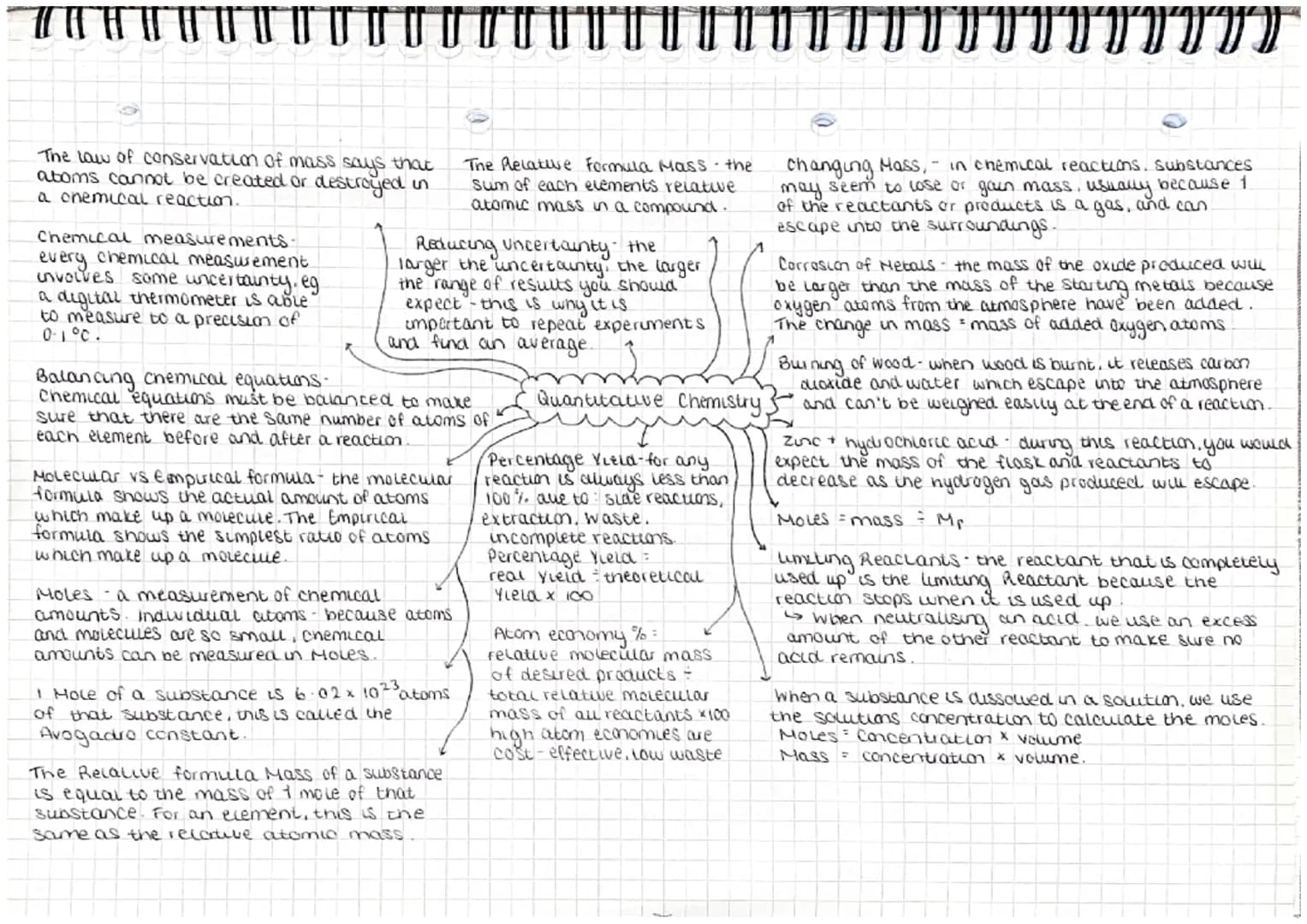
Ever wondered why chemists are obsessed with balancing equations and measuring everything so precisely? It all starts with the law of conservation of mass - atoms can't just vanish or appear from nowhere during reactions, which means you'll always have the same number of each type of atom before and after.
When you're doing chemical calculations, remember that every measurement has uncertainty. A digital thermometer might only be accurate to 0.1°C, so the bigger the uncertainty, the more you should repeat experiments and find averages to get reliable results.
The difference between molecular and empirical formulas is crucial for your exams. Molecular formula tells you the exact number of atoms in a molecule, whilst empirical formula shows the simplest ratio - think of it as the recipe in its most basic form.
Moles are chemistry's way of counting tiny particles. Since atoms are impossibly small, we group them into moles - and one mole always contains 6.02 × 10²³ particles (that's Avogadro's constant). The relative formula mass equals the mass of one mole, making calculations much more manageable.
Key Insight: When reactions seem to gain or lose mass (like burning wood or rusting metal), it's usually because gases are escaping or oxygen from the air is joining the party - the atoms are still conserved, just in different places!
Understanding limiting reactants helps explain why reactions stop before everything's used up. The reactant that runs out first stops the whole show, just like running out of bread when making sandwiches. Use the formula Moles = mass ÷ Mr or Moles = concentration × volume depending on whether you're dealing with solids or solutions.


 Chemistry
 English Literature
 Sociology
 Biology