
Ever wondered why your baking ingredients weigh the same before... Show more
Sign up to see the contentIt's free!
Access to all documents
Improve your grades
Join milions of students
By signing up you accept Terms of Service and Privacy Policy
Subjects

Maths

Chemistry

Biology

English Language

History
Responding to change (a2 only)
Infection and response
Homeostasis and response
Energy transfers (a2 only)
Cell biology
Organisms respond to changes in their internal and external environments (a-level only)
Biological molecules
Organisation
Substance exchange
Bioenergetics
Genetic information & variation
Inheritance, variation and evolution
Genetics & ecosystems (a2 only)
Ecology
Cells
Show all topics
1l the quest for political stability: germany, 1871-1991
Britain & the wider world: 1745 -1901
The cold war
Inter-war germany
Medieval period: 1066 -1509
2d religious conflict and the church in england, c1529-c1570
2o democracy and nazism: germany, 1918-1945
1f industrialisation and the people: britain, c1783-1885
1c the tudors: england, 1485-1603
2m wars and welfare: britain in transition, 1906-1957
World war two & the holocaust
2n revolution and dictatorship: russia, 1917-1953
2s the making of modern britain, 1951-2007
World war one
Britain: 1509 -1745
Show all topics
765
•
23 Nov 2025
•

Stefany
@stef_mvp
Ever wondered why your baking ingredients weigh the same before... Show more
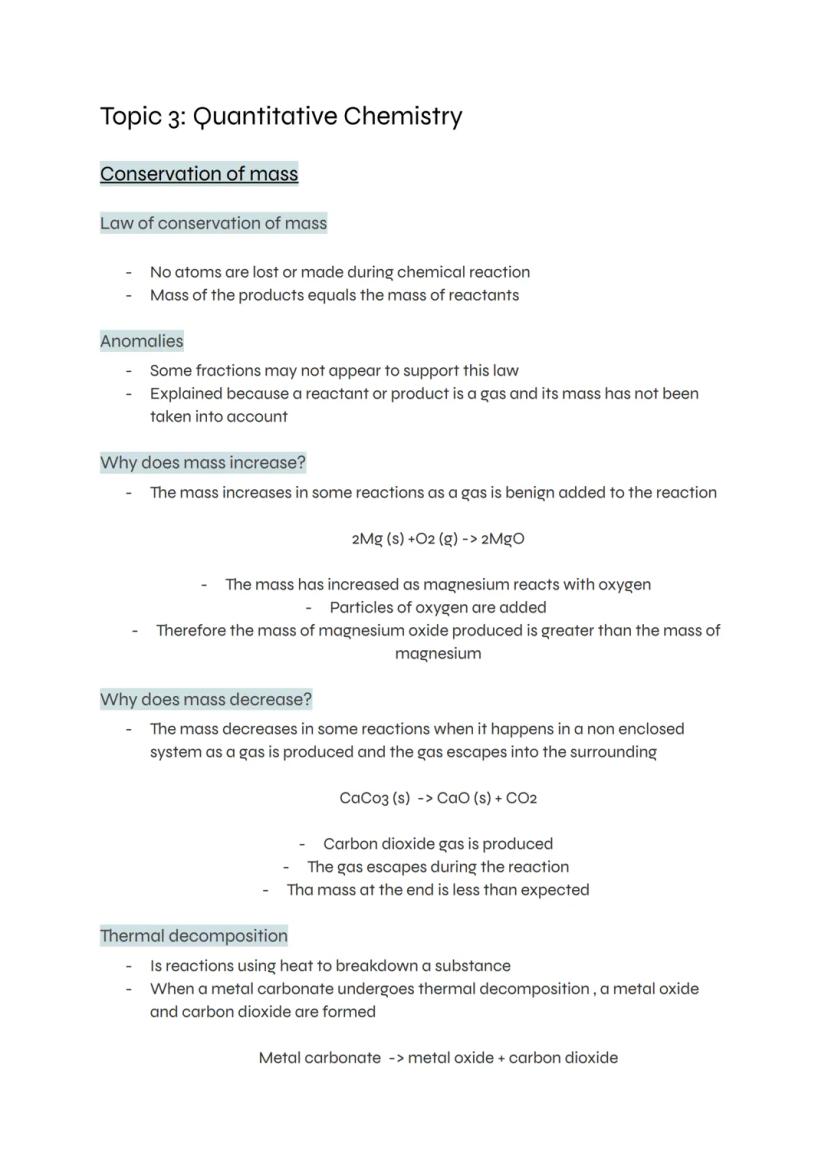

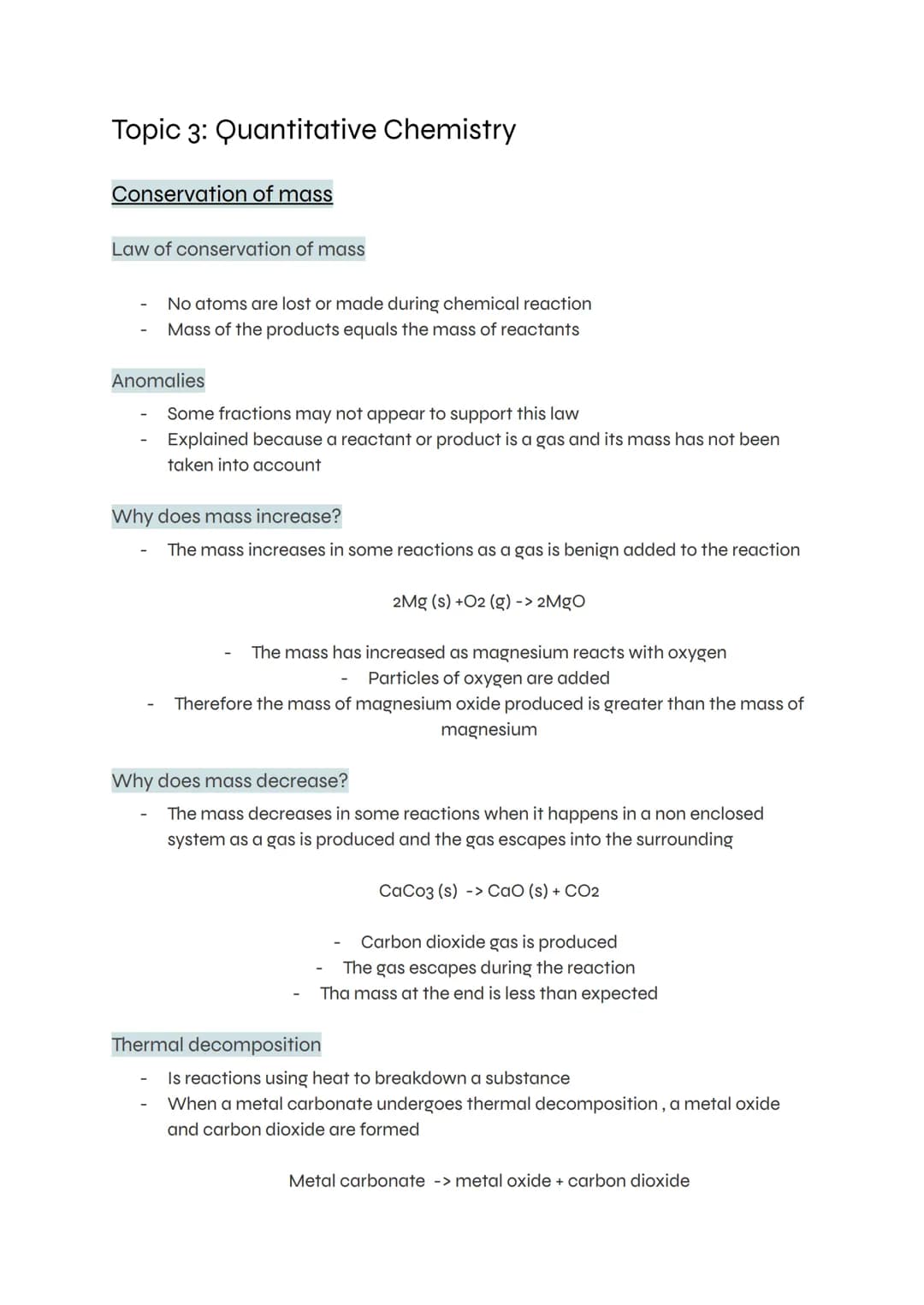
Here's a fundamental rule that never breaks: no atoms are lost or made during chemical reactions. This means the mass of your starting materials (reactants) always equals the mass of what you end up with (products).
But sometimes your scales might suggest otherwise! If mass appears to increase, it's because a gas is joining the reaction - like when magnesium burns and oxygen from the air gets added to form magnesium oxide. If mass seems to decrease, it's because a gas escapes - think of heating limestone where carbon dioxide gas floats away, leaving you with less solid material.
Thermal decomposition is simply using heat to break substances apart. When you heat metal carbonates (like limestone), they always split into a metal oxide and carbon dioxide gas - a pattern that's dead useful for predicting reaction products.
Quick Check: If your experiment shows unexpected mass changes, ask yourself: "What gas might be entering or leaving this reaction?"
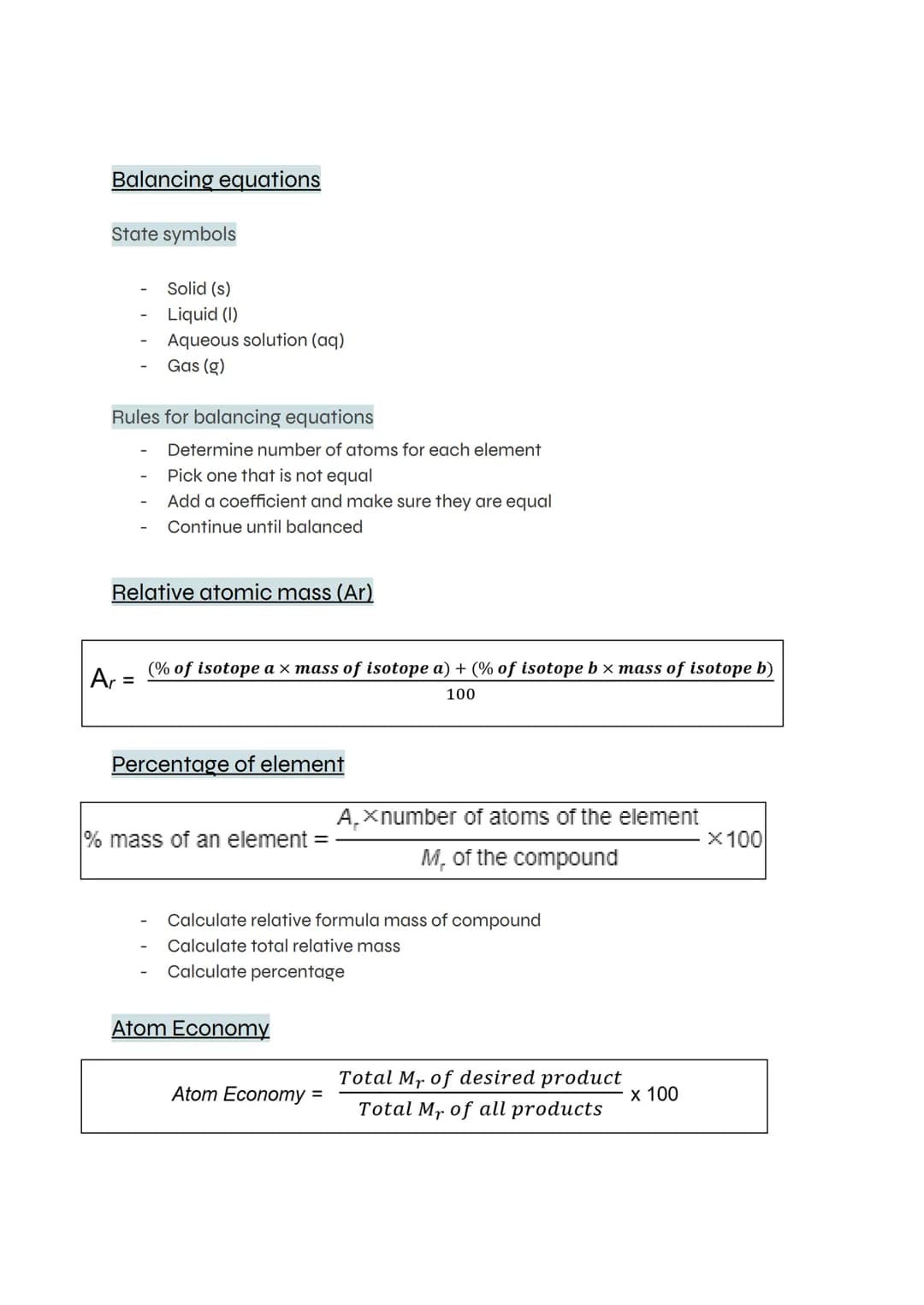
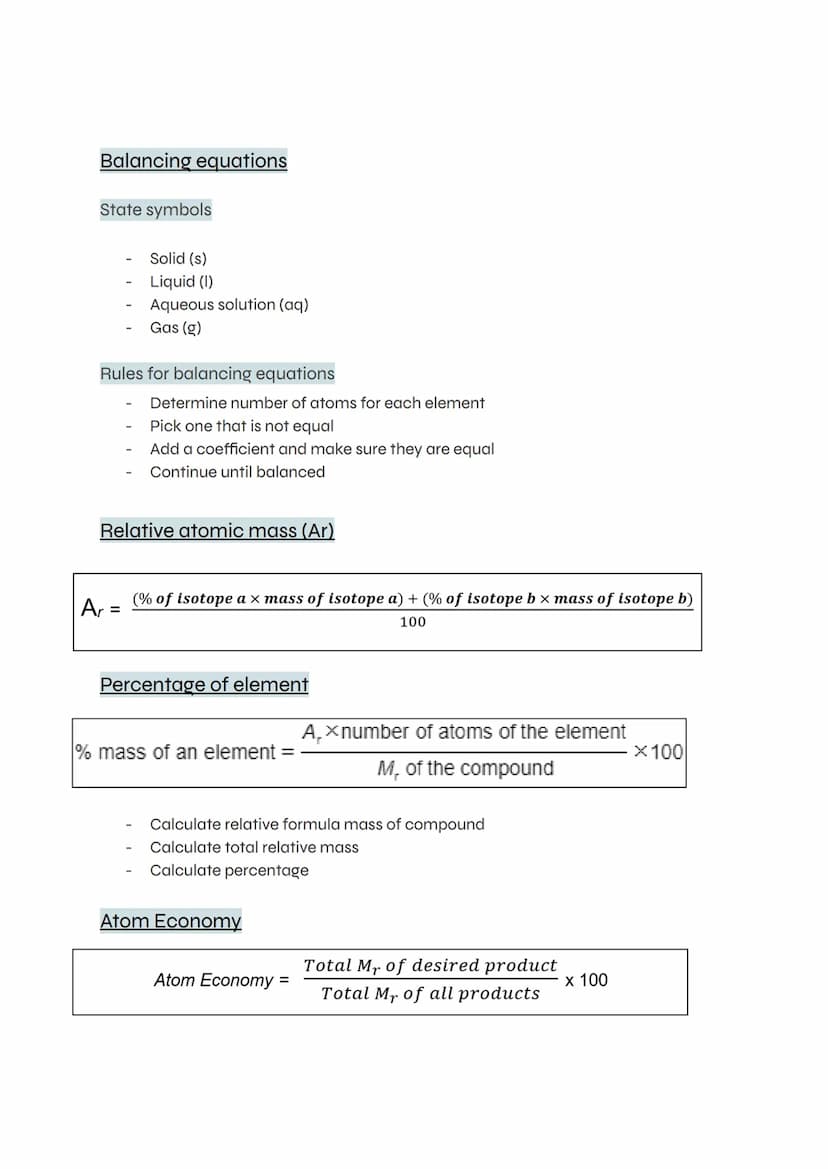
Balancing chemical equations is like solving a puzzle - you need equal numbers of each type of atom on both sides. Start by counting atoms of each element, pick the most unbalanced one, and add coefficients (the numbers in front) until everything matches up.
State symbols tell you the physical form: (s) for solid, (l) for liquid, (g) for gas, and (aq) for dissolved in water. These matter because they explain why mass might seem to change in reactions.
Relative atomic mass calculations help you find average atomic masses when isotopes are involved. The formula weighs each isotope by how common it is. Meanwhile, percentage composition tells you how much of each element is in a compound - divide the element's total mass by the compound's total mass, then multiply by 100.
Atom economy measures how wasteful a reaction is. If you only get one product, you've achieved 100% atom economy - everything you started with becomes useful product.
Pro Tip: Always write state symbols in equations - they're often the key to explaining unexpected results!
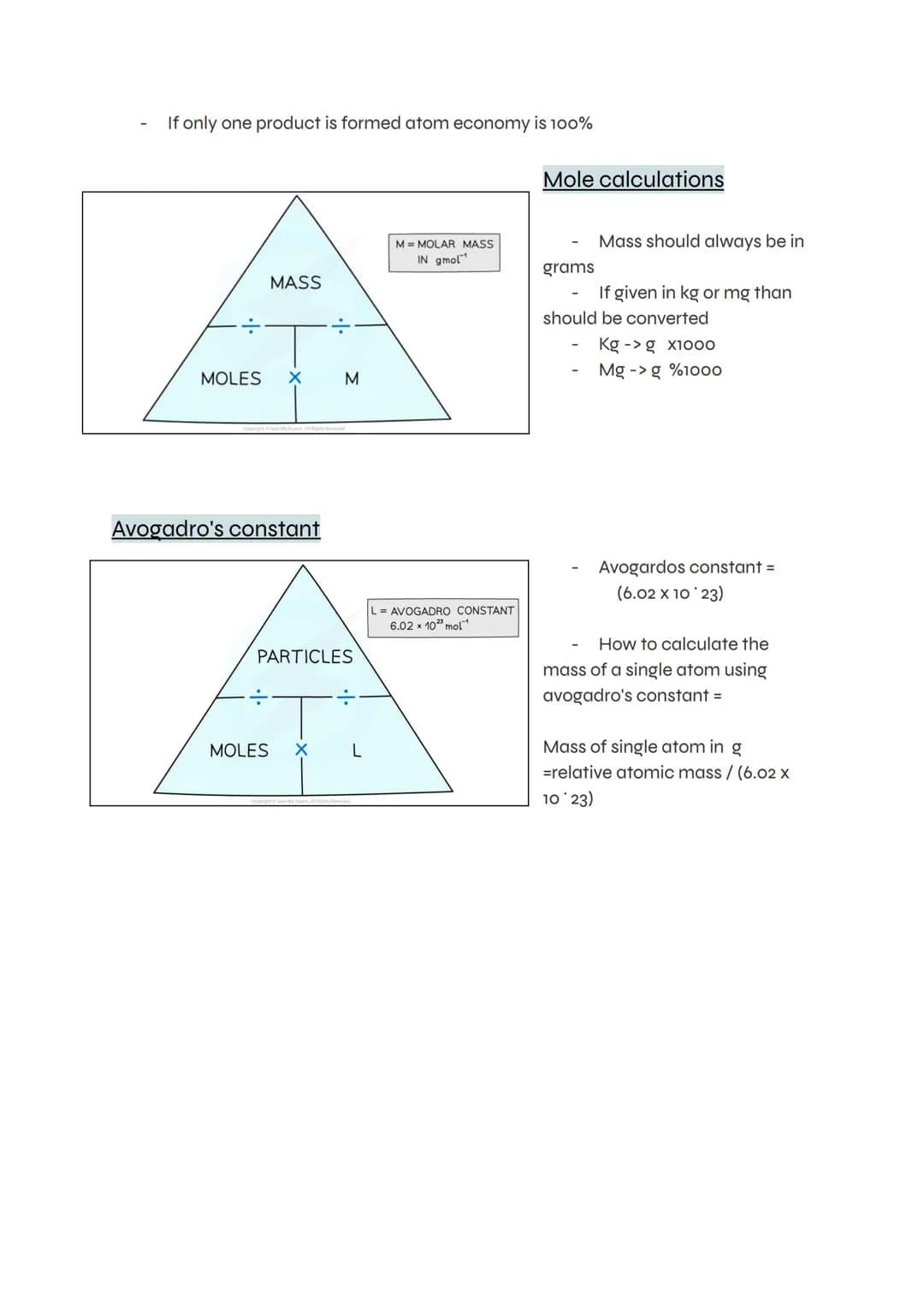
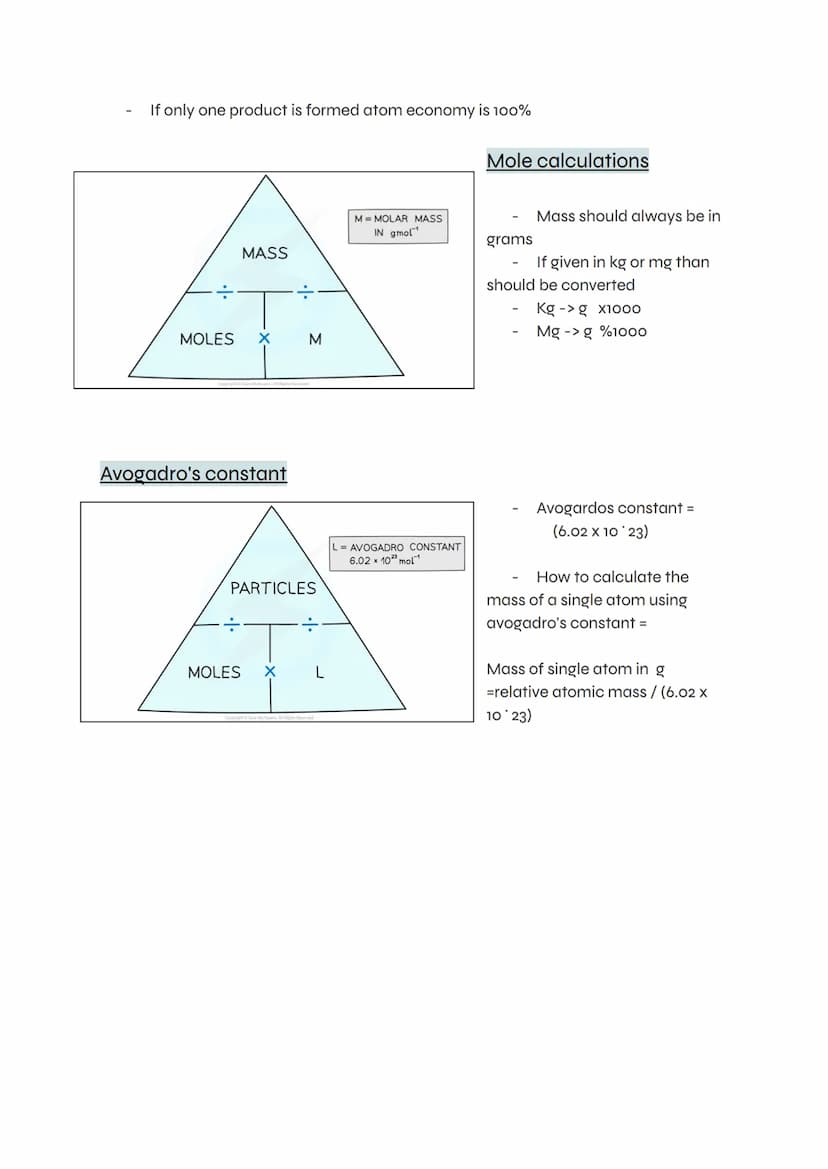
The mole is chemistry's way of counting particles - it's like saying "a dozen" but for atoms and molecules. One mole contains exactly 6.02 × 10²³ particles, which is Avogadro's constant.
Getting your units right is crucial. Always work in grams for mass calculations. If you're given kilograms, multiply by 1000 to convert to grams. If you've got milligrams, divide by 1000.
You can calculate the mass of a single atom by dividing the relative atomic mass by Avogadro's constant. This gives you the tiny mass of just one atom in grams - a mind-bogglingly small number that shows just how light individual atoms really are.
Think of moles as chemistry's universal translator - they let you convert between the number of particles, mass, and volume of gases. Once you master moles, quantitative chemistry becomes much more straightforward.
Memory Hook: Remember "MAV" - Mass, Amount (moles), Volume. These three quantities are connected in most chemistry calculations!
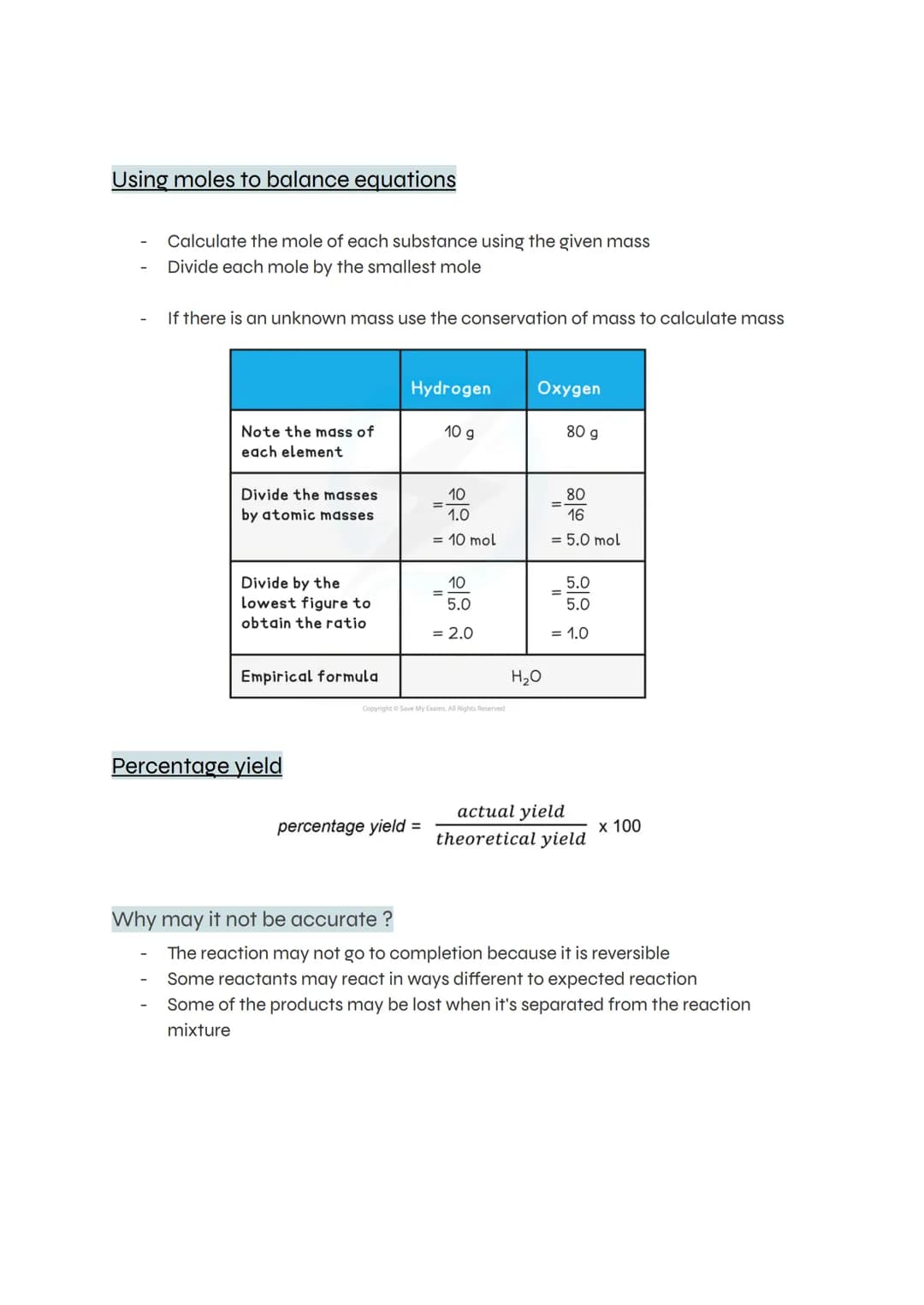
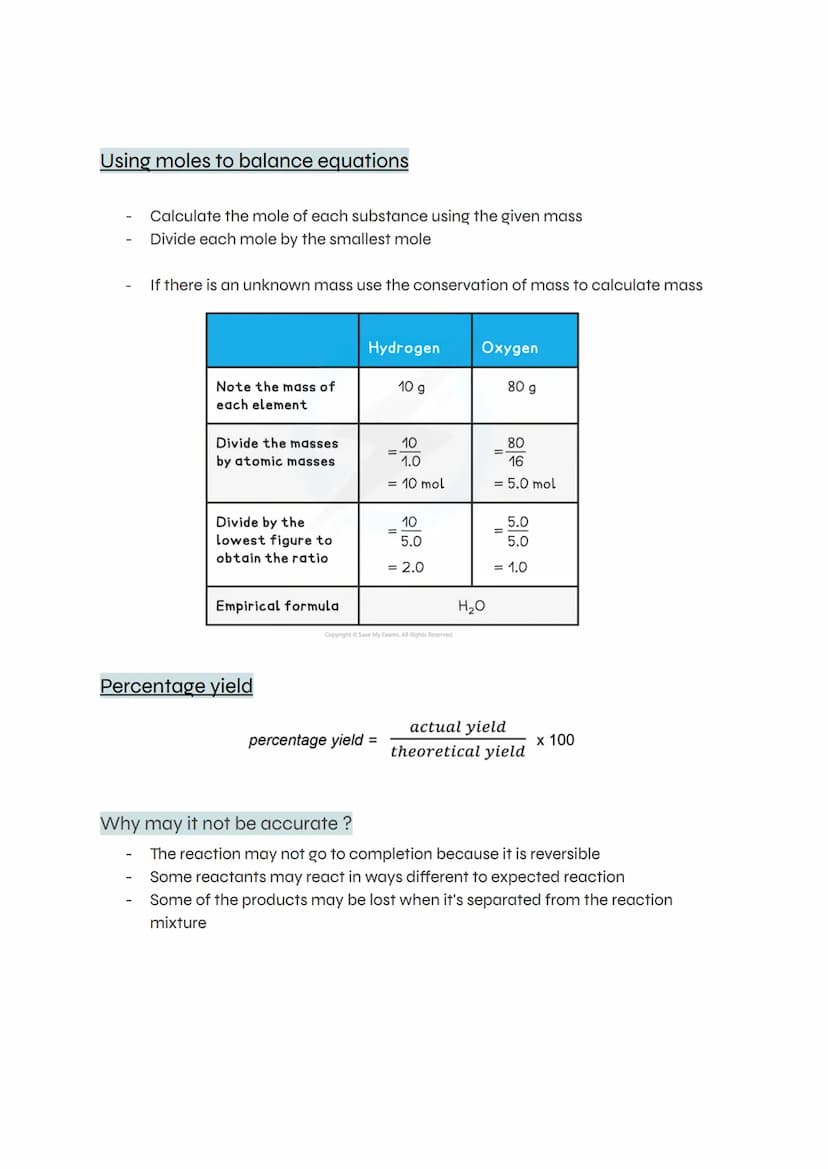
Finding empirical formulas from experimental data follows a clear pattern. Take the mass of each element, divide by their atomic masses to get moles, then divide all results by the smallest number to find the simplest whole number ratio.
Percentage yield compares what you actually got in an experiment to what the theory predicted you should get. Real reactions rarely give 100% yield because they're messy - some reaction mixture gets lost, side reactions occur, or the main reaction doesn't go to completion.
Understanding why yields aren't perfect helps you improve experimental technique. Reversible reactions can't reach completion because products keep turning back into reactants. Some chemicals might react in unexpected ways, creating unwanted products instead.
When you're separating your desired product from the reaction mixture, some inevitably gets left behind. This is why industrial chemists spend so much time optimising separation techniques - every percentage point of yield recovered saves money.
Reality Check: If someone claims 100% yield in a complex reaction, be suspicious - real chemistry is rarely that perfect!
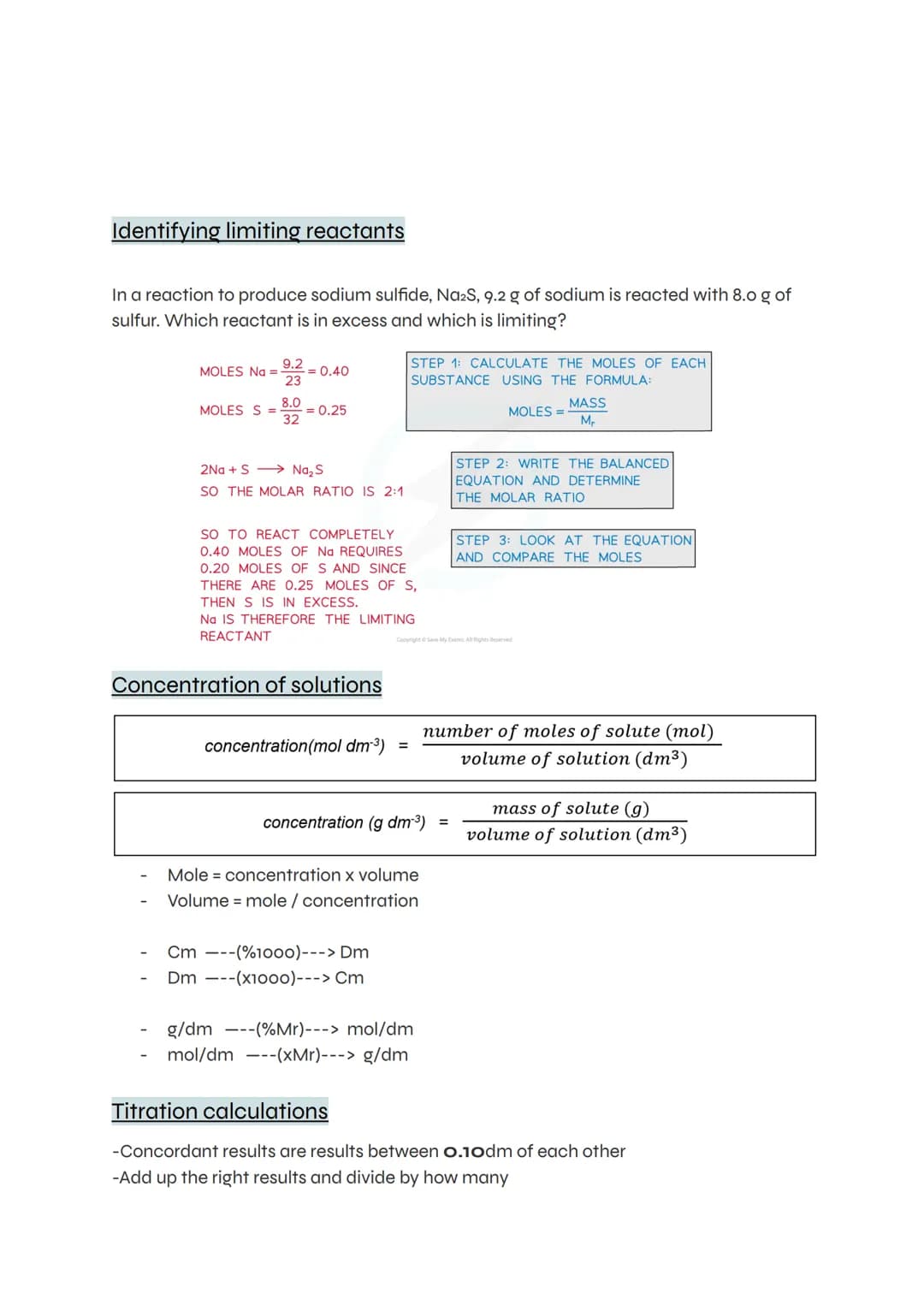
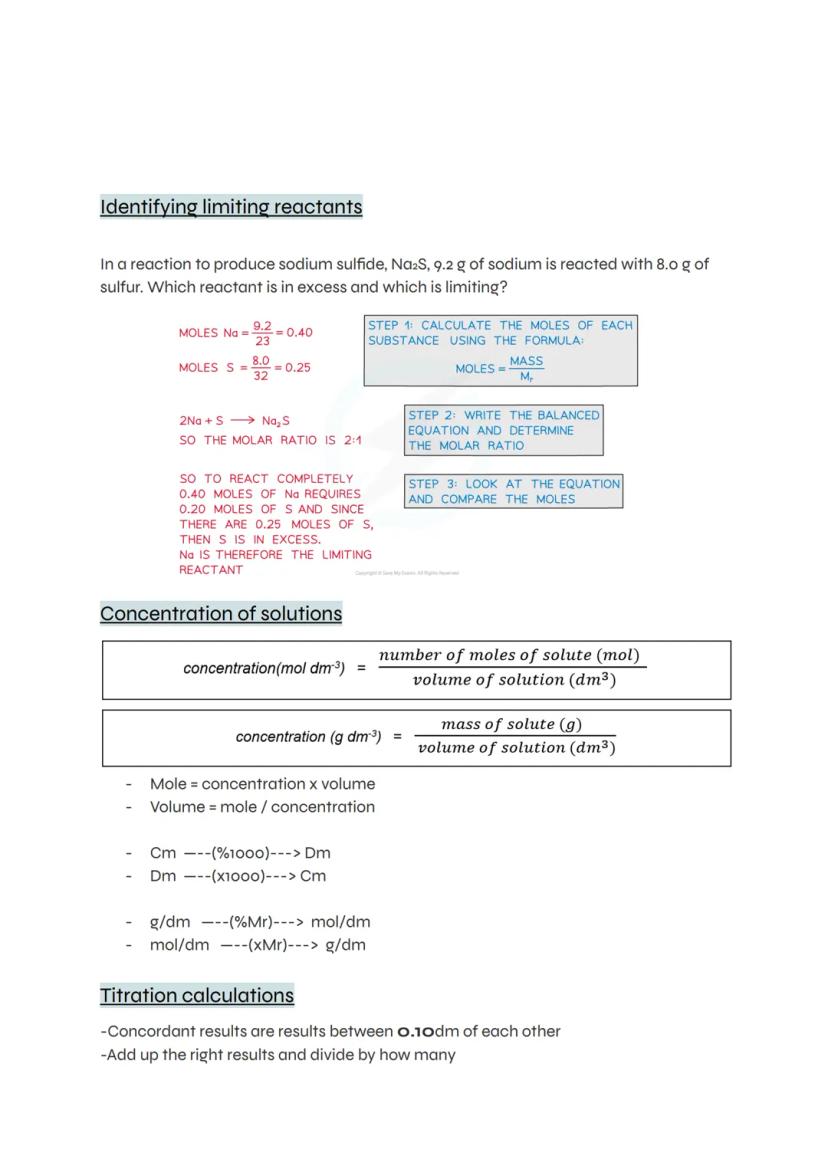
Limiting reactants control how much product you can make - like having 10 burger buns but only 8 patties means you can only make 8 burgers. Calculate moles of each reactant, check the balanced equation's ratio, and see which runs out first.
The step-by-step method is foolproof: calculate moles, write the balanced equation to find molar ratios, then compare what you have with what you need. Whichever reactant you don't have enough of becomes your limiting factor.
Concentration can be expressed in mol/dm³ or g/dm³. The triangle method works brilliantly here - concentration equals moles divided by volume, with easy rearrangements for finding missing values.
Titration calculations rely on concordant results - readings within 0.10 cm³ of each other. Average these reliable results and ignore any obvious outliers that suggest experimental errors.
Lab Tip: Always identify your limiting reactant before predicting how much product you'll make - it's the chemical equivalent of checking you've got enough ingredients before cooking!
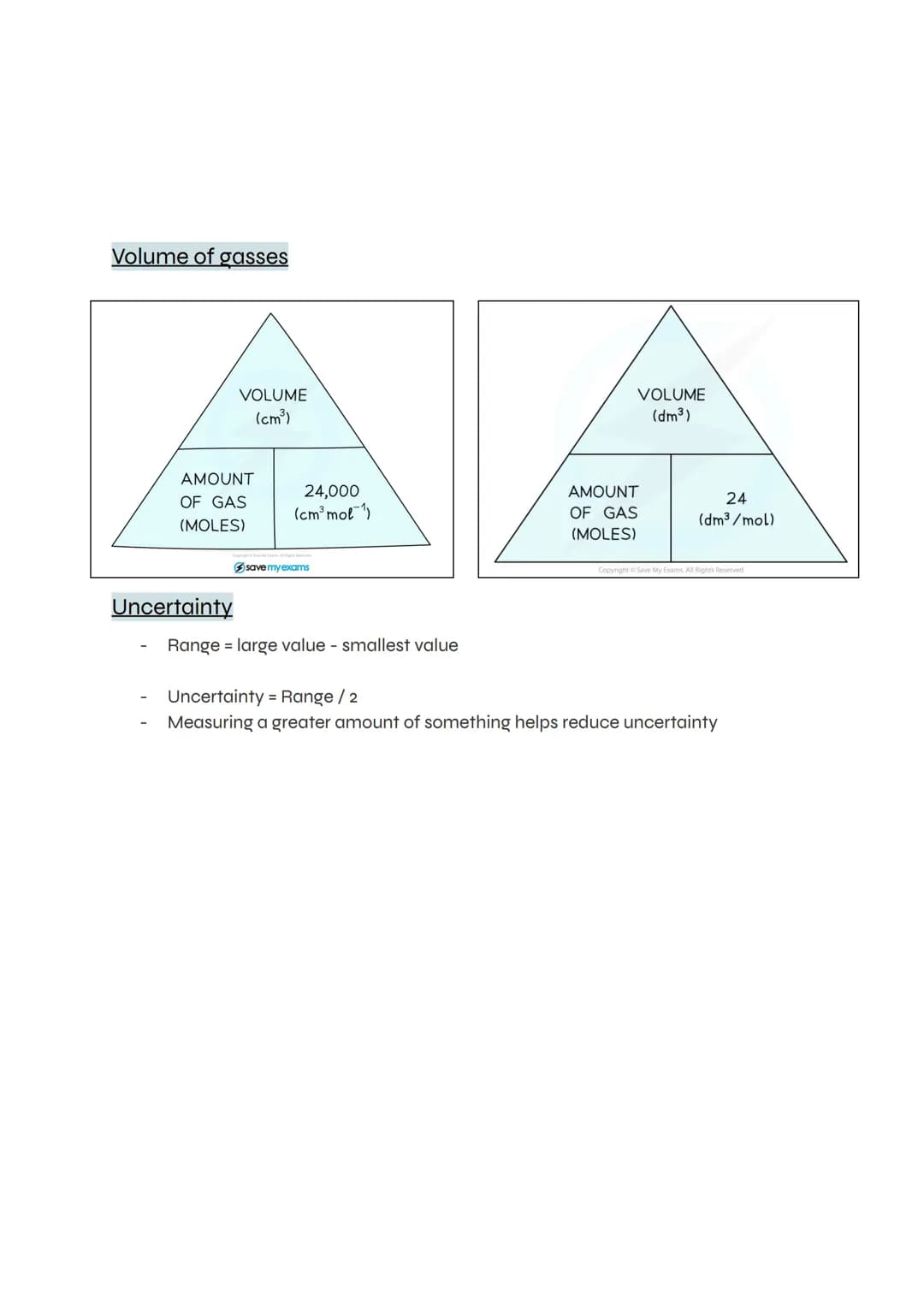
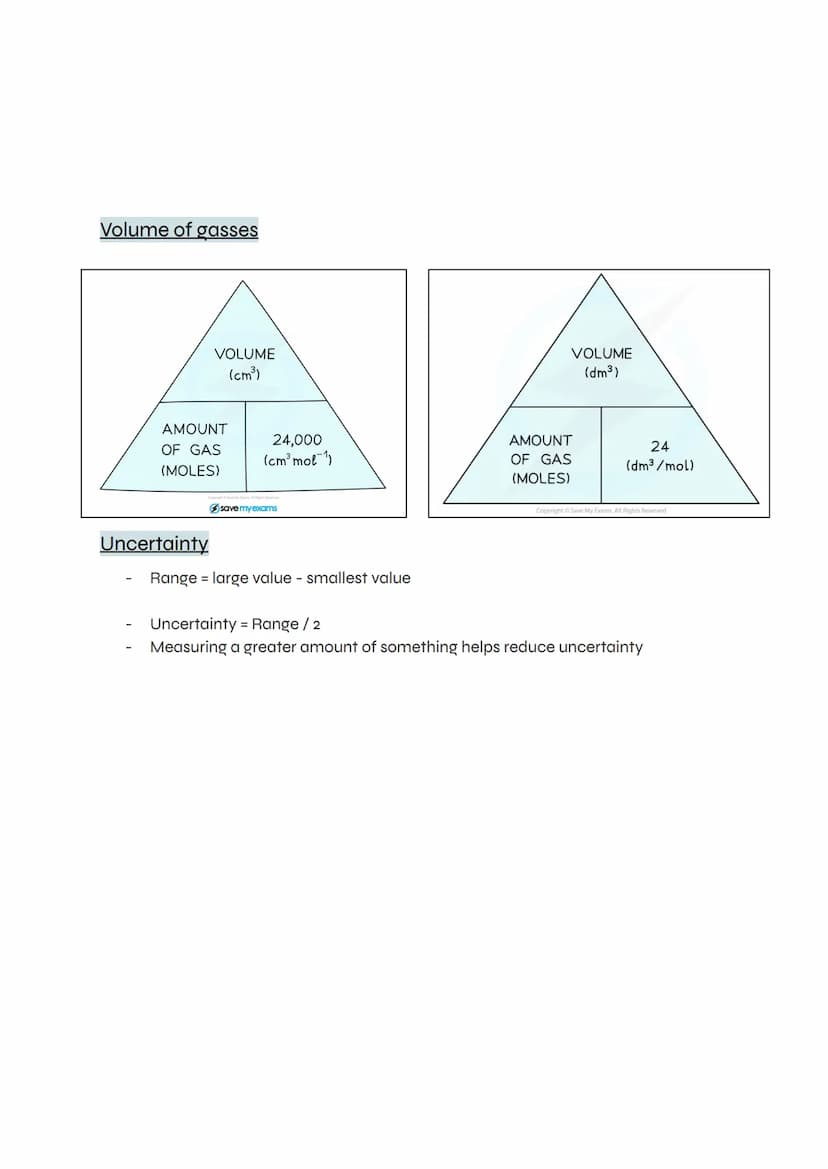
Gas volumes follow predictable patterns at room temperature and pressure. One mole of any gas occupies 24 dm³ (or 24,000 cm³). This makes gas calculations surprisingly straightforward once you remember the conversion factors.
Whether you're working in dm³ or cm³ depends on your data, but the principle stays the same. The neat thing about gases is that volume directly relates to moles - double the moles, double the volume.
Uncertainty in measurements affects all experimental work. Calculate it by finding the range (biggest value minus smallest value) and dividing by 2. The more you measure, the smaller your percentage uncertainty becomes.
Reducing uncertainty improves data quality. Using larger quantities, more precise equipment, or taking multiple readings all help. Understanding uncertainty helps you evaluate whether differences between results are meaningful or just experimental noise.
Practical Point: When measuring gases, small uncertainties in volume can lead to big errors in calculated moles - always consider your experimental limitations!

Our AI Companion is a student-focused AI tool that offers more than just answers. Built on millions of Knowunity resources, it provides relevant information, personalised study plans, quizzes, and content directly in the chat, adapting to your individual learning journey.
You can download the app from Google Play Store and Apple App Store.
That's right! Enjoy free access to study content, connect with fellow students, and get instant help – all at your fingertips.
App Store
Google Play
The app is very easy to use and well designed. I have found everything I was looking for so far and have been able to learn a lot from the presentations! I will definitely use the app for a class assignment! And of course it also helps a lot as an inspiration.
Stefan S
iOS user
This app is really great. There are so many study notes and help [...]. My problem subject is French, for example, and the app has so many options for help. Thanks to this app, I have improved my French. I would recommend it to anyone.
Samantha Klich
Android user
Wow, I am really amazed. I just tried the app because I've seen it advertised many times and was absolutely stunned. This app is THE HELP you want for school and above all, it offers so many things, such as workouts and fact sheets, which have been VERY helpful to me personally.
Anna
iOS user
Best app on earth! no words because it’s too good
Thomas R
iOS user
Just amazing. Let's me revise 10x better, this app is a quick 10/10. I highly recommend it to anyone. I can watch and search for notes. I can save them in the subject folder. I can revise it any time when I come back. If you haven't tried this app, you're really missing out.
Basil
Android user
This app has made me feel so much more confident in my exam prep, not only through boosting my own self confidence through the features that allow you to connect with others and feel less alone, but also through the way the app itself is centred around making you feel better. It is easy to navigate, fun to use, and helpful to anyone struggling in absolutely any way.
David K
iOS user
The app's just great! All I have to do is enter the topic in the search bar and I get the response real fast. I don't have to watch 10 YouTube videos to understand something, so I'm saving my time. Highly recommended!
Sudenaz Ocak
Android user
In school I was really bad at maths but thanks to the app, I am doing better now. I am so grateful that you made the app.
Greenlight Bonnie
Android user
very reliable app to help and grow your ideas of Maths, English and other related topics in your works. please use this app if your struggling in areas, this app is key for that. wish I'd of done a review before. and it's also free so don't worry about that.
Rohan U
Android user
I know a lot of apps use fake accounts to boost their reviews but this app deserves it all. Originally I was getting 4 in my English exams and this time I got a grade 7. I didn’t even know about this app three days until the exam and it has helped A LOT. Please actually trust me and use it as I’m sure you too will see developments.
Xander S
iOS user
THE QUIZES AND FLASHCARDS ARE SO USEFUL AND I LOVE THE SCHOOLGPT. IT ALSO IS LITREALLY LIKE CHATGPT BUT SMARTER!! HELPED ME WITH MY MASCARA PROBLEMS TOO!! AS WELL AS MY REAL SUBJECTS ! DUHHH 😍😁😲🤑💗✨🎀😮
Elisha
iOS user
This apps acc the goat. I find revision so boring but this app makes it so easy to organize it all and then you can ask the freeeee ai to test yourself so good and you can easily upload your own stuff. highly recommend as someone taking mocks now
Paul T
iOS user
The app is very easy to use and well designed. I have found everything I was looking for so far and have been able to learn a lot from the presentations! I will definitely use the app for a class assignment! And of course it also helps a lot as an inspiration.
Stefan S
iOS user
This app is really great. There are so many study notes and help [...]. My problem subject is French, for example, and the app has so many options for help. Thanks to this app, I have improved my French. I would recommend it to anyone.
Samantha Klich
Android user
Wow, I am really amazed. I just tried the app because I've seen it advertised many times and was absolutely stunned. This app is THE HELP you want for school and above all, it offers so many things, such as workouts and fact sheets, which have been VERY helpful to me personally.
Anna
iOS user
Best app on earth! no words because it’s too good
Thomas R
iOS user
Just amazing. Let's me revise 10x better, this app is a quick 10/10. I highly recommend it to anyone. I can watch and search for notes. I can save them in the subject folder. I can revise it any time when I come back. If you haven't tried this app, you're really missing out.
Basil
Android user
This app has made me feel so much more confident in my exam prep, not only through boosting my own self confidence through the features that allow you to connect with others and feel less alone, but also through the way the app itself is centred around making you feel better. It is easy to navigate, fun to use, and helpful to anyone struggling in absolutely any way.
David K
iOS user
The app's just great! All I have to do is enter the topic in the search bar and I get the response real fast. I don't have to watch 10 YouTube videos to understand something, so I'm saving my time. Highly recommended!
Sudenaz Ocak
Android user
In school I was really bad at maths but thanks to the app, I am doing better now. I am so grateful that you made the app.
Greenlight Bonnie
Android user
very reliable app to help and grow your ideas of Maths, English and other related topics in your works. please use this app if your struggling in areas, this app is key for that. wish I'd of done a review before. and it's also free so don't worry about that.
Rohan U
Android user
I know a lot of apps use fake accounts to boost their reviews but this app deserves it all. Originally I was getting 4 in my English exams and this time I got a grade 7. I didn’t even know about this app three days until the exam and it has helped A LOT. Please actually trust me and use it as I’m sure you too will see developments.
Xander S
iOS user
THE QUIZES AND FLASHCARDS ARE SO USEFUL AND I LOVE THE SCHOOLGPT. IT ALSO IS LITREALLY LIKE CHATGPT BUT SMARTER!! HELPED ME WITH MY MASCARA PROBLEMS TOO!! AS WELL AS MY REAL SUBJECTS ! DUHHH 😍😁😲🤑💗✨🎀😮
Elisha
iOS user
This apps acc the goat. I find revision so boring but this app makes it so easy to organize it all and then you can ask the freeeee ai to test yourself so good and you can easily upload your own stuff. highly recommend as someone taking mocks now
Paul T
iOS user
Stefany
@stef_mvp
Ever wondered why your baking ingredients weigh the same before and after mixing, or why a rusty nail weighs more than the original iron? Quantitative chemistry explains these everyday mysteries through the law of conservation of mass and teaches you... Show more
Access to all documents
Improve your grades
Join milions of students
By signing up you accept Terms of Service and Privacy Policy
Here's a fundamental rule that never breaks: no atoms are lost or made during chemical reactions. This means the mass of your starting materials (reactants) always equals the mass of what you end up with (products).
But sometimes your scales might suggest otherwise! If mass appears to increase, it's because a gas is joining the reaction - like when magnesium burns and oxygen from the air gets added to form magnesium oxide. If mass seems to decrease, it's because a gas escapes - think of heating limestone where carbon dioxide gas floats away, leaving you with less solid material.
Thermal decomposition is simply using heat to break substances apart. When you heat metal carbonates (like limestone), they always split into a metal oxide and carbon dioxide gas - a pattern that's dead useful for predicting reaction products.
Quick Check: If your experiment shows unexpected mass changes, ask yourself: "What gas might be entering or leaving this reaction?"
Access to all documents
Improve your grades
Join milions of students
By signing up you accept Terms of Service and Privacy Policy
Balancing chemical equations is like solving a puzzle - you need equal numbers of each type of atom on both sides. Start by counting atoms of each element, pick the most unbalanced one, and add coefficients (the numbers in front) until everything matches up.
State symbols tell you the physical form: (s) for solid, (l) for liquid, (g) for gas, and (aq) for dissolved in water. These matter because they explain why mass might seem to change in reactions.
Relative atomic mass calculations help you find average atomic masses when isotopes are involved. The formula weighs each isotope by how common it is. Meanwhile, percentage composition tells you how much of each element is in a compound - divide the element's total mass by the compound's total mass, then multiply by 100.
Atom economy measures how wasteful a reaction is. If you only get one product, you've achieved 100% atom economy - everything you started with becomes useful product.
Pro Tip: Always write state symbols in equations - they're often the key to explaining unexpected results!
Access to all documents
Improve your grades
Join milions of students
By signing up you accept Terms of Service and Privacy Policy
The mole is chemistry's way of counting particles - it's like saying "a dozen" but for atoms and molecules. One mole contains exactly 6.02 × 10²³ particles, which is Avogadro's constant.
Getting your units right is crucial. Always work in grams for mass calculations. If you're given kilograms, multiply by 1000 to convert to grams. If you've got milligrams, divide by 1000.
You can calculate the mass of a single atom by dividing the relative atomic mass by Avogadro's constant. This gives you the tiny mass of just one atom in grams - a mind-bogglingly small number that shows just how light individual atoms really are.
Think of moles as chemistry's universal translator - they let you convert between the number of particles, mass, and volume of gases. Once you master moles, quantitative chemistry becomes much more straightforward.
Memory Hook: Remember "MAV" - Mass, Amount (moles), Volume. These three quantities are connected in most chemistry calculations!
Access to all documents
Improve your grades
Join milions of students
By signing up you accept Terms of Service and Privacy Policy
Finding empirical formulas from experimental data follows a clear pattern. Take the mass of each element, divide by their atomic masses to get moles, then divide all results by the smallest number to find the simplest whole number ratio.
Percentage yield compares what you actually got in an experiment to what the theory predicted you should get. Real reactions rarely give 100% yield because they're messy - some reaction mixture gets lost, side reactions occur, or the main reaction doesn't go to completion.
Understanding why yields aren't perfect helps you improve experimental technique. Reversible reactions can't reach completion because products keep turning back into reactants. Some chemicals might react in unexpected ways, creating unwanted products instead.
When you're separating your desired product from the reaction mixture, some inevitably gets left behind. This is why industrial chemists spend so much time optimising separation techniques - every percentage point of yield recovered saves money.
Reality Check: If someone claims 100% yield in a complex reaction, be suspicious - real chemistry is rarely that perfect!
Access to all documents
Improve your grades
Join milions of students
By signing up you accept Terms of Service and Privacy Policy
Limiting reactants control how much product you can make - like having 10 burger buns but only 8 patties means you can only make 8 burgers. Calculate moles of each reactant, check the balanced equation's ratio, and see which runs out first.
The step-by-step method is foolproof: calculate moles, write the balanced equation to find molar ratios, then compare what you have with what you need. Whichever reactant you don't have enough of becomes your limiting factor.
Concentration can be expressed in mol/dm³ or g/dm³. The triangle method works brilliantly here - concentration equals moles divided by volume, with easy rearrangements for finding missing values.
Titration calculations rely on concordant results - readings within 0.10 cm³ of each other. Average these reliable results and ignore any obvious outliers that suggest experimental errors.
Lab Tip: Always identify your limiting reactant before predicting how much product you'll make - it's the chemical equivalent of checking you've got enough ingredients before cooking!
Access to all documents
Improve your grades
Join milions of students
By signing up you accept Terms of Service and Privacy Policy
Gas volumes follow predictable patterns at room temperature and pressure. One mole of any gas occupies 24 dm³ (or 24,000 cm³). This makes gas calculations surprisingly straightforward once you remember the conversion factors.
Whether you're working in dm³ or cm³ depends on your data, but the principle stays the same. The neat thing about gases is that volume directly relates to moles - double the moles, double the volume.
Uncertainty in measurements affects all experimental work. Calculate it by finding the range (biggest value minus smallest value) and dividing by 2. The more you measure, the smaller your percentage uncertainty becomes.
Reducing uncertainty improves data quality. Using larger quantities, more precise equipment, or taking multiple readings all help. Understanding uncertainty helps you evaluate whether differences between results are meaningful or just experimental noise.
Practical Point: When measuring gases, small uncertainties in volume can lead to big errors in calculated moles - always consider your experimental limitations!
Access to all documents
Improve your grades
Join milions of students
By signing up you accept Terms of Service and Privacy Policy
Our AI Companion is a student-focused AI tool that offers more than just answers. Built on millions of Knowunity resources, it provides relevant information, personalised study plans, quizzes, and content directly in the chat, adapting to your individual learning journey.
You can download the app from Google Play Store and Apple App Store.
That's right! Enjoy free access to study content, connect with fellow students, and get instant help – all at your fingertips.
17
Smart Tools NEW
Transform this note into: ✓ 50+ Practice Questions ✓ Interactive Flashcards ✓ Full Mock Exam ✓ Essay Outlines
Explore a detailed compilation of key concepts across Biology, Chemistry, and Physics for the GCSE curriculum. This resource covers essential topics, including atomic structure, ecosystems, chemical reactions, and more, providing students with a thorough understanding to excel in their studies. Ideal for revision and exam preparation.
BiologyExplore the fundamentals of balancing chemical equations and understanding moles in this concise study resource. Key topics include the law of conservation of mass, relative formula mass (RFM), and stoichiometry. Ideal for students looking to master quantitative chemistry concepts and improve their problem-solving skills in chemical reactions.
ChemistryExplore key concepts in Quantitative Chemistry, including moles, limiting reactants, atom economy, and percentage yield. This summary covers essential calculations, definitions, and principles crucial for mastering GCSE AQA Higher Triple Chemistry. Ideal for exam preparation and active recall.
ChemistryExplore key concepts of balancing chemical equations and understanding combustion reactions in this concise revision resource for Year 8/9 Combined Science. Ideal for mastering the fundamentals of chemical reactions and their applications.
ChemistryExplore essential principles of quantitative chemistry, including atom economy, percentage yield, and mole calculations. This summary covers key equations and definitions relevant for GCSE AQA Chemistry, helping you understand concepts like limiting and excess reactants, concentration, and relative atomic mass.
ChemistryExplore key concepts in quantitative chemistry, including limiting reactants, conservation of mass, mole calculations, and percentage yield. This summary covers essential formulas and examples to help you understand stoichiometry and improve your exam performance. Ideal for GCSE AQA students.
ChemistryApp Store
Google Play
The app is very easy to use and well designed. I have found everything I was looking for so far and have been able to learn a lot from the presentations! I will definitely use the app for a class assignment! And of course it also helps a lot as an inspiration.
Stefan S
iOS user
This app is really great. There are so many study notes and help [...]. My problem subject is French, for example, and the app has so many options for help. Thanks to this app, I have improved my French. I would recommend it to anyone.
Samantha Klich
Android user
Wow, I am really amazed. I just tried the app because I've seen it advertised many times and was absolutely stunned. This app is THE HELP you want for school and above all, it offers so many things, such as workouts and fact sheets, which have been VERY helpful to me personally.
Anna
iOS user
Best app on earth! no words because it’s too good
Thomas R
iOS user
Just amazing. Let's me revise 10x better, this app is a quick 10/10. I highly recommend it to anyone. I can watch and search for notes. I can save them in the subject folder. I can revise it any time when I come back. If you haven't tried this app, you're really missing out.
Basil
Android user
This app has made me feel so much more confident in my exam prep, not only through boosting my own self confidence through the features that allow you to connect with others and feel less alone, but also through the way the app itself is centred around making you feel better. It is easy to navigate, fun to use, and helpful to anyone struggling in absolutely any way.
David K
iOS user
The app's just great! All I have to do is enter the topic in the search bar and I get the response real fast. I don't have to watch 10 YouTube videos to understand something, so I'm saving my time. Highly recommended!
Sudenaz Ocak
Android user
In school I was really bad at maths but thanks to the app, I am doing better now. I am so grateful that you made the app.
Greenlight Bonnie
Android user
very reliable app to help and grow your ideas of Maths, English and other related topics in your works. please use this app if your struggling in areas, this app is key for that. wish I'd of done a review before. and it's also free so don't worry about that.
Rohan U
Android user
I know a lot of apps use fake accounts to boost their reviews but this app deserves it all. Originally I was getting 4 in my English exams and this time I got a grade 7. I didn’t even know about this app three days until the exam and it has helped A LOT. Please actually trust me and use it as I’m sure you too will see developments.
Xander S
iOS user
THE QUIZES AND FLASHCARDS ARE SO USEFUL AND I LOVE THE SCHOOLGPT. IT ALSO IS LITREALLY LIKE CHATGPT BUT SMARTER!! HELPED ME WITH MY MASCARA PROBLEMS TOO!! AS WELL AS MY REAL SUBJECTS ! DUHHH 😍😁😲🤑💗✨🎀😮
Elisha
iOS user
This apps acc the goat. I find revision so boring but this app makes it so easy to organize it all and then you can ask the freeeee ai to test yourself so good and you can easily upload your own stuff. highly recommend as someone taking mocks now
Paul T
iOS user
The app is very easy to use and well designed. I have found everything I was looking for so far and have been able to learn a lot from the presentations! I will definitely use the app for a class assignment! And of course it also helps a lot as an inspiration.
Stefan S
iOS user
This app is really great. There are so many study notes and help [...]. My problem subject is French, for example, and the app has so many options for help. Thanks to this app, I have improved my French. I would recommend it to anyone.
Samantha Klich
Android user
Wow, I am really amazed. I just tried the app because I've seen it advertised many times and was absolutely stunned. This app is THE HELP you want for school and above all, it offers so many things, such as workouts and fact sheets, which have been VERY helpful to me personally.
Anna
iOS user
Best app on earth! no words because it’s too good
Thomas R
iOS user
Just amazing. Let's me revise 10x better, this app is a quick 10/10. I highly recommend it to anyone. I can watch and search for notes. I can save them in the subject folder. I can revise it any time when I come back. If you haven't tried this app, you're really missing out.
Basil
Android user
This app has made me feel so much more confident in my exam prep, not only through boosting my own self confidence through the features that allow you to connect with others and feel less alone, but also through the way the app itself is centred around making you feel better. It is easy to navigate, fun to use, and helpful to anyone struggling in absolutely any way.
David K
iOS user
The app's just great! All I have to do is enter the topic in the search bar and I get the response real fast. I don't have to watch 10 YouTube videos to understand something, so I'm saving my time. Highly recommended!
Sudenaz Ocak
Android user
In school I was really bad at maths but thanks to the app, I am doing better now. I am so grateful that you made the app.
Greenlight Bonnie
Android user
very reliable app to help and grow your ideas of Maths, English and other related topics in your works. please use this app if your struggling in areas, this app is key for that. wish I'd of done a review before. and it's also free so don't worry about that.
Rohan U
Android user
I know a lot of apps use fake accounts to boost their reviews but this app deserves it all. Originally I was getting 4 in my English exams and this time I got a grade 7. I didn’t even know about this app three days until the exam and it has helped A LOT. Please actually trust me and use it as I’m sure you too will see developments.
Xander S
iOS user
THE QUIZES AND FLASHCARDS ARE SO USEFUL AND I LOVE THE SCHOOLGPT. IT ALSO IS LITREALLY LIKE CHATGPT BUT SMARTER!! HELPED ME WITH MY MASCARA PROBLEMS TOO!! AS WELL AS MY REAL SUBJECTS ! DUHHH 😍😁😲🤑💗✨🎀😮
Elisha
iOS user
This apps acc the goat. I find revision so boring but this app makes it so easy to organize it all and then you can ask the freeeee ai to test yourself so good and you can easily upload your own stuff. highly recommend as someone taking mocks now
Paul T
iOS user