
Metal reactions are key to understanding chemistry. This topic covers... Show more
 English Literature
 Sociology
 Biology
Sign up to see the contentIt's free!
Access to all documents
Improve your grades
Join milions of students
By signing up you accept Terms of Service and Privacy Policy
Subjects
Classic Dramatic Literature
Modern Lyric Poetry
Influential English-Language Authors
Classic and Contemporary Novels
Literary Character Analysis
Romantic and Love Poetry
Reading Analysis and Interpretation
Evidence Analysis and Integration
Author's Stylistic Elements
Figurative Language and Rhetoric
Show all topics
Human Organ Systems
Cellular Organization and Development
Biomolecular Structure and Organization
Enzyme Structure and Regulation
Cellular Organization Types
Biological Homeostatic Processes
Cellular Membrane Structure
Autotrophic Energy Processes
Environmental Sustainability and Impact
Neural Communication Systems
Show all topics
Social Sciences Research & Practice
Social Structure and Mobility
Classic Social Influence Experiments
Social Systems Theories
Family and Relationship Dynamics
Memory Systems and Processes
Neural Bases of Behavior
Social Influence and Attraction
Psychotherapeutic Approaches
Human Agency and Responsibility
Show all topics
Chemical Sciences and Applications
Chemical Bond Types and Properties
Organic Functional Groups
Atomic Structure and Composition
Chromatographic Separation Principles
Chemical Compound Classifications
Electrochemical Cell Systems
Periodic Table Organization
Chemical Reaction Kinetics
Chemical Equation Conservation
Show all topics
Nazi Germany and Holocaust 1933-1945
World Wars and Peace Treaties
European Monarchs and Statesmen
Cold War Global Tensions
Medieval Institutions and Systems
European Renaissance and Enlightenment
Modern Global Environmental-Health Challenges
Modern Military Conflicts
Medieval Migration and Invasions
World Wars Era and Impact
Show all topics
309
•
Updated 23 Feb 2026
•

Mayesha ☆
@mayeshatas07
Metal reactions are key to understanding chemistry. This topic covers... Show more

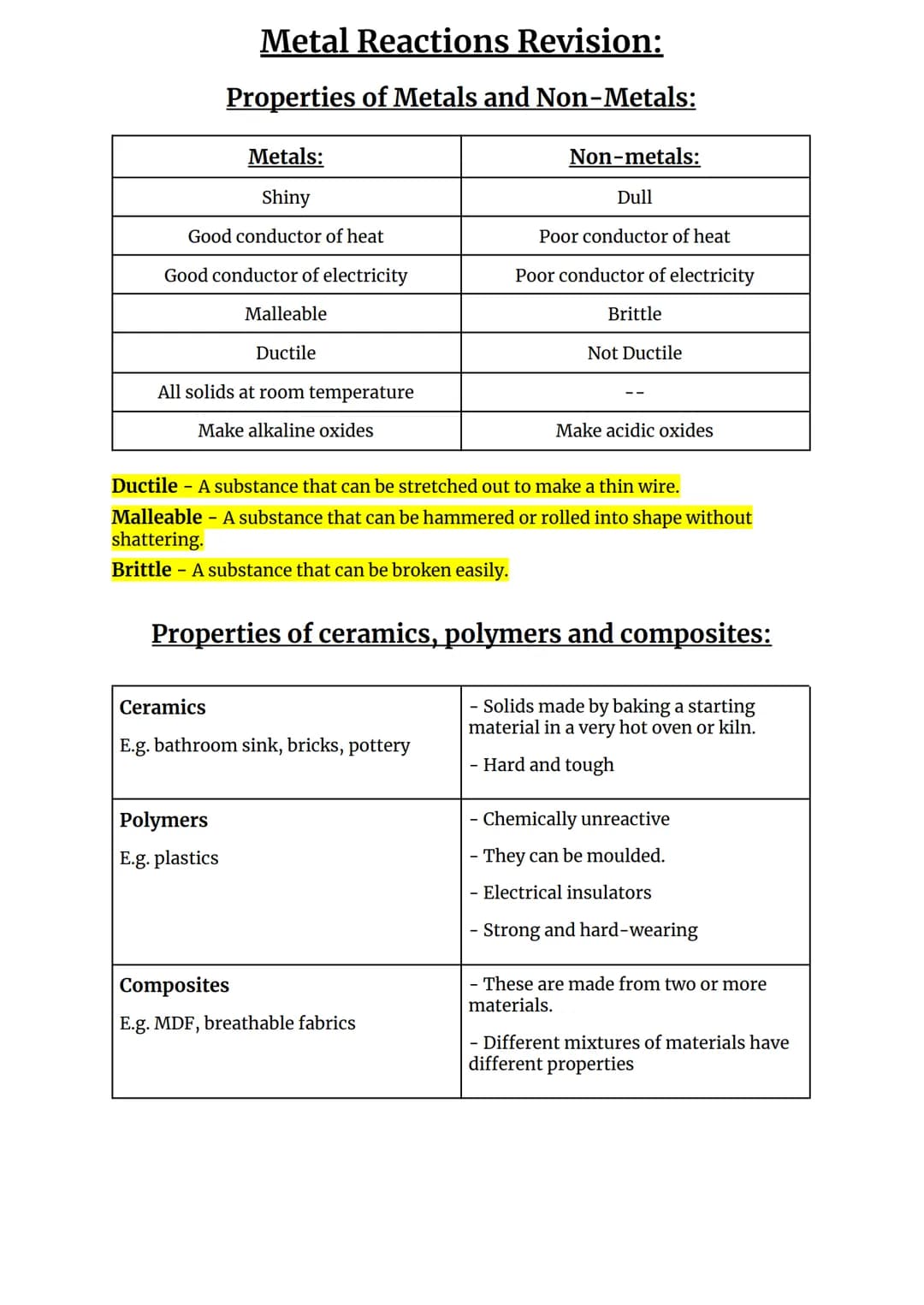
Metals and non-metals have distinct properties that determine their uses. Metals are shiny, malleable (can be hammered into shape), and ductile (can be stretched into wires). They're also good conductors of heat and electricity, and they form alkaline oxides.
Non-metals, on the other hand, tend to be dull and brittle, conducting heat and electricity poorly. They typically form acidic oxides when they react with oxygen.
Modern materials go beyond simple metals and non-metals. Ceramics like bathroom sinks and pottery are hard, tough and chemically unreactive solids made by baking materials in kilns. Polymers (plastics) can be moulded and serve as electrical insulators. Composites combine multiple materials to create products with unique properties, like MDF or breathable fabrics.
Did you know? The property of malleability is why gold can be hammered into sheets so thin they're almost transparent - just a few atoms thick!
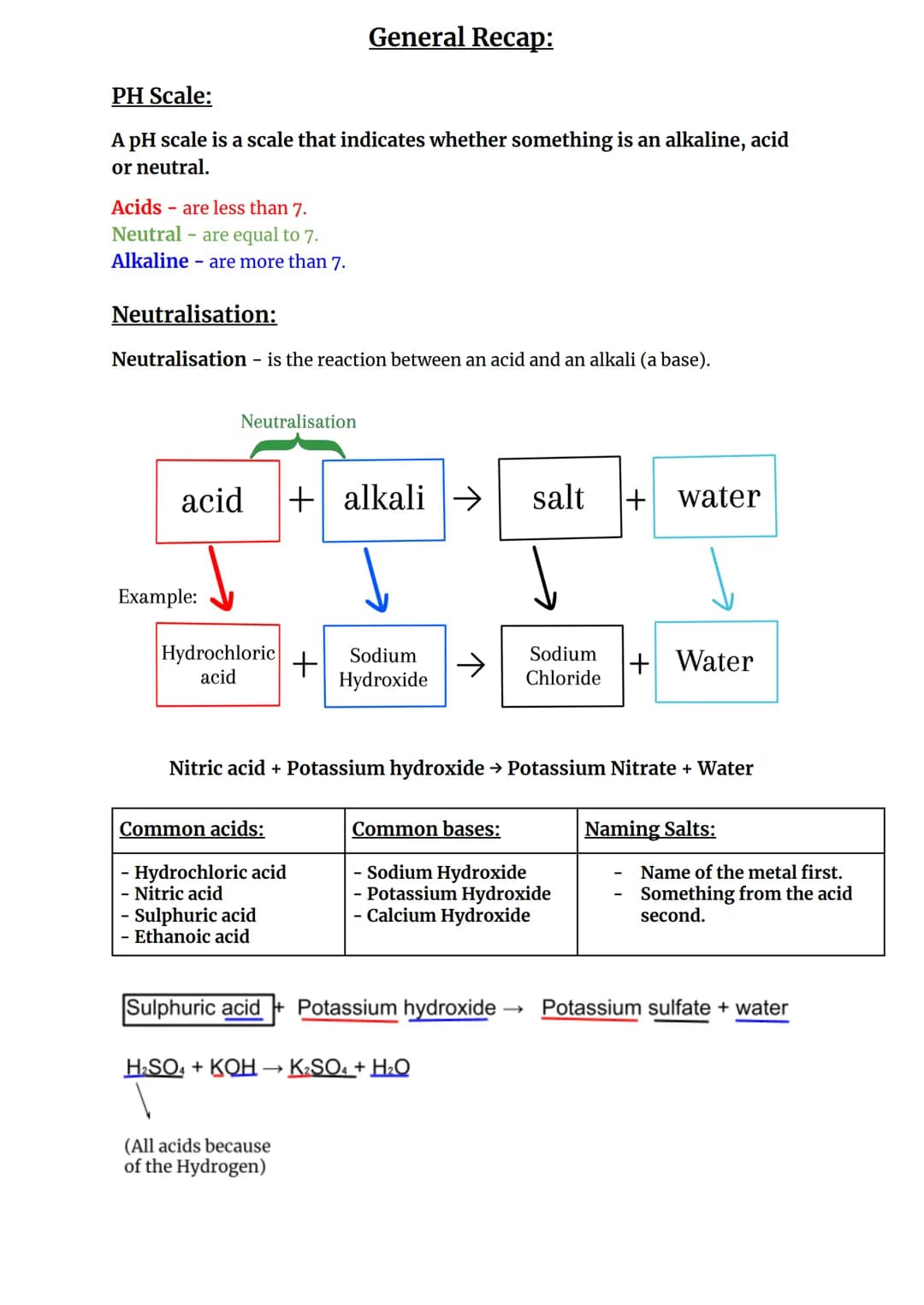
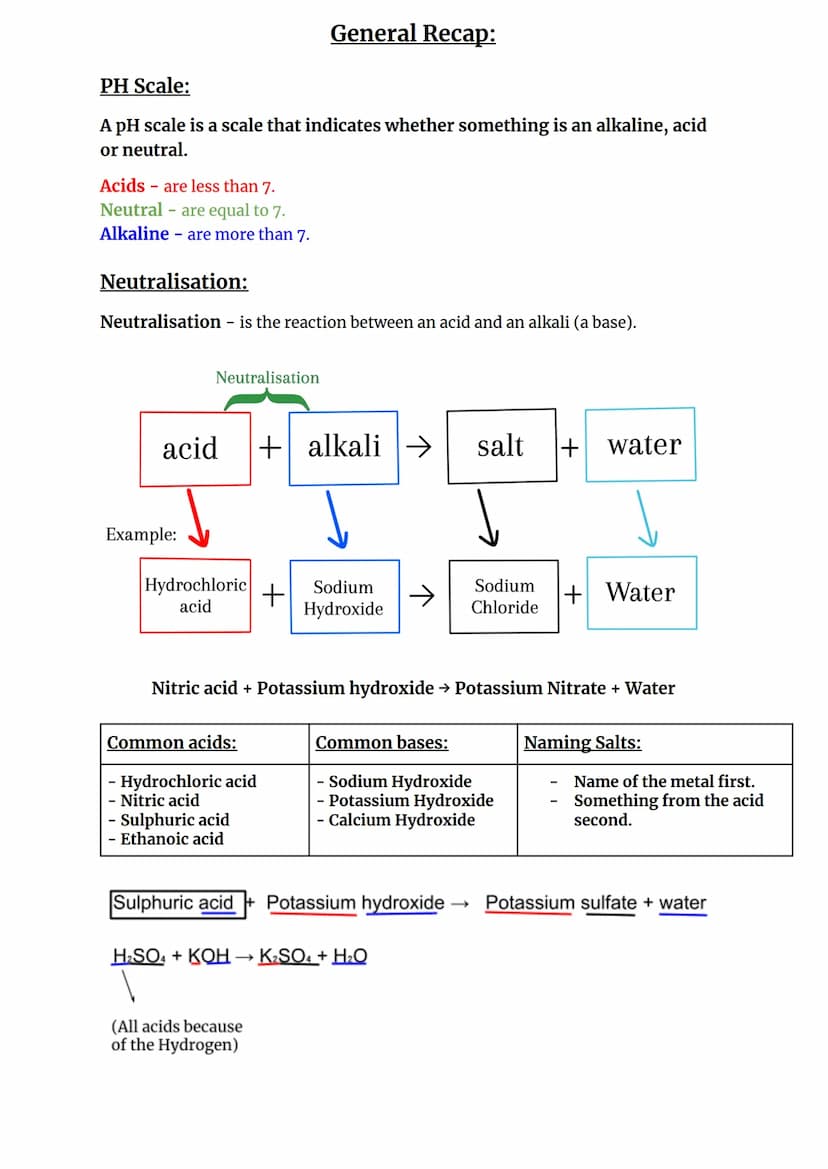
The pH scale tells us how acidic or alkaline a substance is. Anything below 7 is an acid, exactly 7 is neutral, and above 7 is an alkaline (or base). This scale helps us understand how chemicals will interact.
Neutralisation happens when an acid reacts with an alkali (base) to form a salt and water. The acid's hydrogen ions combine with the alkali's hydroxide ions. For example, when hydrochloric acid reacts with sodium hydroxide, they form sodium chloride (table salt) and water.
Common acids include hydrochloric, nitric, sulphuric and ethanoic acids. Common bases include sodium hydroxide, potassium hydroxide and calcium hydroxide. When naming the salts produced in neutralisation reactions, the metal name comes first, followed by something from the acid (chloride from hydrochloric acid, sulfate from sulphuric acid, nitrate from nitric acid).
Remember: In neutralisation reactions, the acid always contributes hydrogen while the base always contributes hydroxide . These combine to form water (H₂O).
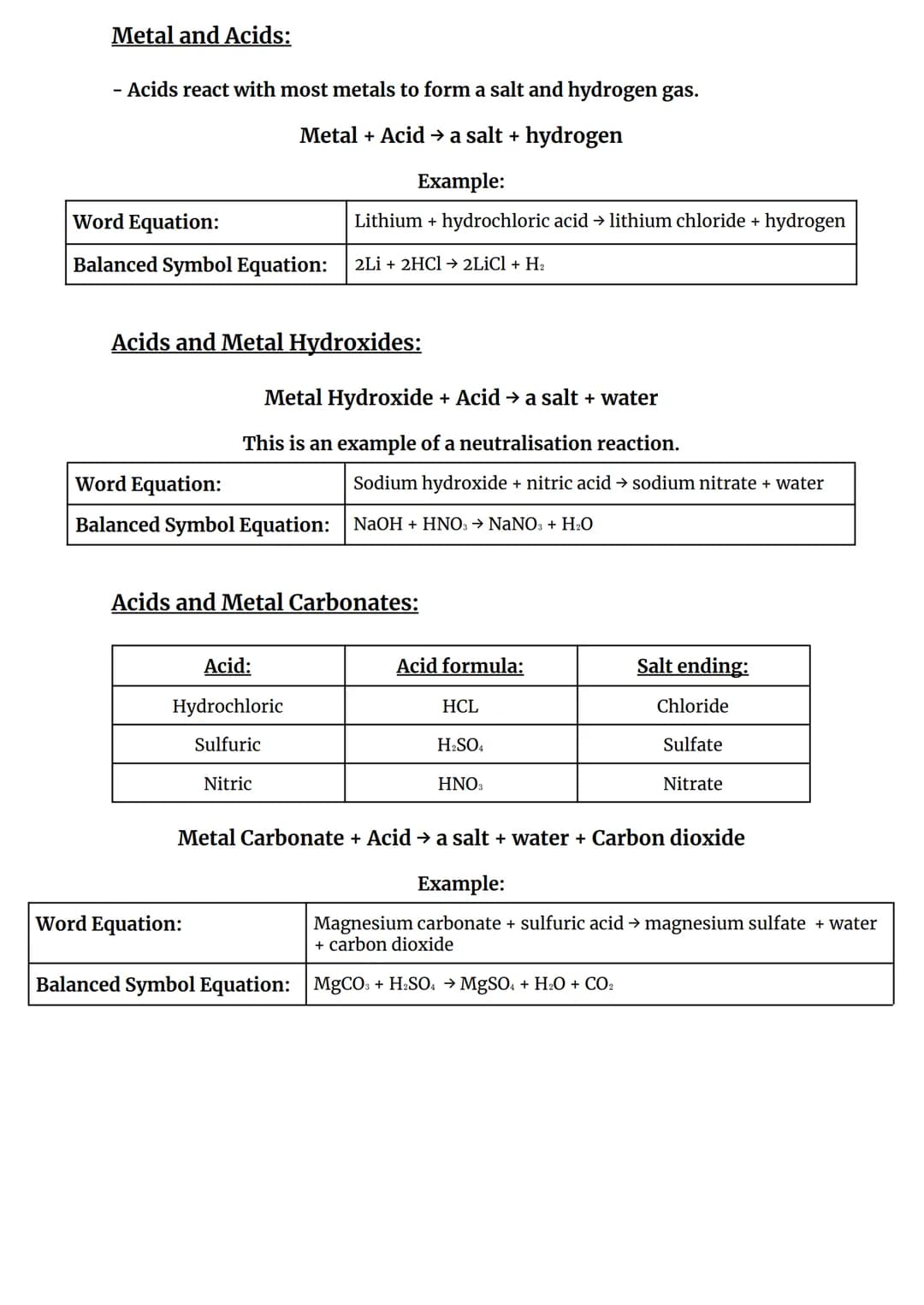
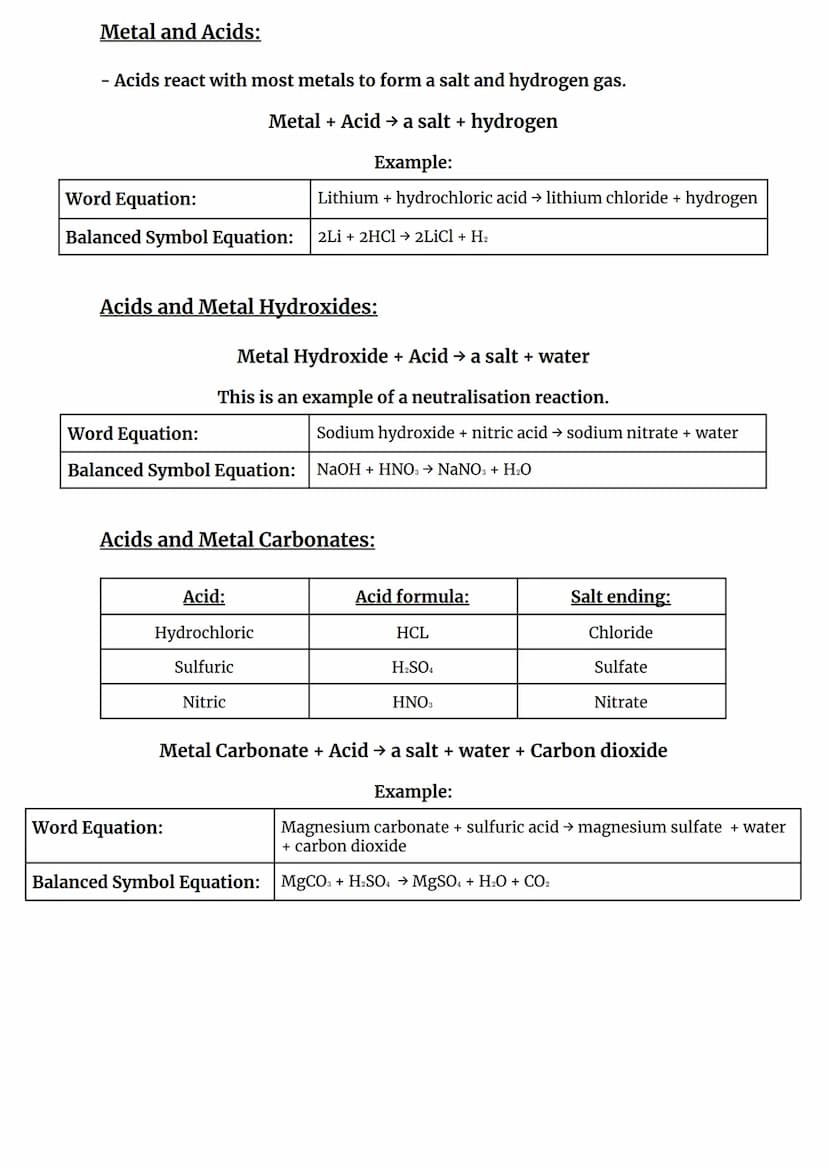
Acids react with most metals to produce a salt and hydrogen gas. This follows the pattern: Metal + Acid → Salt + Hydrogen. For example, when lithium reacts with hydrochloric acid, it produces lithium chloride and hydrogen gas .
Metal hydroxides react with acids in neutralisation reactions, producing a salt and water. When sodium hydroxide meets nitric acid, they form sodium nitrate and water .
Metal carbonates react with acids to form a salt, water, and carbon dioxide. The reaction with magnesium carbonate and sulphuric acid follows this pattern: MgCO₃ + H₂SO₄ → MgSO₄ + H₂O + CO₂. The type of acid determines the salt produced - hydrochloric acid produces chlorides, sulphuric acid produces sulfates, and nitric acid produces nitrates.
Quick tip: When revising acid reactions, remember that metal + acid always gives hydrogen, while carbonates + acid always gives carbon dioxide!
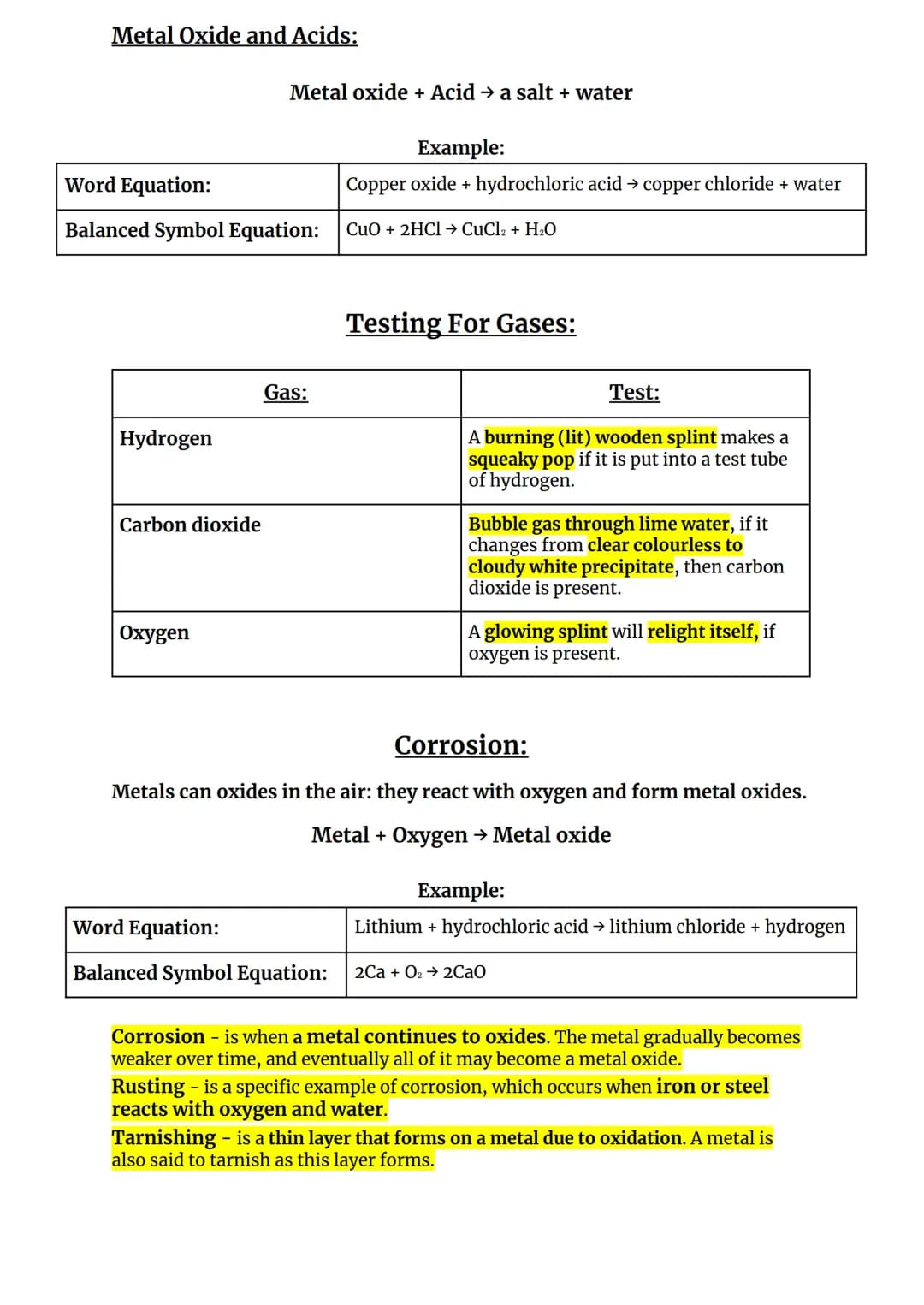
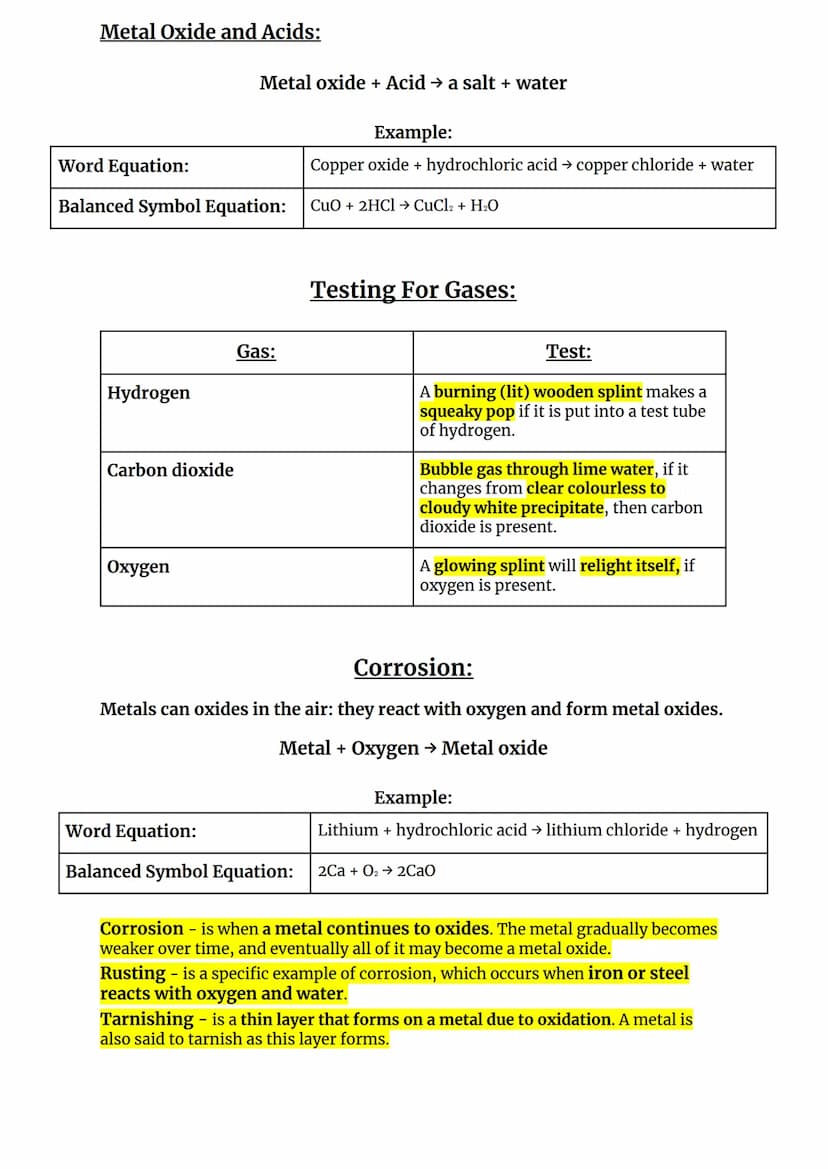
Metal oxides react with acids to form a salt and water. For instance, copper oxide reacts with hydrochloric acid to produce copper chloride and water . This is another type of neutralisation reaction.
You can identify gases through simple tests. For hydrogen, use a burning splint - it makes a distinctive "squeaky pop" sound. For carbon dioxide, bubble it through lime water, which turns cloudy white if CO₂ is present. For oxygen, use a glowing splint which will relight in its presence.
Corrosion occurs when metals react with oxygen in the air to form metal oxides. This follows the pattern: Metal + Oxygen → Metal oxide. For example, calcium reacts with oxygen to form calcium oxide . Rusting specifically refers to iron or steel corroding when exposed to oxygen and water, while tarnishing describes the thin layer that forms on metals due to oxidation.
Everyday science: Have you noticed how a bicycle left outside in the rain rusts faster than one kept in a garage? That's because both water and oxygen are needed for rusting to occur!
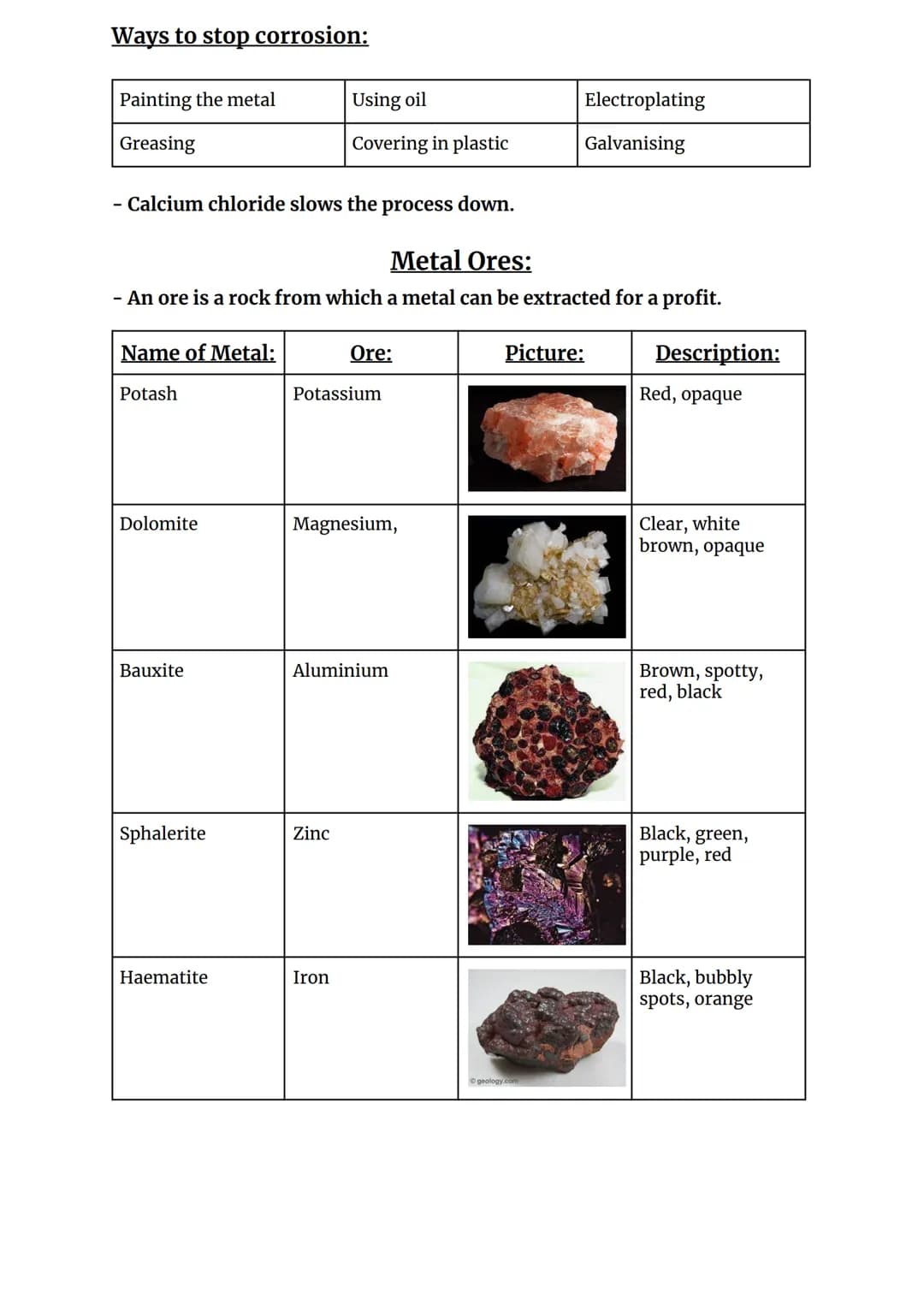
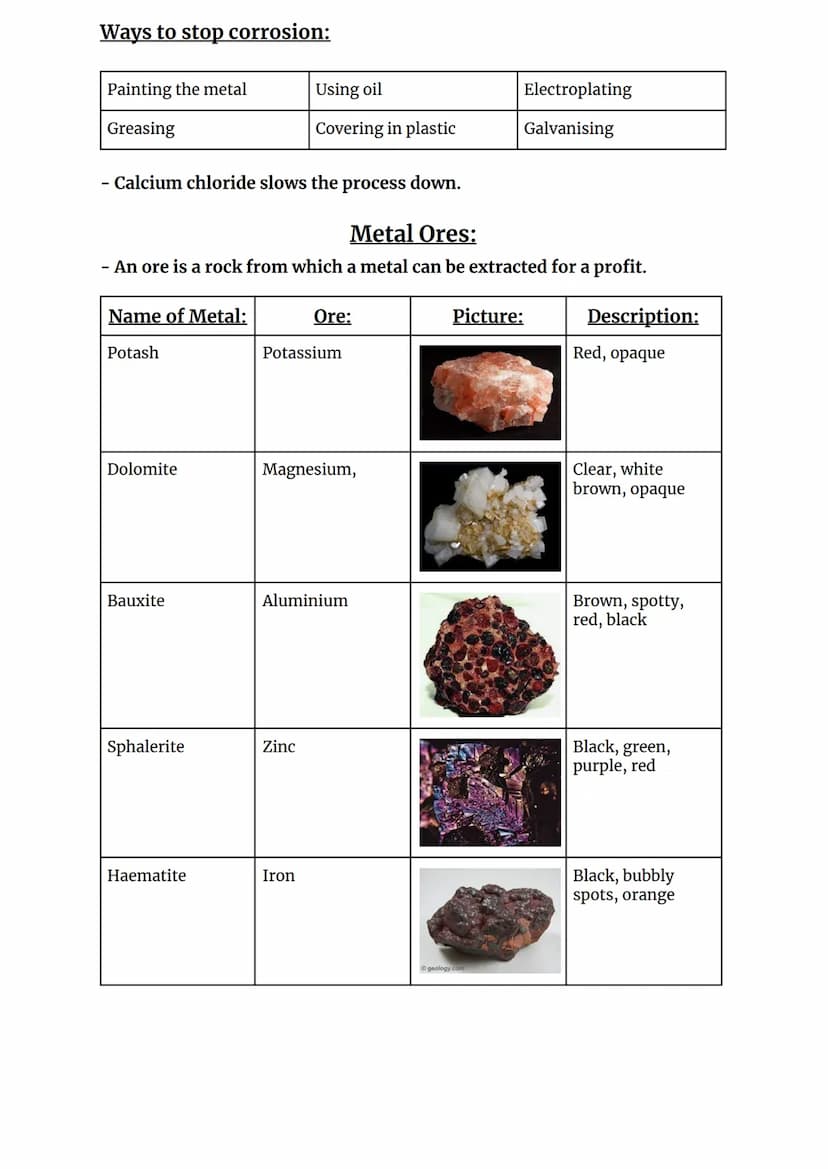
You can prevent corrosion in several ways: painting, oiling, electroplating, greasing, plastic coating, or galvanising (coating with zinc). Calcium chloride can also slow down corrosion processes.
Metal ores are rocks from which metals can be extracted profitably. Different ores yield different metals. Potassium comes from potash (red, opaque), while magnesium is extracted from dolomite (clear, white). Bauxite (brown with spots of red and black) yields aluminium, and sphalerite (which can be black, green, purple or red) produces zinc.
Haematite, a black ore with orange, bubbly spots, is the primary source of iron. These ores occur naturally in the earth's crust and have unique physical appearances that help geologists identify them.
Fascinating fact: The aluminium in just one soda can requires mining about four times its weight in bauxite ore to produce!
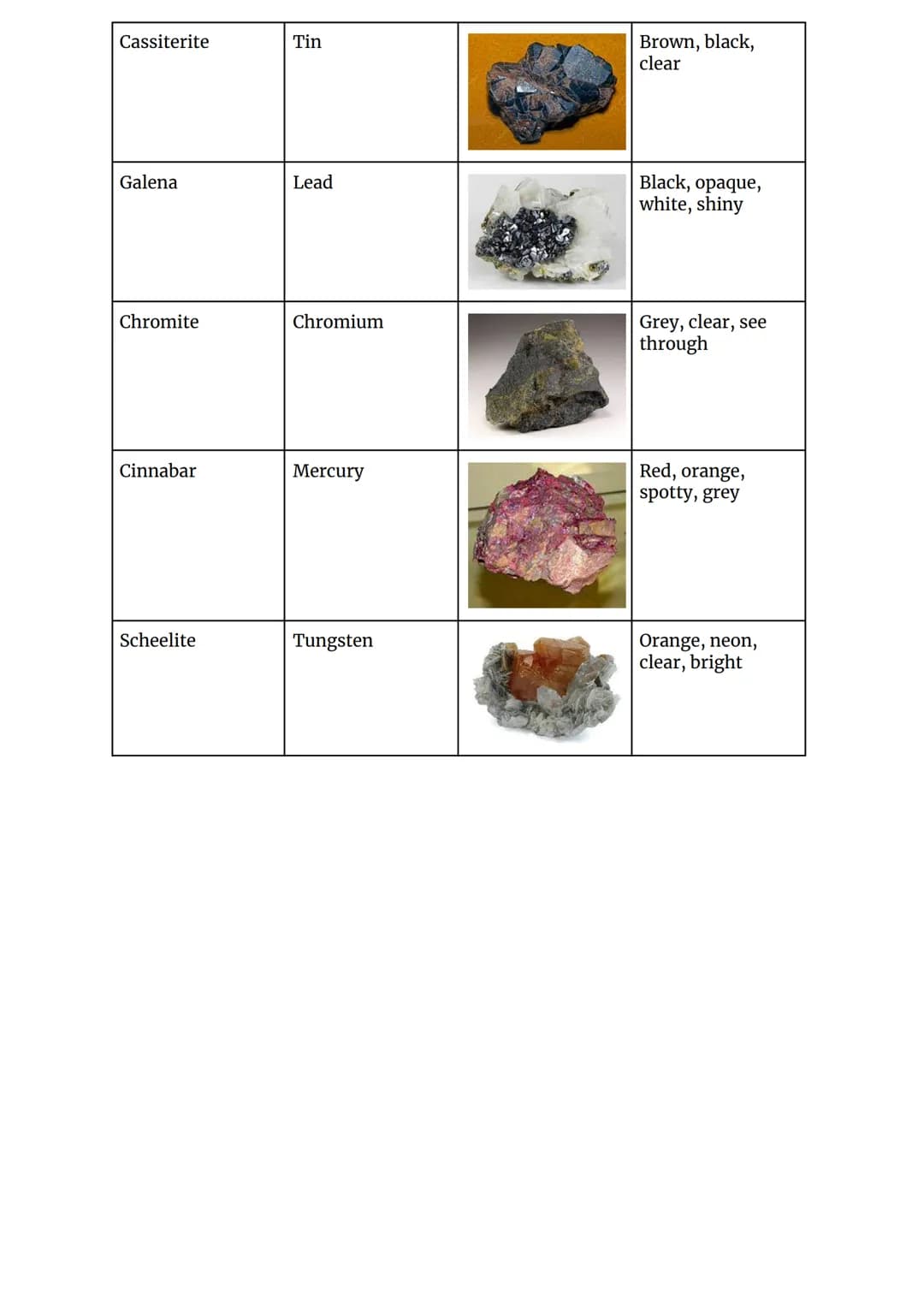
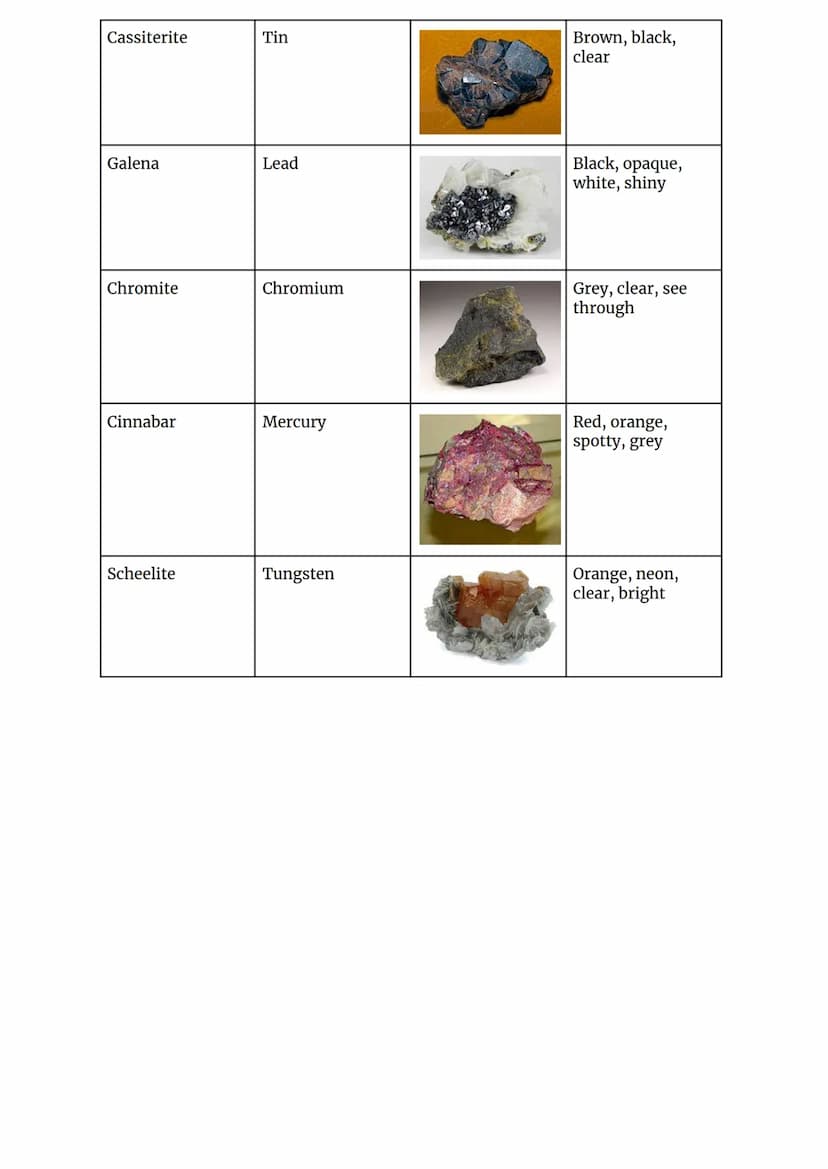
Different metals require different extraction methods based on their ores. Cassiterite, which appears brown to black and sometimes clear, is the main ore for tin production. Galena, a black, opaque, sometimes shiny ore with white patches, yields lead.
Chromite, which is grey and sometimes transparent, contains chromium - an essential metal for stainless steel production. Cinnabar, with its distinctive red-orange colour and grey spots, is where we get mercury from.
Scheelite, recognizable by its bright orange, neon-like appearance, is a major source of tungsten. This metal is crucial for making filaments in light bulbs and extremely hard tools.
Did you know? Tungsten has the highest melting point of any metal (3,422°C), which is why it's used in light bulb filaments that need to get very hot without melting!
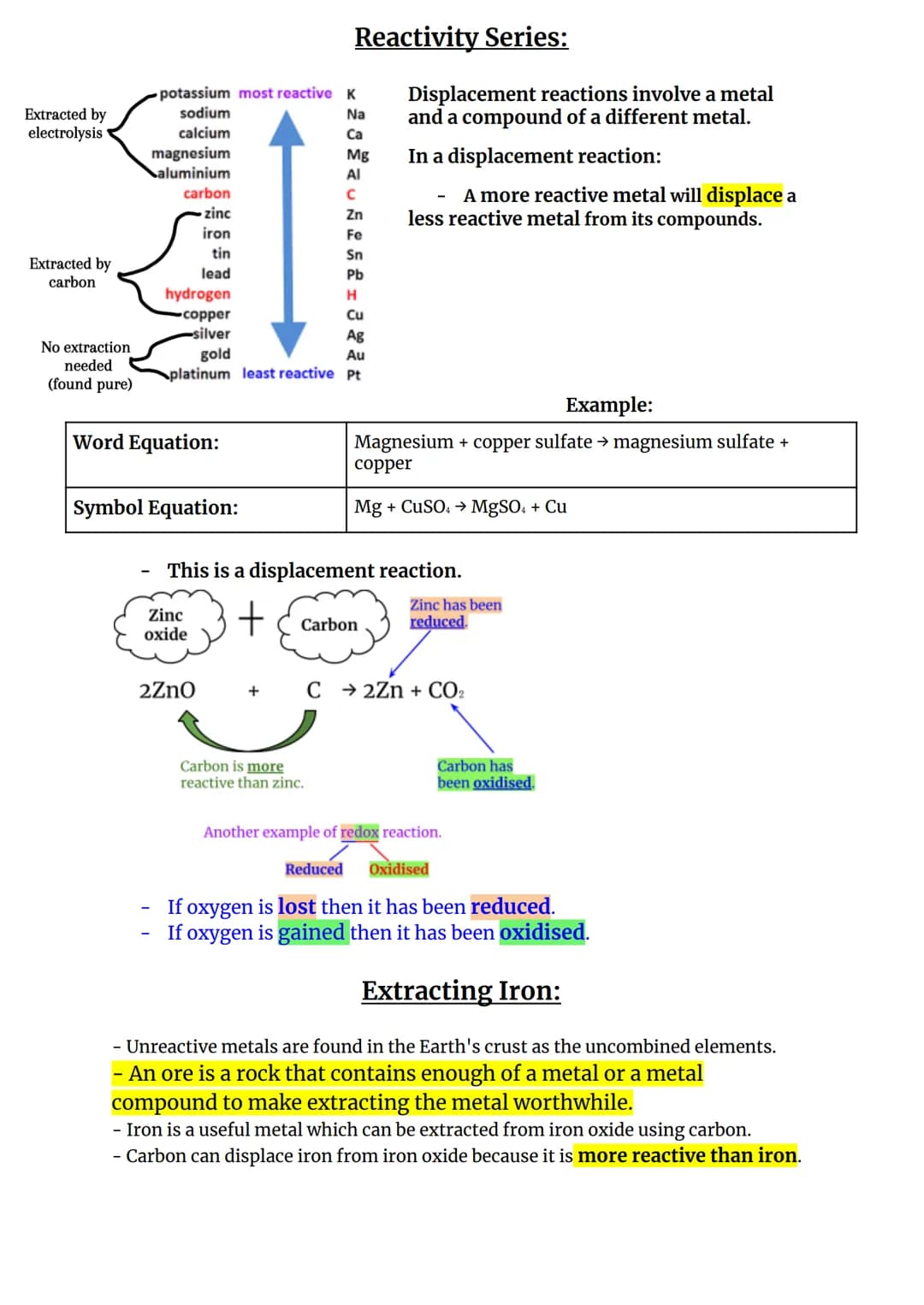
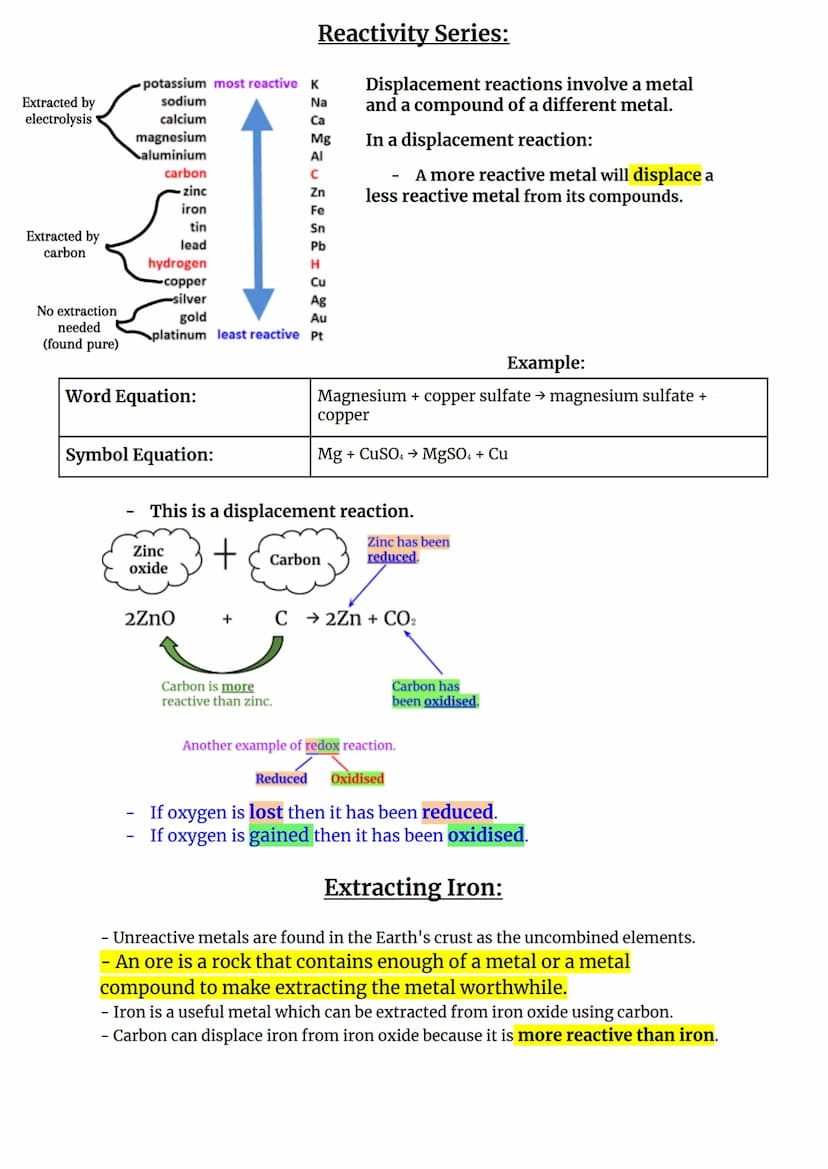
The reactivity series ranks metals from most to least reactive. Potassium, sodium, calcium, magnesium and aluminium are highly reactive and must be extracted using electrolysis. Less reactive metals like zinc, iron, tin and lead can be extracted using carbon.
In displacement reactions, a more reactive metal will displace a less reactive metal from its compounds. For example, magnesium will displace copper from copper sulfate: Mg + CuSO₄ → MgSO₄ + Cu.
These reactions often involve reduction and oxidation (redox). When oxygen is lost, a substance is reduced; when oxygen is gained, it's oxidised. For instance, when zinc oxide reacts with carbon , zinc is reduced (gains electrons) while carbon is oxidised (loses electrons).
Exam tip: Remember "OILRIG" - Oxidation Is Loss (of electrons), Reduction Is Gain (of electrons) - to keep track of what's happening in these reactions.
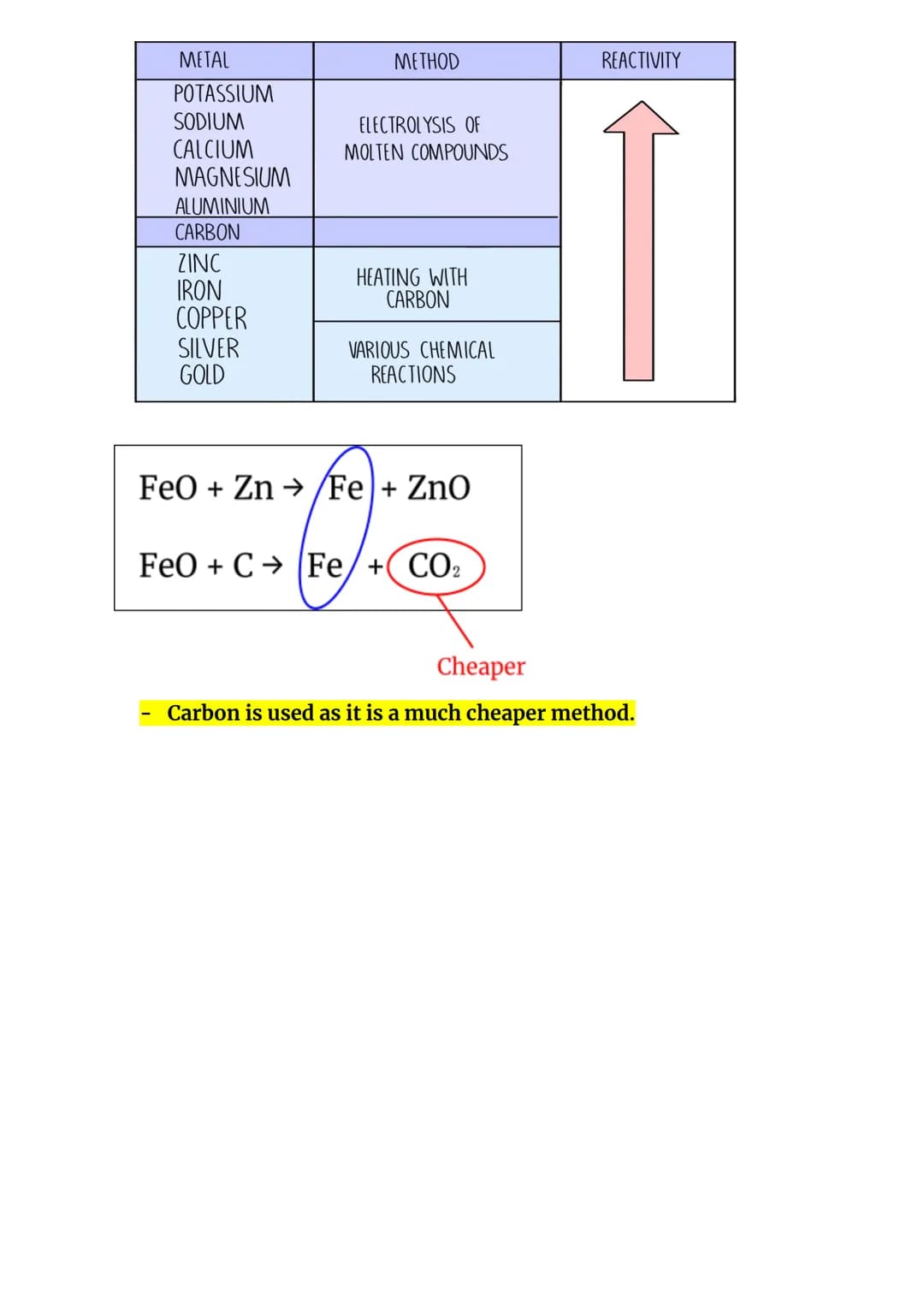
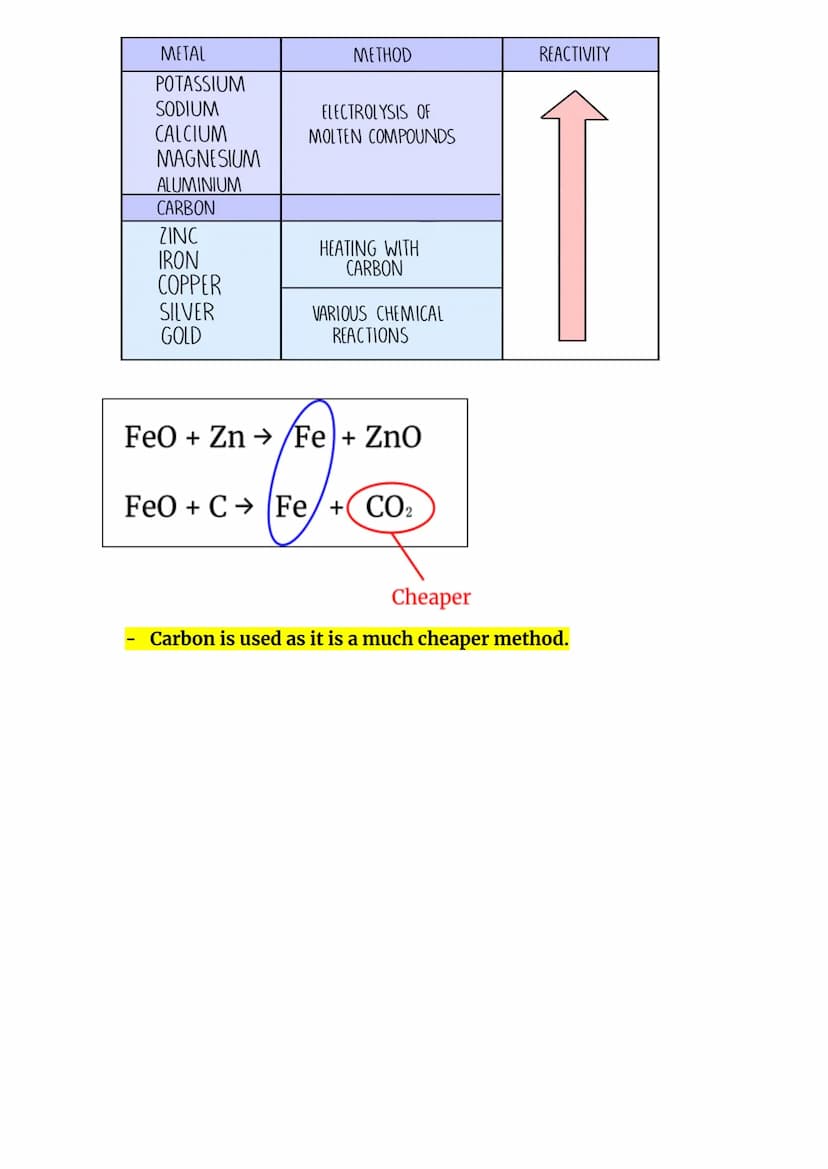
The method used to extract a metal depends on its reactivity. The most reactive metals (potassium, sodium, calcium, magnesium, aluminium) require electrolysis of their molten compounds, which uses electricity to separate the metal.
Moderately reactive metals (zinc, iron) can be extracted by heating with carbon. The carbon is more reactive with oxygen than these metals are, so it can pull the oxygen away from metal oxides. For example, iron oxide reacts with carbon to form iron and carbon dioxide: FeO + C → Fe + CO₂.
Less reactive metals like copper, silver and gold require various chemical reactions for extraction or may even be found in their pure form. While electrolysis is more precise, carbon reduction is often preferred for metals like iron because it's much cheaper despite being less environmentally friendly.
Historical context: The ability to extract and work with metals defined entire periods of human history - from the Bronze Age to the Iron Age, and now our modern technological age!
Our AI Companion is a student-focused AI tool that offers more than just answers. Built on millions of Knowunity resources, it provides relevant information, personalised study plans, quizzes, and content directly in the chat, adapting to your individual learning journey.
You can download the app from Google Play Store and Apple App Store.
That's right! Enjoy free access to study content, connect with fellow students, and get instant help – all at your fingertips.
App Store
Google Play
The app is very easy to use and well designed. I have found everything I was looking for so far and have been able to learn a lot from the presentations! I will definitely use the app for a class assignment! And of course it also helps a lot as an inspiration.
Stefan S
iOS user
This app is really great. There are so many study notes and help [...]. My problem subject is French, for example, and the app has so many options for help. Thanks to this app, I have improved my French. I would recommend it to anyone.
Samantha Klich
Android user
Wow, I am really amazed. I just tried the app because I've seen it advertised many times and was absolutely stunned. This app is THE HELP you want for school and above all, it offers so many things, such as workouts and fact sheets, which have been VERY helpful to me personally.
Anna
iOS user
Best app on earth! no words because it’s too good
Thomas R
iOS user
Just amazing. Let's me revise 10x better, this app is a quick 10/10. I highly recommend it to anyone. I can watch and search for notes. I can save them in the subject folder. I can revise it any time when I come back. If you haven't tried this app, you're really missing out.
Basil
Android user
This app has made me feel so much more confident in my exam prep, not only through boosting my own self confidence through the features that allow you to connect with others and feel less alone, but also through the way the app itself is centred around making you feel better. It is easy to navigate, fun to use, and helpful to anyone struggling in absolutely any way.
David K
iOS user
The app's just great! All I have to do is enter the topic in the search bar and I get the response real fast. I don't have to watch 10 YouTube videos to understand something, so I'm saving my time. Highly recommended!
Sudenaz Ocak
Android user
In school I was really bad at maths but thanks to the app, I am doing better now. I am so grateful that you made the app.
Greenlight Bonnie
Android user
very reliable app to help and grow your ideas of Maths, English and other related topics in your works. please use this app if your struggling in areas, this app is key for that. wish I'd of done a review before. and it's also free so don't worry about that.
Rohan U
Android user
I know a lot of apps use fake accounts to boost their reviews but this app deserves it all. Originally I was getting 4 in my English exams and this time I got a grade 7. I didn’t even know about this app three days until the exam and it has helped A LOT. Please actually trust me and use it as I’m sure you too will see developments.
Xander S
iOS user
THE QUIZES AND FLASHCARDS ARE SO USEFUL AND I LOVE Knowunity AI. IT ALSO IS LITREALLY LIKE CHATGPT BUT SMARTER!! HELPED ME WITH MY MASCARA PROBLEMS TOO!! AS WELL AS MY REAL SUBJECTS ! DUHHH 😍😁😲🤑💗✨🎀😮
Elisha
iOS user
This apps acc the goat. I find revision so boring but this app makes it so easy to organize it all and then you can ask the freeeee ai to test yourself so good and you can easily upload your own stuff. highly recommend as someone taking mocks now
Paul T
iOS user
The app is very easy to use and well designed. I have found everything I was looking for so far and have been able to learn a lot from the presentations! I will definitely use the app for a class assignment! And of course it also helps a lot as an inspiration.
Stefan S
iOS user
This app is really great. There are so many study notes and help [...]. My problem subject is French, for example, and the app has so many options for help. Thanks to this app, I have improved my French. I would recommend it to anyone.
Samantha Klich
Android user
Wow, I am really amazed. I just tried the app because I've seen it advertised many times and was absolutely stunned. This app is THE HELP you want for school and above all, it offers so many things, such as workouts and fact sheets, which have been VERY helpful to me personally.
Anna
iOS user
Best app on earth! no words because it’s too good
Thomas R
iOS user
Just amazing. Let's me revise 10x better, this app is a quick 10/10. I highly recommend it to anyone. I can watch and search for notes. I can save them in the subject folder. I can revise it any time when I come back. If you haven't tried this app, you're really missing out.
Basil
Android user
This app has made me feel so much more confident in my exam prep, not only through boosting my own self confidence through the features that allow you to connect with others and feel less alone, but also through the way the app itself is centred around making you feel better. It is easy to navigate, fun to use, and helpful to anyone struggling in absolutely any way.
David K
iOS user
The app's just great! All I have to do is enter the topic in the search bar and I get the response real fast. I don't have to watch 10 YouTube videos to understand something, so I'm saving my time. Highly recommended!
Sudenaz Ocak
Android user
In school I was really bad at maths but thanks to the app, I am doing better now. I am so grateful that you made the app.
Greenlight Bonnie
Android user
very reliable app to help and grow your ideas of Maths, English and other related topics in your works. please use this app if your struggling in areas, this app is key for that. wish I'd of done a review before. and it's also free so don't worry about that.
Rohan U
Android user
I know a lot of apps use fake accounts to boost their reviews but this app deserves it all. Originally I was getting 4 in my English exams and this time I got a grade 7. I didn’t even know about this app three days until the exam and it has helped A LOT. Please actually trust me and use it as I’m sure you too will see developments.
Xander S
iOS user
THE QUIZES AND FLASHCARDS ARE SO USEFUL AND I LOVE Knowunity AI. IT ALSO IS LITREALLY LIKE CHATGPT BUT SMARTER!! HELPED ME WITH MY MASCARA PROBLEMS TOO!! AS WELL AS MY REAL SUBJECTS ! DUHHH 😍😁😲🤑💗✨🎀😮
Elisha
iOS user
This apps acc the goat. I find revision so boring but this app makes it so easy to organize it all and then you can ask the freeeee ai to test yourself so good and you can easily upload your own stuff. highly recommend as someone taking mocks now
Paul T
iOS user
Mayesha ☆
@mayeshatas07
Metal reactions are key to understanding chemistry. This topic covers how metals and non-metals differ in their properties, how acids interact with various substances, and the processes involved in extracting metals from their ores. Understanding these concepts will help you... Show more
Access to all documents
Improve your grades
Join milions of students
By signing up you accept Terms of Service and Privacy Policy
Metals and non-metals have distinct properties that determine their uses. Metals are shiny, malleable (can be hammered into shape), and ductile (can be stretched into wires). They're also good conductors of heat and electricity, and they form alkaline oxides.
Non-metals, on the other hand, tend to be dull and brittle, conducting heat and electricity poorly. They typically form acidic oxides when they react with oxygen.
Modern materials go beyond simple metals and non-metals. Ceramics like bathroom sinks and pottery are hard, tough and chemically unreactive solids made by baking materials in kilns. Polymers (plastics) can be moulded and serve as electrical insulators. Composites combine multiple materials to create products with unique properties, like MDF or breathable fabrics.
Did you know? The property of malleability is why gold can be hammered into sheets so thin they're almost transparent - just a few atoms thick!
Access to all documents
Improve your grades
Join milions of students
By signing up you accept Terms of Service and Privacy Policy
The pH scale tells us how acidic or alkaline a substance is. Anything below 7 is an acid, exactly 7 is neutral, and above 7 is an alkaline (or base). This scale helps us understand how chemicals will interact.
Neutralisation happens when an acid reacts with an alkali (base) to form a salt and water. The acid's hydrogen ions combine with the alkali's hydroxide ions. For example, when hydrochloric acid reacts with sodium hydroxide, they form sodium chloride (table salt) and water.
Common acids include hydrochloric, nitric, sulphuric and ethanoic acids. Common bases include sodium hydroxide, potassium hydroxide and calcium hydroxide. When naming the salts produced in neutralisation reactions, the metal name comes first, followed by something from the acid (chloride from hydrochloric acid, sulfate from sulphuric acid, nitrate from nitric acid).
Remember: In neutralisation reactions, the acid always contributes hydrogen while the base always contributes hydroxide . These combine to form water (H₂O).
Access to all documents
Improve your grades
Join milions of students
By signing up you accept Terms of Service and Privacy Policy
Acids react with most metals to produce a salt and hydrogen gas. This follows the pattern: Metal + Acid → Salt + Hydrogen. For example, when lithium reacts with hydrochloric acid, it produces lithium chloride and hydrogen gas .
Metal hydroxides react with acids in neutralisation reactions, producing a salt and water. When sodium hydroxide meets nitric acid, they form sodium nitrate and water .
Metal carbonates react with acids to form a salt, water, and carbon dioxide. The reaction with magnesium carbonate and sulphuric acid follows this pattern: MgCO₃ + H₂SO₄ → MgSO₄ + H₂O + CO₂. The type of acid determines the salt produced - hydrochloric acid produces chlorides, sulphuric acid produces sulfates, and nitric acid produces nitrates.
Quick tip: When revising acid reactions, remember that metal + acid always gives hydrogen, while carbonates + acid always gives carbon dioxide!
Access to all documents
Improve your grades
Join milions of students
By signing up you accept Terms of Service and Privacy Policy
Metal oxides react with acids to form a salt and water. For instance, copper oxide reacts with hydrochloric acid to produce copper chloride and water . This is another type of neutralisation reaction.
You can identify gases through simple tests. For hydrogen, use a burning splint - it makes a distinctive "squeaky pop" sound. For carbon dioxide, bubble it through lime water, which turns cloudy white if CO₂ is present. For oxygen, use a glowing splint which will relight in its presence.
Corrosion occurs when metals react with oxygen in the air to form metal oxides. This follows the pattern: Metal + Oxygen → Metal oxide. For example, calcium reacts with oxygen to form calcium oxide . Rusting specifically refers to iron or steel corroding when exposed to oxygen and water, while tarnishing describes the thin layer that forms on metals due to oxidation.
Everyday science: Have you noticed how a bicycle left outside in the rain rusts faster than one kept in a garage? That's because both water and oxygen are needed for rusting to occur!
Access to all documents
Improve your grades
Join milions of students
By signing up you accept Terms of Service and Privacy Policy
You can prevent corrosion in several ways: painting, oiling, electroplating, greasing, plastic coating, or galvanising (coating with zinc). Calcium chloride can also slow down corrosion processes.
Metal ores are rocks from which metals can be extracted profitably. Different ores yield different metals. Potassium comes from potash (red, opaque), while magnesium is extracted from dolomite (clear, white). Bauxite (brown with spots of red and black) yields aluminium, and sphalerite (which can be black, green, purple or red) produces zinc.
Haematite, a black ore with orange, bubbly spots, is the primary source of iron. These ores occur naturally in the earth's crust and have unique physical appearances that help geologists identify them.
Fascinating fact: The aluminium in just one soda can requires mining about four times its weight in bauxite ore to produce!
Access to all documents
Improve your grades
Join milions of students
By signing up you accept Terms of Service and Privacy Policy
Different metals require different extraction methods based on their ores. Cassiterite, which appears brown to black and sometimes clear, is the main ore for tin production. Galena, a black, opaque, sometimes shiny ore with white patches, yields lead.
Chromite, which is grey and sometimes transparent, contains chromium - an essential metal for stainless steel production. Cinnabar, with its distinctive red-orange colour and grey spots, is where we get mercury from.
Scheelite, recognizable by its bright orange, neon-like appearance, is a major source of tungsten. This metal is crucial for making filaments in light bulbs and extremely hard tools.
Did you know? Tungsten has the highest melting point of any metal (3,422°C), which is why it's used in light bulb filaments that need to get very hot without melting!
Access to all documents
Improve your grades
Join milions of students
By signing up you accept Terms of Service and Privacy Policy
The reactivity series ranks metals from most to least reactive. Potassium, sodium, calcium, magnesium and aluminium are highly reactive and must be extracted using electrolysis. Less reactive metals like zinc, iron, tin and lead can be extracted using carbon.
In displacement reactions, a more reactive metal will displace a less reactive metal from its compounds. For example, magnesium will displace copper from copper sulfate: Mg + CuSO₄ → MgSO₄ + Cu.
These reactions often involve reduction and oxidation (redox). When oxygen is lost, a substance is reduced; when oxygen is gained, it's oxidised. For instance, when zinc oxide reacts with carbon , zinc is reduced (gains electrons) while carbon is oxidised (loses electrons).
Exam tip: Remember "OILRIG" - Oxidation Is Loss (of electrons), Reduction Is Gain (of electrons) - to keep track of what's happening in these reactions.
Access to all documents
Improve your grades
Join milions of students
By signing up you accept Terms of Service and Privacy Policy
The method used to extract a metal depends on its reactivity. The most reactive metals (potassium, sodium, calcium, magnesium, aluminium) require electrolysis of their molten compounds, which uses electricity to separate the metal.
Moderately reactive metals (zinc, iron) can be extracted by heating with carbon. The carbon is more reactive with oxygen than these metals are, so it can pull the oxygen away from metal oxides. For example, iron oxide reacts with carbon to form iron and carbon dioxide: FeO + C → Fe + CO₂.
Less reactive metals like copper, silver and gold require various chemical reactions for extraction or may even be found in their pure form. While electrolysis is more precise, carbon reduction is often preferred for metals like iron because it's much cheaper despite being less environmentally friendly.
Historical context: The ability to extract and work with metals defined entire periods of human history - from the Bronze Age to the Iron Age, and now our modern technological age!
Our AI Companion is a student-focused AI tool that offers more than just answers. Built on millions of Knowunity resources, it provides relevant information, personalised study plans, quizzes, and content directly in the chat, adapting to your individual learning journey.
You can download the app from Google Play Store and Apple App Store.
That's right! Enjoy free access to study content, connect with fellow students, and get instant help – all at your fingertips.
9
Smart Tools NEW
Transform this note into: ✓ 50+ Practice Questions ✓ Interactive Flashcards ✓ Full Mock Exam ✓ Essay Outlines
Explore the chemical reaction between Iron and Sulphur, leading to the formation of Iron Sulphide (FeS). This study note covers the properties of Iron and Sulphur, the nature of mixtures versus compounds, and the irreversible changes during the reaction. Ideal for understanding chemical bonding, energy changes, and particle diagrams.
 Chemistry
Explore the principles of electrolysis, including the roles of electrodes (anode and cathode), electrolytes, and the processes of reduction and oxidation. This summary covers key concepts such as Faraday's laws and the behavior of ions during electrolysis, tailored for Edexcel Chemistry specifications.
ChemistryApp Store
Google Play
The app is very easy to use and well designed. I have found everything I was looking for so far and have been able to learn a lot from the presentations! I will definitely use the app for a class assignment! And of course it also helps a lot as an inspiration.
Stefan S
iOS user
This app is really great. There are so many study notes and help [...]. My problem subject is French, for example, and the app has so many options for help. Thanks to this app, I have improved my French. I would recommend it to anyone.
Samantha Klich
Android user
Wow, I am really amazed. I just tried the app because I've seen it advertised many times and was absolutely stunned. This app is THE HELP you want for school and above all, it offers so many things, such as workouts and fact sheets, which have been VERY helpful to me personally.
Anna
iOS user
Best app on earth! no words because it’s too good
Thomas R
iOS user
Just amazing. Let's me revise 10x better, this app is a quick 10/10. I highly recommend it to anyone. I can watch and search for notes. I can save them in the subject folder. I can revise it any time when I come back. If you haven't tried this app, you're really missing out.
Basil
Android user
This app has made me feel so much more confident in my exam prep, not only through boosting my own self confidence through the features that allow you to connect with others and feel less alone, but also through the way the app itself is centred around making you feel better. It is easy to navigate, fun to use, and helpful to anyone struggling in absolutely any way.
David K
iOS user
The app's just great! All I have to do is enter the topic in the search bar and I get the response real fast. I don't have to watch 10 YouTube videos to understand something, so I'm saving my time. Highly recommended!
Sudenaz Ocak
Android user
In school I was really bad at maths but thanks to the app, I am doing better now. I am so grateful that you made the app.
Greenlight Bonnie
Android user
very reliable app to help and grow your ideas of Maths, English and other related topics in your works. please use this app if your struggling in areas, this app is key for that. wish I'd of done a review before. and it's also free so don't worry about that.
Rohan U
Android user
I know a lot of apps use fake accounts to boost their reviews but this app deserves it all. Originally I was getting 4 in my English exams and this time I got a grade 7. I didn’t even know about this app three days until the exam and it has helped A LOT. Please actually trust me and use it as I’m sure you too will see developments.
Xander S
iOS user
THE QUIZES AND FLASHCARDS ARE SO USEFUL AND I LOVE Knowunity AI. IT ALSO IS LITREALLY LIKE CHATGPT BUT SMARTER!! HELPED ME WITH MY MASCARA PROBLEMS TOO!! AS WELL AS MY REAL SUBJECTS ! DUHHH 😍😁😲🤑💗✨🎀😮
Elisha
iOS user
This apps acc the goat. I find revision so boring but this app makes it so easy to organize it all and then you can ask the freeeee ai to test yourself so good and you can easily upload your own stuff. highly recommend as someone taking mocks now
Paul T
iOS user
The app is very easy to use and well designed. I have found everything I was looking for so far and have been able to learn a lot from the presentations! I will definitely use the app for a class assignment! And of course it also helps a lot as an inspiration.
Stefan S
iOS user
This app is really great. There are so many study notes and help [...]. My problem subject is French, for example, and the app has so many options for help. Thanks to this app, I have improved my French. I would recommend it to anyone.
Samantha Klich
Android user
Wow, I am really amazed. I just tried the app because I've seen it advertised many times and was absolutely stunned. This app is THE HELP you want for school and above all, it offers so many things, such as workouts and fact sheets, which have been VERY helpful to me personally.
Anna
iOS user
Best app on earth! no words because it’s too good
Thomas R
iOS user
Just amazing. Let's me revise 10x better, this app is a quick 10/10. I highly recommend it to anyone. I can watch and search for notes. I can save them in the subject folder. I can revise it any time when I come back. If you haven't tried this app, you're really missing out.
Basil
Android user
This app has made me feel so much more confident in my exam prep, not only through boosting my own self confidence through the features that allow you to connect with others and feel less alone, but also through the way the app itself is centred around making you feel better. It is easy to navigate, fun to use, and helpful to anyone struggling in absolutely any way.
David K
iOS user
The app's just great! All I have to do is enter the topic in the search bar and I get the response real fast. I don't have to watch 10 YouTube videos to understand something, so I'm saving my time. Highly recommended!
Sudenaz Ocak
Android user
In school I was really bad at maths but thanks to the app, I am doing better now. I am so grateful that you made the app.
Greenlight Bonnie
Android user
very reliable app to help and grow your ideas of Maths, English and other related topics in your works. please use this app if your struggling in areas, this app is key for that. wish I'd of done a review before. and it's also free so don't worry about that.
Rohan U
Android user
I know a lot of apps use fake accounts to boost their reviews but this app deserves it all. Originally I was getting 4 in my English exams and this time I got a grade 7. I didn’t even know about this app three days until the exam and it has helped A LOT. Please actually trust me and use it as I’m sure you too will see developments.
Xander S
iOS user
THE QUIZES AND FLASHCARDS ARE SO USEFUL AND I LOVE Knowunity AI. IT ALSO IS LITREALLY LIKE CHATGPT BUT SMARTER!! HELPED ME WITH MY MASCARA PROBLEMS TOO!! AS WELL AS MY REAL SUBJECTS ! DUHHH 😍😁😲🤑💗✨🎀😮
Elisha
iOS user
This apps acc the goat. I find revision so boring but this app makes it so easy to organize it all and then you can ask the freeeee ai to test yourself so good and you can easily upload your own stuff. highly recommend as someone taking mocks now
Paul T
iOS user