
This content covers the essential chemistry of periodicity, Group 2... Show more
 English Literature
 Sociology
 Biology
Sign up to see the contentIt's free!
Access to all documents
Improve your grades
Join milions of students
By signing up you accept Terms of Service and Privacy Policy
Subjects
Classic Dramatic Literature
Modern Lyric Poetry
Influential English-Language Authors
Classic and Contemporary Novels
Literary Character Analysis
Romantic and Love Poetry
Reading Analysis and Interpretation
Evidence Analysis and Integration
Author's Stylistic Elements
Figurative Language and Rhetoric
Show all topics
Human Organ Systems
Cellular Organization and Development
Biomolecular Structure and Organization
Enzyme Structure and Regulation
Cellular Organization Types
Biological Homeostatic Processes
Cellular Membrane Structure
Autotrophic Energy Processes
Environmental Sustainability and Impact
Neural Communication Systems
Show all topics
Social Sciences Research & Practice
Social Structure and Mobility
Classic Social Influence Experiments
Social Systems Theories
Family and Relationship Dynamics
Memory Systems and Processes
Neural Bases of Behavior
Social Influence and Attraction
Psychotherapeutic Approaches
Human Agency and Responsibility
Show all topics
Chemical Sciences and Applications
Chemical Bond Types and Properties
Organic Functional Groups
Atomic Structure and Composition
Chromatographic Separation Principles
Chemical Compound Classifications
Electrochemical Cell Systems
Periodic Table Organization
Chemical Reaction Kinetics
Chemical Equation Conservation
Show all topics
Nazi Germany and Holocaust 1933-1945
World Wars and Peace Treaties
European Monarchs and Statesmen
Cold War Global Tensions
Medieval Institutions and Systems
European Renaissance and Enlightenment
Modern Global Environmental-Health Challenges
Modern Military Conflicts
Medieval Migration and Invasions
World Wars Era and Impact
Show all topics
289
•
12 Feb 2026
•
Emily
@emily_knhn
This content covers the essential chemistry of periodicity, Group 2... Show more
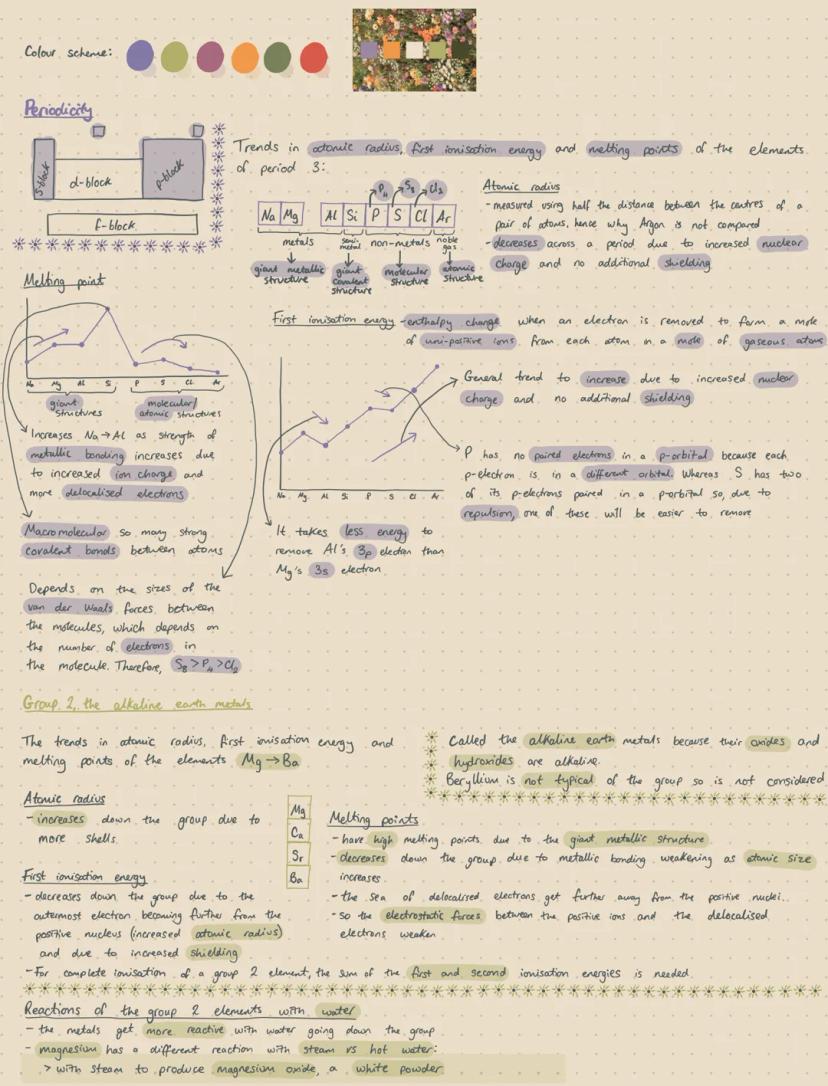


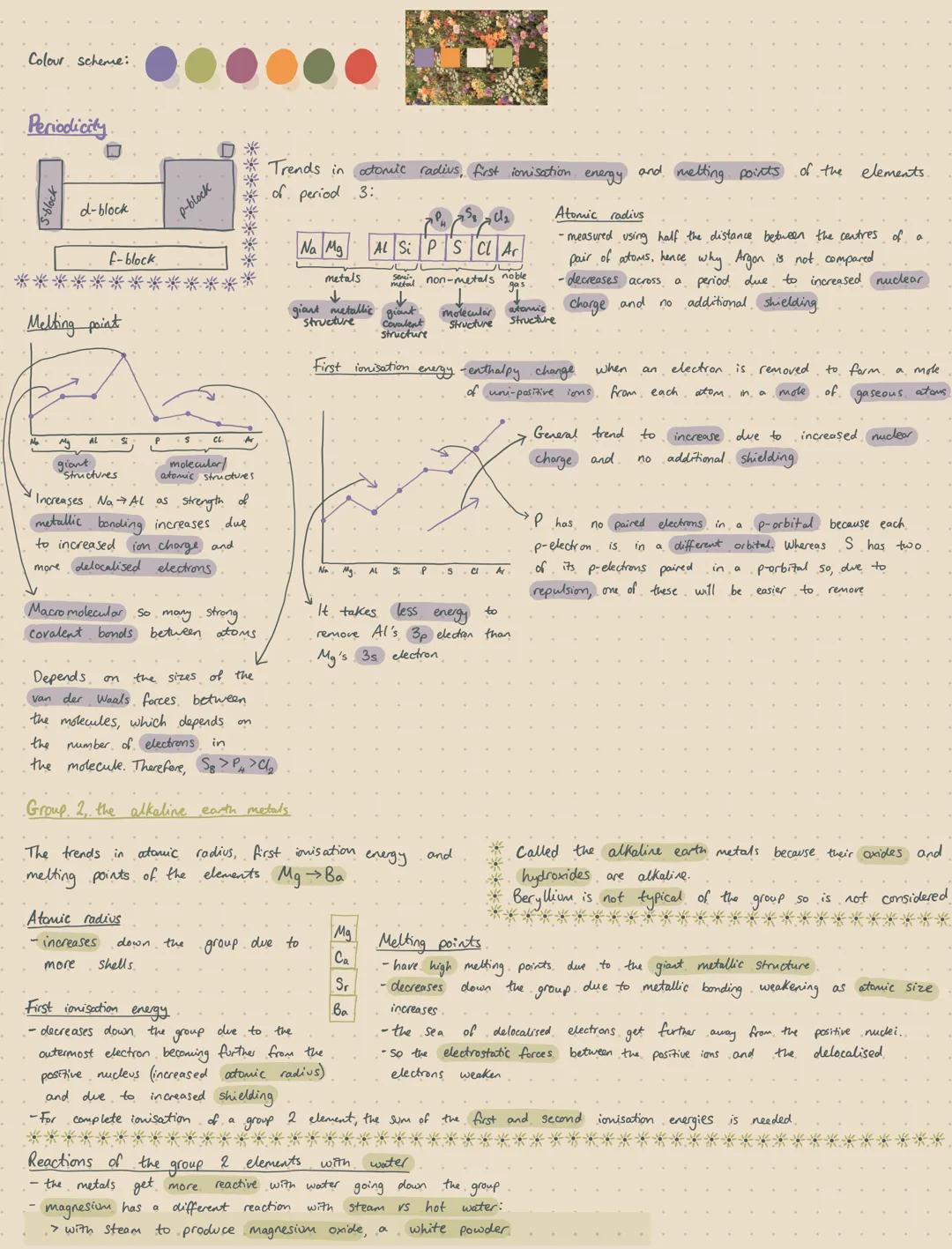
Periodic trends across period 3 are all about nuclear charge increasing whilst electrons stay in the same shell. This makes atomic radius decrease and first ionisation energy increase as you go from sodium to chlorine.
Melting points follow a clear pattern: metals like sodium and magnesium have giant metallic structures with strong bonding, silicon has a giant covalent structure , whilst phosphorus to argon are simple molecules held together by weak van der Waals forces.
Group 2 metals (magnesium to barium) are called alkaline earth metals because their oxides and hydroxides are alkaline. Going down the group, atomic radius increases due to more electron shells, first ionisation energy decreases due to increased shielding, and melting points decrease as metallic bonding weakens.
Key Exam Tip: Remember that beryllium isn't typical of Group 2, so it's often excluded from trend questions. Focus on Mg-Ba patterns.
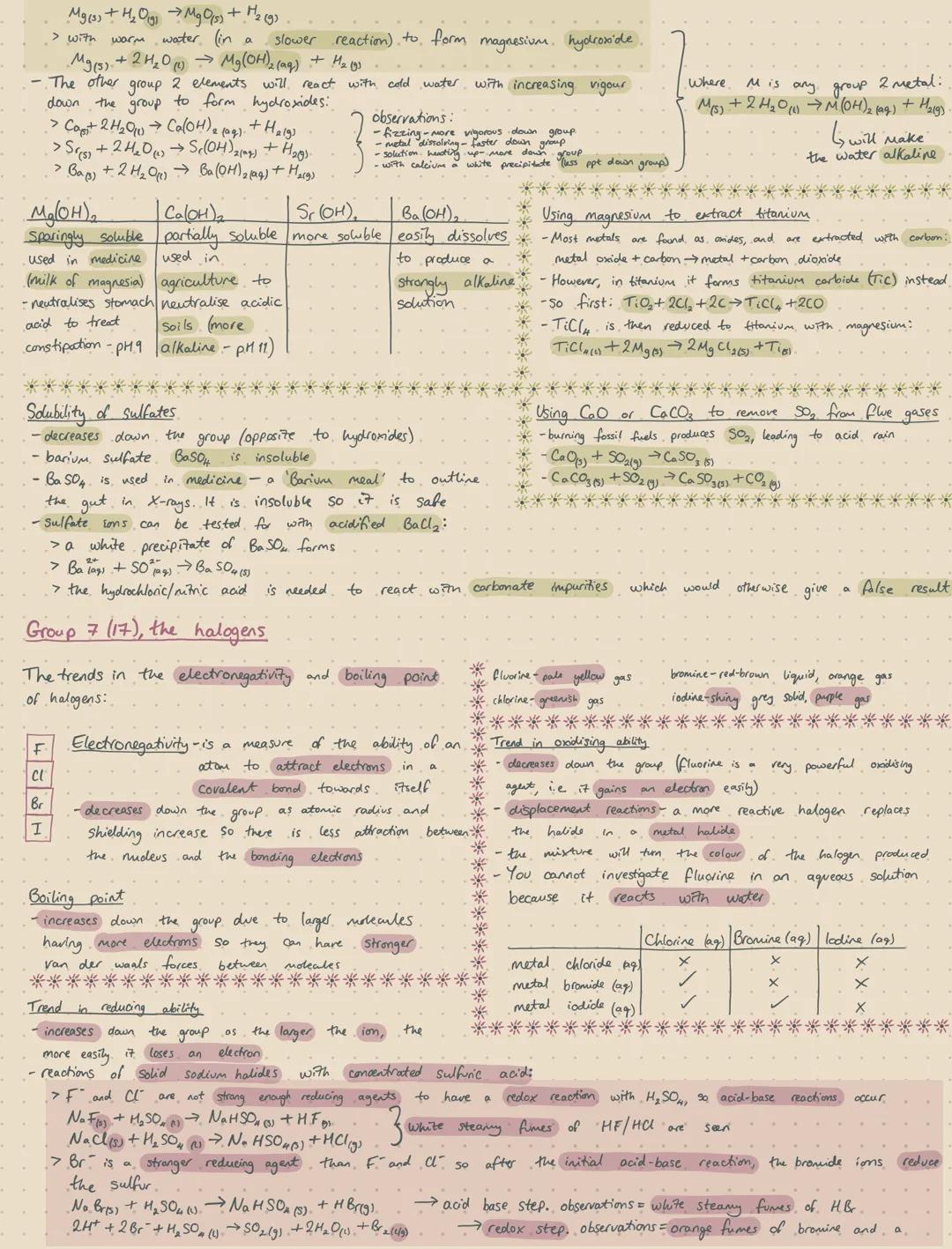
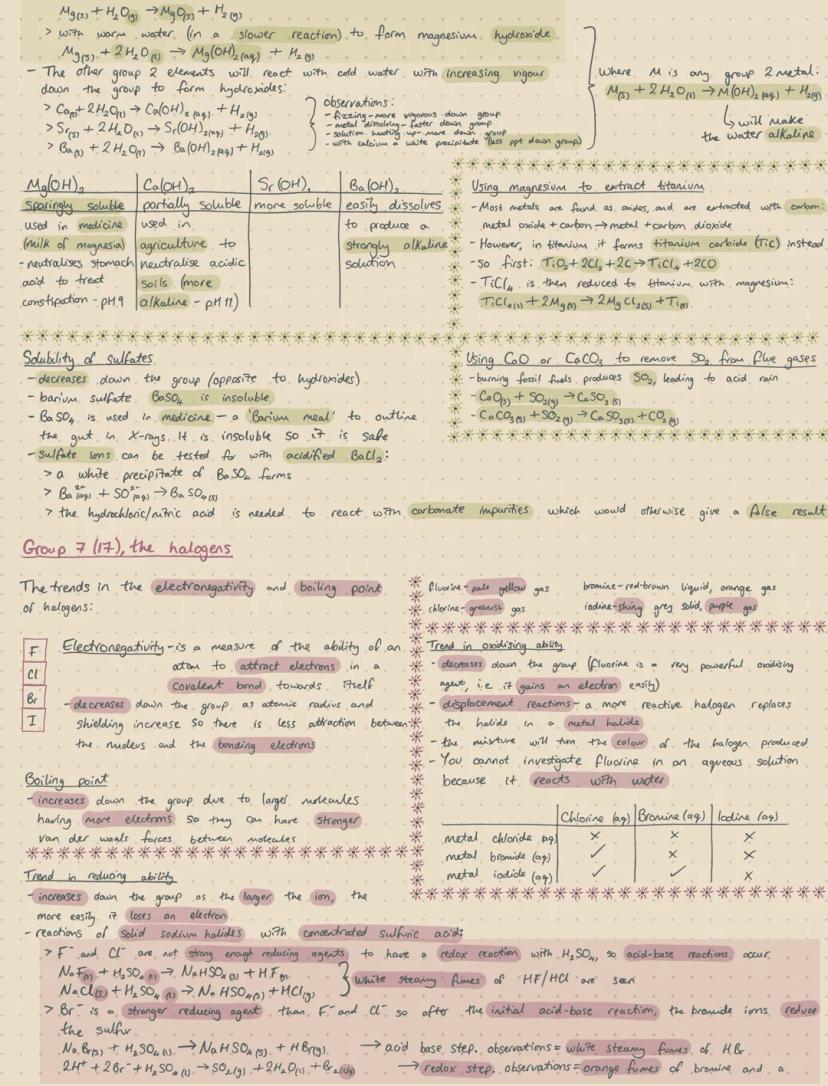
Group 2 reactivity with water increases dramatically down the group. Magnesium barely reacts with cold water but produces magnesium oxide with steam. Calcium, strontium and barium react more vigorously with cold water, producing hydroxides and fizzing more violently as you go down.
The solubility trends are crucial to remember: hydroxides become more soluble down the group (Mg(OH)₂ is sparingly soluble, Ba(OH)₂ dissolves easily), whilst sulfates become less soluble (BaSO₄ is completely insoluble).
Practical applications are everywhere: magnesium extracts titanium metal because it's reactive enough to reduce TiCl₄, calcium compounds remove SO₂ from power station emissions, and barium sulfate is used in medical X-rays because it's completely insoluble and safe.
Real-World Connection: That "barium meal" patients drink before X-rays? It's BaSO₄ - perfectly safe because it won't dissolve in your body!
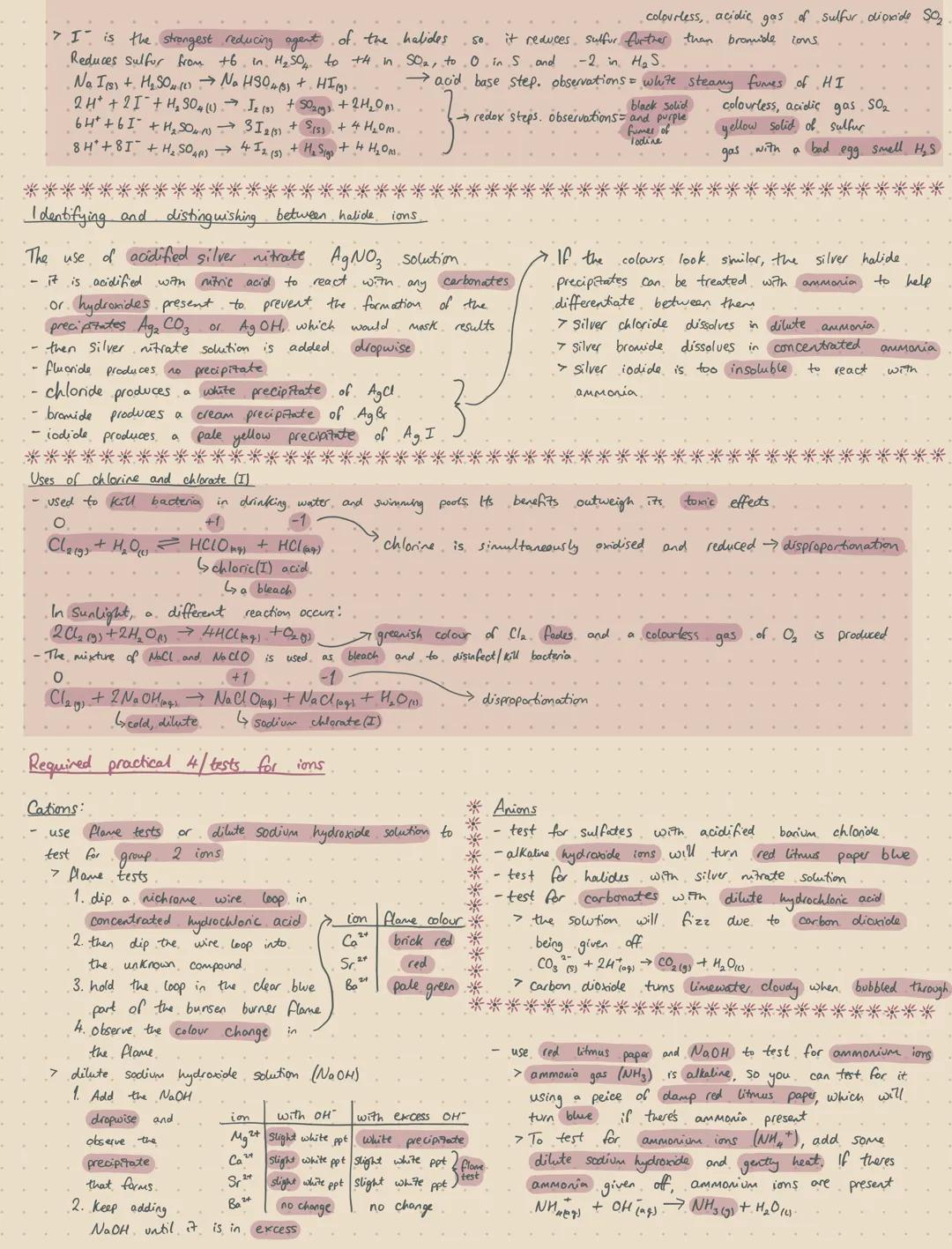
Halogen trends are the opposite of Group 2 in many ways. Electronegativity decreases down the group as atoms get bigger, boiling points increase due to stronger van der Waals forces, and oxidising ability decreases (fluorine is the most powerful oxidising agent).
Displacement reactions show these trends perfectly - chlorine displaces bromine and iodine from their compounds, bromine displaces iodine, but you can't test fluorine in water because it reacts too violently.
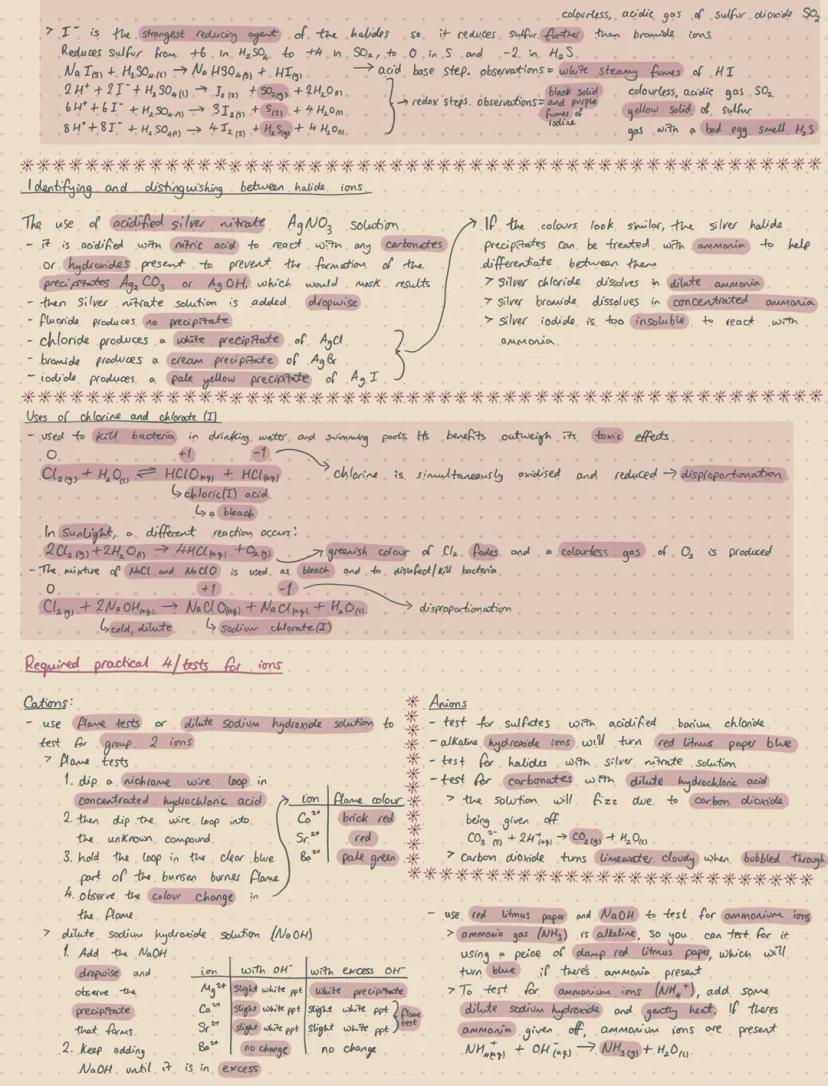
The reactions with concentrated sulfuric acid reveal reducing power: fluorine and chlorine just have acid-base reactions, bromine produces orange fumes and SO₂, whilst iodine goes further - producing purple iodine vapour, yellow sulfur, and even smelly hydrogen sulfide gas.
Testing halides uses silver nitrate: white precipitate for chloride, cream for bromide, pale yellow for iodide. If colours look similar, try ammonia - AgCl dissolves in dilute NH₃, AgBr needs concentrated NH₃, and AgI won't dissolve at all.
Lab Safety Note: These halogen reactions produce toxic gases - always work in a fume cupboard and know your observation colours for exams!
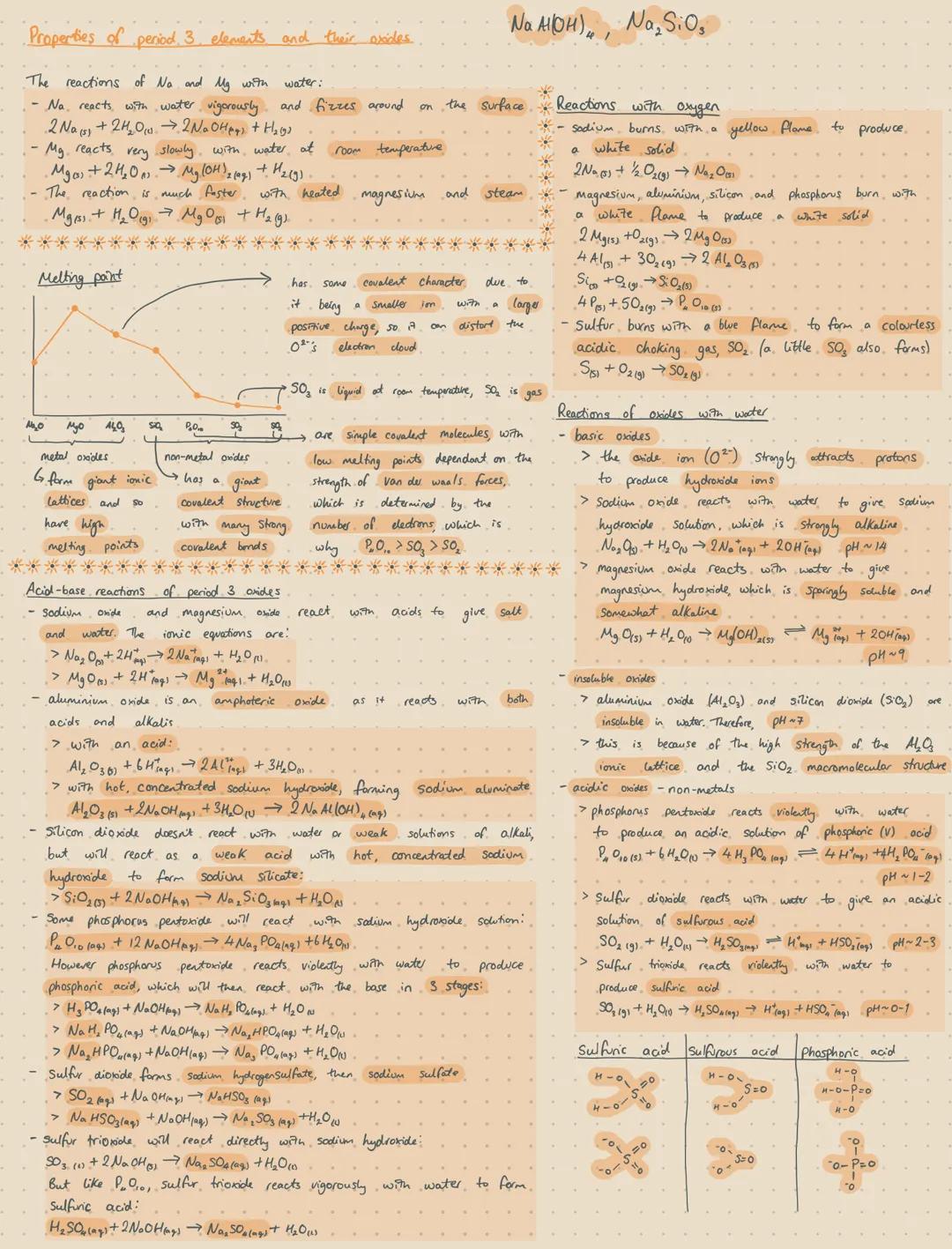
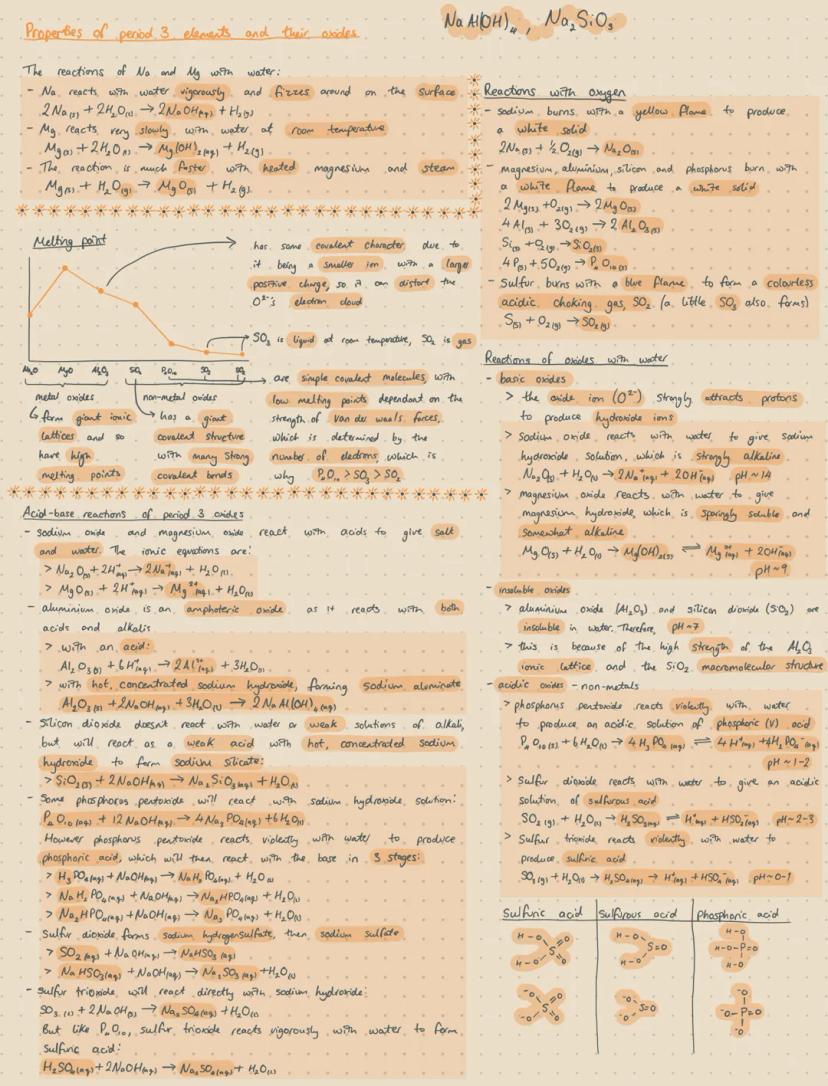
Period 3 oxides show a clear trend from basic to acidic as you move from metals to non-metals. Sodium and magnesium oxides are basic - they react with acids and dissolve in water to form alkaline solutions with pH values around 9-14.
Aluminium oxide is special because it's amphoteric - it reacts with both acids AND bases. This makes it incredibly useful industrially. Silicon dioxide is largely unreactive due to its giant covalent structure.
Non-metal oxides like P₄O₁₀, SO₂ and SO₃ are acidic oxides. They react vigorously with water to form strong acids (phosphoric, sulfurous, and sulfuric acids respectively) with very low pH values (0-3).
The melting point pattern reflects structure: ionic oxides have high melting points, SiO₂ has an extremely high melting point due to giant covalent bonding, whilst simple molecular oxides like SO₂ have low melting points.
Exam Strategy: Learn the pH values and whether oxides dissolve in water - this comes up frequently in multiple choice questions!
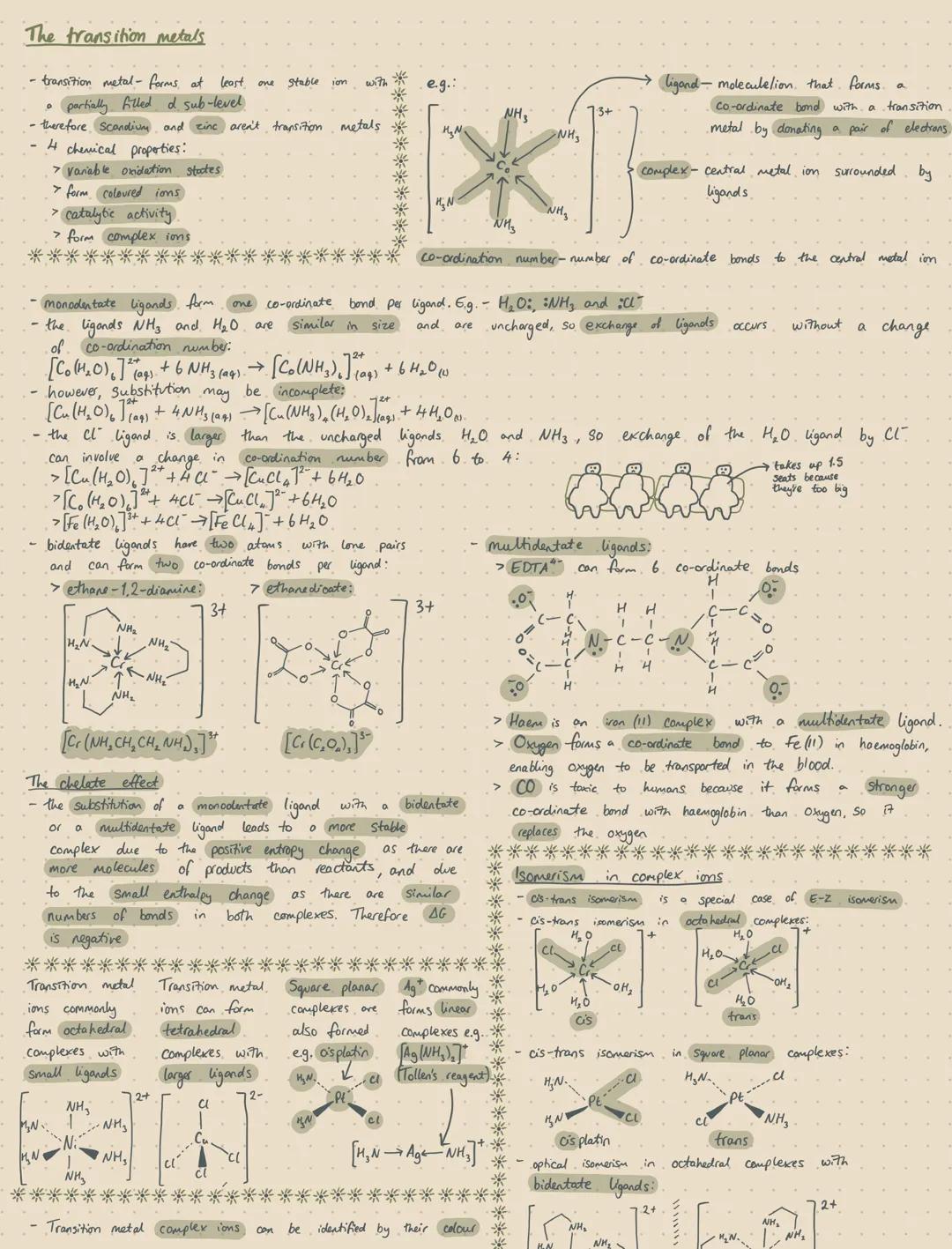
Transition metals are defined as elements forming at least one stable ion with a partially filled d sub-shell. This excludes scandium and zinc from being "true" transition metals, despite their position in the periodic table.
Complex ions form when ligands (molecules or ions with lone pairs) form coordinate bonds with central metal ions. Coordination number tells you how many coordinate bonds surround the metal - usually 4 or 6.
Ligand exchange reactions are fascinating: water ligands can be replaced by ammonia without changing coordination number (both are similar sized and neutral), but chloride ligands are larger and often change coordination from 6 to 4.
Bidentate ligands like ethane-1,2-diamine can form two coordinate bonds per molecule, making complexes more stable. They "take up 1.5 seats" around the metal ion because they're bulkier than monodentate ligands.
Visual Learning Tip: Draw out these complex ions - seeing the 3D arrangements helps you understand why coordination numbers change with different ligands!
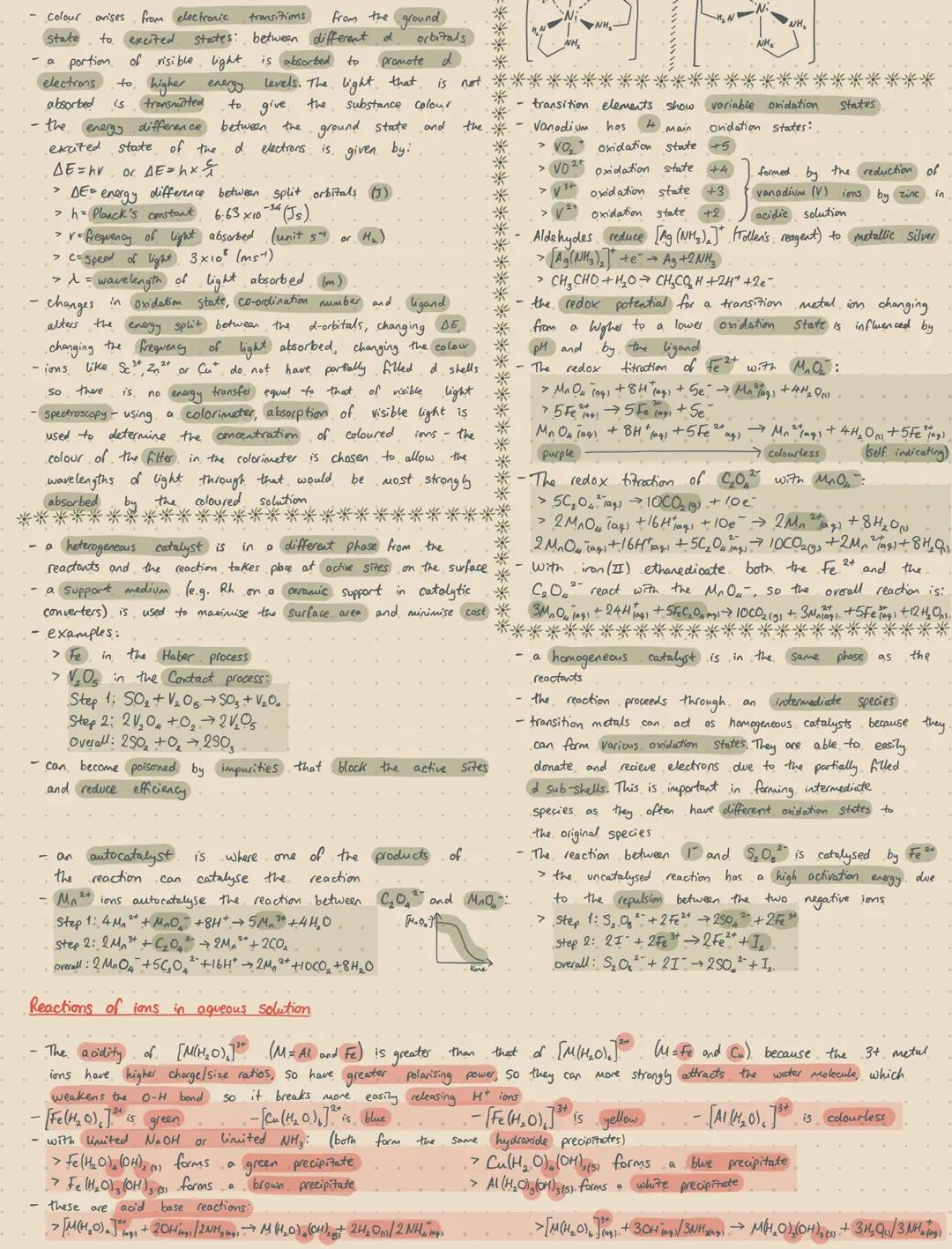
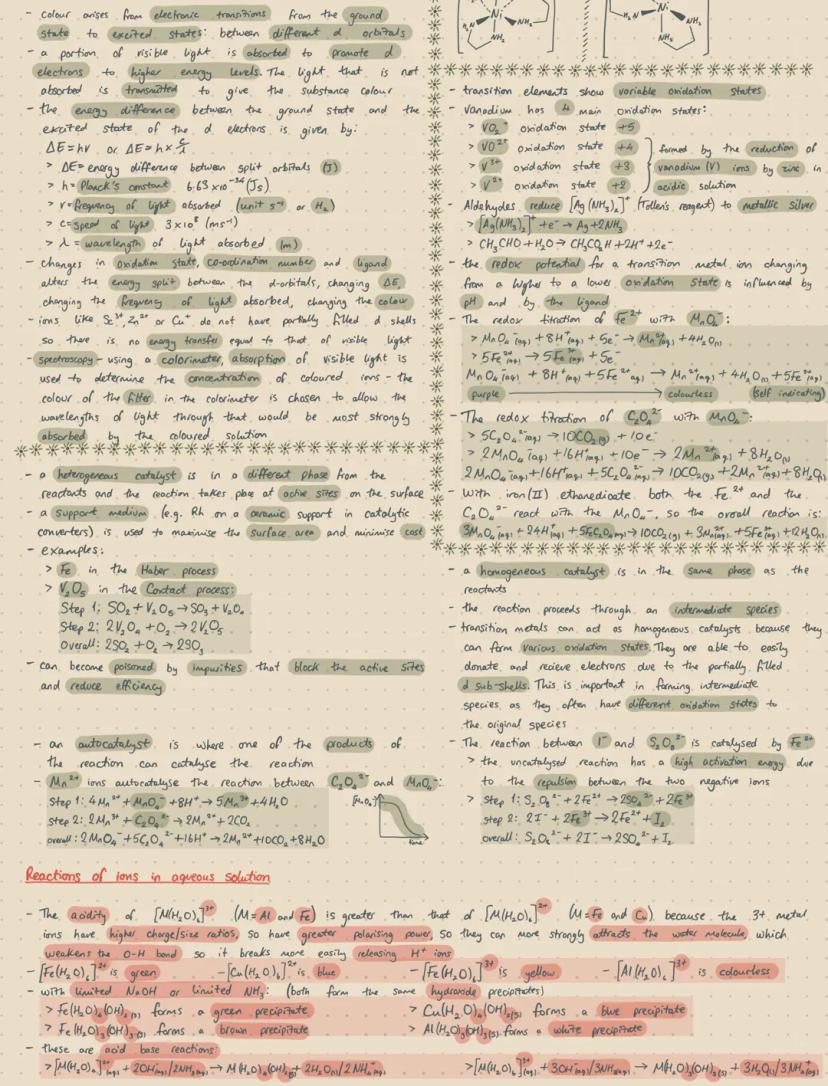
Colour in transition metals comes from d-electrons jumping between energy levels when they absorb specific wavelengths of visible light. The colour you see is what's left after certain wavelengths are absorbed.
Variable oxidation states make transition metals excellent catalysts. Vanadium shows +2, +3, +4, and +5 states with distinctive colours - perfect for demonstrating redox reactions in the lab.
Catalysis works in two ways: heterogeneous catalysts (like iron in the Haber process) are in a different phase from reactants, whilst homogeneous catalysts are in the same phase and work through intermediate species.
Redox titrations with transition metals are self-indicating. MnO₄⁻ (purple) turning colourless at the endpoint means no indicator needed - the manganese ion itself shows when the reaction's complete.
Lab Connection: That purple potassium manganate(VII) you use in titrations? It's the perfect example of transition metal colour and redox chemistry working together!

Aqueous metal ions behave as weak acids because water ligands can lose H⁺ ions. When you add NaOH dropwise, you get coloured precipitates: green for Fe²⁺, brown for Fe³⁺, blue for Cu²⁺, and white for Al³⁺.
Excess NaOH causes different behaviour: iron and copper precipitates remain unchanged, but aluminium dissolves to form a colourless solution because Al(OH)₃ is amphoteric.
Ammonia addition also gives precipitates initially, but excess NH₃ dissolves the copper precipitate to form the stunning deep blue [Cu(NH₃)₄(H₂O)₂]²⁺ complex - one of chemistry's most beautiful colour changes.
Carbonate reactions are trickier because CO₃²⁻ ions react with water around highly charged ions like Fe³⁺ and Al³⁺, producing bubbles of CO₂ and hydroxide precipitates instead of simple carbonates.
Practical Exam Focus: These precipitation reactions are perfect for identifying unknown metal ions - learn the colours and what happens with excess reagents!
Our AI Companion is a student-focused AI tool that offers more than just answers. Built on millions of Knowunity resources, it provides relevant information, personalised study plans, quizzes, and content directly in the chat, adapting to your individual learning journey.
You can download the app from Google Play Store and Apple App Store.
That's right! Enjoy free access to study content, connect with fellow students, and get instant help – all at your fingertips.
App Store
Google Play
The app is very easy to use and well designed. I have found everything I was looking for so far and have been able to learn a lot from the presentations! I will definitely use the app for a class assignment! And of course it also helps a lot as an inspiration.
Stefan S
iOS user
This app is really great. There are so many study notes and help [...]. My problem subject is French, for example, and the app has so many options for help. Thanks to this app, I have improved my French. I would recommend it to anyone.
Samantha Klich
Android user
Wow, I am really amazed. I just tried the app because I've seen it advertised many times and was absolutely stunned. This app is THE HELP you want for school and above all, it offers so many things, such as workouts and fact sheets, which have been VERY helpful to me personally.
Anna
iOS user
Best app on earth! no words because it’s too good
Thomas R
iOS user
Just amazing. Let's me revise 10x better, this app is a quick 10/10. I highly recommend it to anyone. I can watch and search for notes. I can save them in the subject folder. I can revise it any time when I come back. If you haven't tried this app, you're really missing out.
Basil
Android user
This app has made me feel so much more confident in my exam prep, not only through boosting my own self confidence through the features that allow you to connect with others and feel less alone, but also through the way the app itself is centred around making you feel better. It is easy to navigate, fun to use, and helpful to anyone struggling in absolutely any way.
David K
iOS user
The app's just great! All I have to do is enter the topic in the search bar and I get the response real fast. I don't have to watch 10 YouTube videos to understand something, so I'm saving my time. Highly recommended!
Sudenaz Ocak
Android user
In school I was really bad at maths but thanks to the app, I am doing better now. I am so grateful that you made the app.
Greenlight Bonnie
Android user
very reliable app to help and grow your ideas of Maths, English and other related topics in your works. please use this app if your struggling in areas, this app is key for that. wish I'd of done a review before. and it's also free so don't worry about that.
Rohan U
Android user
I know a lot of apps use fake accounts to boost their reviews but this app deserves it all. Originally I was getting 4 in my English exams and this time I got a grade 7. I didn’t even know about this app three days until the exam and it has helped A LOT. Please actually trust me and use it as I’m sure you too will see developments.
Xander S
iOS user
THE QUIZES AND FLASHCARDS ARE SO USEFUL AND I LOVE Knowunity AI. IT ALSO IS LITREALLY LIKE CHATGPT BUT SMARTER!! HELPED ME WITH MY MASCARA PROBLEMS TOO!! AS WELL AS MY REAL SUBJECTS ! DUHHH 😍😁😲🤑💗✨🎀😮
Elisha
iOS user
This apps acc the goat. I find revision so boring but this app makes it so easy to organize it all and then you can ask the freeeee ai to test yourself so good and you can easily upload your own stuff. highly recommend as someone taking mocks now
Paul T
iOS user
The app is very easy to use and well designed. I have found everything I was looking for so far and have been able to learn a lot from the presentations! I will definitely use the app for a class assignment! And of course it also helps a lot as an inspiration.
Stefan S
iOS user
This app is really great. There are so many study notes and help [...]. My problem subject is French, for example, and the app has so many options for help. Thanks to this app, I have improved my French. I would recommend it to anyone.
Samantha Klich
Android user
Wow, I am really amazed. I just tried the app because I've seen it advertised many times and was absolutely stunned. This app is THE HELP you want for school and above all, it offers so many things, such as workouts and fact sheets, which have been VERY helpful to me personally.
Anna
iOS user
Best app on earth! no words because it’s too good
Thomas R
iOS user
Just amazing. Let's me revise 10x better, this app is a quick 10/10. I highly recommend it to anyone. I can watch and search for notes. I can save them in the subject folder. I can revise it any time when I come back. If you haven't tried this app, you're really missing out.
Basil
Android user
This app has made me feel so much more confident in my exam prep, not only through boosting my own self confidence through the features that allow you to connect with others and feel less alone, but also through the way the app itself is centred around making you feel better. It is easy to navigate, fun to use, and helpful to anyone struggling in absolutely any way.
David K
iOS user
The app's just great! All I have to do is enter the topic in the search bar and I get the response real fast. I don't have to watch 10 YouTube videos to understand something, so I'm saving my time. Highly recommended!
Sudenaz Ocak
Android user
In school I was really bad at maths but thanks to the app, I am doing better now. I am so grateful that you made the app.
Greenlight Bonnie
Android user
very reliable app to help and grow your ideas of Maths, English and other related topics in your works. please use this app if your struggling in areas, this app is key for that. wish I'd of done a review before. and it's also free so don't worry about that.
Rohan U
Android user
I know a lot of apps use fake accounts to boost their reviews but this app deserves it all. Originally I was getting 4 in my English exams and this time I got a grade 7. I didn’t even know about this app three days until the exam and it has helped A LOT. Please actually trust me and use it as I’m sure you too will see developments.
Xander S
iOS user
THE QUIZES AND FLASHCARDS ARE SO USEFUL AND I LOVE Knowunity AI. IT ALSO IS LITREALLY LIKE CHATGPT BUT SMARTER!! HELPED ME WITH MY MASCARA PROBLEMS TOO!! AS WELL AS MY REAL SUBJECTS ! DUHHH 😍😁😲🤑💗✨🎀😮
Elisha
iOS user
This apps acc the goat. I find revision so boring but this app makes it so easy to organize it all and then you can ask the freeeee ai to test yourself so good and you can easily upload your own stuff. highly recommend as someone taking mocks now
Paul T
iOS user
Emily
@emily_knhn
This content covers the essential chemistry of periodicity, Group 2 and 7 elements, and transition metals that you'll need for your A-Level exams. You'll learn about key trends across periods and down groups, plus the fascinating world of transition metal... Show more
Access to all documents
Improve your grades
Join milions of students
By signing up you accept Terms of Service and Privacy Policy
Periodic trends across period 3 are all about nuclear charge increasing whilst electrons stay in the same shell. This makes atomic radius decrease and first ionisation energy increase as you go from sodium to chlorine.
Melting points follow a clear pattern: metals like sodium and magnesium have giant metallic structures with strong bonding, silicon has a giant covalent structure , whilst phosphorus to argon are simple molecules held together by weak van der Waals forces.
Group 2 metals (magnesium to barium) are called alkaline earth metals because their oxides and hydroxides are alkaline. Going down the group, atomic radius increases due to more electron shells, first ionisation energy decreases due to increased shielding, and melting points decrease as metallic bonding weakens.
Key Exam Tip: Remember that beryllium isn't typical of Group 2, so it's often excluded from trend questions. Focus on Mg-Ba patterns.
Access to all documents
Improve your grades
Join milions of students
By signing up you accept Terms of Service and Privacy Policy
Group 2 reactivity with water increases dramatically down the group. Magnesium barely reacts with cold water but produces magnesium oxide with steam. Calcium, strontium and barium react more vigorously with cold water, producing hydroxides and fizzing more violently as you go down.
The solubility trends are crucial to remember: hydroxides become more soluble down the group (Mg(OH)₂ is sparingly soluble, Ba(OH)₂ dissolves easily), whilst sulfates become less soluble (BaSO₄ is completely insoluble).
Practical applications are everywhere: magnesium extracts titanium metal because it's reactive enough to reduce TiCl₄, calcium compounds remove SO₂ from power station emissions, and barium sulfate is used in medical X-rays because it's completely insoluble and safe.
Real-World Connection: That "barium meal" patients drink before X-rays? It's BaSO₄ - perfectly safe because it won't dissolve in your body!
Access to all documents
Improve your grades
Join milions of students
By signing up you accept Terms of Service and Privacy Policy
Halogen trends are the opposite of Group 2 in many ways. Electronegativity decreases down the group as atoms get bigger, boiling points increase due to stronger van der Waals forces, and oxidising ability decreases (fluorine is the most powerful oxidising agent).
Displacement reactions show these trends perfectly - chlorine displaces bromine and iodine from their compounds, bromine displaces iodine, but you can't test fluorine in water because it reacts too violently.
The reactions with concentrated sulfuric acid reveal reducing power: fluorine and chlorine just have acid-base reactions, bromine produces orange fumes and SO₂, whilst iodine goes further - producing purple iodine vapour, yellow sulfur, and even smelly hydrogen sulfide gas.
Testing halides uses silver nitrate: white precipitate for chloride, cream for bromide, pale yellow for iodide. If colours look similar, try ammonia - AgCl dissolves in dilute NH₃, AgBr needs concentrated NH₃, and AgI won't dissolve at all.
Lab Safety Note: These halogen reactions produce toxic gases - always work in a fume cupboard and know your observation colours for exams!
Access to all documents
Improve your grades
Join milions of students
By signing up you accept Terms of Service and Privacy Policy
Period 3 oxides show a clear trend from basic to acidic as you move from metals to non-metals. Sodium and magnesium oxides are basic - they react with acids and dissolve in water to form alkaline solutions with pH values around 9-14.
Aluminium oxide is special because it's amphoteric - it reacts with both acids AND bases. This makes it incredibly useful industrially. Silicon dioxide is largely unreactive due to its giant covalent structure.
Non-metal oxides like P₄O₁₀, SO₂ and SO₃ are acidic oxides. They react vigorously with water to form strong acids (phosphoric, sulfurous, and sulfuric acids respectively) with very low pH values (0-3).
The melting point pattern reflects structure: ionic oxides have high melting points, SiO₂ has an extremely high melting point due to giant covalent bonding, whilst simple molecular oxides like SO₂ have low melting points.
Exam Strategy: Learn the pH values and whether oxides dissolve in water - this comes up frequently in multiple choice questions!
Access to all documents
Improve your grades
Join milions of students
By signing up you accept Terms of Service and Privacy Policy
Transition metals are defined as elements forming at least one stable ion with a partially filled d sub-shell. This excludes scandium and zinc from being "true" transition metals, despite their position in the periodic table.
Complex ions form when ligands (molecules or ions with lone pairs) form coordinate bonds with central metal ions. Coordination number tells you how many coordinate bonds surround the metal - usually 4 or 6.
Ligand exchange reactions are fascinating: water ligands can be replaced by ammonia without changing coordination number (both are similar sized and neutral), but chloride ligands are larger and often change coordination from 6 to 4.
Bidentate ligands like ethane-1,2-diamine can form two coordinate bonds per molecule, making complexes more stable. They "take up 1.5 seats" around the metal ion because they're bulkier than monodentate ligands.
Visual Learning Tip: Draw out these complex ions - seeing the 3D arrangements helps you understand why coordination numbers change with different ligands!
Access to all documents
Improve your grades
Join milions of students
By signing up you accept Terms of Service and Privacy Policy
Colour in transition metals comes from d-electrons jumping between energy levels when they absorb specific wavelengths of visible light. The colour you see is what's left after certain wavelengths are absorbed.
Variable oxidation states make transition metals excellent catalysts. Vanadium shows +2, +3, +4, and +5 states with distinctive colours - perfect for demonstrating redox reactions in the lab.
Catalysis works in two ways: heterogeneous catalysts (like iron in the Haber process) are in a different phase from reactants, whilst homogeneous catalysts are in the same phase and work through intermediate species.
Redox titrations with transition metals are self-indicating. MnO₄⁻ (purple) turning colourless at the endpoint means no indicator needed - the manganese ion itself shows when the reaction's complete.
Lab Connection: That purple potassium manganate(VII) you use in titrations? It's the perfect example of transition metal colour and redox chemistry working together!
Access to all documents
Improve your grades
Join milions of students
By signing up you accept Terms of Service and Privacy Policy
Aqueous metal ions behave as weak acids because water ligands can lose H⁺ ions. When you add NaOH dropwise, you get coloured precipitates: green for Fe²⁺, brown for Fe³⁺, blue for Cu²⁺, and white for Al³⁺.
Excess NaOH causes different behaviour: iron and copper precipitates remain unchanged, but aluminium dissolves to form a colourless solution because Al(OH)₃ is amphoteric.
Ammonia addition also gives precipitates initially, but excess NH₃ dissolves the copper precipitate to form the stunning deep blue [Cu(NH₃)₄(H₂O)₂]²⁺ complex - one of chemistry's most beautiful colour changes.
Carbonate reactions are trickier because CO₃²⁻ ions react with water around highly charged ions like Fe³⁺ and Al³⁺, producing bubbles of CO₂ and hydroxide precipitates instead of simple carbonates.
Practical Exam Focus: These precipitation reactions are perfect for identifying unknown metal ions - learn the colours and what happens with excess reagents!
Our AI Companion is a student-focused AI tool that offers more than just answers. Built on millions of Knowunity resources, it provides relevant information, personalised study plans, quizzes, and content directly in the chat, adapting to your individual learning journey.
You can download the app from Google Play Store and Apple App Store.
That's right! Enjoy free access to study content, connect with fellow students, and get instant help – all at your fingertips.
5
Smart Tools NEW
Transform this note into: ✓ 50+ Practice Questions ✓ Interactive Flashcards ✓ Full Mock Exam ✓ Essay Outlines
Explore key concepts in A-level chemistry with this comprehensive overview of periodic trends, focusing on Group 2 (alkaline earth metals) and Group 7 (halogens). Understand redox reactions, ionization energy, atomic radius, and the reactivity of elements. Ideal for revision and exam preparation.
 Chemistry
Explore the physical and chemical properties of Group 2 elements (alkaline earth metals) including trends in solubility, ionization energy, and reactivity with water. This summary covers key concepts such as metallic bonding, oxidation-reduction reactions, and the formation of hydroxides and metal oxides. Ideal for A Level Chemistry students.
ChemistryExplore the mechanisms and reactions of carbonyl compounds, including aldehydes and ketones. This summary covers nucleophilic addition, oxidation processes, and the role of reducing agents like NaBH4. Ideal for organic chemistry students seeking to understand functional groups and their transformations.
ChemistryExplore the chemistry of Group 7 elements, including halide ion tests, precipitation reactions, and redox processes. This summary covers key concepts such as periodic trends, water treatment applications, and required practicals for AQA A-level inorganic chemistry.
ChemistryExplore the properties, trends, and reactions of Group 7 elements (Halogens) in this detailed summary. Understand key concepts such as electronegativity, displacement reactions, and the identification of halide ions through various tests. Ideal for AQA AS Chemistry students seeking to grasp the fundamentals of halogens and their chemical behavior.
ChemistryApp Store
Google Play
The app is very easy to use and well designed. I have found everything I was looking for so far and have been able to learn a lot from the presentations! I will definitely use the app for a class assignment! And of course it also helps a lot as an inspiration.
Stefan S
iOS user
This app is really great. There are so many study notes and help [...]. My problem subject is French, for example, and the app has so many options for help. Thanks to this app, I have improved my French. I would recommend it to anyone.
Samantha Klich
Android user
Wow, I am really amazed. I just tried the app because I've seen it advertised many times and was absolutely stunned. This app is THE HELP you want for school and above all, it offers so many things, such as workouts and fact sheets, which have been VERY helpful to me personally.
Anna
iOS user
Best app on earth! no words because it’s too good
Thomas R
iOS user
Just amazing. Let's me revise 10x better, this app is a quick 10/10. I highly recommend it to anyone. I can watch and search for notes. I can save them in the subject folder. I can revise it any time when I come back. If you haven't tried this app, you're really missing out.
Basil
Android user
This app has made me feel so much more confident in my exam prep, not only through boosting my own self confidence through the features that allow you to connect with others and feel less alone, but also through the way the app itself is centred around making you feel better. It is easy to navigate, fun to use, and helpful to anyone struggling in absolutely any way.
David K
iOS user
The app's just great! All I have to do is enter the topic in the search bar and I get the response real fast. I don't have to watch 10 YouTube videos to understand something, so I'm saving my time. Highly recommended!
Sudenaz Ocak
Android user
In school I was really bad at maths but thanks to the app, I am doing better now. I am so grateful that you made the app.
Greenlight Bonnie
Android user
very reliable app to help and grow your ideas of Maths, English and other related topics in your works. please use this app if your struggling in areas, this app is key for that. wish I'd of done a review before. and it's also free so don't worry about that.
Rohan U
Android user
I know a lot of apps use fake accounts to boost their reviews but this app deserves it all. Originally I was getting 4 in my English exams and this time I got a grade 7. I didn’t even know about this app three days until the exam and it has helped A LOT. Please actually trust me and use it as I’m sure you too will see developments.
Xander S
iOS user
THE QUIZES AND FLASHCARDS ARE SO USEFUL AND I LOVE Knowunity AI. IT ALSO IS LITREALLY LIKE CHATGPT BUT SMARTER!! HELPED ME WITH MY MASCARA PROBLEMS TOO!! AS WELL AS MY REAL SUBJECTS ! DUHHH 😍😁😲🤑💗✨🎀😮
Elisha
iOS user
This apps acc the goat. I find revision so boring but this app makes it so easy to organize it all and then you can ask the freeeee ai to test yourself so good and you can easily upload your own stuff. highly recommend as someone taking mocks now
Paul T
iOS user
The app is very easy to use and well designed. I have found everything I was looking for so far and have been able to learn a lot from the presentations! I will definitely use the app for a class assignment! And of course it also helps a lot as an inspiration.
Stefan S
iOS user
This app is really great. There are so many study notes and help [...]. My problem subject is French, for example, and the app has so many options for help. Thanks to this app, I have improved my French. I would recommend it to anyone.
Samantha Klich
Android user
Wow, I am really amazed. I just tried the app because I've seen it advertised many times and was absolutely stunned. This app is THE HELP you want for school and above all, it offers so many things, such as workouts and fact sheets, which have been VERY helpful to me personally.
Anna
iOS user
Best app on earth! no words because it’s too good
Thomas R
iOS user
Just amazing. Let's me revise 10x better, this app is a quick 10/10. I highly recommend it to anyone. I can watch and search for notes. I can save them in the subject folder. I can revise it any time when I come back. If you haven't tried this app, you're really missing out.
Basil
Android user
This app has made me feel so much more confident in my exam prep, not only through boosting my own self confidence through the features that allow you to connect with others and feel less alone, but also through the way the app itself is centred around making you feel better. It is easy to navigate, fun to use, and helpful to anyone struggling in absolutely any way.
David K
iOS user
The app's just great! All I have to do is enter the topic in the search bar and I get the response real fast. I don't have to watch 10 YouTube videos to understand something, so I'm saving my time. Highly recommended!
Sudenaz Ocak
Android user
In school I was really bad at maths but thanks to the app, I am doing better now. I am so grateful that you made the app.
Greenlight Bonnie
Android user
very reliable app to help and grow your ideas of Maths, English and other related topics in your works. please use this app if your struggling in areas, this app is key for that. wish I'd of done a review before. and it's also free so don't worry about that.
Rohan U
Android user
I know a lot of apps use fake accounts to boost their reviews but this app deserves it all. Originally I was getting 4 in my English exams and this time I got a grade 7. I didn’t even know about this app three days until the exam and it has helped A LOT. Please actually trust me and use it as I’m sure you too will see developments.
Xander S
iOS user
THE QUIZES AND FLASHCARDS ARE SO USEFUL AND I LOVE Knowunity AI. IT ALSO IS LITREALLY LIKE CHATGPT BUT SMARTER!! HELPED ME WITH MY MASCARA PROBLEMS TOO!! AS WELL AS MY REAL SUBJECTS ! DUHHH 😍😁😲🤑💗✨🎀😮
Elisha
iOS user
This apps acc the goat. I find revision so boring but this app makes it so easy to organize it all and then you can ask the freeeee ai to test yourself so good and you can easily upload your own stuff. highly recommend as someone taking mocks now
Paul T
iOS user