Key Definitions and Principles
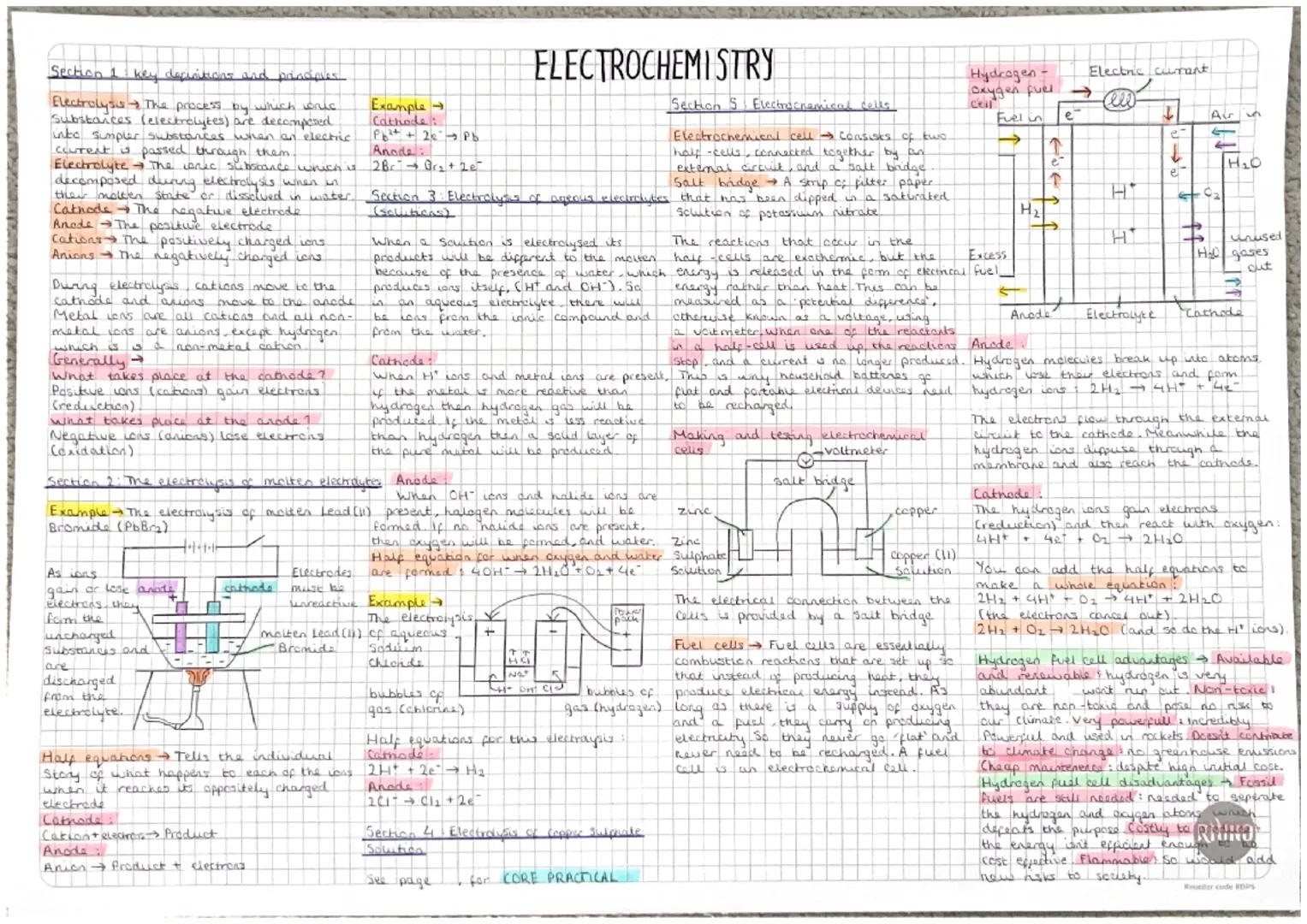
Electrolysis is the process that breaks down ionic substances (called electrolytes) using an electric current. Think of it as using electricity to force chemical reactions that wouldn't normally happen on their own.
The setup involves two electrodes - the cathode (negative) and anode (positive). During electrolysis, positively charged ions (cations) are attracted to the negative cathode, whilst negatively charged ions (anions) head to the positive anode.
Here's the key bit: at the cathode, cations gain electrons (this is called reduction). At the anode, anions lose electrons (called oxidation). Remember this pattern - it's crucial for understanding what products you'll get from any electrolysis reaction.
💡 Quick Tip: Metal ions are always cations, and non-metal ions are anions - except hydrogen, which is a non-metal cation!
Electrolysis of Molten Compounds
When you electrolyse molten ionic compounds, the process is quite straightforward because there's no water to complicate things. Take molten lead bromide (PbBr₂) as an example.
The lead ions (Pb²⁺) move to the cathode where they gain electrons to form pure lead metal. Meanwhile, bromide ions (Br⁻) travel to the anode where they lose electrons and form bromine gas.
Half equations tell you exactly what happens at each electrode. They're like mini-stories showing how ions gain or lose electrons to become discharged (turned into neutral substances).
💡 Remember: In molten electrolysis, you'll always get the metal at the cathode and the non-metal at the anode.
Electrolysis of Solutions
Things get more interesting when you electrolyse solutions because water produces its own ions (H⁺ and OH⁻) that compete with the original compound's ions.
At the cathode, if the metal is more reactive than hydrogen, you'll get hydrogen gas bubbling off instead of the metal. Only less reactive metals (like copper) will actually form at the cathode.
At the anode, halide ions (like Cl⁻ or Br⁻) will form halogen gases if present. If there are no halide ions, you'll get oxygen gas and water instead.
💡 Key Example: Electrolysing sodium chloride solution gives you hydrogen gas at the cathode and chlorine gas at the anode - not sodium metal!
Electrochemical Cells and Fuel Cells
Electrochemical cells work like the reverse of electrolysis - they use chemical reactions to generate electricity rather than using electricity to force reactions. They consist of two half-cells connected by a salt bridge.
Hydrogen fuel cells are particularly clever. They combine hydrogen and oxygen to produce water, electricity, and nothing else harmful. The hydrogen molecules split into ions and electrons, with electrons flowing through an external circuit to create current.
These fuel cells are brilliant because they're renewable and don't produce greenhouse gases. However, they're still expensive to make and often require fossil fuels to produce the hydrogen in the first place.
💡 Future Energy: Fuel cells could power cars and homes cleanly, but the technology needs to become more cost-effective first.


 Chemistry
 English Literature
 Sociology
 Biology