
Understanding how atoms bond together is the key to explaining... Show more
 Chemistry
 English Literature
 Sociology
 Biology
Sign up to see the contentIt's free!
Access to all documents
Improve your grades
Join milions of students
By signing up you accept Terms of Service and Privacy Policy
Subjects
Classic Dramatic Literature
Modern Lyric Poetry
Influential English-Language Authors
Classic and Contemporary Novels
Literary Character Analysis
Romantic and Love Poetry
Reading Analysis and Interpretation
Evidence Analysis and Integration
Author's Stylistic Elements
Figurative Language and Rhetoric
Show all topics
Human Organ Systems
Cellular Organization and Development
Biomolecular Structure and Organization
Enzyme Structure and Regulation
Cellular Organization Types
Biological Homeostatic Processes
Cellular Membrane Structure
Autotrophic Energy Processes
Environmental Sustainability and Impact
Neural Communication Systems
Show all topics
Social Sciences Research & Practice
Social Structure and Mobility
Classic Social Influence Experiments
Social Systems Theories
Family and Relationship Dynamics
Memory Systems and Processes
Neural Bases of Behavior
Social Influence and Attraction
Psychotherapeutic Approaches
Human Agency and Responsibility
Show all topics
Chemical Sciences and Applications
Chemical Bond Types and Properties
Organic Functional Groups
Atomic Structure and Composition
Chromatographic Separation Principles
Chemical Compound Classifications
Electrochemical Cell Systems
Periodic Table Organization
Chemical Reaction Kinetics
Chemical Equation Conservation
Show all topics
Nazi Germany and Holocaust 1933-1945
World Wars and Peace Treaties
European Monarchs and Statesmen
Cold War Global Tensions
Medieval Institutions and Systems
European Renaissance and Enlightenment
Modern Global Environmental-Health Challenges
Modern Military Conflicts
Medieval Migration and Invasions
World Wars Era and Impact
Show all topics
372
•
Updated 6 Mar 2026
•
Olamide
@olamide_26
Understanding how atoms bond together is the key to explaining... Show more
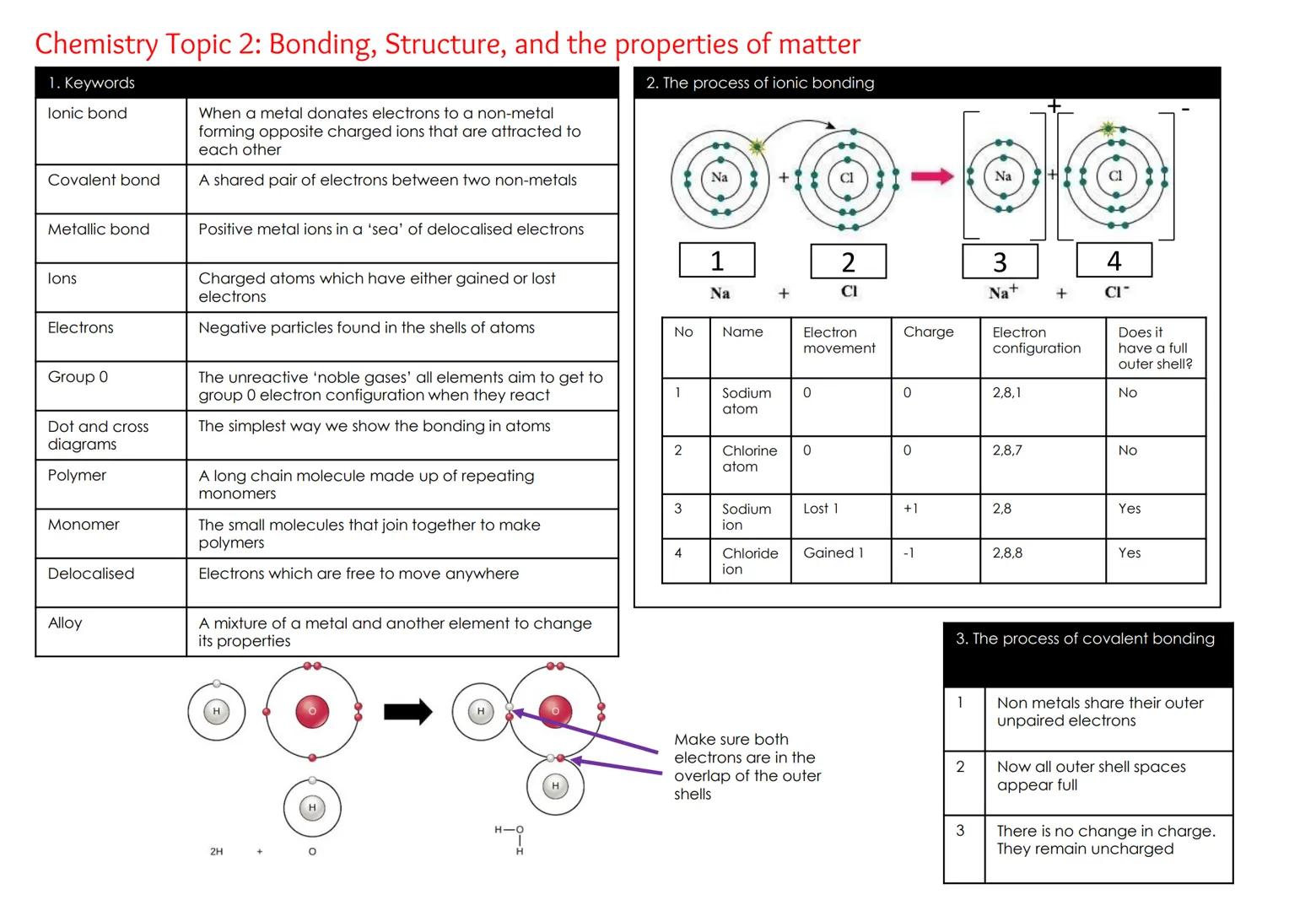
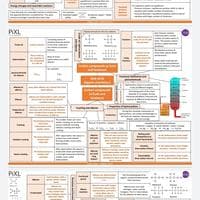
Ever wondered why some materials conduct electricity whilst others don't? It all comes down to how atoms stick together through chemical bonding. There are three main types you need to master for your exams.
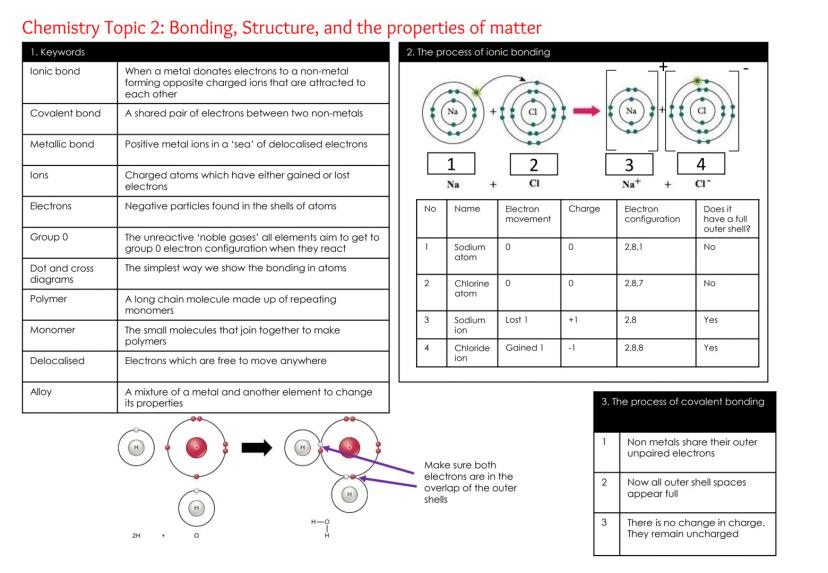
Ionic bonding happens when metals donate electrons to non-metals, creating oppositely charged particles called ions that attract each other strongly. Think of sodium chloride (table salt) - the sodium atom gives up an electron to become Na⁺, whilst chlorine gains it to become Cl⁻.
Covalent bonding occurs when non-metals share pairs of electrons between them. Picture two atoms literally sharing their outer electrons to fill up their electron shells. Hydrogen gas (H₂) is a perfect example - two hydrogen atoms sharing one pair of electrons.
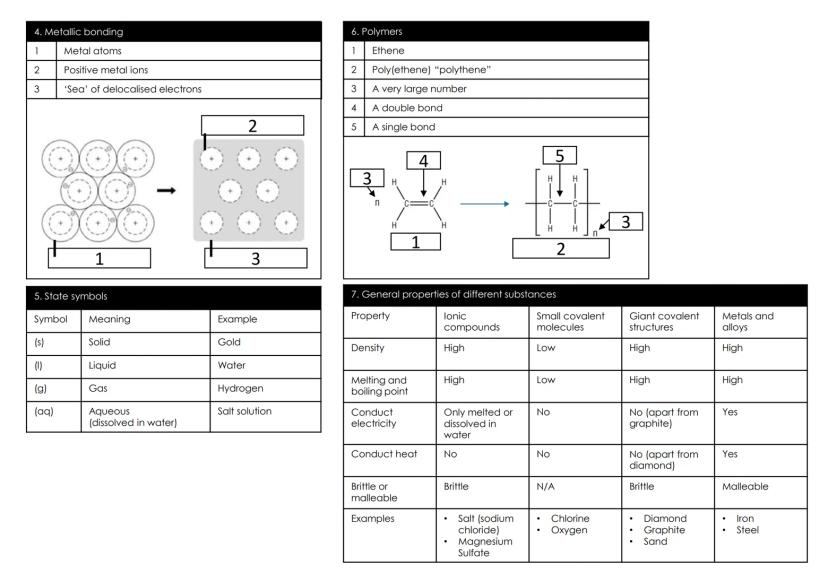
Metallic bonding creates a unique structure where positive metal ions sit in a 'sea' of delocalised electrons that can move freely. This explains why metals conduct electricity and can be hammered into different shapes.
Quick Tip: Remember that all atoms want to achieve a full outer electron shell like the noble gases in Group 0!
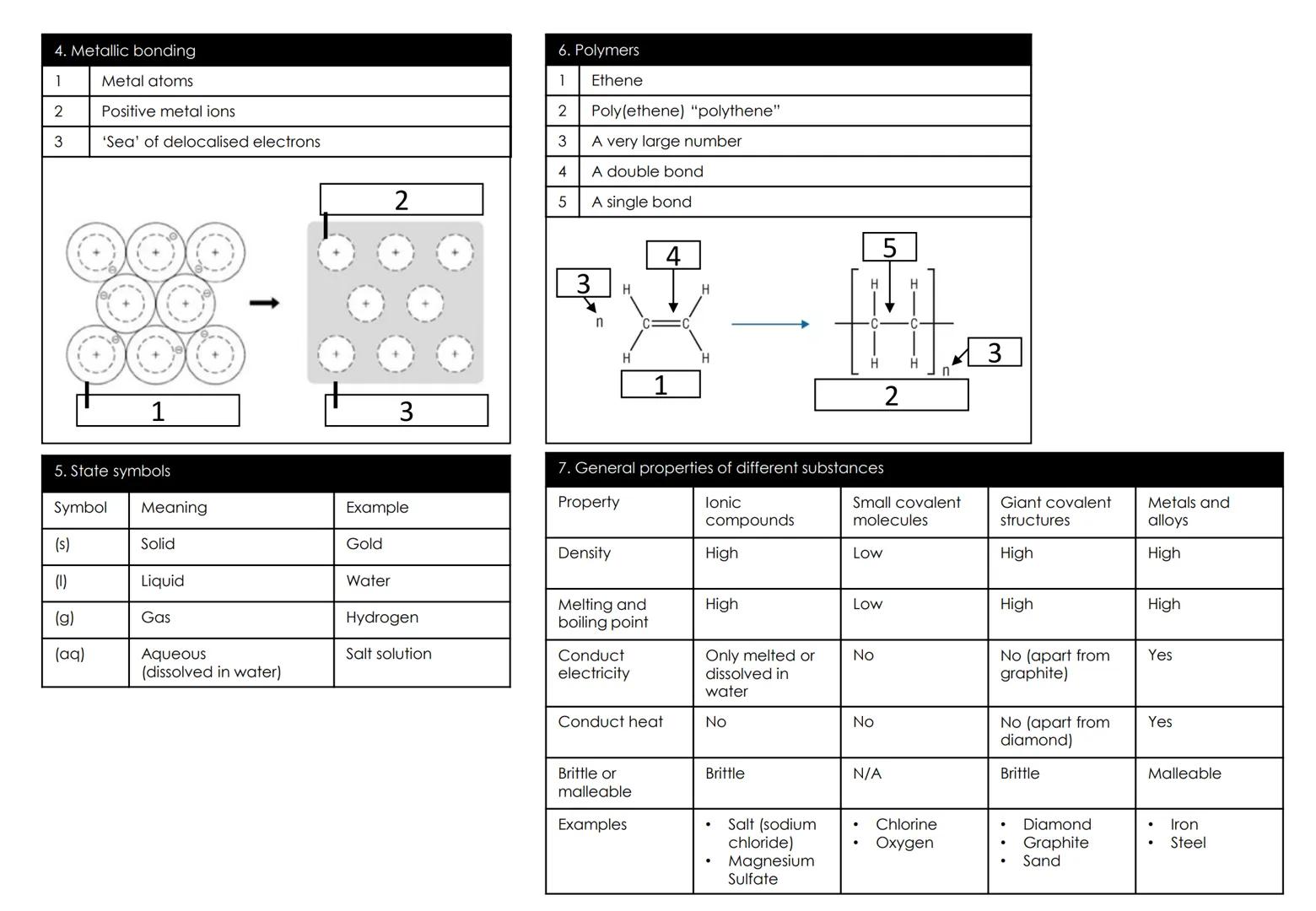
The type of bonding completely determines how a substance behaves, which is crucial for your understanding of materials science. Ionic compounds like salt have high melting points and only conduct electricity when dissolved or melted - never as solids.
Small covalent molecules such as water or oxygen gas have low melting points and don't conduct electricity at all. They're often gases or liquids at room temperature because the forces between molecules are quite weak.
Giant covalent structures like diamond create incredibly hard materials with very high melting points. However, most don't conduct electricity because their electrons are locked in place (graphite being the notable exception).
Metals and alloys are brilliant at conducting both heat and electricity thanks to those mobile delocalised electrons. They're also malleable - you can bash them into different shapes without breaking them, unlike brittle ionic compounds.
Polymers deserve special mention - these are long chain molecules made from repeating units called monomers. Poly(ethene) plastic bags are made from thousands of ethene molecules joined together!
Exam Focus: Learn the property table - it's a guaranteed exam question asking you to match substances to their bonding type!
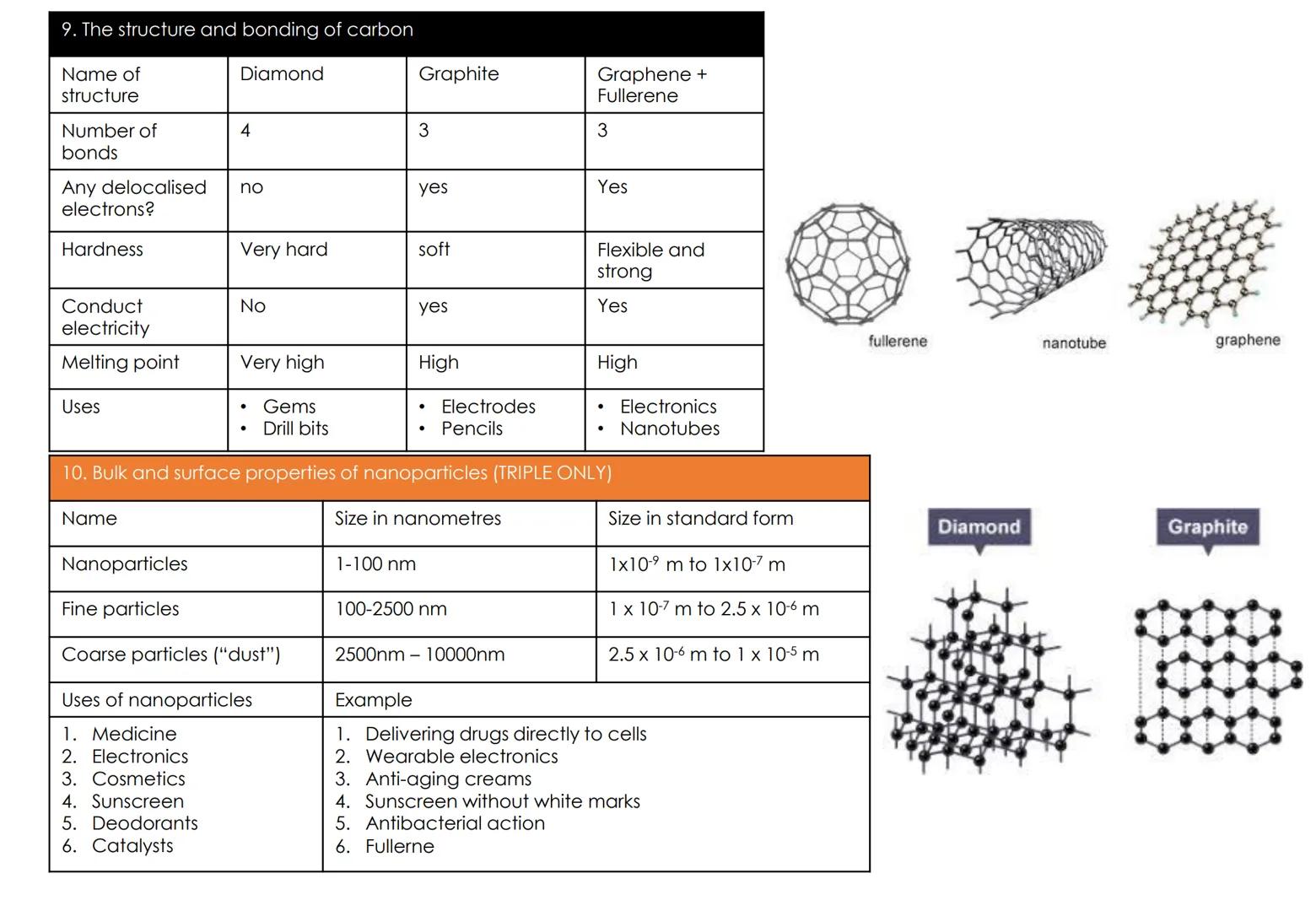
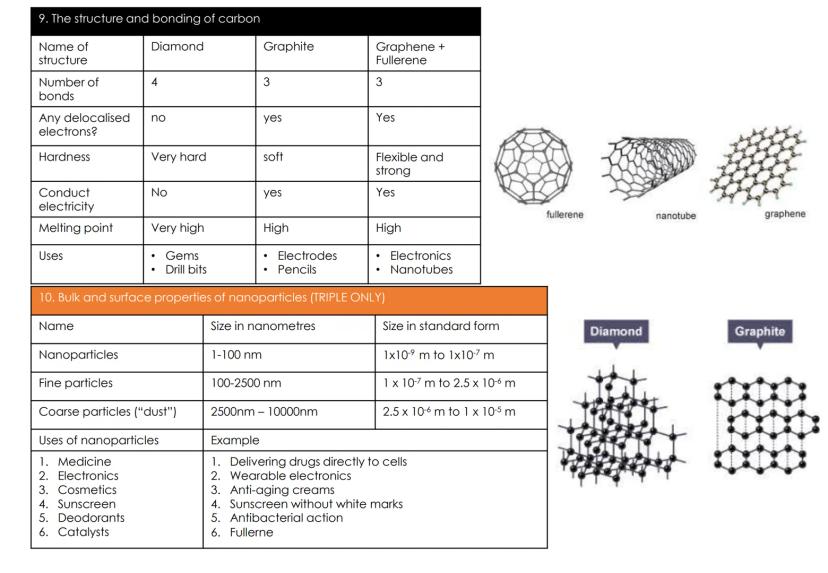
Carbon is absolutely fascinating because it can form completely different structures depending on how its atoms bond together. Diamond uses all four of carbon's electrons in strong covalent bonds, creating the hardest natural substance - perfect for drill bits and expensive jewellery!
Graphite only uses three electrons for bonding, leaving one free to move around. This makes it soft (great for pencils) and able to conduct electricity (useful for electrodes). The layers can slide over each other easily, which is why pencils work.
Graphene and fullerenes are newer discoveries with amazing properties. Graphene is basically a single layer of graphite that's incredibly strong yet flexible - perfect for future electronics and touchscreens.
Nanoparticles are tiny materials between 1-100 nanometres that behave very differently from bulk materials. They're revolutionising everything from medicine (delivering drugs directly to cancer cells) to cosmetics (sunscreen that doesn't leave white marks on your skin).
The smaller the particle, the higher the surface area to volume ratio, which makes nanoparticles incredibly reactive and useful as catalysts in industrial processes.
Triple Science Bonus: Remember that 1 nanometre = 1×10⁻⁹ metres - that's incredibly small!
Our AI Companion is a student-focused AI tool that offers more than just answers. Built on millions of Knowunity resources, it provides relevant information, personalised study plans, quizzes, and content directly in the chat, adapting to your individual learning journey.
You can download the app from Google Play Store and Apple App Store.
That's right! Enjoy free access to study content, connect with fellow students, and get instant help – all at your fingertips.
App Store
Google Play
The app is very easy to use and well designed. I have found everything I was looking for so far and have been able to learn a lot from the presentations! I will definitely use the app for a class assignment! And of course it also helps a lot as an inspiration.
Stefan S
iOS user
This app is really great. There are so many study notes and help [...]. My problem subject is French, for example, and the app has so many options for help. Thanks to this app, I have improved my French. I would recommend it to anyone.
Samantha Klich
Android user
Wow, I am really amazed. I just tried the app because I've seen it advertised many times and was absolutely stunned. This app is THE HELP you want for school and above all, it offers so many things, such as workouts and fact sheets, which have been VERY helpful to me personally.
Anna
iOS user
Best app on earth! no words because it’s too good
Thomas R
iOS user
Just amazing. Let's me revise 10x better, this app is a quick 10/10. I highly recommend it to anyone. I can watch and search for notes. I can save them in the subject folder. I can revise it any time when I come back. If you haven't tried this app, you're really missing out.
Basil
Android user
This app has made me feel so much more confident in my exam prep, not only through boosting my own self confidence through the features that allow you to connect with others and feel less alone, but also through the way the app itself is centred around making you feel better. It is easy to navigate, fun to use, and helpful to anyone struggling in absolutely any way.
David K
iOS user
The app's just great! All I have to do is enter the topic in the search bar and I get the response real fast. I don't have to watch 10 YouTube videos to understand something, so I'm saving my time. Highly recommended!
Sudenaz Ocak
Android user
In school I was really bad at maths but thanks to the app, I am doing better now. I am so grateful that you made the app.
Greenlight Bonnie
Android user
very reliable app to help and grow your ideas of Maths, English and other related topics in your works. please use this app if your struggling in areas, this app is key for that. wish I'd of done a review before. and it's also free so don't worry about that.
Rohan U
Android user
I know a lot of apps use fake accounts to boost their reviews but this app deserves it all. Originally I was getting 4 in my English exams and this time I got a grade 7. I didn’t even know about this app three days until the exam and it has helped A LOT. Please actually trust me and use it as I’m sure you too will see developments.
Xander S
iOS user
THE QUIZES AND FLASHCARDS ARE SO USEFUL AND I LOVE Knowunity AI. IT ALSO IS LITREALLY LIKE CHATGPT BUT SMARTER!! HELPED ME WITH MY MASCARA PROBLEMS TOO!! AS WELL AS MY REAL SUBJECTS ! DUHHH 😍😁😲🤑💗✨🎀😮
Elisha
iOS user
This apps acc the goat. I find revision so boring but this app makes it so easy to organize it all and then you can ask the freeeee ai to test yourself so good and you can easily upload your own stuff. highly recommend as someone taking mocks now
Paul T
iOS user
The app is very easy to use and well designed. I have found everything I was looking for so far and have been able to learn a lot from the presentations! I will definitely use the app for a class assignment! And of course it also helps a lot as an inspiration.
Stefan S
iOS user
This app is really great. There are so many study notes and help [...]. My problem subject is French, for example, and the app has so many options for help. Thanks to this app, I have improved my French. I would recommend it to anyone.
Samantha Klich
Android user
Wow, I am really amazed. I just tried the app because I've seen it advertised many times and was absolutely stunned. This app is THE HELP you want for school and above all, it offers so many things, such as workouts and fact sheets, which have been VERY helpful to me personally.
Anna
iOS user
Best app on earth! no words because it’s too good
Thomas R
iOS user
Just amazing. Let's me revise 10x better, this app is a quick 10/10. I highly recommend it to anyone. I can watch and search for notes. I can save them in the subject folder. I can revise it any time when I come back. If you haven't tried this app, you're really missing out.
Basil
Android user
This app has made me feel so much more confident in my exam prep, not only through boosting my own self confidence through the features that allow you to connect with others and feel less alone, but also through the way the app itself is centred around making you feel better. It is easy to navigate, fun to use, and helpful to anyone struggling in absolutely any way.
David K
iOS user
The app's just great! All I have to do is enter the topic in the search bar and I get the response real fast. I don't have to watch 10 YouTube videos to understand something, so I'm saving my time. Highly recommended!
Sudenaz Ocak
Android user
In school I was really bad at maths but thanks to the app, I am doing better now. I am so grateful that you made the app.
Greenlight Bonnie
Android user
very reliable app to help and grow your ideas of Maths, English and other related topics in your works. please use this app if your struggling in areas, this app is key for that. wish I'd of done a review before. and it's also free so don't worry about that.
Rohan U
Android user
I know a lot of apps use fake accounts to boost their reviews but this app deserves it all. Originally I was getting 4 in my English exams and this time I got a grade 7. I didn’t even know about this app three days until the exam and it has helped A LOT. Please actually trust me and use it as I’m sure you too will see developments.
Xander S
iOS user
THE QUIZES AND FLASHCARDS ARE SO USEFUL AND I LOVE Knowunity AI. IT ALSO IS LITREALLY LIKE CHATGPT BUT SMARTER!! HELPED ME WITH MY MASCARA PROBLEMS TOO!! AS WELL AS MY REAL SUBJECTS ! DUHHH 😍😁😲🤑💗✨🎀😮
Elisha
iOS user
This apps acc the goat. I find revision so boring but this app makes it so easy to organize it all and then you can ask the freeeee ai to test yourself so good and you can easily upload your own stuff. highly recommend as someone taking mocks now
Paul T
iOS user
Olamide
@olamide_26
Understanding how atoms bond together is the key to explaining why materials behave so differently - from the hardness of diamond to the flexibility of plastic bags. This topic explores the three main types of chemical bonding and how they... Show more
Access to all documents
Improve your grades
Join milions of students
By signing up you accept Terms of Service and Privacy Policy
Ever wondered why some materials conduct electricity whilst others don't? It all comes down to how atoms stick together through chemical bonding. There are three main types you need to master for your exams.
Ionic bonding happens when metals donate electrons to non-metals, creating oppositely charged particles called ions that attract each other strongly. Think of sodium chloride (table salt) - the sodium atom gives up an electron to become Na⁺, whilst chlorine gains it to become Cl⁻.
Covalent bonding occurs when non-metals share pairs of electrons between them. Picture two atoms literally sharing their outer electrons to fill up their electron shells. Hydrogen gas (H₂) is a perfect example - two hydrogen atoms sharing one pair of electrons.
Metallic bonding creates a unique structure where positive metal ions sit in a 'sea' of delocalised electrons that can move freely. This explains why metals conduct electricity and can be hammered into different shapes.
Quick Tip: Remember that all atoms want to achieve a full outer electron shell like the noble gases in Group 0!
Access to all documents
Improve your grades
Join milions of students
By signing up you accept Terms of Service and Privacy Policy
The type of bonding completely determines how a substance behaves, which is crucial for your understanding of materials science. Ionic compounds like salt have high melting points and only conduct electricity when dissolved or melted - never as solids.
Small covalent molecules such as water or oxygen gas have low melting points and don't conduct electricity at all. They're often gases or liquids at room temperature because the forces between molecules are quite weak.
Giant covalent structures like diamond create incredibly hard materials with very high melting points. However, most don't conduct electricity because their electrons are locked in place (graphite being the notable exception).
Metals and alloys are brilliant at conducting both heat and electricity thanks to those mobile delocalised electrons. They're also malleable - you can bash them into different shapes without breaking them, unlike brittle ionic compounds.
Polymers deserve special mention - these are long chain molecules made from repeating units called monomers. Poly(ethene) plastic bags are made from thousands of ethene molecules joined together!
Exam Focus: Learn the property table - it's a guaranteed exam question asking you to match substances to their bonding type!
Access to all documents
Improve your grades
Join milions of students
By signing up you accept Terms of Service and Privacy Policy
Carbon is absolutely fascinating because it can form completely different structures depending on how its atoms bond together. Diamond uses all four of carbon's electrons in strong covalent bonds, creating the hardest natural substance - perfect for drill bits and expensive jewellery!
Graphite only uses three electrons for bonding, leaving one free to move around. This makes it soft (great for pencils) and able to conduct electricity (useful for electrodes). The layers can slide over each other easily, which is why pencils work.
Graphene and fullerenes are newer discoveries with amazing properties. Graphene is basically a single layer of graphite that's incredibly strong yet flexible - perfect for future electronics and touchscreens.
Nanoparticles are tiny materials between 1-100 nanometres that behave very differently from bulk materials. They're revolutionising everything from medicine (delivering drugs directly to cancer cells) to cosmetics (sunscreen that doesn't leave white marks on your skin).
The smaller the particle, the higher the surface area to volume ratio, which makes nanoparticles incredibly reactive and useful as catalysts in industrial processes.
Triple Science Bonus: Remember that 1 nanometre = 1×10⁻⁹ metres - that's incredibly small!
Our AI Companion is a student-focused AI tool that offers more than just answers. Built on millions of Knowunity resources, it provides relevant information, personalised study plans, quizzes, and content directly in the chat, adapting to your individual learning journey.
You can download the app from Google Play Store and Apple App Store.
That's right! Enjoy free access to study content, connect with fellow students, and get instant help – all at your fingertips.
8
Smart Tools NEW
Transform this note into: ✓ 50+ Practice Questions ✓ Interactive Flashcards ✓ Full Mock Exam ✓ Essay Outlines
App Store
Google Play
The app is very easy to use and well designed. I have found everything I was looking for so far and have been able to learn a lot from the presentations! I will definitely use the app for a class assignment! And of course it also helps a lot as an inspiration.
Stefan S
iOS user
This app is really great. There are so many study notes and help [...]. My problem subject is French, for example, and the app has so many options for help. Thanks to this app, I have improved my French. I would recommend it to anyone.
Samantha Klich
Android user
Wow, I am really amazed. I just tried the app because I've seen it advertised many times and was absolutely stunned. This app is THE HELP you want for school and above all, it offers so many things, such as workouts and fact sheets, which have been VERY helpful to me personally.
Anna
iOS user
Best app on earth! no words because it’s too good
Thomas R
iOS user
Just amazing. Let's me revise 10x better, this app is a quick 10/10. I highly recommend it to anyone. I can watch and search for notes. I can save them in the subject folder. I can revise it any time when I come back. If you haven't tried this app, you're really missing out.
Basil
Android user
This app has made me feel so much more confident in my exam prep, not only through boosting my own self confidence through the features that allow you to connect with others and feel less alone, but also through the way the app itself is centred around making you feel better. It is easy to navigate, fun to use, and helpful to anyone struggling in absolutely any way.
David K
iOS user
The app's just great! All I have to do is enter the topic in the search bar and I get the response real fast. I don't have to watch 10 YouTube videos to understand something, so I'm saving my time. Highly recommended!
Sudenaz Ocak
Android user
In school I was really bad at maths but thanks to the app, I am doing better now. I am so grateful that you made the app.
Greenlight Bonnie
Android user
very reliable app to help and grow your ideas of Maths, English and other related topics in your works. please use this app if your struggling in areas, this app is key for that. wish I'd of done a review before. and it's also free so don't worry about that.
Rohan U
Android user
I know a lot of apps use fake accounts to boost their reviews but this app deserves it all. Originally I was getting 4 in my English exams and this time I got a grade 7. I didn’t even know about this app three days until the exam and it has helped A LOT. Please actually trust me and use it as I’m sure you too will see developments.
Xander S
iOS user
THE QUIZES AND FLASHCARDS ARE SO USEFUL AND I LOVE Knowunity AI. IT ALSO IS LITREALLY LIKE CHATGPT BUT SMARTER!! HELPED ME WITH MY MASCARA PROBLEMS TOO!! AS WELL AS MY REAL SUBJECTS ! DUHHH 😍😁😲🤑💗✨🎀😮
Elisha
iOS user
This apps acc the goat. I find revision so boring but this app makes it so easy to organize it all and then you can ask the freeeee ai to test yourself so good and you can easily upload your own stuff. highly recommend as someone taking mocks now
Paul T
iOS user
The app is very easy to use and well designed. I have found everything I was looking for so far and have been able to learn a lot from the presentations! I will definitely use the app for a class assignment! And of course it also helps a lot as an inspiration.
Stefan S
iOS user
This app is really great. There are so many study notes and help [...]. My problem subject is French, for example, and the app has so many options for help. Thanks to this app, I have improved my French. I would recommend it to anyone.
Samantha Klich
Android user
Wow, I am really amazed. I just tried the app because I've seen it advertised many times and was absolutely stunned. This app is THE HELP you want for school and above all, it offers so many things, such as workouts and fact sheets, which have been VERY helpful to me personally.
Anna
iOS user
Best app on earth! no words because it’s too good
Thomas R
iOS user
Just amazing. Let's me revise 10x better, this app is a quick 10/10. I highly recommend it to anyone. I can watch and search for notes. I can save them in the subject folder. I can revise it any time when I come back. If you haven't tried this app, you're really missing out.
Basil
Android user
This app has made me feel so much more confident in my exam prep, not only through boosting my own self confidence through the features that allow you to connect with others and feel less alone, but also through the way the app itself is centred around making you feel better. It is easy to navigate, fun to use, and helpful to anyone struggling in absolutely any way.
David K
iOS user
The app's just great! All I have to do is enter the topic in the search bar and I get the response real fast. I don't have to watch 10 YouTube videos to understand something, so I'm saving my time. Highly recommended!
Sudenaz Ocak
Android user
In school I was really bad at maths but thanks to the app, I am doing better now. I am so grateful that you made the app.
Greenlight Bonnie
Android user
very reliable app to help and grow your ideas of Maths, English and other related topics in your works. please use this app if your struggling in areas, this app is key for that. wish I'd of done a review before. and it's also free so don't worry about that.
Rohan U
Android user
I know a lot of apps use fake accounts to boost their reviews but this app deserves it all. Originally I was getting 4 in my English exams and this time I got a grade 7. I didn’t even know about this app three days until the exam and it has helped A LOT. Please actually trust me and use it as I’m sure you too will see developments.
Xander S
iOS user
THE QUIZES AND FLASHCARDS ARE SO USEFUL AND I LOVE Knowunity AI. IT ALSO IS LITREALLY LIKE CHATGPT BUT SMARTER!! HELPED ME WITH MY MASCARA PROBLEMS TOO!! AS WELL AS MY REAL SUBJECTS ! DUHHH 😍😁😲🤑💗✨🎀😮
Elisha
iOS user
This apps acc the goat. I find revision so boring but this app makes it so easy to organize it all and then you can ask the freeeee ai to test yourself so good and you can easily upload your own stuff. highly recommend as someone taking mocks now
Paul T
iOS user