Atoms and Atomic Structure
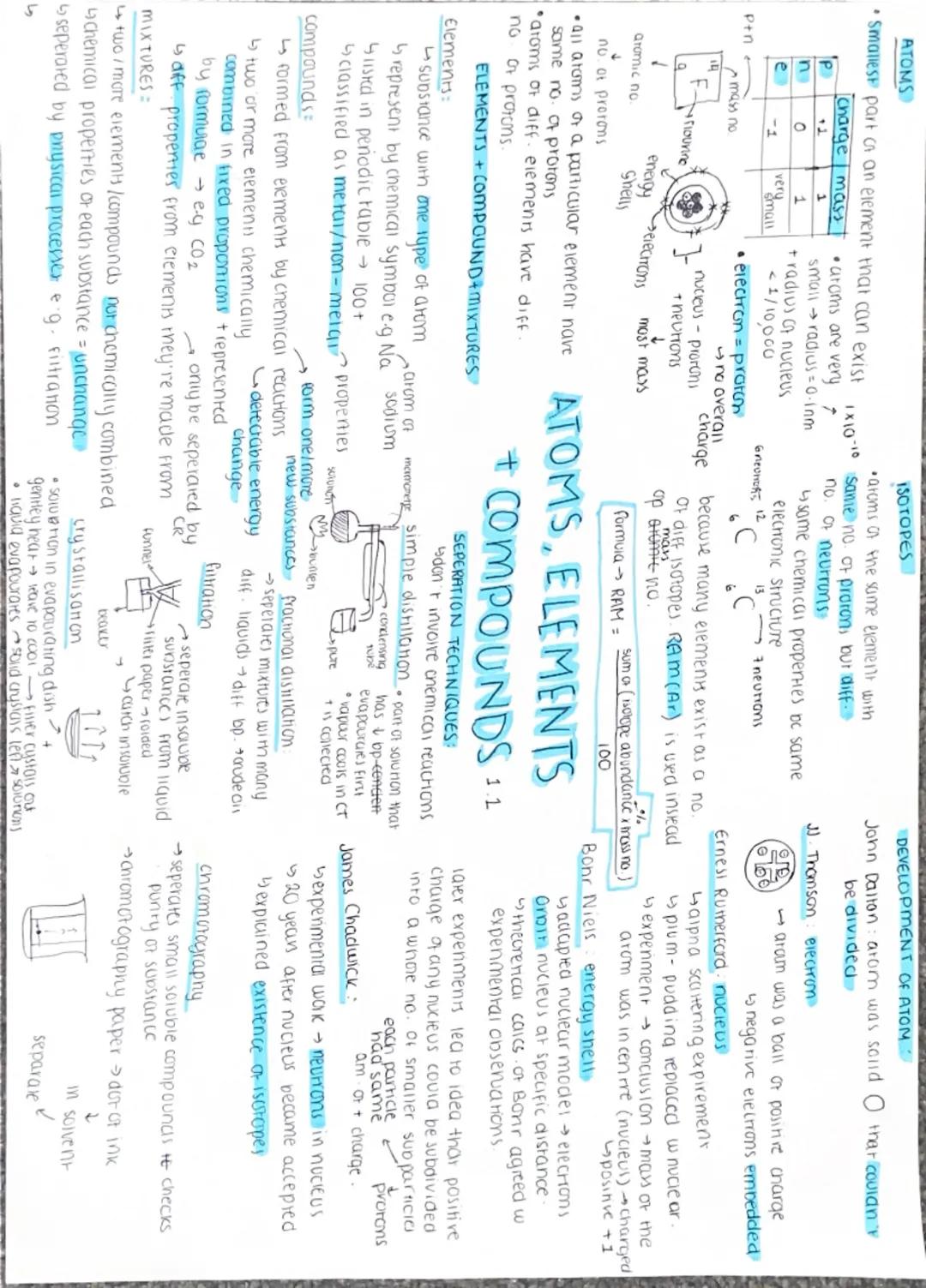
Think of atoms as the smallest LEGO pieces that make up everything in the universe. Each atom contains a tiny, dense nucleus at its centre, packed with protons (positive charge) and neutrons (no charge). Whizzing around this nucleus are electrons (negative charge) in energy shells.
Here's what makes atoms fascinating: the nucleus is incredibly small compared to the whole atom - imagine a marble in the centre of a football stadium! The atomic number tells you how many protons an element has, whilst the mass number is the total of protons plus neutrons.
Isotopes are atoms of the same element that have different numbers of neutrons. They're like identical twins with slightly different weights - same chemical behaviour, but different masses. Scientists use relative atomic mass (RAM) because most elements exist as mixtures of isotopes.
Quick Tip: Remember that atoms are electrically neutral because they have equal numbers of protons and electrons!
How Our Understanding of Atoms Developed
The story of atomic theory is like a detective mystery that took over a century to solve. John Dalton started things off, imagining atoms as solid, indivisible spheres. Then J.J. Thomson discovered electrons and proposed the "plum pudding model" - a ball of positive charge with electrons dotted throughout like raisins in a pudding.
Everything changed when Ernest Rutherford fired particles at gold foil in his famous experiment. Most particles went straight through, but some bounced back - proving that atoms have a tiny, dense, positively charged nucleus at their centre.
Niels Bohr then figured out that electrons orbit the nucleus at specific distances in energy shells, rather than randomly floating about. Finally, James Chadwick discovered neutrons in the nucleus, which explained why isotopes exist.
Did You Know: It took 20 years after discovering the nucleus for scientists to fully accept the idea - that's how revolutionary it was!
Elements, Compounds and Mixtures
Elements are pure substances made of just one type of atom - think gold, oxygen, or carbon. There are over 100 elements on the periodic table, each with its own unique atomic number. They're classified as metals or non-metals based on their properties.
Compounds form when two or more elements chemically bond together in fixed proportions. Water (H₂O) always contains exactly two hydrogen atoms for every oxygen atom. Compounds have completely different properties from their original elements - sodium (explosive metal) plus chlorine (poisonous gas) makes salt (essential for life)!
Mixtures are different - they're just elements or compounds mixed together without chemical bonding. Air is a mixture of gases, and you can separate mixtures using physical methods without breaking any chemical bonds.
Key Point: Chemical reactions are needed to make or break compounds, but mixtures can be separated using physical techniques.
Separation Techniques
Scientists have developed brilliant methods to separate mixtures without using chemical reactions. Simple distillation works by heating a liquid mixture - the substance with the lower boiling point evaporates first, then condenses back to liquid in a separate container.
Fractional distillation is the heavy-duty version, used for separating crude oil into petrol, diesel, and other products. Filtration separates insoluble solids from liquids using filter paper, whilst crystallisation lets you recover dissolved solids by evaporating the solvent and cooling.
Chromatography is particularly useful for separating small amounts of dissolved substances and checking purity. You've probably seen this with ink on blotting paper - different coloured dyes travel at different speeds up the paper.
Lab Tip: Always choose your separation method based on the physical properties of what you're trying to separate - solubility, boiling point, or particle size.

 Chemistry
 English Literature
 Biology
 Sociology