
This cheatsheet pack covers the essential concepts for A-Level AQA... Show more
 Sociology
Sign up to see the contentIt's free!
Access to all documents
Improve your grades
Join milions of students
By signing up you accept Terms of Service and Privacy Policy

Maths

Chemistry

Biology

English Language

History
Responding to change (a2 only)
Infection and response
Homeostasis and response
Energy transfers (a2 only)
Cell biology
Organisms respond to changes in their internal and external environments (a-level only)
Biological molecules
Organisation
Substance exchange
Bioenergetics
Genetic information & variation
Inheritance, variation and evolution
Genetics & ecosystems (a2 only)
Ecology
Cells
Show all topics
Britain & the wider world: 1745 -1901
1l the quest for political stability: germany, 1871-1991
The cold war
Inter-war germany
Medieval period: 1066 -1509
2d religious conflict and the church in england, c1529-c1570
2o democracy and nazism: germany, 1918-1945
1f industrialisation and the people: britain, c1783-1885
1c the tudors: england, 1485-1603
2m wars and welfare: britain in transition, 1906-1957
World war two & the holocaust
2n revolution and dictatorship: russia, 1917-1953
2s the making of modern britain, 1951-2007
World war one
Britain: 1509 -1745
Show all topics
157
0
ameerah
03/12/2025
Chemistry
AQA A-level Chemistry cheat sheet
2,417
•
3 Dec 2025
•
ameerah
@ameerah_iuyauxibtnph
This cheatsheet pack covers the essential concepts for A-Level AQA... Show more

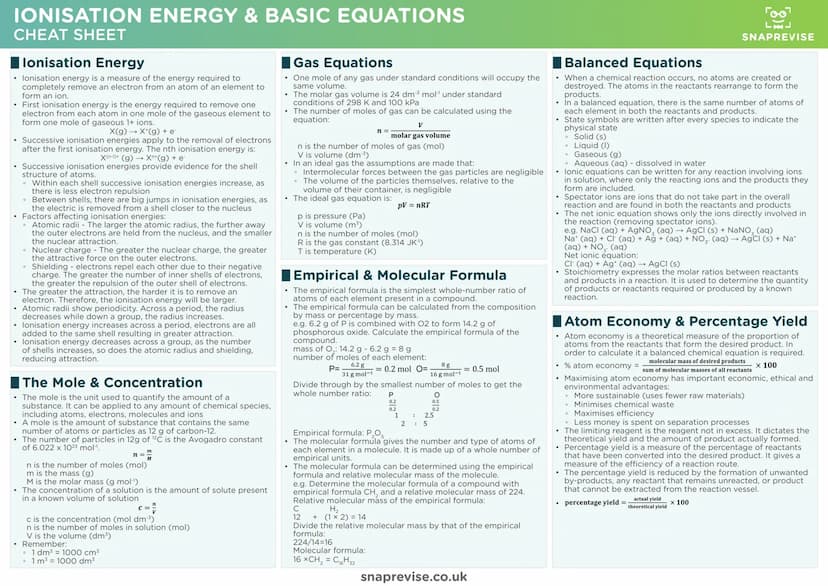
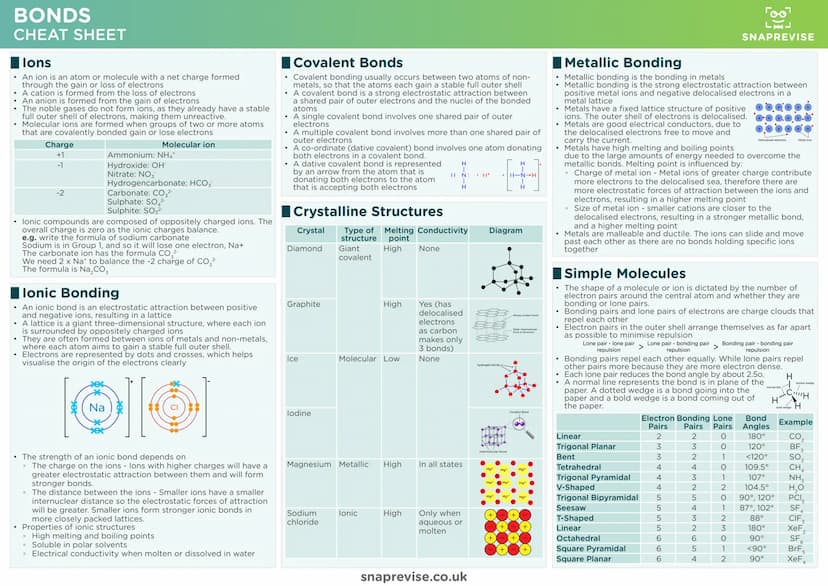
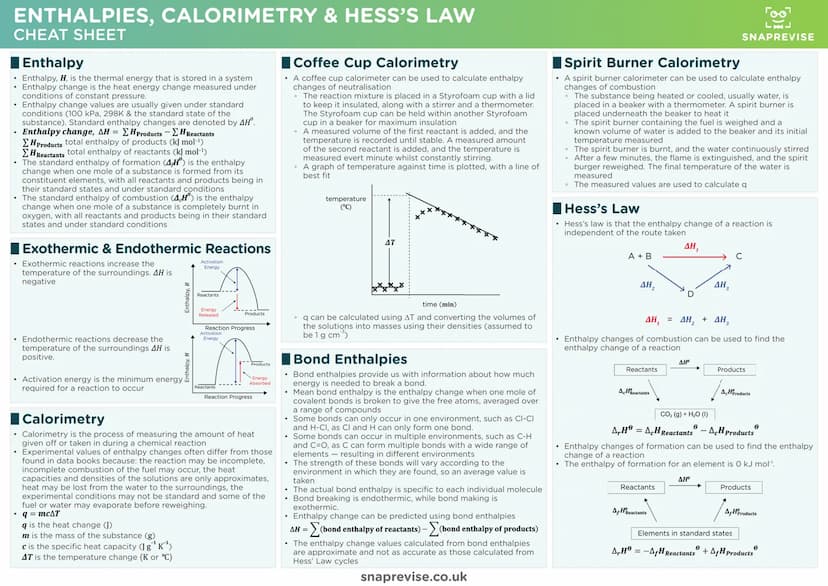
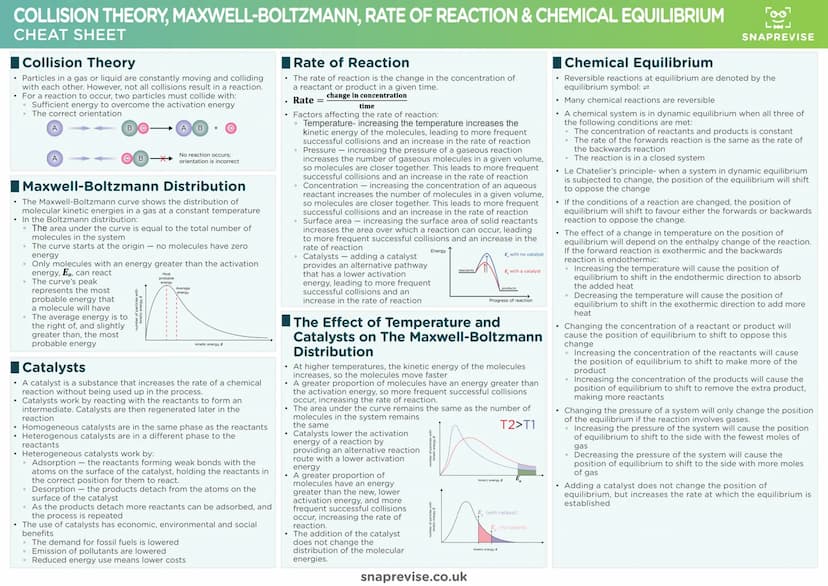
This is your ultimate A-Level AQA Chemistry revision resource - a comprehensive cheatsheet pack designed to condense the entire course into easily digestible pages. Each section focuses on the most important definitions, key terms, diagrams and concepts you'll need to succeed in your exams.
The pack has been carefully structured to match the AQA specification points, ensuring you won't miss any crucial information. From atomic structure to organic synthesis, every topic is covered with clear explanations and practical examples.
Quick Tip: Use this pack alongside your textbooks for focused revision - it's perfect for last-minute cramming or reinforcing your understanding of complex topics.

This page showcases SnapRevise's biology content, specifically focusing on heart structure and the cardiac cycle. The platform offers various study tools including bite-sized videos, smart quizzes, and mini revision guides.
The heart section covers internal structure, with diagrams showing the atria as elastic chambers that receive blood. You can see quiz progress tracking and different study modes available.
The platform emphasises personalised learning paths and 24/7 tutor support, making it more accessible than traditional private tutoring. Features include predicted exam packs and intelligent study recommendations.
Study Smart: Interactive quizzes help reinforce your understanding - don't just read, actively test yourself!
This cheatsheet pack transforms the entire A-Level Chemistry course into super condensed pages that focus on what really matters. You'll find the most important definitions, key terms, diagrams and essential concepts all in one place.
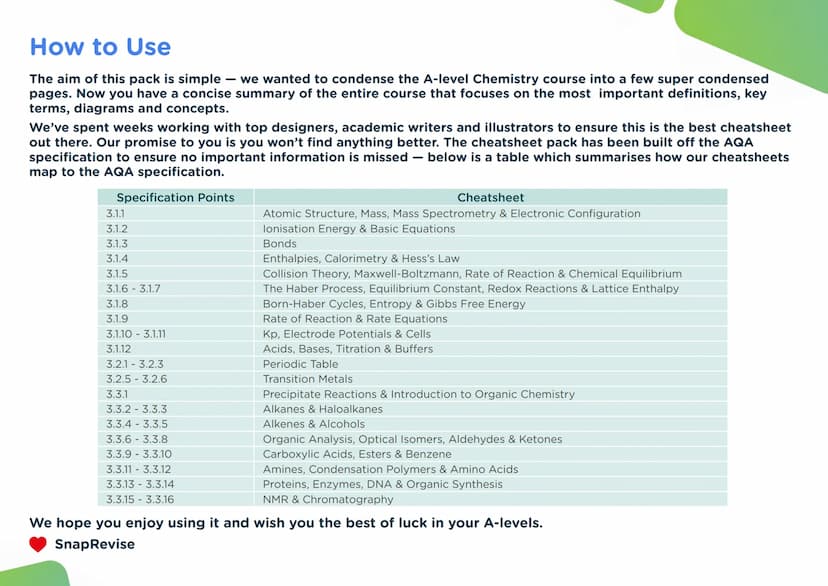
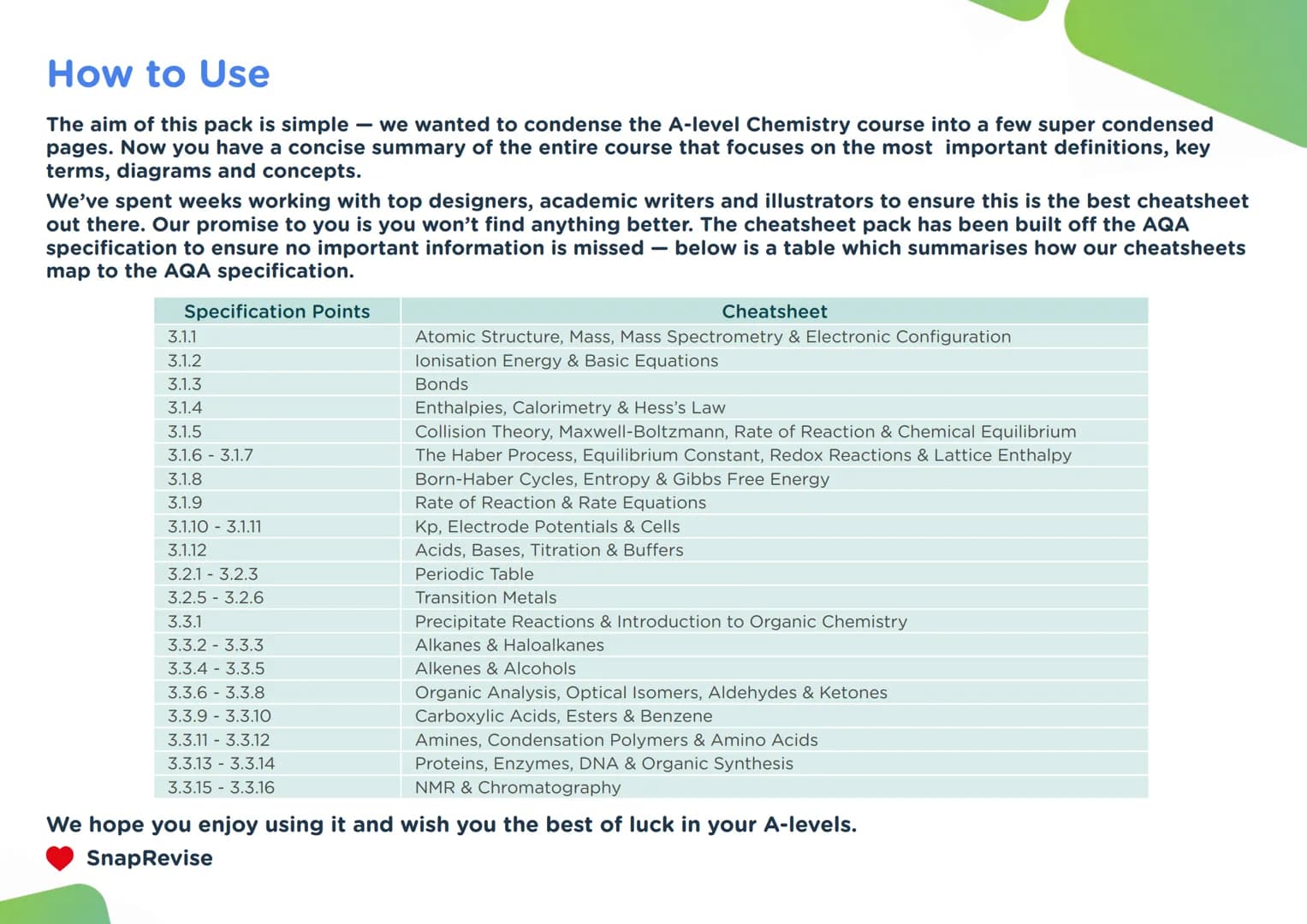
The content maps perfectly to AQA specification points from 3.1.1 through 3.3.16. This covers everything from atomic structure and mass spectrometry to NMR and chromatography. Each topic has been carefully selected to ensure you don't miss anything crucial for your exams.
The pack includes organic chemistry fundamentals like alkanes, haloalkanes, alkenes and alcohols. You'll also find advanced topics such as transition metals, equilibrium constants, and protein structures. The comprehensive coverage means this can be your go-to revision resource throughout your A-Level journey.
Pro Tip: This pack works brilliantly for last-minute revision or as a quick reference guide whilst doing practice papers!
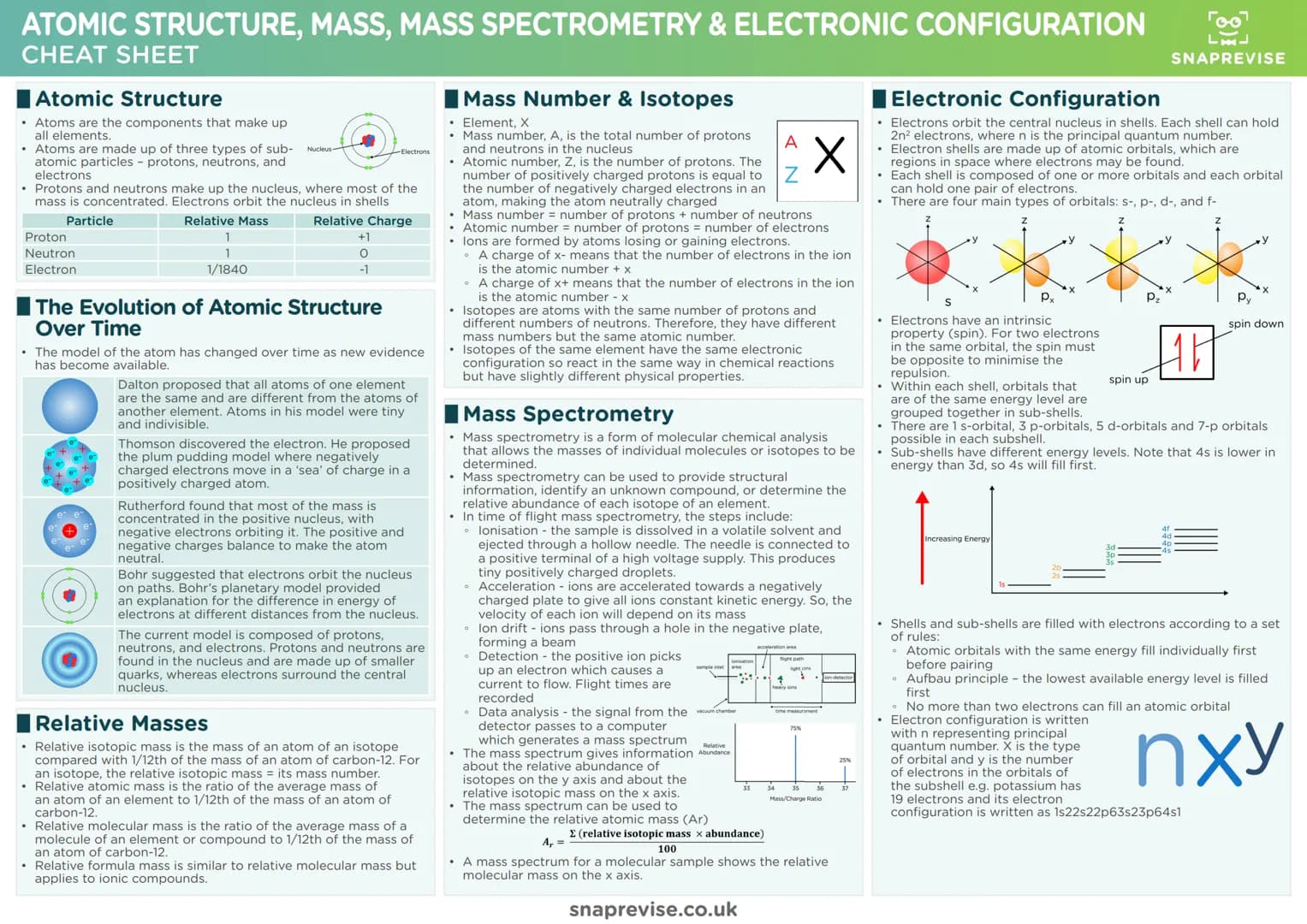
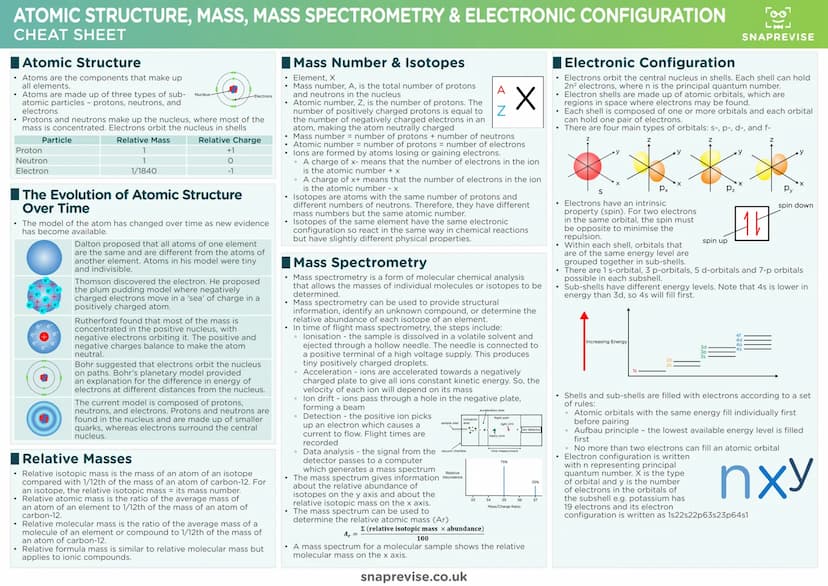
Understanding atomic structure is absolutely fundamental to everything else in chemistry. Atoms consist of protons, neutrons and electrons, with the nucleus containing most of the mass whilst electrons orbit in shells around it.
The atomic model has evolved significantly over time. Dalton's indivisible atoms gave way to Thomson's plum pudding model, then Rutherford discovered the nucleus, and finally Bohr proposed electron shells. Today's model recognises that protons and neutrons are made of smaller particles called quarks.
Mass spectrometry is brilliant for identifying unknown compounds and determining isotopic abundance. The time-of-flight method involves ionisation, acceleration, drift and detection. You can calculate relative atomic mass using the formula: Ar = Σ(relative isotopic mass × abundance)/100.
Electronic configuration follows specific rules - electrons fill the lowest energy levels first (Aufbau principle), with orbitals of the same energy filling singly before pairing. Remember that 4s fills before 3d because it's actually lower in energy.
Remember: Isotopes have the same number of protons but different numbers of neutrons - they react identically but have different physical properties!
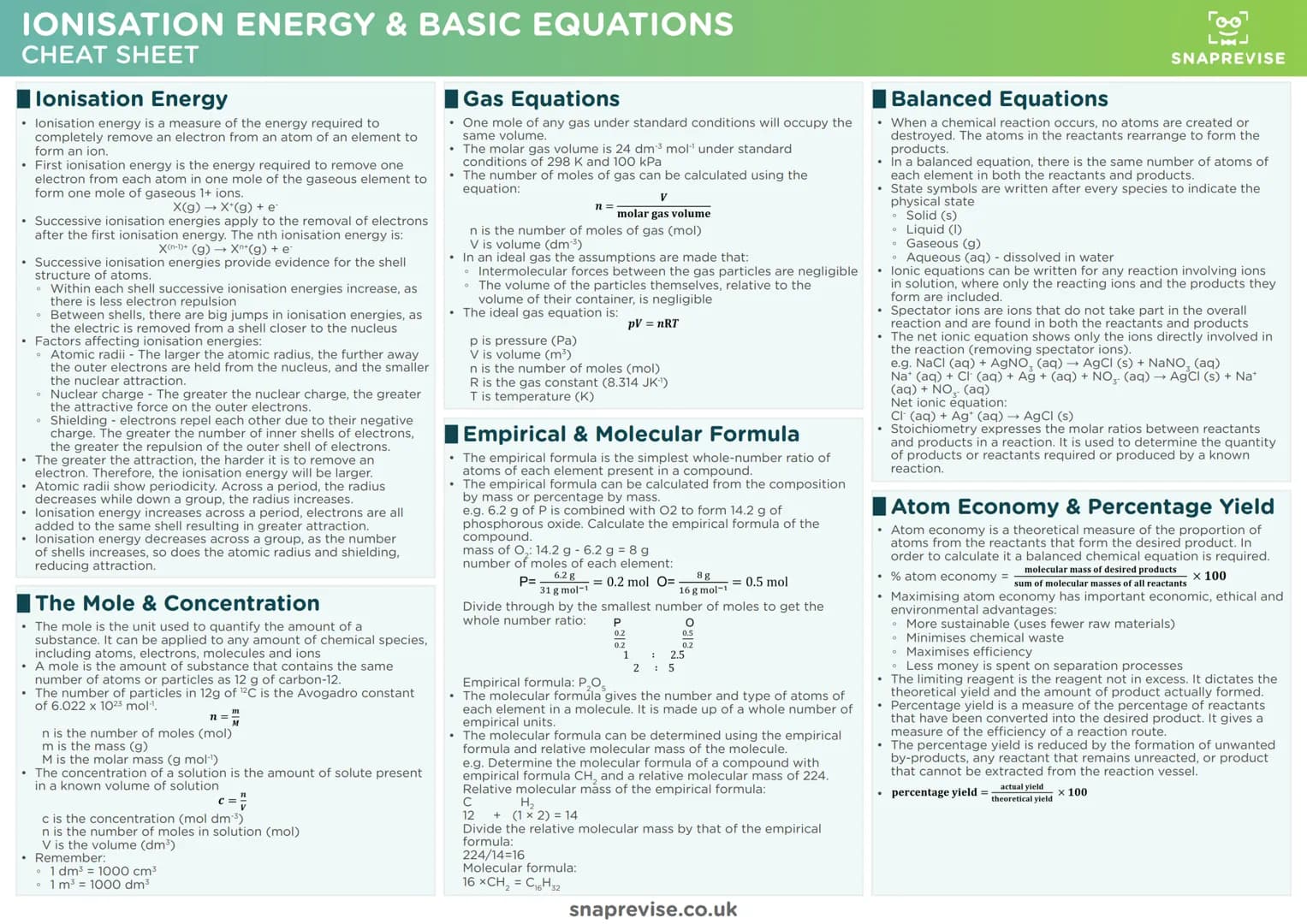
Ionisation energy measures how much energy you need to remove electrons from atoms. The first ionisation energy removes one electron to form a 1+ ion, and successive ionisation energies get progressively larger as you remove more electrons.
Three key factors affect ionisation energies: atomic radius (larger atoms hold electrons less tightly), nuclear charge (more protons mean stronger attraction), and shielding (inner electrons repel outer ones). This explains why ionisation energy increases across periods but decreases down groups.
The mole is chemistry's way of counting particles - one mole contains Avogadro's number (6.022 × 10²³) of particles. Key equations include n = m/M for calculating moles from mass, and c = n/V for concentration calculations.
Empirical formulas show the simplest whole-number ratio of atoms in compounds. You calculate them by finding moles of each element, then dividing by the smallest number to get the ratio. Molecular formulas are whole-number multiples of empirical formulas.
Atom economy and percentage yield measure reaction efficiency. Atom economy considers how much of your starting materials ends up in the desired product, whilst percentage yield compares actual to theoretical yields.
Key Insight: Successive ionisation energies show clear jumps between electron shells - this provides excellent evidence for atomic structure!
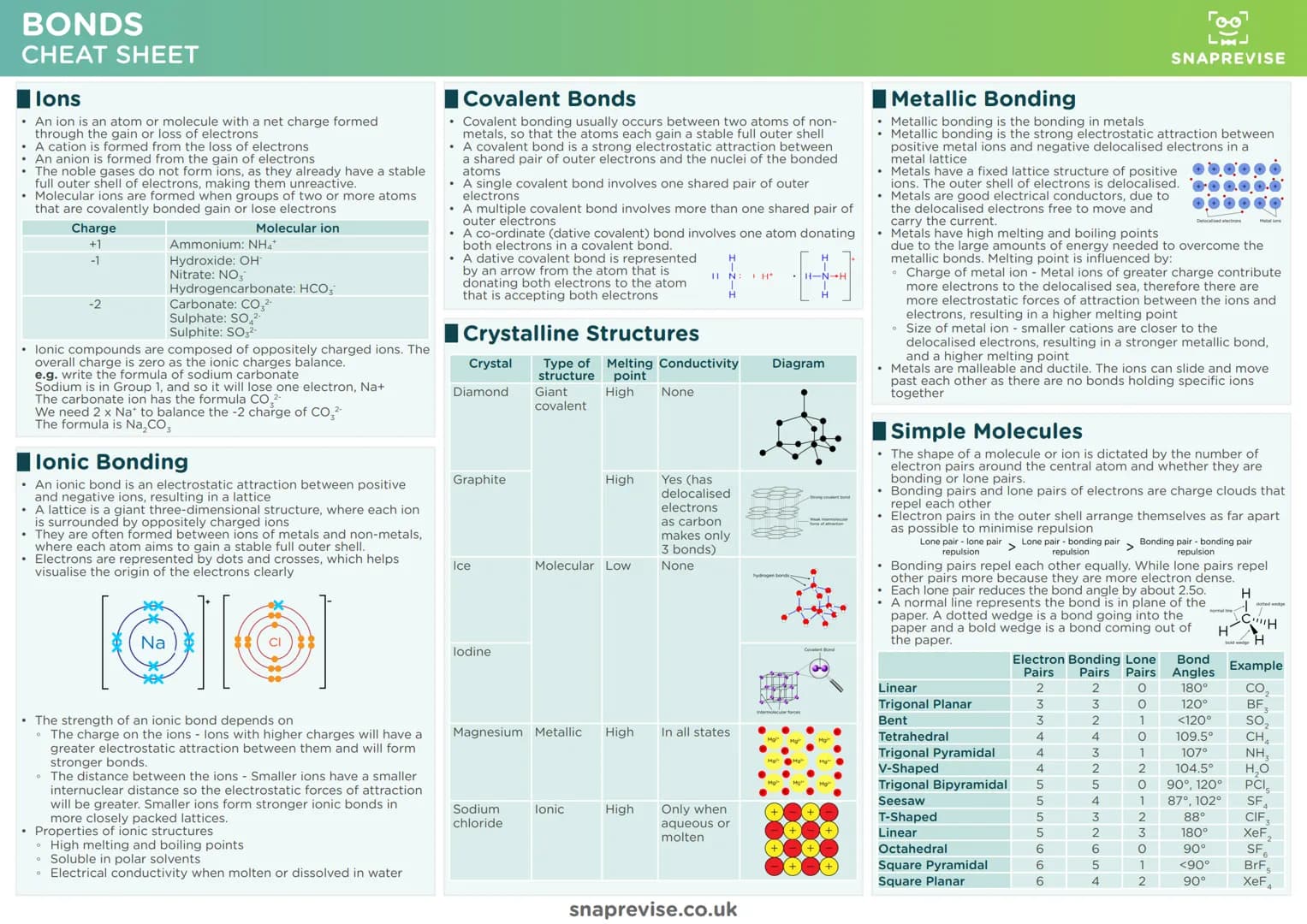
Ionic bonding happens when metals transfer electrons to non-metals, creating oppositely charged ions that attract electrostatically. The resulting lattice structures are giant 3D arrangements where each ion is surrounded by oppositely charged neighbours.
Ionic bond strength depends on two factors: charge on the ions (higher charges mean stronger bonds) and size of the ions (smaller ions get closer together, creating stronger attractions). This explains why MgO has a much higher melting point than NaCl.
Covalent bonds form when non-metals share electron pairs to achieve stable outer shells. You can have single, double or triple bonds depending on how many electron pairs are shared. Coordinate bonds occur when one atom donates both electrons in the shared pair.
Different crystal structures have completely different properties. Ionic crystals conduct electricity when molten and dissolve in polar solvents. Covalent networks like diamond are incredibly hard with high melting points, whilst molecular crystals are much softer with lower melting points.
Quick Check: Remember that ionic compounds conduct electricity when molten or dissolved because the ions become free to move!

Enthalpy is the heat energy stored in chemical systems, and enthalpy changes tell you whether reactions release or absorb energy. Exothermic reactions have negative ΔH values and warm up the surroundings, whilst endothermic reactions have positive ΔH values and cool things down.
Calorimetry lets you measure enthalpy changes experimentally using the equation q = mcΔT. Coffee cup calorimeters work well for neutralisation reactions, whilst spirit burner calorimeters measure combustion enthalpies. Remember that experimental values often differ from data book values due to heat losses and incomplete reactions.
Hess's Law states that enthalpy change is independent of the route taken - this is incredibly useful for calculating enthalpies you can't measure directly. You can use either combustion data or formation data to construct Hess cycles and find unknown enthalpy changes.
Bond enthalpies provide another way to estimate enthalpy changes. Bond breaking is always endothermic whilst bond making is exothermic. The equation ΔH = Σ(bonds broken) - Σ(bonds made) gives approximate values, though they're less accurate than Hess cycle calculations.
Lab Tip: When doing calorimetry experiments, plot temperature vs time and extrapolate back to find the true temperature change!
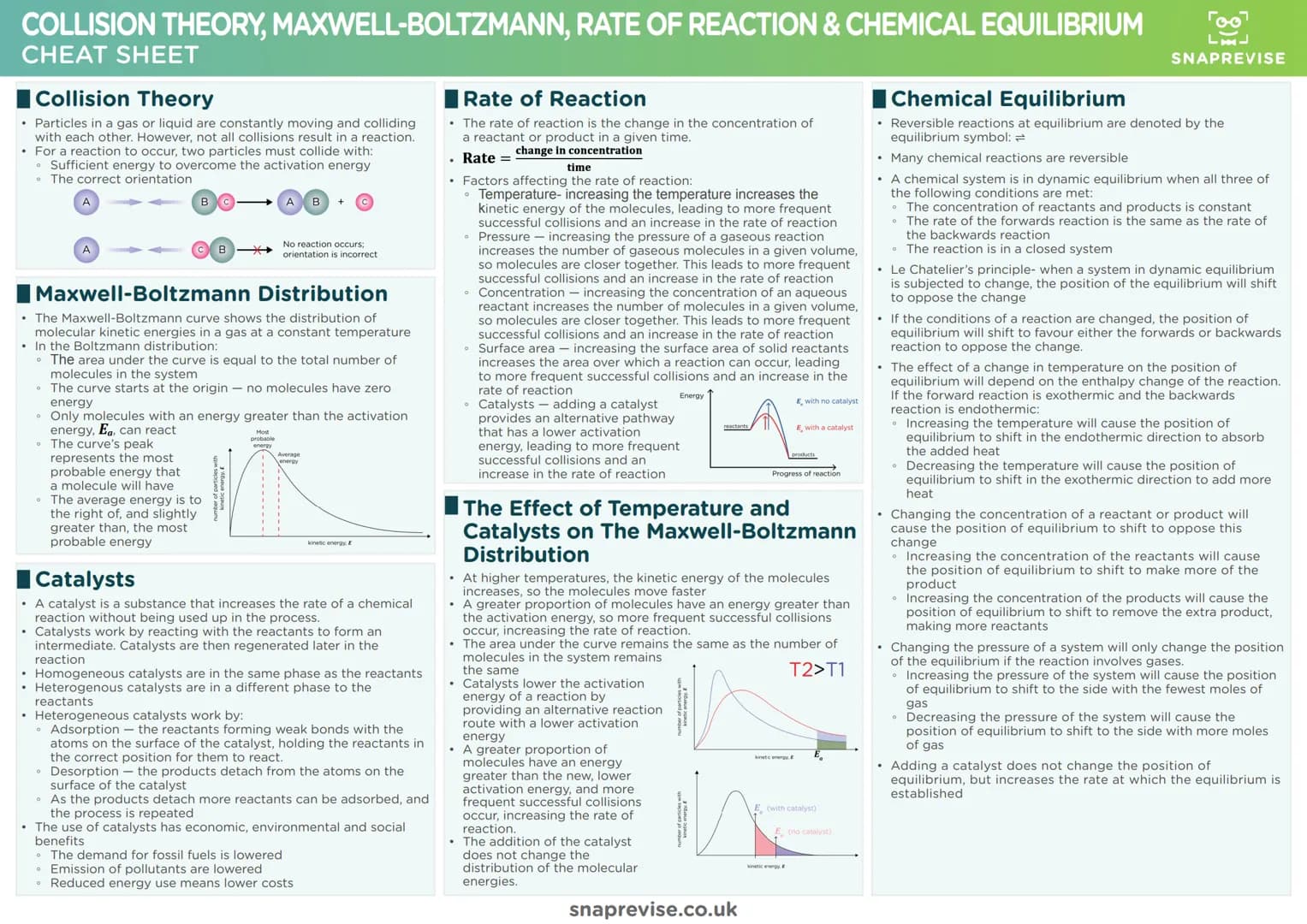
Collision theory explains why reactions happen - particles must collide with sufficient energy (above the activation energy) and in the correct orientation. Most collisions don't result in reactions because these conditions aren't met.
The Maxwell-Boltzmann distribution shows how molecular energies are spread in a gas. Only molecules with energy above Ea can react, and the curve never starts from zero because no molecules have zero energy. Temperature increases shift the whole curve to higher energies.
Catalysts speed up reactions by providing alternative pathways with lower activation energies. Homogeneous catalysts are in the same phase as reactants, whilst heterogeneous catalysts work through adsorption and desorption on their surfaces.
Chemical equilibrium occurs in closed systems when forward and backward reaction rates are equal, keeping concentrations constant. Le Chatelier's principle predicts how equilibrium responds to changes - the system always opposes the change you make.
Temperature, pressure, and concentration changes all shift equilibrium position, but catalysts only affect the rate at which equilibrium is reached. Understanding these principles is crucial for optimising industrial processes.
Key Point: Increasing temperature favours the endothermic direction, whilst increasing pressure favours the side with fewer gas molecules!
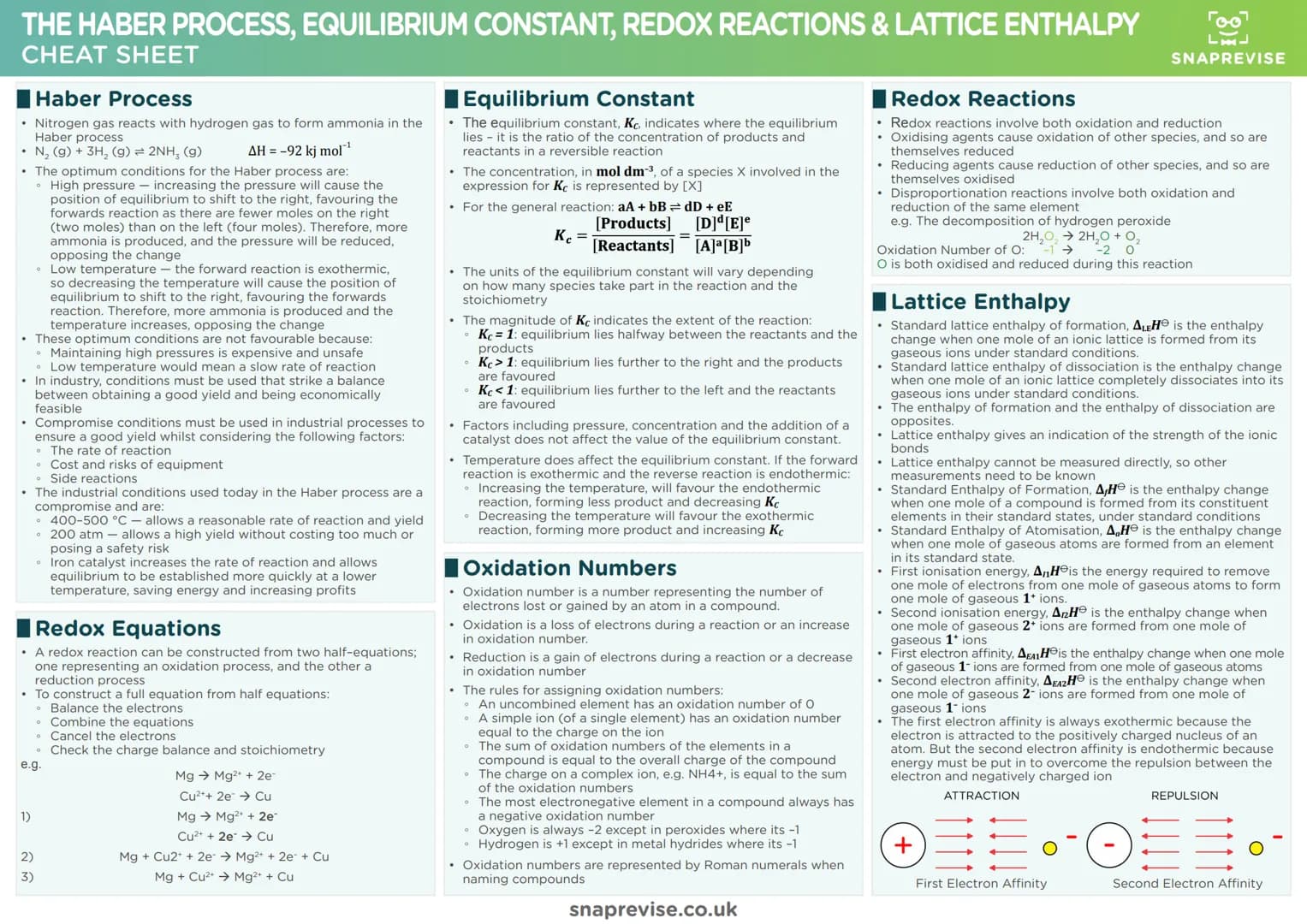
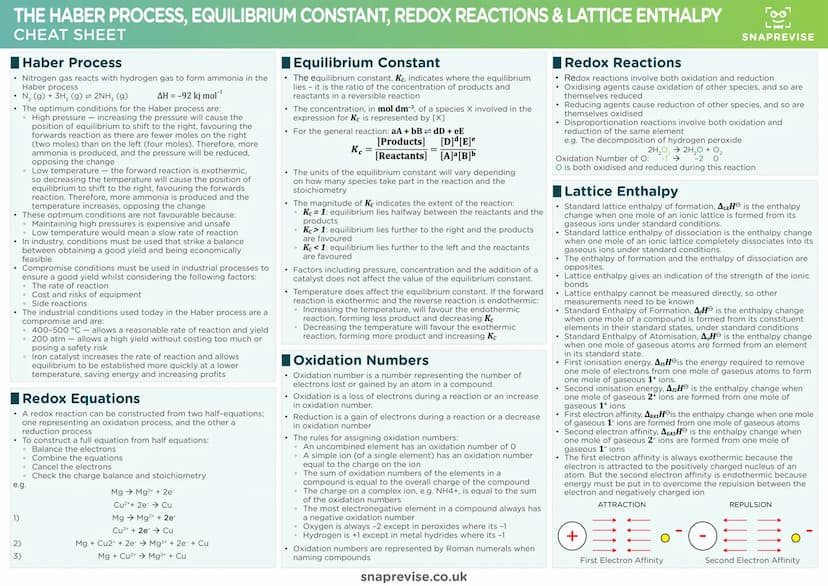
The Haber process demonstrates real-world applications of equilibrium principles. N₂ + 3H₂ ⇌ 2NH₃ with ΔH = -92 kJ mol⁻¹. Theoretically, you'd want high pressure and low temperature for maximum yield, but these aren't economically viable.
Industrial compromise conditions balance yield with practicality: 400-500°C gives reasonable rates, 200 atm provides good yield without excessive costs, and iron catalysts allow lower temperatures. These decisions involve economic and safety considerations.
The equilibrium constant Kc shows where equilibrium lies. When Kc > 1, products are favoured; when Kc < 1, reactants dominate. Temperature affects Kc values, but pressure, concentration and catalysts don't change the constant itself.
Redox reactions involve electron transfer - oxidation is electron loss (increase in oxidation number) whilst reduction is electron gain (decrease in oxidation number). You can combine half-equations by balancing electrons first, then combining and cancelling.
Lattice enthalpy measures ionic bond strength but can't be measured directly. You need other enthalpy values like atomisation, ionisation, and electron affinity to calculate it using energy cycles.
Industrial Chemistry: The Haber process shows how theory meets reality - compromise conditions are essential for profitable production!
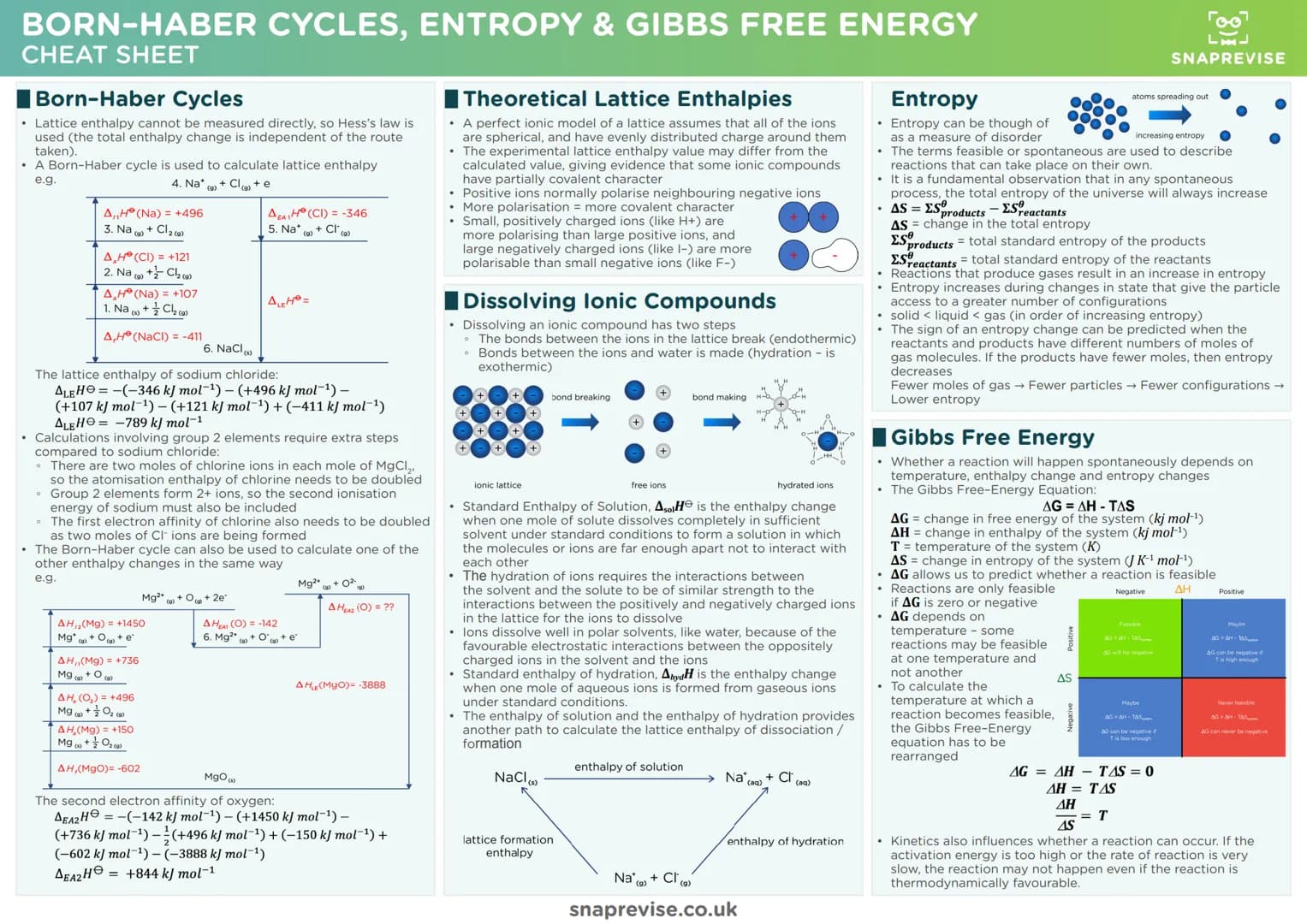
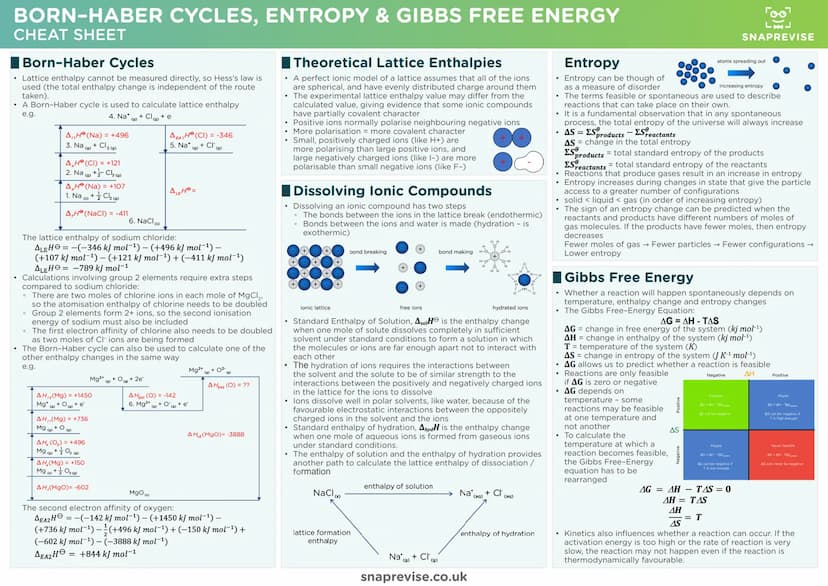
Born-Haber cycles use Hess's Law to calculate lattice enthalpies indirectly. You construct energy level diagrams showing all the steps from elements to ionic compounds, including atomisation, ionisation, electron affinity, and formation enthalpies.
These cycles become more complex for Group 2 compounds because you need second ionisation energies and multiple electron affinities. Differences between theoretical and experimental lattice enthalpies suggest covalent character in supposedly ionic bonds.
Entropy measures disorder in systems - solids have low entropy, gases have high entropy. The universe's total entropy always increases in spontaneous processes. You can predict entropy changes by counting gas molecules in reactions.
Gibbs free energy combines enthalpy and entropy effects: ΔG = ΔH - TΔS. Reactions are only feasible when ΔG ≤ 0, which depends on temperature. Some reactions become feasible only above certain temperatures when the TΔS term dominates.
The key insight is that thermodynamic feasibility doesn't guarantee that reactions will actually happen - kinetic factors like activation energy and reaction rates also matter enormously.
Top Tip: Remember that feasibility (ΔG < 0) doesn't mean a reaction will happen quickly - kinetics and thermodynamics are completely different considerations!
Our AI Companion is a student-focused AI tool that offers more than just answers. Built on millions of Knowunity resources, it provides relevant information, personalised study plans, quizzes, and content directly in the chat, adapting to your individual learning journey.
You can download the app from Google Play Store and Apple App Store.
That's right! Enjoy free access to study content, connect with fellow students, and get instant help – all at your fingertips.
App Store
Google Play
The app is very easy to use and well designed. I have found everything I was looking for so far and have been able to learn a lot from the presentations! I will definitely use the app for a class assignment! And of course it also helps a lot as an inspiration.
Stefan S
iOS user
This app is really great. There are so many study notes and help [...]. My problem subject is French, for example, and the app has so many options for help. Thanks to this app, I have improved my French. I would recommend it to anyone.
Samantha Klich
Android user
Wow, I am really amazed. I just tried the app because I've seen it advertised many times and was absolutely stunned. This app is THE HELP you want for school and above all, it offers so many things, such as workouts and fact sheets, which have been VERY helpful to me personally.
Anna
iOS user
Best app on earth! no words because it’s too good
Thomas R
iOS user
Just amazing. Let's me revise 10x better, this app is a quick 10/10. I highly recommend it to anyone. I can watch and search for notes. I can save them in the subject folder. I can revise it any time when I come back. If you haven't tried this app, you're really missing out.
Basil
Android user
This app has made me feel so much more confident in my exam prep, not only through boosting my own self confidence through the features that allow you to connect with others and feel less alone, but also through the way the app itself is centred around making you feel better. It is easy to navigate, fun to use, and helpful to anyone struggling in absolutely any way.
David K
iOS user
The app's just great! All I have to do is enter the topic in the search bar and I get the response real fast. I don't have to watch 10 YouTube videos to understand something, so I'm saving my time. Highly recommended!
Sudenaz Ocak
Android user
In school I was really bad at maths but thanks to the app, I am doing better now. I am so grateful that you made the app.
Greenlight Bonnie
Android user
very reliable app to help and grow your ideas of Maths, English and other related topics in your works. please use this app if your struggling in areas, this app is key for that. wish I'd of done a review before. and it's also free so don't worry about that.
Rohan U
Android user
I know a lot of apps use fake accounts to boost their reviews but this app deserves it all. Originally I was getting 4 in my English exams and this time I got a grade 7. I didn’t even know about this app three days until the exam and it has helped A LOT. Please actually trust me and use it as I’m sure you too will see developments.
Xander S
iOS user
THE QUIZES AND FLASHCARDS ARE SO USEFUL AND I LOVE THE SCHOOLGPT. IT ALSO IS LITREALLY LIKE CHATGPT BUT SMARTER!! HELPED ME WITH MY MASCARA PROBLEMS TOO!! AS WELL AS MY REAL SUBJECTS ! DUHHH 😍😁😲🤑💗✨🎀😮
Elisha
iOS user
This apps acc the goat. I find revision so boring but this app makes it so easy to organize it all and then you can ask the freeeee ai to test yourself so good and you can easily upload your own stuff. highly recommend as someone taking mocks now
Paul T
iOS user
The app is very easy to use and well designed. I have found everything I was looking for so far and have been able to learn a lot from the presentations! I will definitely use the app for a class assignment! And of course it also helps a lot as an inspiration.
Stefan S
iOS user
This app is really great. There are so many study notes and help [...]. My problem subject is French, for example, and the app has so many options for help. Thanks to this app, I have improved my French. I would recommend it to anyone.
Samantha Klich
Android user
Wow, I am really amazed. I just tried the app because I've seen it advertised many times and was absolutely stunned. This app is THE HELP you want for school and above all, it offers so many things, such as workouts and fact sheets, which have been VERY helpful to me personally.
Anna
iOS user
Best app on earth! no words because it’s too good
Thomas R
iOS user
Just amazing. Let's me revise 10x better, this app is a quick 10/10. I highly recommend it to anyone. I can watch and search for notes. I can save them in the subject folder. I can revise it any time when I come back. If you haven't tried this app, you're really missing out.
Basil
Android user
This app has made me feel so much more confident in my exam prep, not only through boosting my own self confidence through the features that allow you to connect with others and feel less alone, but also through the way the app itself is centred around making you feel better. It is easy to navigate, fun to use, and helpful to anyone struggling in absolutely any way.
David K
iOS user
The app's just great! All I have to do is enter the topic in the search bar and I get the response real fast. I don't have to watch 10 YouTube videos to understand something, so I'm saving my time. Highly recommended!
Sudenaz Ocak
Android user
In school I was really bad at maths but thanks to the app, I am doing better now. I am so grateful that you made the app.
Greenlight Bonnie
Android user
very reliable app to help and grow your ideas of Maths, English and other related topics in your works. please use this app if your struggling in areas, this app is key for that. wish I'd of done a review before. and it's also free so don't worry about that.
Rohan U
Android user
I know a lot of apps use fake accounts to boost their reviews but this app deserves it all. Originally I was getting 4 in my English exams and this time I got a grade 7. I didn’t even know about this app three days until the exam and it has helped A LOT. Please actually trust me and use it as I’m sure you too will see developments.
Xander S
iOS user
THE QUIZES AND FLASHCARDS ARE SO USEFUL AND I LOVE THE SCHOOLGPT. IT ALSO IS LITREALLY LIKE CHATGPT BUT SMARTER!! HELPED ME WITH MY MASCARA PROBLEMS TOO!! AS WELL AS MY REAL SUBJECTS ! DUHHH 😍😁😲🤑💗✨🎀😮
Elisha
iOS user
This apps acc the goat. I find revision so boring but this app makes it so easy to organize it all and then you can ask the freeeee ai to test yourself so good and you can easily upload your own stuff. highly recommend as someone taking mocks now
Paul T
iOS user
ameerah
@ameerah_iuyauxibtnph
This cheatsheet pack covers the essential concepts for A-Level AQA Chemistry, condensing the entire course into digestible summaries. You'll find everything from basic atomic structure to complex thermodynamics, designed to help you master the key definitions, equations and concepts you... Show more
Access to all documents
Improve your grades
Join milions of students
By signing up you accept Terms of Service and Privacy Policy
This is your ultimate A-Level AQA Chemistry revision resource - a comprehensive cheatsheet pack designed to condense the entire course into easily digestible pages. Each section focuses on the most important definitions, key terms, diagrams and concepts you'll need to succeed in your exams.
The pack has been carefully structured to match the AQA specification points, ensuring you won't miss any crucial information. From atomic structure to organic synthesis, every topic is covered with clear explanations and practical examples.
Quick Tip: Use this pack alongside your textbooks for focused revision - it's perfect for last-minute cramming or reinforcing your understanding of complex topics.
Access to all documents
Improve your grades
Join milions of students
By signing up you accept Terms of Service and Privacy Policy
This page showcases SnapRevise's biology content, specifically focusing on heart structure and the cardiac cycle. The platform offers various study tools including bite-sized videos, smart quizzes, and mini revision guides.
The heart section covers internal structure, with diagrams showing the atria as elastic chambers that receive blood. You can see quiz progress tracking and different study modes available.
The platform emphasises personalised learning paths and 24/7 tutor support, making it more accessible than traditional private tutoring. Features include predicted exam packs and intelligent study recommendations.
Study Smart: Interactive quizzes help reinforce your understanding - don't just read, actively test yourself!
Access to all documents
Improve your grades
Join milions of students
By signing up you accept Terms of Service and Privacy Policy
This cheatsheet pack transforms the entire A-Level Chemistry course into super condensed pages that focus on what really matters. You'll find the most important definitions, key terms, diagrams and essential concepts all in one place.
The content maps perfectly to AQA specification points from 3.1.1 through 3.3.16. This covers everything from atomic structure and mass spectrometry to NMR and chromatography. Each topic has been carefully selected to ensure you don't miss anything crucial for your exams.
The pack includes organic chemistry fundamentals like alkanes, haloalkanes, alkenes and alcohols. You'll also find advanced topics such as transition metals, equilibrium constants, and protein structures. The comprehensive coverage means this can be your go-to revision resource throughout your A-Level journey.
Pro Tip: This pack works brilliantly for last-minute revision or as a quick reference guide whilst doing practice papers!
Access to all documents
Improve your grades
Join milions of students
By signing up you accept Terms of Service and Privacy Policy
Understanding atomic structure is absolutely fundamental to everything else in chemistry. Atoms consist of protons, neutrons and electrons, with the nucleus containing most of the mass whilst electrons orbit in shells around it.
The atomic model has evolved significantly over time. Dalton's indivisible atoms gave way to Thomson's plum pudding model, then Rutherford discovered the nucleus, and finally Bohr proposed electron shells. Today's model recognises that protons and neutrons are made of smaller particles called quarks.
Mass spectrometry is brilliant for identifying unknown compounds and determining isotopic abundance. The time-of-flight method involves ionisation, acceleration, drift and detection. You can calculate relative atomic mass using the formula: Ar = Σ(relative isotopic mass × abundance)/100.
Electronic configuration follows specific rules - electrons fill the lowest energy levels first (Aufbau principle), with orbitals of the same energy filling singly before pairing. Remember that 4s fills before 3d because it's actually lower in energy.
Remember: Isotopes have the same number of protons but different numbers of neutrons - they react identically but have different physical properties!
Access to all documents
Improve your grades
Join milions of students
By signing up you accept Terms of Service and Privacy Policy
Ionisation energy measures how much energy you need to remove electrons from atoms. The first ionisation energy removes one electron to form a 1+ ion, and successive ionisation energies get progressively larger as you remove more electrons.
Three key factors affect ionisation energies: atomic radius (larger atoms hold electrons less tightly), nuclear charge (more protons mean stronger attraction), and shielding (inner electrons repel outer ones). This explains why ionisation energy increases across periods but decreases down groups.
The mole is chemistry's way of counting particles - one mole contains Avogadro's number (6.022 × 10²³) of particles. Key equations include n = m/M for calculating moles from mass, and c = n/V for concentration calculations.
Empirical formulas show the simplest whole-number ratio of atoms in compounds. You calculate them by finding moles of each element, then dividing by the smallest number to get the ratio. Molecular formulas are whole-number multiples of empirical formulas.
Atom economy and percentage yield measure reaction efficiency. Atom economy considers how much of your starting materials ends up in the desired product, whilst percentage yield compares actual to theoretical yields.
Key Insight: Successive ionisation energies show clear jumps between electron shells - this provides excellent evidence for atomic structure!
Access to all documents
Improve your grades
Join milions of students
By signing up you accept Terms of Service and Privacy Policy
Ionic bonding happens when metals transfer electrons to non-metals, creating oppositely charged ions that attract electrostatically. The resulting lattice structures are giant 3D arrangements where each ion is surrounded by oppositely charged neighbours.
Ionic bond strength depends on two factors: charge on the ions (higher charges mean stronger bonds) and size of the ions (smaller ions get closer together, creating stronger attractions). This explains why MgO has a much higher melting point than NaCl.
Covalent bonds form when non-metals share electron pairs to achieve stable outer shells. You can have single, double or triple bonds depending on how many electron pairs are shared. Coordinate bonds occur when one atom donates both electrons in the shared pair.
Different crystal structures have completely different properties. Ionic crystals conduct electricity when molten and dissolve in polar solvents. Covalent networks like diamond are incredibly hard with high melting points, whilst molecular crystals are much softer with lower melting points.
Quick Check: Remember that ionic compounds conduct electricity when molten or dissolved because the ions become free to move!
Access to all documents
Improve your grades
Join milions of students
By signing up you accept Terms of Service and Privacy Policy
Enthalpy is the heat energy stored in chemical systems, and enthalpy changes tell you whether reactions release or absorb energy. Exothermic reactions have negative ΔH values and warm up the surroundings, whilst endothermic reactions have positive ΔH values and cool things down.
Calorimetry lets you measure enthalpy changes experimentally using the equation q = mcΔT. Coffee cup calorimeters work well for neutralisation reactions, whilst spirit burner calorimeters measure combustion enthalpies. Remember that experimental values often differ from data book values due to heat losses and incomplete reactions.
Hess's Law states that enthalpy change is independent of the route taken - this is incredibly useful for calculating enthalpies you can't measure directly. You can use either combustion data or formation data to construct Hess cycles and find unknown enthalpy changes.
Bond enthalpies provide another way to estimate enthalpy changes. Bond breaking is always endothermic whilst bond making is exothermic. The equation ΔH = Σ(bonds broken) - Σ(bonds made) gives approximate values, though they're less accurate than Hess cycle calculations.
Lab Tip: When doing calorimetry experiments, plot temperature vs time and extrapolate back to find the true temperature change!
Access to all documents
Improve your grades
Join milions of students
By signing up you accept Terms of Service and Privacy Policy
Collision theory explains why reactions happen - particles must collide with sufficient energy (above the activation energy) and in the correct orientation. Most collisions don't result in reactions because these conditions aren't met.
The Maxwell-Boltzmann distribution shows how molecular energies are spread in a gas. Only molecules with energy above Ea can react, and the curve never starts from zero because no molecules have zero energy. Temperature increases shift the whole curve to higher energies.
Catalysts speed up reactions by providing alternative pathways with lower activation energies. Homogeneous catalysts are in the same phase as reactants, whilst heterogeneous catalysts work through adsorption and desorption on their surfaces.
Chemical equilibrium occurs in closed systems when forward and backward reaction rates are equal, keeping concentrations constant. Le Chatelier's principle predicts how equilibrium responds to changes - the system always opposes the change you make.
Temperature, pressure, and concentration changes all shift equilibrium position, but catalysts only affect the rate at which equilibrium is reached. Understanding these principles is crucial for optimising industrial processes.
Key Point: Increasing temperature favours the endothermic direction, whilst increasing pressure favours the side with fewer gas molecules!
Access to all documents
Improve your grades
Join milions of students
By signing up you accept Terms of Service and Privacy Policy
The Haber process demonstrates real-world applications of equilibrium principles. N₂ + 3H₂ ⇌ 2NH₃ with ΔH = -92 kJ mol⁻¹. Theoretically, you'd want high pressure and low temperature for maximum yield, but these aren't economically viable.
Industrial compromise conditions balance yield with practicality: 400-500°C gives reasonable rates, 200 atm provides good yield without excessive costs, and iron catalysts allow lower temperatures. These decisions involve economic and safety considerations.
The equilibrium constant Kc shows where equilibrium lies. When Kc > 1, products are favoured; when Kc < 1, reactants dominate. Temperature affects Kc values, but pressure, concentration and catalysts don't change the constant itself.
Redox reactions involve electron transfer - oxidation is electron loss (increase in oxidation number) whilst reduction is electron gain (decrease in oxidation number). You can combine half-equations by balancing electrons first, then combining and cancelling.
Lattice enthalpy measures ionic bond strength but can't be measured directly. You need other enthalpy values like atomisation, ionisation, and electron affinity to calculate it using energy cycles.
Industrial Chemistry: The Haber process shows how theory meets reality - compromise conditions are essential for profitable production!
Access to all documents
Improve your grades
Join milions of students
By signing up you accept Terms of Service and Privacy Policy
Born-Haber cycles use Hess's Law to calculate lattice enthalpies indirectly. You construct energy level diagrams showing all the steps from elements to ionic compounds, including atomisation, ionisation, electron affinity, and formation enthalpies.
These cycles become more complex for Group 2 compounds because you need second ionisation energies and multiple electron affinities. Differences between theoretical and experimental lattice enthalpies suggest covalent character in supposedly ionic bonds.
Entropy measures disorder in systems - solids have low entropy, gases have high entropy. The universe's total entropy always increases in spontaneous processes. You can predict entropy changes by counting gas molecules in reactions.
Gibbs free energy combines enthalpy and entropy effects: ΔG = ΔH - TΔS. Reactions are only feasible when ΔG ≤ 0, which depends on temperature. Some reactions become feasible only above certain temperatures when the TΔS term dominates.
The key insight is that thermodynamic feasibility doesn't guarantee that reactions will actually happen - kinetic factors like activation energy and reaction rates also matter enormously.
Top Tip: Remember that feasibility (ΔG < 0) doesn't mean a reaction will happen quickly - kinetics and thermodynamics are completely different considerations!
Our AI Companion is a student-focused AI tool that offers more than just answers. Built on millions of Knowunity resources, it provides relevant information, personalised study plans, quizzes, and content directly in the chat, adapting to your individual learning journey.
You can download the app from Google Play Store and Apple App Store.
That's right! Enjoy free access to study content, connect with fellow students, and get instant help – all at your fingertips.
157
Smart Tools NEW
Transform this note into: ✓ 50+ Practice Questions ✓ Interactive Flashcards ✓ Full Mock Exam ✓ Essay Outlines
App Store
Google Play
The app is very easy to use and well designed. I have found everything I was looking for so far and have been able to learn a lot from the presentations! I will definitely use the app for a class assignment! And of course it also helps a lot as an inspiration.
Stefan S
iOS user
This app is really great. There are so many study notes and help [...]. My problem subject is French, for example, and the app has so many options for help. Thanks to this app, I have improved my French. I would recommend it to anyone.
Samantha Klich
Android user
Wow, I am really amazed. I just tried the app because I've seen it advertised many times and was absolutely stunned. This app is THE HELP you want for school and above all, it offers so many things, such as workouts and fact sheets, which have been VERY helpful to me personally.
Anna
iOS user
Best app on earth! no words because it’s too good
Thomas R
iOS user
Just amazing. Let's me revise 10x better, this app is a quick 10/10. I highly recommend it to anyone. I can watch and search for notes. I can save them in the subject folder. I can revise it any time when I come back. If you haven't tried this app, you're really missing out.
Basil
Android user
This app has made me feel so much more confident in my exam prep, not only through boosting my own self confidence through the features that allow you to connect with others and feel less alone, but also through the way the app itself is centred around making you feel better. It is easy to navigate, fun to use, and helpful to anyone struggling in absolutely any way.
David K
iOS user
The app's just great! All I have to do is enter the topic in the search bar and I get the response real fast. I don't have to watch 10 YouTube videos to understand something, so I'm saving my time. Highly recommended!
Sudenaz Ocak
Android user
In school I was really bad at maths but thanks to the app, I am doing better now. I am so grateful that you made the app.
Greenlight Bonnie
Android user
very reliable app to help and grow your ideas of Maths, English and other related topics in your works. please use this app if your struggling in areas, this app is key for that. wish I'd of done a review before. and it's also free so don't worry about that.
Rohan U
Android user
I know a lot of apps use fake accounts to boost their reviews but this app deserves it all. Originally I was getting 4 in my English exams and this time I got a grade 7. I didn’t even know about this app three days until the exam and it has helped A LOT. Please actually trust me and use it as I’m sure you too will see developments.
Xander S
iOS user
THE QUIZES AND FLASHCARDS ARE SO USEFUL AND I LOVE THE SCHOOLGPT. IT ALSO IS LITREALLY LIKE CHATGPT BUT SMARTER!! HELPED ME WITH MY MASCARA PROBLEMS TOO!! AS WELL AS MY REAL SUBJECTS ! DUHHH 😍😁😲🤑💗✨🎀😮
Elisha
iOS user
This apps acc the goat. I find revision so boring but this app makes it so easy to organize it all and then you can ask the freeeee ai to test yourself so good and you can easily upload your own stuff. highly recommend as someone taking mocks now
Paul T
iOS user
The app is very easy to use and well designed. I have found everything I was looking for so far and have been able to learn a lot from the presentations! I will definitely use the app for a class assignment! And of course it also helps a lot as an inspiration.
Stefan S
iOS user
This app is really great. There are so many study notes and help [...]. My problem subject is French, for example, and the app has so many options for help. Thanks to this app, I have improved my French. I would recommend it to anyone.
Samantha Klich
Android user
Wow, I am really amazed. I just tried the app because I've seen it advertised many times and was absolutely stunned. This app is THE HELP you want for school and above all, it offers so many things, such as workouts and fact sheets, which have been VERY helpful to me personally.
Anna
iOS user
Best app on earth! no words because it’s too good
Thomas R
iOS user
Just amazing. Let's me revise 10x better, this app is a quick 10/10. I highly recommend it to anyone. I can watch and search for notes. I can save them in the subject folder. I can revise it any time when I come back. If you haven't tried this app, you're really missing out.
Basil
Android user
This app has made me feel so much more confident in my exam prep, not only through boosting my own self confidence through the features that allow you to connect with others and feel less alone, but also through the way the app itself is centred around making you feel better. It is easy to navigate, fun to use, and helpful to anyone struggling in absolutely any way.
David K
iOS user
The app's just great! All I have to do is enter the topic in the search bar and I get the response real fast. I don't have to watch 10 YouTube videos to understand something, so I'm saving my time. Highly recommended!
Sudenaz Ocak
Android user
In school I was really bad at maths but thanks to the app, I am doing better now. I am so grateful that you made the app.
Greenlight Bonnie
Android user
very reliable app to help and grow your ideas of Maths, English and other related topics in your works. please use this app if your struggling in areas, this app is key for that. wish I'd of done a review before. and it's also free so don't worry about that.
Rohan U
Android user
I know a lot of apps use fake accounts to boost their reviews but this app deserves it all. Originally I was getting 4 in my English exams and this time I got a grade 7. I didn’t even know about this app three days until the exam and it has helped A LOT. Please actually trust me and use it as I’m sure you too will see developments.
Xander S
iOS user
THE QUIZES AND FLASHCARDS ARE SO USEFUL AND I LOVE THE SCHOOLGPT. IT ALSO IS LITREALLY LIKE CHATGPT BUT SMARTER!! HELPED ME WITH MY MASCARA PROBLEMS TOO!! AS WELL AS MY REAL SUBJECTS ! DUHHH 😍😁😲🤑💗✨🎀😮
Elisha
iOS user
This apps acc the goat. I find revision so boring but this app makes it so easy to organize it all and then you can ask the freeeee ai to test yourself so good and you can easily upload your own stuff. highly recommend as someone taking mocks now
Paul T
iOS user