

Managing people is one of the most important aspects of... Show more
 Business
 English Literature
 Sociology
 Biology
Sign up to see the contentIt's free!
Access to all documents
Improve your grades
Join milions of students
Knowunity AI
Subjects
Triangle Congruence and Similarity Theorems
Triangle Properties and Classification
Linear Equations and Graphs
Geometric Angle Relationships
Trigonometric Functions and Identities
Equation Solving Techniques
Circle Geometry Fundamentals
Division Operations and Methods
Basic Differentiation Rules
Exponent and Logarithm Properties
Show all topics
Human Organ Systems
Reproductive Cell Cycles
Biological Sciences Subdisciplines
Cellular Energy Metabolism
Autotrophic Energy Processes
Inheritance Patterns and Principles
Biomolecular Structure and Organization
Cell Cycle and Division Mechanics
Cellular Organization and Development
Biological Structural Organization
Show all topics
Chemical Sciences and Applications
Atomic Structure and Composition
Molecular Electron Structure Representation
Atomic Electron Behavior
Matter Properties and Water
Mole Concept and Calculations
Gas Laws and Behavior
Periodic Table Organization
Chemical Thermodynamics Fundamentals
Chemical Bond Types and Properties
Show all topics
European Renaissance and Enlightenment
European Cultural Movements 800-1920
American Revolution Era 1763-1797
American Civil War 1861-1865
Global Imperial Systems
Mongol and Chinese Dynasties
U.S. Presidents and World Leaders
Historical Sources and Documentation
World Wars Era and Impact
World Religious Systems
Show all topics
Classic and Contemporary Novels
Literary Character Analysis
Rhetorical Theory and Practice
Classic Literary Narratives
Reading Analysis and Interpretation
Narrative Structure and Techniques
English Language Components
Influential English-Language Authors
Basic Sentence Structure
Narrative Voice and Perspective
Show all topics
202
•
Updated Mar 22, 2026
•
Managing people is one of the most important aspects of... Show more
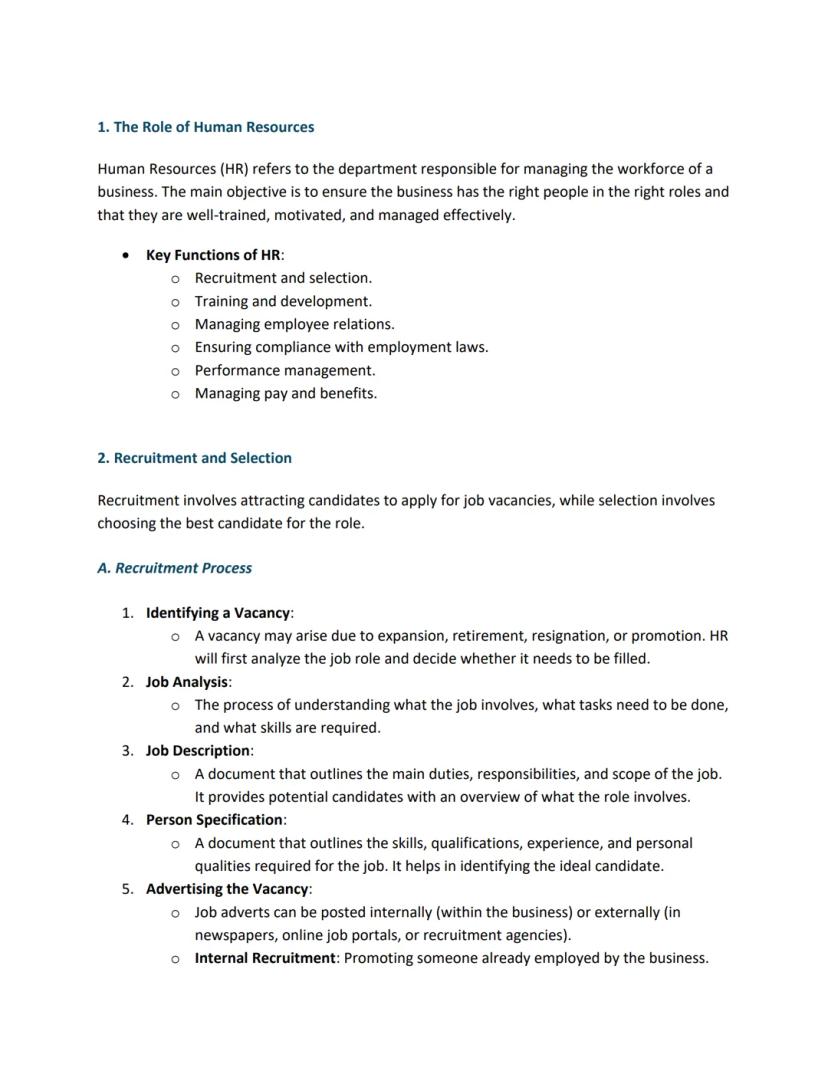
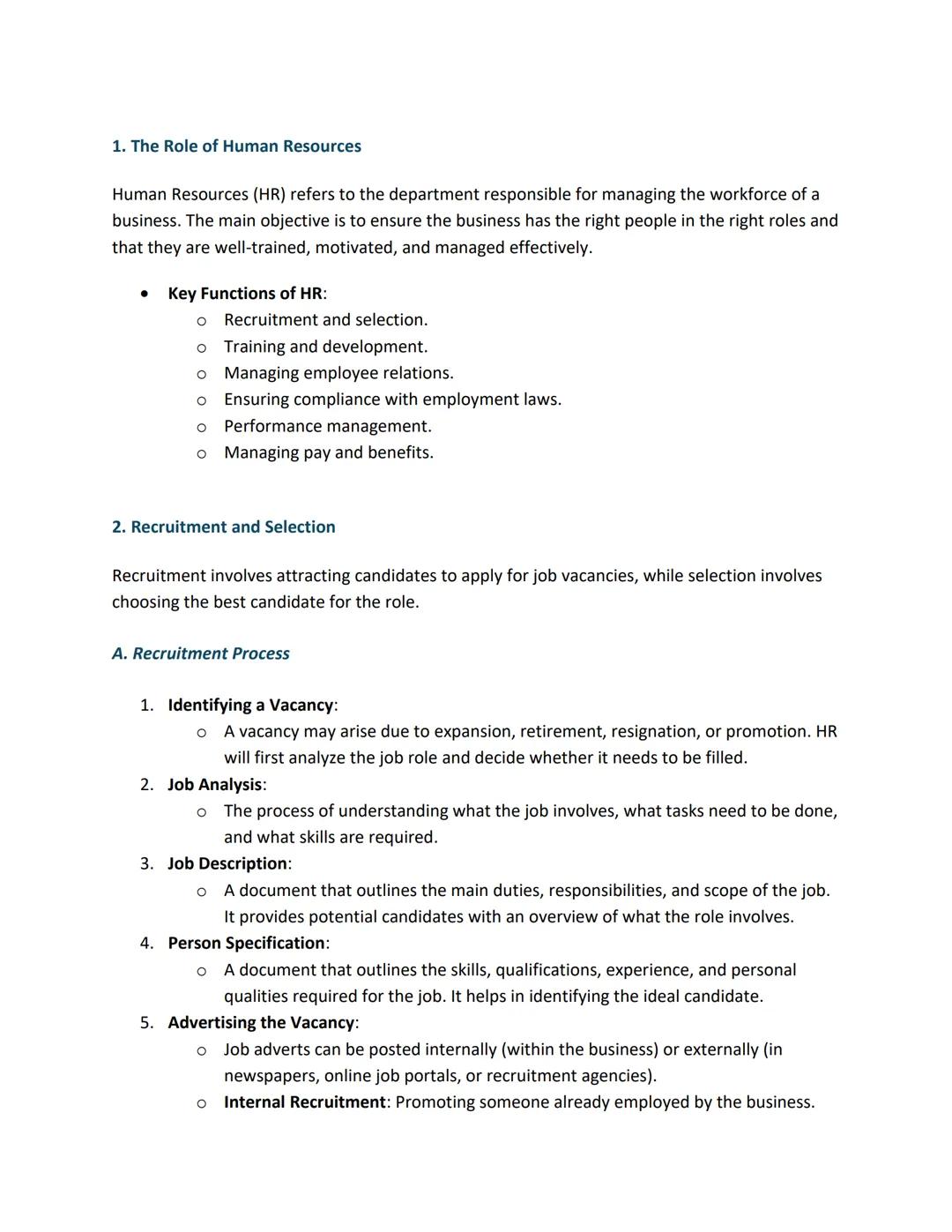
Your future workplace will have an HR department working behind the scenes to make sure the business has skilled, motivated employees in every role. Think of HR as the people who handle all the "people stuff" - from finding new workers to sorting out workplace issues.
When businesses need new staff, they don't just stick a "help wanted" sign in the window anymore. The recruitment process starts with understanding exactly what the job involves through job analysis. This leads to creating two key documents: a job description (what you'll actually be doing) and a person specification (what skills and qualities you need).
Companies can recruit internally by promoting existing employees or look externally for fresh talent. Internal recruitment is cheaper and rewards loyal staff, but external recruitment brings new ideas and skills to the business.
Quick Tip: When you're job hunting, always read both the job description and person specification carefully - they tell you exactly what the employer wants and help you tailor your application.
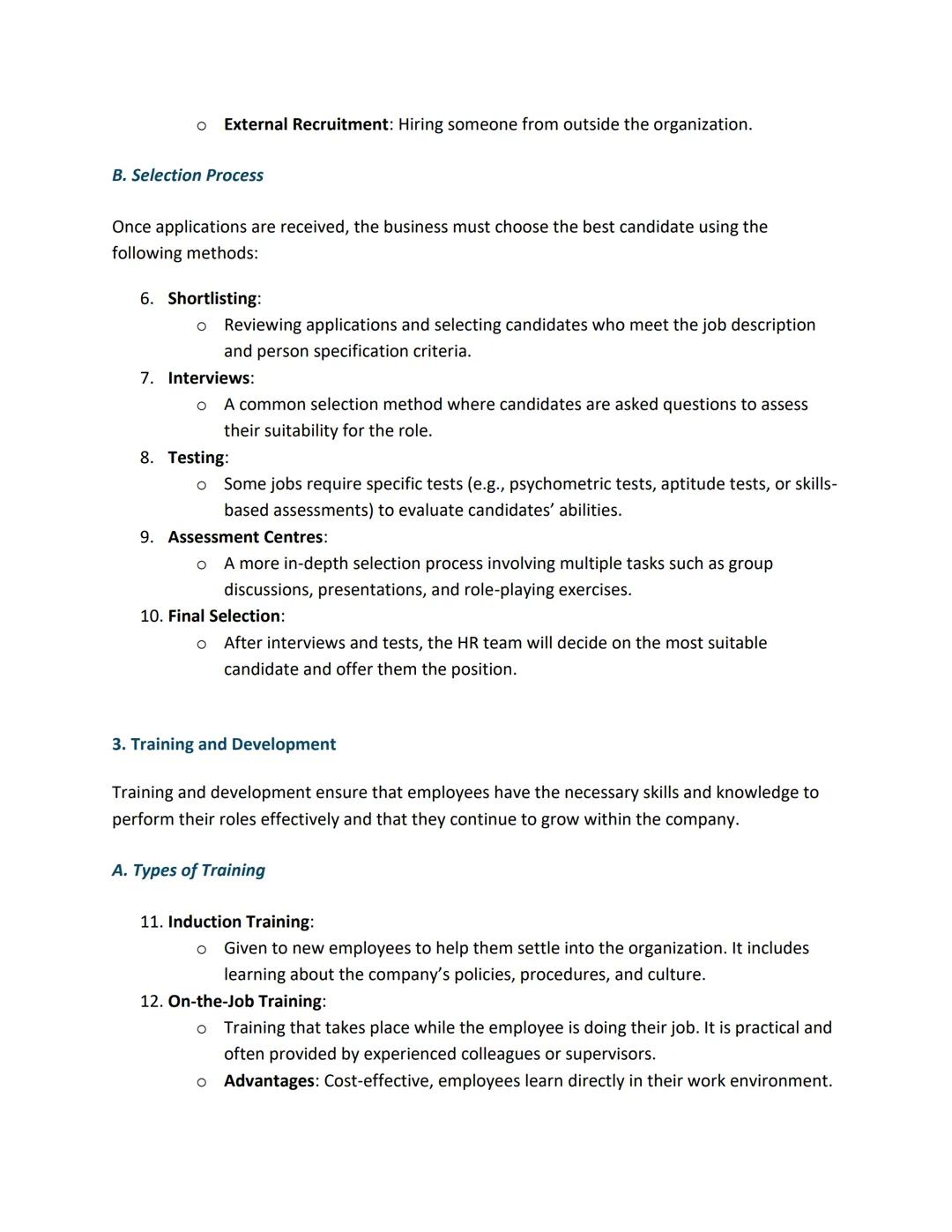
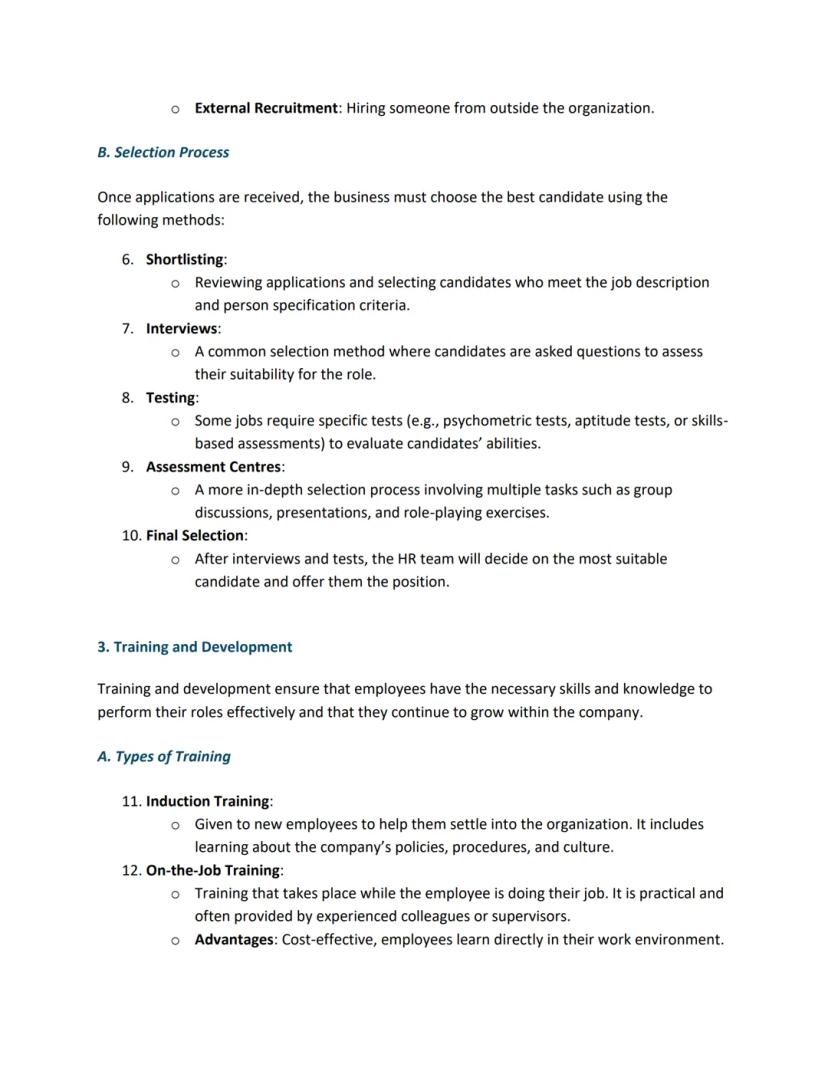
Once applications flood in, businesses use several methods to pick the best candidate. Shortlisting narrows down applications to those who meet the basic requirements. Then comes the fun part - interviews, testing, and sometimes assessment centres where you might do group exercises or presentations.
After someone gets hired, they can't just jump straight into the deep end. Induction training helps new employees understand the company culture and basic procedures. It's like getting your bearings in a new school - essential for settling in properly.
There are two main types of ongoing training. On-the-job training happens whilst you're working - it's practical and cost-effective, but can disrupt workflow. Off-the-job training takes place away from work, allowing complete focus on learning new skills, though it's more expensive.
Training isn't just nice to have - it increases productivity, reduces mistakes, and keeps employees happy. Employee development goes further, focusing on long-term career growth and helping people reach their potential.
Reality Check: Companies that invest in training their staff properly tend to have lower turnover rates and more satisfied employees.
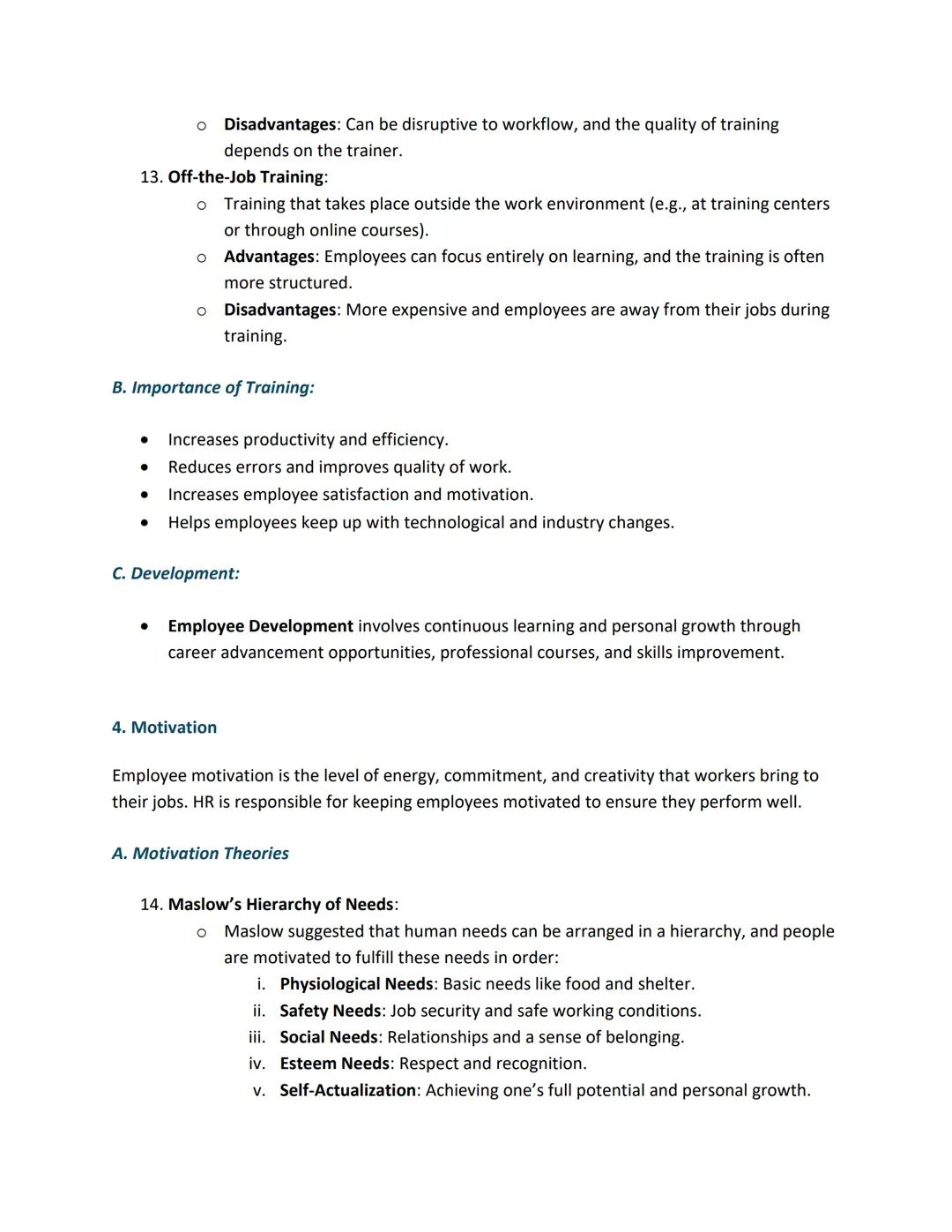
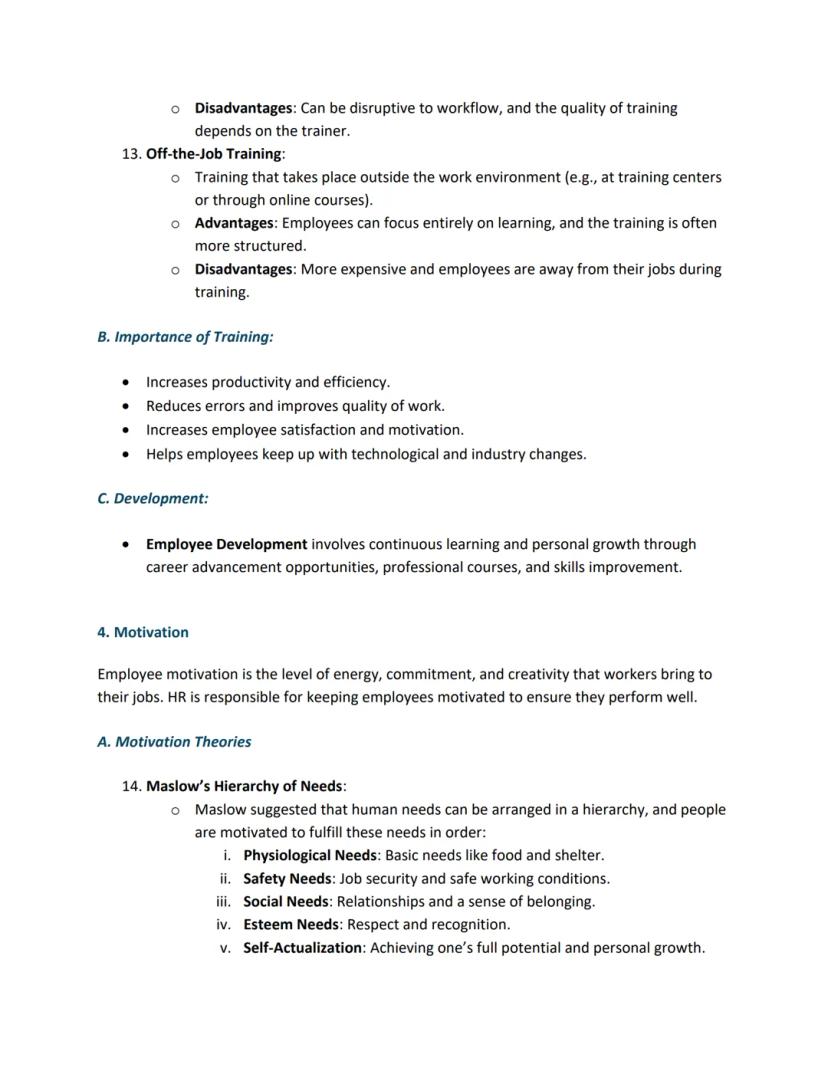
Understanding what drives people to work hard is crucial for any business. Maslow's Hierarchy of Needs suggests we're motivated by different things at different times - starting with basic needs like food and shelter, moving up through job security, relationships, respect, and finally self-actualisation (reaching your full potential).
Herzberg's Two-Factor Theory takes a different approach. It identifies hygiene factors (salary, working conditions, company policies) that prevent dissatisfaction but don't necessarily motivate. The real motivators are things like achievement, recognition, responsibility, and growth opportunities.
This explains why simply throwing money at employees doesn't always work. While financial rewards like salaries, wages, bonuses, and commission matter, non-financial rewards can be just as powerful.
Smart businesses use recognition programmes, offer career progression, provide job enrichment (more interesting, challenging work), and embrace flexible working arrangements. These approaches tap into people's deeper needs for respect, growth, and work-life balance.
Think About It: When you're choosing between job offers, consider both the salary and the non-financial benefits - they might matter more than you think in the long run.
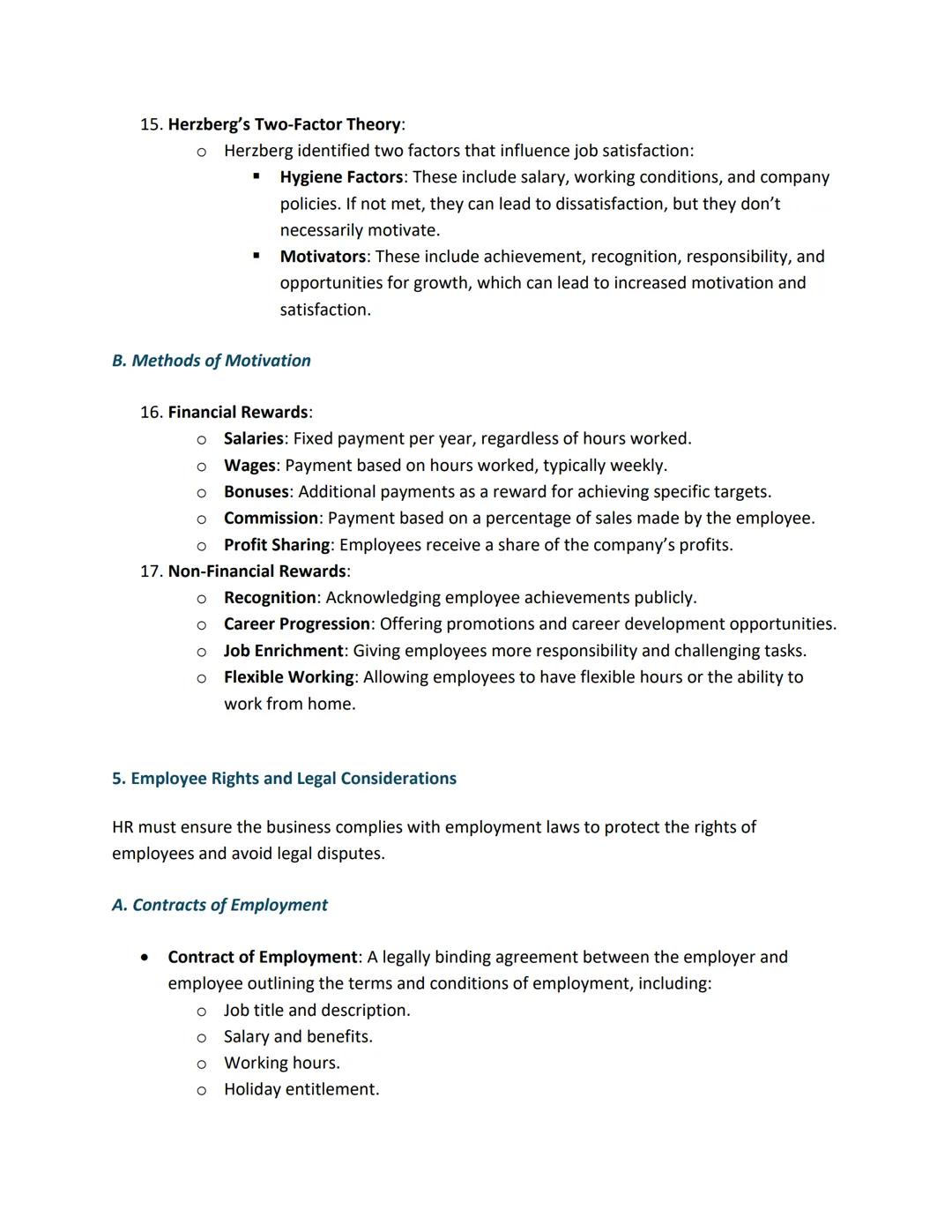
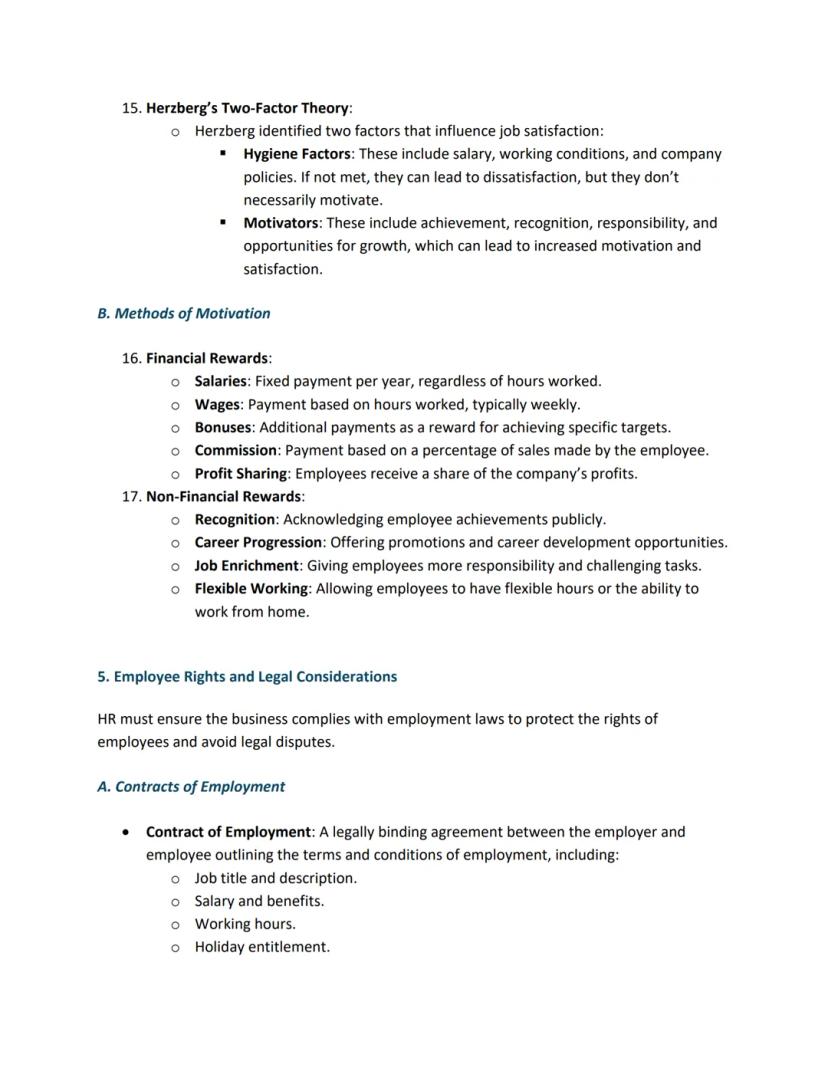
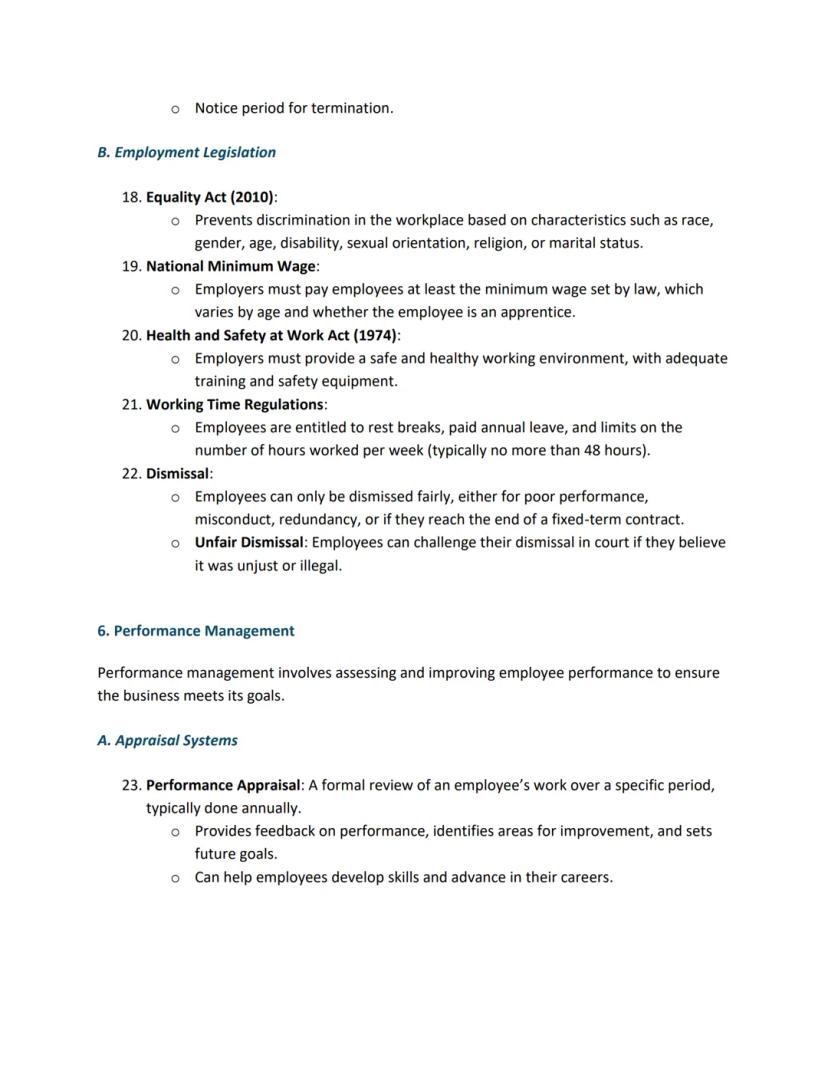
Every worker in the UK has legal rights that employers must respect. Your contract of employment is a legally binding document that spells out everything from your job title and salary to your working hours and holiday entitlement. It's your safety net if disputes arise.
The Equality Act 2010 prevents discrimination based on characteristics like race, gender, age, disability, or sexual orientation. This means everyone deserves fair treatment in hiring, promotion, and day-to-day work situations.
Financial protection comes through the National Minimum Wage, which varies by age and employment type. Meanwhile, the Health and Safety at Work Act 1974 ensures employers provide safe working conditions and proper training.
Working Time Regulations protect you from exploitation by limiting working hours (usually 48 hours per week maximum) and guaranteeing rest breaks and paid annual leave. If you're dismissed, it must be for fair reasons like poor performance, misconduct, or redundancy - unfair dismissal can be challenged in court.
Know Your Rights: Understanding employment law isn't just academic - it could protect you from unfair treatment in your future career.
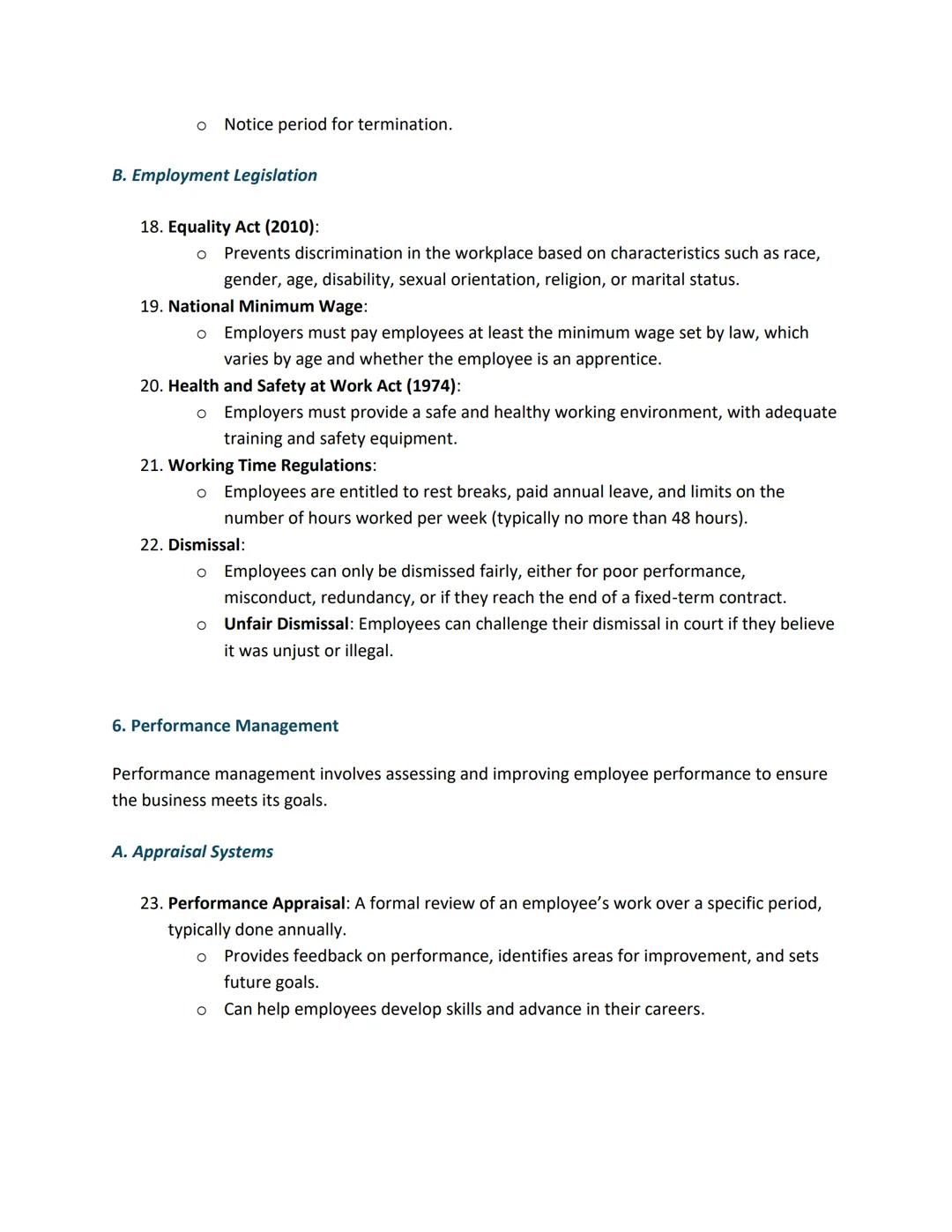
Businesses need to know how well their employees are performing, which is where performance management comes in. Most companies use performance appraisals - formal reviews that happen annually to assess your work, provide feedback, and set future goals.
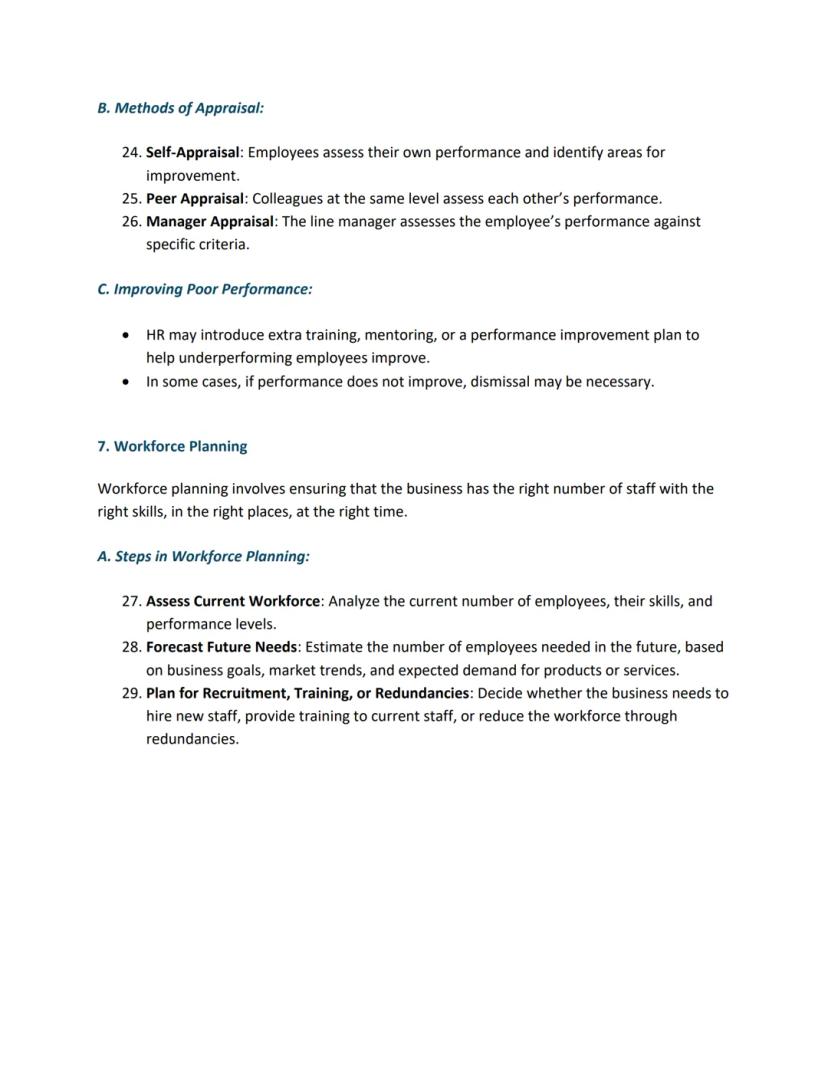
These appraisals take different forms. Self-appraisal lets you reflect on your own performance and identify improvement areas. Peer appraisal involves colleagues at your level assessing each other, whilst manager appraisal sees your boss evaluating your work against specific criteria.
When performance falls short, good HR departments don't just give up on people. They might offer extra training, mentoring, or create a performance improvement plan to help struggling employees get back on track.
However, if performance doesn't improve despite support, dismissal might become necessary. The key is that businesses must follow fair procedures and give people genuine opportunities to improve before taking such drastic action.
Career Insight: Regular performance reviews aren't just about criticism - they're opportunities to showcase achievements, discuss career goals, and identify development needs.
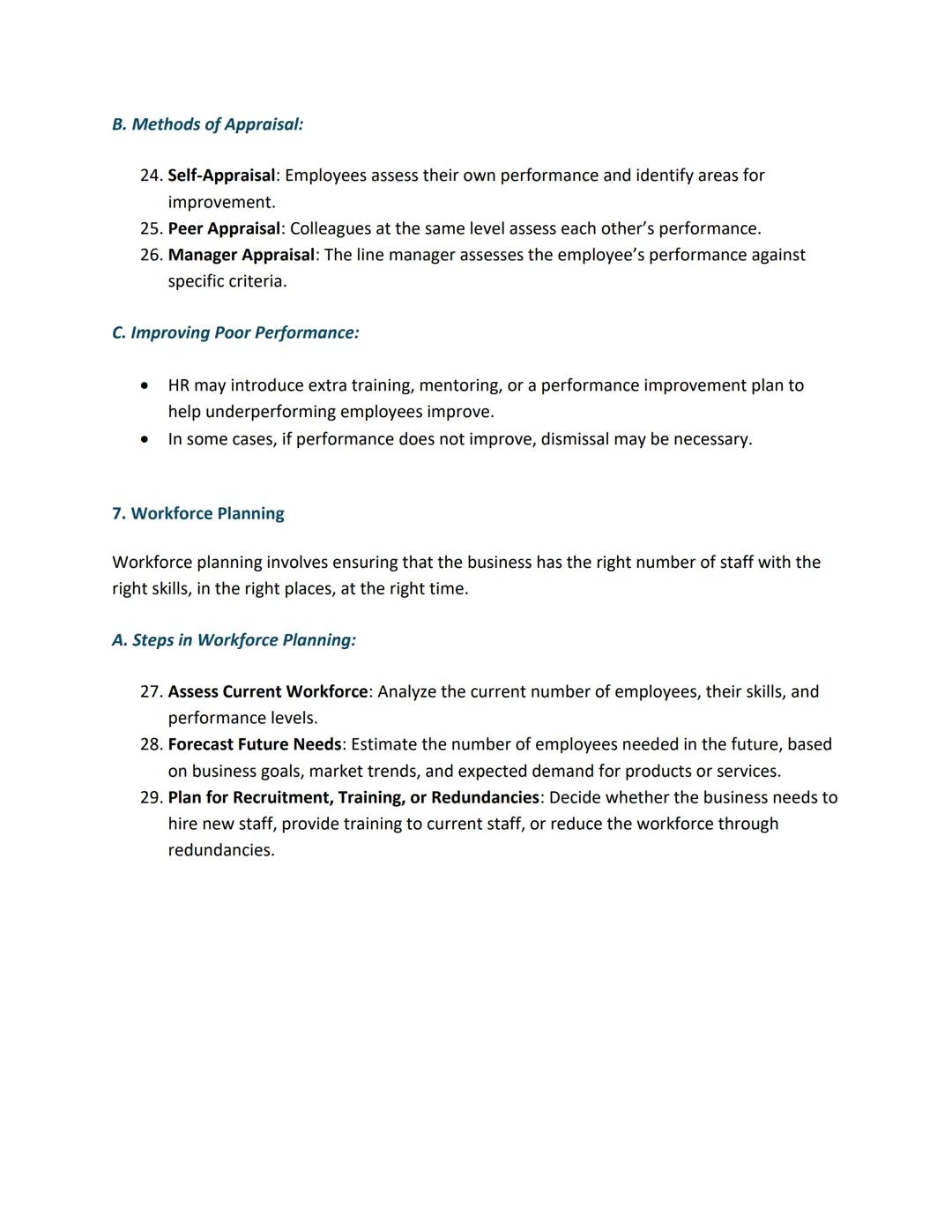
Workforce planning is like a crystal ball for businesses - trying to predict what staff they'll need in the future and making sure they're prepared. It's a three-step process that smart companies take seriously.
First, they assess their current workforce by analysing employee numbers, skills, and performance levels. This gives them a clear picture of what they're working with right now.
Next comes forecasting future needs based on business goals, market trends, and expected demand. Will they be expanding into new markets? Are certain skills becoming obsolete due to technology? These factors all influence future staffing requirements.
Finally, they plan for recruitment, training, or redundancies depending on what the analysis reveals. They might need to hire specialists, retrain existing staff for new roles, or unfortunately reduce workforce size if the business is contracting.
Effective workforce planning helps businesses avoid the chaos of suddenly realising they don't have the right people for important projects. It also gives employees better career development opportunities when companies can predict future skill needs.
Future Focus: Understanding workforce planning helps you anticipate industry changes and develop skills that will be in demand tomorrow, not just today.
Our AI Companion is a student-focused AI tool that offers more than just answers. Built on millions of Knowunity resources, it provides relevant information, personalised study plans, quizzes, and content directly in the chat, adapting to your individual learning journey.
You can download the app from Google Play Store and Apple App Store.
That's right! Enjoy free access to study content, connect with fellow students, and get instant help – all at your fingertips.
App Store
Google Play
The app is very easy to use and well designed. I have found everything I was looking for so far and have been able to learn a lot from the presentations! I will definitely use the app for a class assignment! And of course it also helps a lot as an inspiration.
Stefan S
iOS user
This app is really great. There are so many study notes and help [...]. My problem subject is French, for example, and the app has so many options for help. Thanks to this app, I have improved my French. I would recommend it to anyone.
Samantha Klich
Android user
Wow, I am really amazed. I just tried the app because I've seen it advertised many times and was absolutely stunned. This app is THE HELP you want for school and above all, it offers so many things, such as workouts and fact sheets, which have been VERY helpful to me personally.
Anna
iOS user
Best app on earth! no words because it’s too good
Thomas R
iOS user
Just amazing. Let's me revise 10x better, this app is a quick 10/10. I highly recommend it to anyone. I can watch and search for notes. I can save them in the subject folder. I can revise it any time when I come back. If you haven't tried this app, you're really missing out.
Basil
Android user
This app has made me feel so much more confident in my exam prep, not only through boosting my own self confidence through the features that allow you to connect with others and feel less alone, but also through the way the app itself is centred around making you feel better. It is easy to navigate, fun to use, and helpful to anyone struggling in absolutely any way.
David K
iOS user
The app's just great! All I have to do is enter the topic in the search bar and I get the response real fast. I don't have to watch 10 YouTube videos to understand something, so I'm saving my time. Highly recommended!
Sudenaz Ocak
Android user
In school I was really bad at maths but thanks to the app, I am doing better now. I am so grateful that you made the app.
Greenlight Bonnie
Android user
very reliable app to help and grow your ideas of Maths, English and other related topics in your works. please use this app if your struggling in areas, this app is key for that. wish I'd of done a review before. and it's also free so don't worry about that.
Rohan U
Android user
I know a lot of apps use fake accounts to boost their reviews but this app deserves it all. Originally I was getting 4 in my English exams and this time I got a grade 7. I didn’t even know about this app three days until the exam and it has helped A LOT. Please actually trust me and use it as I’m sure you too will see developments.
Xander S
iOS user
THE QUIZES AND FLASHCARDS ARE SO USEFUL AND I LOVE Knowunity AI. IT ALSO IS LITREALLY LIKE CHATGPT BUT SMARTER!! HELPED ME WITH MY MASCARA PROBLEMS TOO!! AS WELL AS MY REAL SUBJECTS ! DUHHH 😍😁😲🤑💗✨🎀😮
Elisha
iOS user
This apps acc the goat. I find revision so boring but this app makes it so easy to organize it all and then you can ask the freeeee ai to test yourself so good and you can easily upload your own stuff. highly recommend as someone taking mocks now
Paul T
iOS user
The app is very easy to use and well designed. I have found everything I was looking for so far and have been able to learn a lot from the presentations! I will definitely use the app for a class assignment! And of course it also helps a lot as an inspiration.
Stefan S
iOS user
This app is really great. There are so many study notes and help [...]. My problem subject is French, for example, and the app has so many options for help. Thanks to this app, I have improved my French. I would recommend it to anyone.
Samantha Klich
Android user
Wow, I am really amazed. I just tried the app because I've seen it advertised many times and was absolutely stunned. This app is THE HELP you want for school and above all, it offers so many things, such as workouts and fact sheets, which have been VERY helpful to me personally.
Anna
iOS user
Best app on earth! no words because it’s too good
Thomas R
iOS user
Just amazing. Let's me revise 10x better, this app is a quick 10/10. I highly recommend it to anyone. I can watch and search for notes. I can save them in the subject folder. I can revise it any time when I come back. If you haven't tried this app, you're really missing out.
Basil
Android user
This app has made me feel so much more confident in my exam prep, not only through boosting my own self confidence through the features that allow you to connect with others and feel less alone, but also through the way the app itself is centred around making you feel better. It is easy to navigate, fun to use, and helpful to anyone struggling in absolutely any way.
David K
iOS user
The app's just great! All I have to do is enter the topic in the search bar and I get the response real fast. I don't have to watch 10 YouTube videos to understand something, so I'm saving my time. Highly recommended!
Sudenaz Ocak
Android user
In school I was really bad at maths but thanks to the app, I am doing better now. I am so grateful that you made the app.
Greenlight Bonnie
Android user
very reliable app to help and grow your ideas of Maths, English and other related topics in your works. please use this app if your struggling in areas, this app is key for that. wish I'd of done a review before. and it's also free so don't worry about that.
Rohan U
Android user
I know a lot of apps use fake accounts to boost their reviews but this app deserves it all. Originally I was getting 4 in my English exams and this time I got a grade 7. I didn’t even know about this app three days until the exam and it has helped A LOT. Please actually trust me and use it as I’m sure you too will see developments.
Xander S
iOS user
THE QUIZES AND FLASHCARDS ARE SO USEFUL AND I LOVE Knowunity AI. IT ALSO IS LITREALLY LIKE CHATGPT BUT SMARTER!! HELPED ME WITH MY MASCARA PROBLEMS TOO!! AS WELL AS MY REAL SUBJECTS ! DUHHH 😍😁😲🤑💗✨🎀😮
Elisha
iOS user
This apps acc the goat. I find revision so boring but this app makes it so easy to organize it all and then you can ask the freeeee ai to test yourself so good and you can easily upload your own stuff. highly recommend as someone taking mocks now
Paul T
iOS user
Managing people is one of the most important aspects of running a successful business. Human Resources (HR) handles everything from hiring the right people to keeping them motivated and ensuring they're treated fairly under the law.
Access to all documents
Improve your grades
Join milions of students
Your future workplace will have an HR department working behind the scenes to make sure the business has skilled, motivated employees in every role. Think of HR as the people who handle all the "people stuff" - from finding new workers to sorting out workplace issues.
When businesses need new staff, they don't just stick a "help wanted" sign in the window anymore. The recruitment process starts with understanding exactly what the job involves through job analysis. This leads to creating two key documents: a job description (what you'll actually be doing) and a person specification (what skills and qualities you need).
Companies can recruit internally by promoting existing employees or look externally for fresh talent. Internal recruitment is cheaper and rewards loyal staff, but external recruitment brings new ideas and skills to the business.
Quick Tip: When you're job hunting, always read both the job description and person specification carefully - they tell you exactly what the employer wants and help you tailor your application.
Access to all documents
Improve your grades
Join milions of students
Once applications flood in, businesses use several methods to pick the best candidate. Shortlisting narrows down applications to those who meet the basic requirements. Then comes the fun part - interviews, testing, and sometimes assessment centres where you might do group exercises or presentations.
After someone gets hired, they can't just jump straight into the deep end. Induction training helps new employees understand the company culture and basic procedures. It's like getting your bearings in a new school - essential for settling in properly.
There are two main types of ongoing training. On-the-job training happens whilst you're working - it's practical and cost-effective, but can disrupt workflow. Off-the-job training takes place away from work, allowing complete focus on learning new skills, though it's more expensive.
Training isn't just nice to have - it increases productivity, reduces mistakes, and keeps employees happy. Employee development goes further, focusing on long-term career growth and helping people reach their potential.
Reality Check: Companies that invest in training their staff properly tend to have lower turnover rates and more satisfied employees.
Access to all documents
Improve your grades
Join milions of students
Understanding what drives people to work hard is crucial for any business. Maslow's Hierarchy of Needs suggests we're motivated by different things at different times - starting with basic needs like food and shelter, moving up through job security, relationships, respect, and finally self-actualisation (reaching your full potential).
Herzberg's Two-Factor Theory takes a different approach. It identifies hygiene factors (salary, working conditions, company policies) that prevent dissatisfaction but don't necessarily motivate. The real motivators are things like achievement, recognition, responsibility, and growth opportunities.
This explains why simply throwing money at employees doesn't always work. While financial rewards like salaries, wages, bonuses, and commission matter, non-financial rewards can be just as powerful.
Smart businesses use recognition programmes, offer career progression, provide job enrichment (more interesting, challenging work), and embrace flexible working arrangements. These approaches tap into people's deeper needs for respect, growth, and work-life balance.
Think About It: When you're choosing between job offers, consider both the salary and the non-financial benefits - they might matter more than you think in the long run.
Access to all documents
Improve your grades
Join milions of students
Every worker in the UK has legal rights that employers must respect. Your contract of employment is a legally binding document that spells out everything from your job title and salary to your working hours and holiday entitlement. It's your safety net if disputes arise.
The Equality Act 2010 prevents discrimination based on characteristics like race, gender, age, disability, or sexual orientation. This means everyone deserves fair treatment in hiring, promotion, and day-to-day work situations.
Financial protection comes through the National Minimum Wage, which varies by age and employment type. Meanwhile, the Health and Safety at Work Act 1974 ensures employers provide safe working conditions and proper training.
Working Time Regulations protect you from exploitation by limiting working hours (usually 48 hours per week maximum) and guaranteeing rest breaks and paid annual leave. If you're dismissed, it must be for fair reasons like poor performance, misconduct, or redundancy - unfair dismissal can be challenged in court.
Know Your Rights: Understanding employment law isn't just academic - it could protect you from unfair treatment in your future career.
Access to all documents
Improve your grades
Join milions of students
Businesses need to know how well their employees are performing, which is where performance management comes in. Most companies use performance appraisals - formal reviews that happen annually to assess your work, provide feedback, and set future goals.
These appraisals take different forms. Self-appraisal lets you reflect on your own performance and identify improvement areas. Peer appraisal involves colleagues at your level assessing each other, whilst manager appraisal sees your boss evaluating your work against specific criteria.
When performance falls short, good HR departments don't just give up on people. They might offer extra training, mentoring, or create a performance improvement plan to help struggling employees get back on track.
However, if performance doesn't improve despite support, dismissal might become necessary. The key is that businesses must follow fair procedures and give people genuine opportunities to improve before taking such drastic action.
Career Insight: Regular performance reviews aren't just about criticism - they're opportunities to showcase achievements, discuss career goals, and identify development needs.
Access to all documents
Improve your grades
Join milions of students
Workforce planning is like a crystal ball for businesses - trying to predict what staff they'll need in the future and making sure they're prepared. It's a three-step process that smart companies take seriously.
First, they assess their current workforce by analysing employee numbers, skills, and performance levels. This gives them a clear picture of what they're working with right now.
Next comes forecasting future needs based on business goals, market trends, and expected demand. Will they be expanding into new markets? Are certain skills becoming obsolete due to technology? These factors all influence future staffing requirements.
Finally, they plan for recruitment, training, or redundancies depending on what the analysis reveals. They might need to hire specialists, retrain existing staff for new roles, or unfortunately reduce workforce size if the business is contracting.
Effective workforce planning helps businesses avoid the chaos of suddenly realising they don't have the right people for important projects. It also gives employees better career development opportunities when companies can predict future skill needs.
Future Focus: Understanding workforce planning helps you anticipate industry changes and develop skills that will be in demand tomorrow, not just today.
Our AI Companion is a student-focused AI tool that offers more than just answers. Built on millions of Knowunity resources, it provides relevant information, personalised study plans, quizzes, and content directly in the chat, adapting to your individual learning journey.
You can download the app from Google Play Store and Apple App Store.
That's right! Enjoy free access to study content, connect with fellow students, and get instant help – all at your fingertips.
3
Smart Tools NEW
Transform this note into: ✓ 50+ Practice Questions ✓ Interactive Flashcards ✓ Full Mock Exam ✓ Essay Outlines
App Store
Google Play
The app is very easy to use and well designed. I have found everything I was looking for so far and have been able to learn a lot from the presentations! I will definitely use the app for a class assignment! And of course it also helps a lot as an inspiration.
Stefan S
iOS user
This app is really great. There are so many study notes and help [...]. My problem subject is French, for example, and the app has so many options for help. Thanks to this app, I have improved my French. I would recommend it to anyone.
Samantha Klich
Android user
Wow, I am really amazed. I just tried the app because I've seen it advertised many times and was absolutely stunned. This app is THE HELP you want for school and above all, it offers so many things, such as workouts and fact sheets, which have been VERY helpful to me personally.
Anna
iOS user
Best app on earth! no words because it’s too good
Thomas R
iOS user
Just amazing. Let's me revise 10x better, this app is a quick 10/10. I highly recommend it to anyone. I can watch and search for notes. I can save them in the subject folder. I can revise it any time when I come back. If you haven't tried this app, you're really missing out.
Basil
Android user
This app has made me feel so much more confident in my exam prep, not only through boosting my own self confidence through the features that allow you to connect with others and feel less alone, but also through the way the app itself is centred around making you feel better. It is easy to navigate, fun to use, and helpful to anyone struggling in absolutely any way.
David K
iOS user
The app's just great! All I have to do is enter the topic in the search bar and I get the response real fast. I don't have to watch 10 YouTube videos to understand something, so I'm saving my time. Highly recommended!
Sudenaz Ocak
Android user
In school I was really bad at maths but thanks to the app, I am doing better now. I am so grateful that you made the app.
Greenlight Bonnie
Android user
very reliable app to help and grow your ideas of Maths, English and other related topics in your works. please use this app if your struggling in areas, this app is key for that. wish I'd of done a review before. and it's also free so don't worry about that.
Rohan U
Android user
I know a lot of apps use fake accounts to boost their reviews but this app deserves it all. Originally I was getting 4 in my English exams and this time I got a grade 7. I didn’t even know about this app three days until the exam and it has helped A LOT. Please actually trust me and use it as I’m sure you too will see developments.
Xander S
iOS user
THE QUIZES AND FLASHCARDS ARE SO USEFUL AND I LOVE Knowunity AI. IT ALSO IS LITREALLY LIKE CHATGPT BUT SMARTER!! HELPED ME WITH MY MASCARA PROBLEMS TOO!! AS WELL AS MY REAL SUBJECTS ! DUHHH 😍😁😲🤑💗✨🎀😮
Elisha
iOS user
This apps acc the goat. I find revision so boring but this app makes it so easy to organize it all and then you can ask the freeeee ai to test yourself so good and you can easily upload your own stuff. highly recommend as someone taking mocks now
Paul T
iOS user
The app is very easy to use and well designed. I have found everything I was looking for so far and have been able to learn a lot from the presentations! I will definitely use the app for a class assignment! And of course it also helps a lot as an inspiration.
Stefan S
iOS user
This app is really great. There are so many study notes and help [...]. My problem subject is French, for example, and the app has so many options for help. Thanks to this app, I have improved my French. I would recommend it to anyone.
Samantha Klich
Android user
Wow, I am really amazed. I just tried the app because I've seen it advertised many times and was absolutely stunned. This app is THE HELP you want for school and above all, it offers so many things, such as workouts and fact sheets, which have been VERY helpful to me personally.
Anna
iOS user
Best app on earth! no words because it’s too good
Thomas R
iOS user
Just amazing. Let's me revise 10x better, this app is a quick 10/10. I highly recommend it to anyone. I can watch and search for notes. I can save them in the subject folder. I can revise it any time when I come back. If you haven't tried this app, you're really missing out.
Basil
Android user
This app has made me feel so much more confident in my exam prep, not only through boosting my own self confidence through the features that allow you to connect with others and feel less alone, but also through the way the app itself is centred around making you feel better. It is easy to navigate, fun to use, and helpful to anyone struggling in absolutely any way.
David K
iOS user
The app's just great! All I have to do is enter the topic in the search bar and I get the response real fast. I don't have to watch 10 YouTube videos to understand something, so I'm saving my time. Highly recommended!
Sudenaz Ocak
Android user
In school I was really bad at maths but thanks to the app, I am doing better now. I am so grateful that you made the app.
Greenlight Bonnie
Android user
very reliable app to help and grow your ideas of Maths, English and other related topics in your works. please use this app if your struggling in areas, this app is key for that. wish I'd of done a review before. and it's also free so don't worry about that.
Rohan U
Android user
I know a lot of apps use fake accounts to boost their reviews but this app deserves it all. Originally I was getting 4 in my English exams and this time I got a grade 7. I didn’t even know about this app three days until the exam and it has helped A LOT. Please actually trust me and use it as I’m sure you too will see developments.
Xander S
iOS user
THE QUIZES AND FLASHCARDS ARE SO USEFUL AND I LOVE Knowunity AI. IT ALSO IS LITREALLY LIKE CHATGPT BUT SMARTER!! HELPED ME WITH MY MASCARA PROBLEMS TOO!! AS WELL AS MY REAL SUBJECTS ! DUHHH 😍😁😲🤑💗✨🎀😮
Elisha
iOS user
This apps acc the goat. I find revision so boring but this app makes it so easy to organize it all and then you can ask the freeeee ai to test yourself so good and you can easily upload your own stuff. highly recommend as someone taking mocks now
Paul T
iOS user