
These notes cover two key geography topics: glacial landforms and...
 Biology179 views·Updated 18 Jul 2026·11 pages
Understanding Arêtes, U-Shaped Valleys, Hanging Valleys, OS Maps, and World Population Growth

aimee @aimeekiernan_zupd




1 / 10
1
of 10
Glacial Mountain Features
Ever wondered how those dramatic mountain peaks and ridges you see in photos actually form? It's all down to the incredible power of ice over thousands of years.
An arête is basically a sharp, knife-edge ridge that sits between two bowl-shaped valleys called corries. Think of it as the leftover bit when ice carves away everything else around it. The ice uses freeze-thaw weathering, plucking, and abrasion to slowly eat away at the rock on either side.
When you've got three or more of these corries chomping away at a mountain from different directions, they create a pyramidal peak - that's your classic pointy mountain top. As each corrie gets deeper and wider, they gradually squeeze the mountain between them until you're left with this dramatic spire.
Quick Tip: Picture an arête as the spine of a book - it's what's left when pages (valleys) have been carved out on both sides!
2
of 10
U-Shaped Valleys Formation
Remember those gentle river valleys with their V-shape? Well, glaciers completely transform them into something much more dramatic.
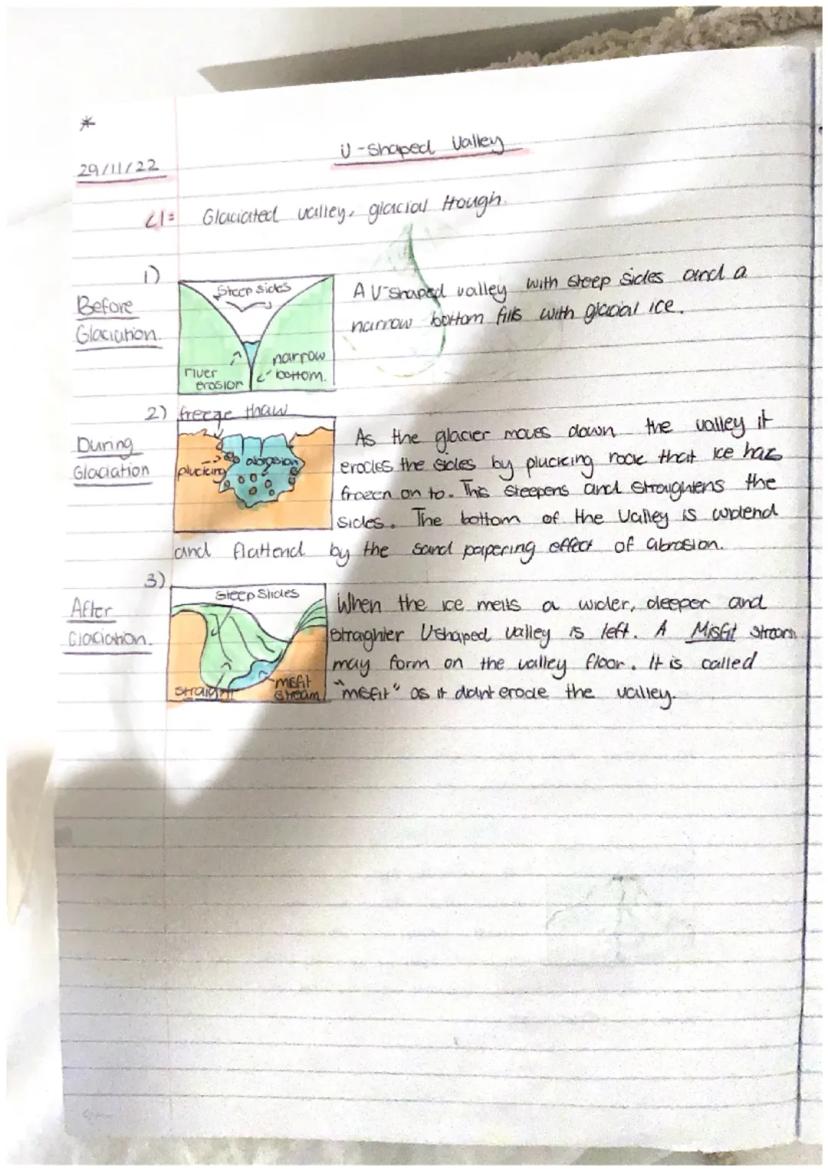
It starts with a normal V-shaped valley that gets filled with glacial ice. As this massive ice sheet moves downhill, it becomes a proper landscape bulldozer. The glacier uses plucking to rip chunks of rock from the valley sides, making them steeper and straighter than before.
Meanwhile, abrasion acts like giant sandpaper on the valley floor, grinding and flattening it out. Think of it as nature's own earthworks project. When the ice eventually melts, you're left with a U-shaped valley - much wider, deeper, and straighter than the original.
Often there's a tiny stream running along the bottom called a misfit stream. It's called "misfit" because it's far too small to have carved such a massive valley - that was all the glacier's work.
Remember: The key difference is the shape - rivers carve V's, glaciers carve U's!
3
of 10
Hanging Valleys and Ribbon Lakes
Some glacial features create spectacular waterfalls and long, thin lakes that really show off ice's sculpting power.
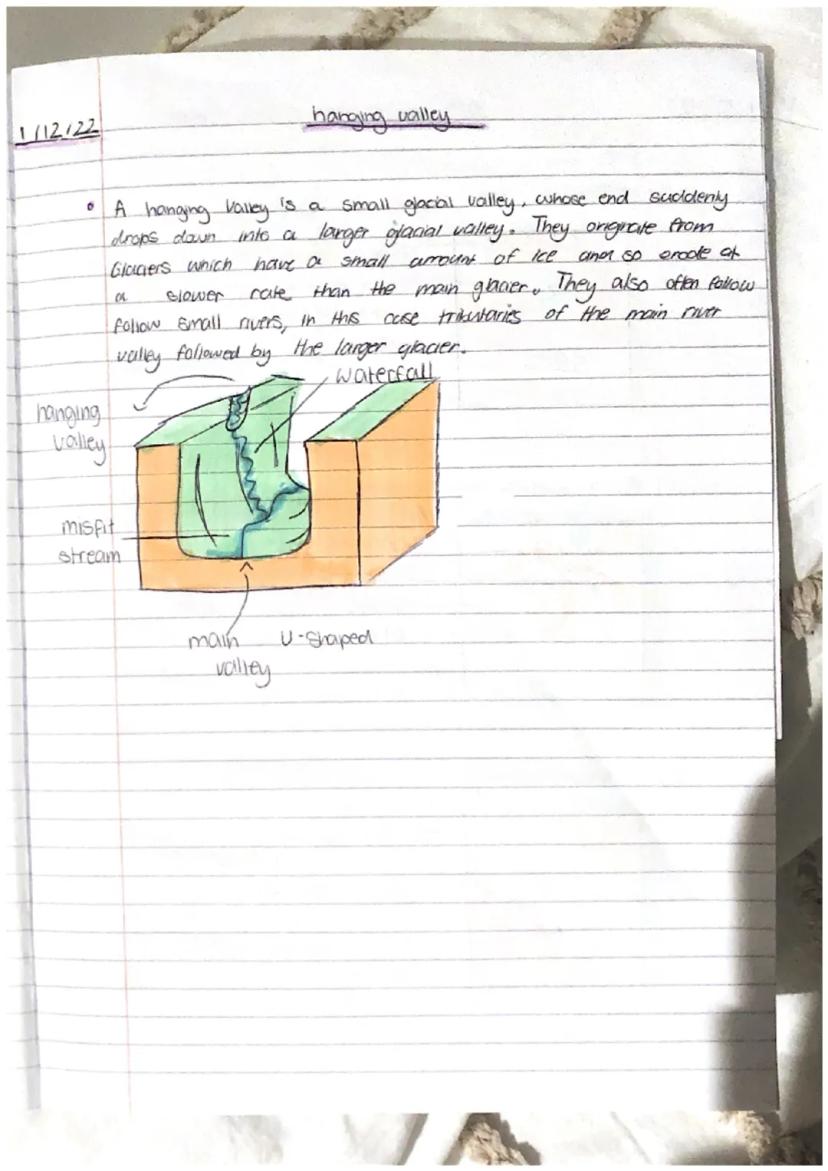
A hanging valley forms when a smaller glacier joins a much larger one. The main glacier, being more powerful, carves its valley much deeper than the smaller tributary glacier can manage. When the ice melts, you're left with this dramatic drop where the smaller valley suddenly plunges down into the main one - perfect waterfall territory.
Ribbon lakes (also called finger lakes) are those long, narrow stretches of water you often see in glaciated valleys. They form in the flat-bottomed U-shaped valleys where the glacier has carved out particularly deep sections or left behind natural dams of rock debris.
These features are brilliant examples of how different-sized glaciers working together create some of the most stunning landscapes on Earth. The misfit streams that flow through these valleys today seem almost comically small compared to the massive landforms around them.
Spot the Pattern: On OS maps, look for steep contour lines suddenly dropping into gentle valley floors - classic hanging valley territory!
4
of 10
Reading Glacial Features on Maps
Knowing how to spot glacial landforms on OS maps is a crucial skill that'll help you recognise these features in real landscapes too.
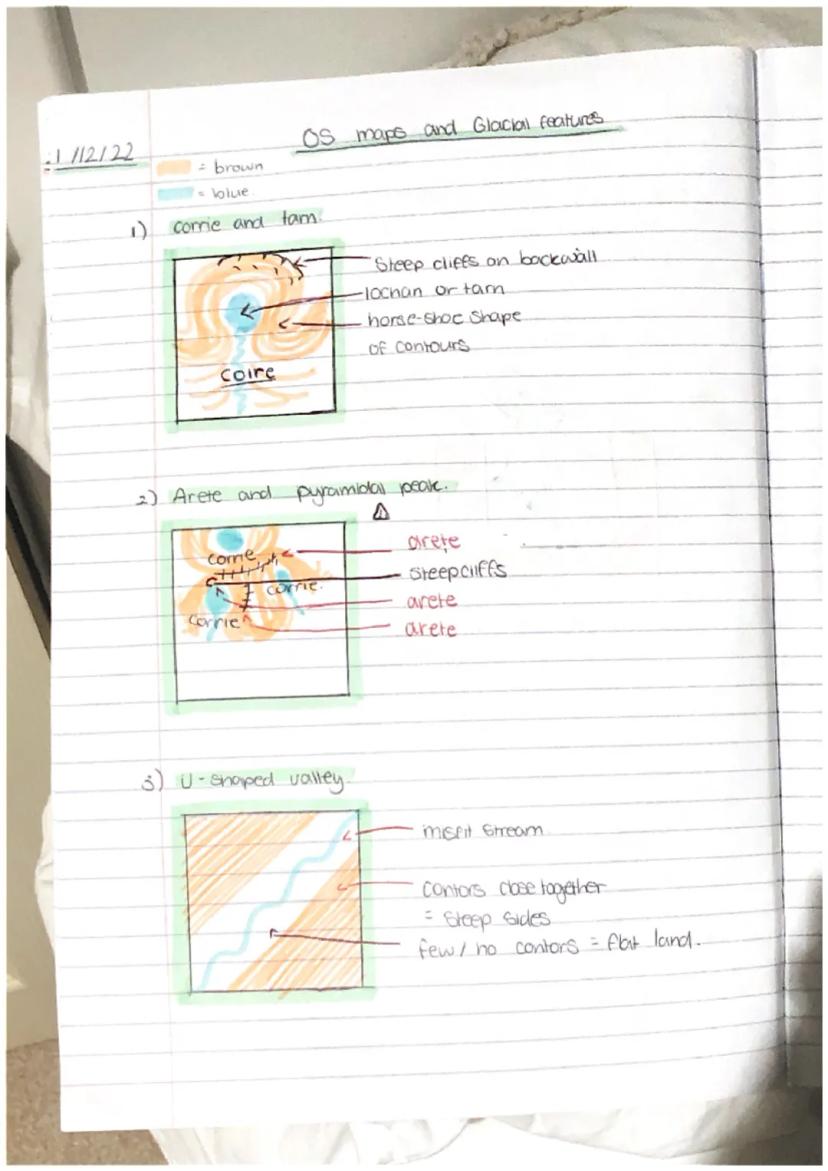
Corries and tarns show up as horseshoe-shaped contour patterns with steep cliffs marked on the back wall. If there's a small lake (tarn or lochan) sitting in the bottom, you've definitely found one. The contour lines will be packed tightly together showing those dramatic steep sides.
Arêtes and pyramidal peaks appear where multiple corries meet. Look for several horseshoe patterns pointing towards a central high point - that's your pyramidal peak, with arêtes forming the sharp ridges between each corrie.
U-shaped valleys are dead giveaways on maps. You'll see contour lines packed close together on both sides (showing steep valley walls) with hardly any contours across the flat valley floor. Often there's a thin blue line showing that misfit stream wandering across the bottom.
Map Reading Tip: Tight contours = steep slopes, spaced-out contours = gentle slopes, no contours = flat land!
5
of 10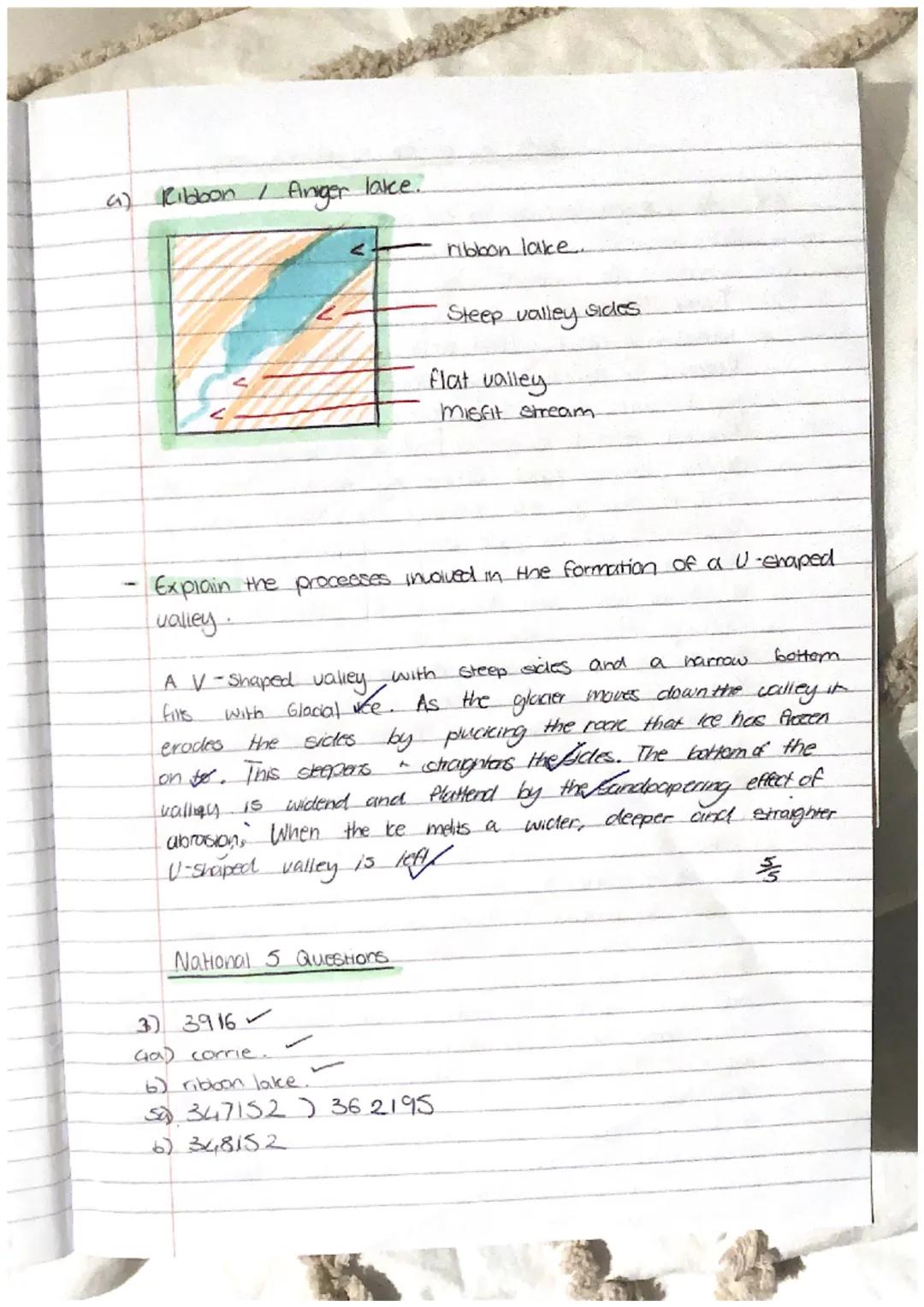
Ribbon Lakes and Exam Practice
Ribbon lakes are those long, skinny bodies of water that stretch along glaciated valleys, often with steep sides rising directly from the water and a misfit stream flowing through.
When tackling exam questions about U-shaped valley formation, stick to the key process: V-shaped valley fills with ice → glacier uses plucking on sides and abrasion on bottom → ice melts leaving wider, deeper, straighter U-shaped valley. Keep your explanations clear and mention the specific erosion processes.
The coordinates and grid references in your notes (like 391637 and 347152) are examples of how you'll need to locate features on OS maps during exams. Practice identifying features using six-figure grid references - it's a skill that comes up regularly.
Remember that these glacial features don't exist in isolation. They're all part of interconnected systems where corries feed into U-shaped valleys, arêtes separate different valleys, and ribbon lakes occupy the deepest sections carved by ice.
Exam Success: Always explain the processes (freeze-thaw, plucking, abrasion) not just describe what you see!
6
of 10
World Population Distribution
Why do billions of people cram into some places while vast areas remain almost empty? It's all about where life is actually liveable and prosperous.
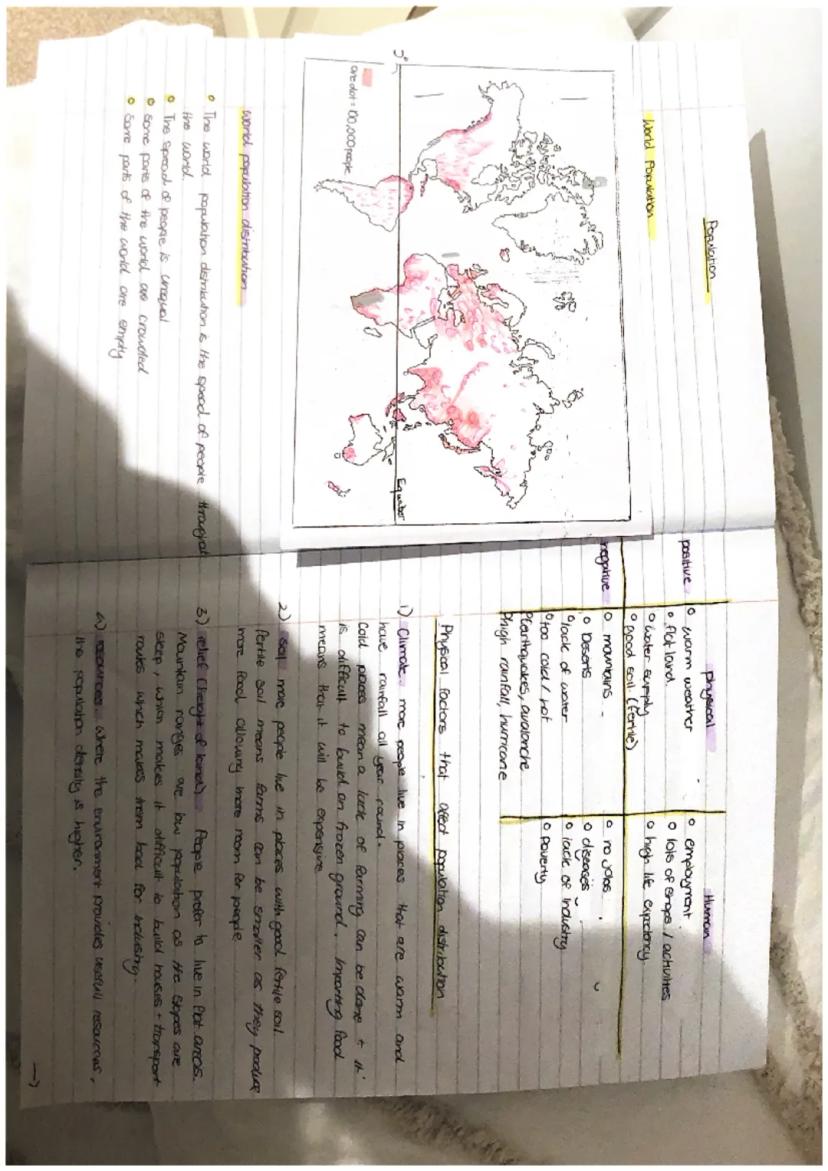
Population distribution simply means how people are spread across the planet - and that spread is incredibly uneven. Some regions are absolutely packed while others are practically deserted. This isn't random; it's driven by both physical and human factors that make places more or less attractive to live in.
Physical factors include climate (people prefer warm areas with reliable rainfall), fertile soil (better farming means more food and smaller farms), flat relief (mountains are tough to build on), and useful natural resources. Basically, if the environment makes life easier, more people will live there.
Human factors cover things like employment opportunities, good transport connections, advanced technology, and established industries. Areas with jobs, infrastructure, and economic opportunities naturally attract larger populations.
Places like deserts, mountains, and polar regions stay sparsely populated because they lack these positive factors - they're too cold, too dry, too steep, or simply too difficult to make a living in.
Think Local: Even in the UK, you can see this pattern - compare population density in London versus the Scottish Highlands!
7
of 10
Human Factors in Population Distribution
The human-made aspects of where people live are just as important as natural conditions - sometimes even more so in our modern world.
Communications and transport are absolutely crucial. Areas with excellent road, rail, air, and internet connections become population magnets because they offer opportunities and convenience. Think about how major cities grow around transport hubs.
Technological development allows places to support much higher population densities. Countries with advanced technology, good education systems, and skilled workforces can house more people comfortably because they're more efficient at producing food, managing resources, and creating wealth.
Economic activities really shape where people cluster. Regions focused on industry or services tend to have much higher population densities than areas dependent on farming or resource extraction. Manufacturing centres and financial hubs draw massive populations because they offer steady employment.
Looking at global patterns, you'll notice that many of the world's most populated areas are in the tropics - places like India and China - where favourable climate combines with economic opportunities.
Modern Reality: Today, economic factors often outweigh physical ones in determining where people choose to live!
8
of 10
World Population Growth Trends
The story of world population growth is pretty mind-blowing when you see it plotted on a graph - we've gone from gradual increases to an explosive boom in just a few centuries.
Looking at the timeline, we hit 6.1 billion in 2000, 7 billion in 2011, 8 billion in 2022, and we're projected to reach 9 billion by 2037 and 9.7 billion by 2050. That's a lot of new people in a relatively short time!
Several key factors drove this population explosion. Improved crop yields meant more food could support more people. Clean water supplies reduced disease transmission, while better healthcare and vaccines made people immune to illnesses that used to kill millions. Lower death rates resulted from better food, housing, and medical care.
The end of World War Two made people feel more secure about having families. Technological advances improved both farming and healthcare dramatically. There's also been a cultural shift where marketing and pop culture influenced people's decisions about family size.
Interestingly, the graph shows different patterns for more developed versus less developed countries, with most future growth expected in less developed regions.
Reality Check: The population has more than doubled in many people's lifetimes - that's unprecedented in human history!
9
of 10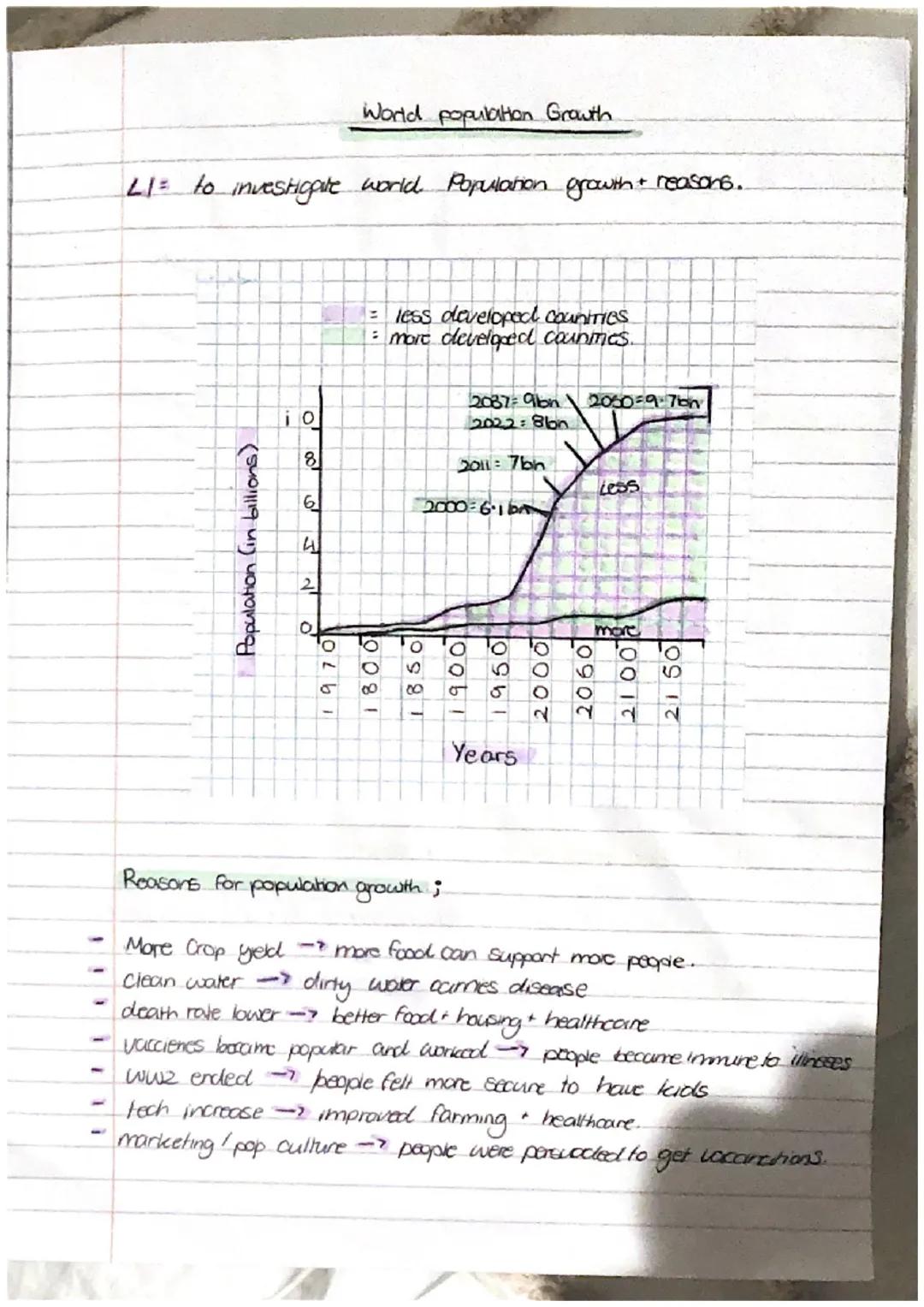
Understanding Population Growth Patterns
The population growth graph tells a fascinating story about how different parts of the world are developing at different rates.
Less developed countries are driving most of the current population growth, while more developed countries have much slower growth rates or even declining populations. This creates a really interesting global pattern where the bulk of new people are being born in regions that often struggle most with resources and infrastructure.
The same factors continue to drive growth: better crop yields supporting larger populations, cleaner water preventing disease deaths, improved healthcare keeping people alive longer, and effective vaccines protecting against deadly illnesses. Technological improvements keep enhancing both farming productivity and medical care.
Post-war security and cultural influences through media and marketing have also shaped family planning decisions. However, these factors affect different countries very differently based on their development level.
Understanding these patterns helps explain current global challenges around resources, migration, and sustainable development. Countries experiencing rapid population growth face different pressures than those with stable or declining populations.
Global Perspective: Today's population patterns will shape tomorrow's economic and environmental challenges worldwide!
10
of 10
We thought you’d never ask...
Our AI Companion is a student-focused AI tool that offers more than just answers. Built on millions of Knowunity resources, it provides relevant information, personalised study plans, quizzes, and content directly in the chat, adapting to your individual learning journey.
You can download the app from Google Play Store and Apple App Store.
That's right! Enjoy free access to study content, connect with fellow students, and get instant help – all at your fingertips.
Similar content
Most popular content in Biology
9T
 Biology
The functions of subcellular structures - B1 Biology
Flashcards on the different functions of subcellular structures: cell membrane, nucleus, mitochondria, ribosomes, cytoplasm, permant vacuole, chloroplasts and cell wall.
102,8215
B
BiologyBiology Paper 1 quiz
this is a simple quiz on key knowledge needed for paper 1
102,7835
BiologyBiology Paper 1 Overview
Comprehensive study notes covering key concepts in cellular biology, human digestion, respiration, photosynthesis, and the circulatory system. This resource includes detailed explanations of cell structures, enzyme functions, nutrient absorption, and the impact of environmental factors on biological processes. Ideal for students preparing for Biology Paper 1 exams.
1115,268384
P
Biologyplants
flash cards
124570
E
Biologyeukaryotic & prokaryotic
quiz for eukaryotic & prokaryotic. fairly easy.
114470
C
Biologycombined science quiz
biology quiz
91,3863
P
Biologyparts of a cell
.
82351
C
Biologycells structure quiz
all about the cells structures
92450
P
Biologyphotosynthesis
this is just recap questions on this. it would help you understand what it is and information like how it transfers etc.
82060
Most popular content
9 Sociology
Sociology of Education Overview
Explore comprehensive A-Level Sociology notes on the education system, covering key theories, policies, and sociological perspectives. This resource includes insights on marketisation, gender roles, cultural deprivation, and educational inequalities, providing a thorough understanding of how education shapes social stratification and individual achievement. Ideal for exam preparation and in-depth study.
12102,9583,041
SociologySociology of Families: Comprehensive Revision
Dive into an extensive overview of family dynamics, perspectives, and patterns in sociology. This resource covers key concepts such as family diversity, gender roles, marriage, and the impact of social policies on family structures. Perfect for A-Level Sociology students preparing for Paper 2.
1273,7532,307
CriminologyCriminology: Crime & Punishment Overview
Comprehensive mindmaps covering key concepts in the Crime and Punishment topic for WJEC Criminology Unit 4. This resource includes detailed insights into the Criminal Justice System, crime prevention strategies, sentencing models, and the roles of various agencies. Ideal for A-Level revision, ensuring you grasp essential theories and legislative processes to excel in your exams.
1254,8941,060
SociologyComprehensive Crime & Deviance Overview
Explore an extensive revision of crime and deviance topics, including theories, types of crime, and the impact of media. This resource covers key concepts such as Marxism, functionalism, gender and crime, and the influence of globalization on criminal behavior. Ideal for students seeking a thorough understanding of criminology and its various theories. Type: Full Topic Revision.
1251,6691,400
C
BiologyCell Biology and Cell structure
cell structures
93,2810
CriminologyWJEC Unit 4 Criminology
Criminology unit 4 detailed revision note
127,176125
SociologySociological Theories Overview
Comprehensive revision of key sociological theories including Functionalism, Marxism, Feminism, and Interpretivism. Explore concepts like value freedom, identity formation, and the critique of social control. Ideal for AQA A-Level Sociology students preparing for exams. This summary covers essential theories and their implications in sociology, providing a clear understanding of each perspective.
1231,480846
T
BiologyThe functions of subcellular structures - B1 Biology
Flashcards on the different functions of subcellular structures: cell membrane, nucleus, mitochondria, ribosomes, cytoplasm, permant vacuole, chloroplasts and cell wall.
102,8215
1
Biology1.cells Gcse biology question cards
combined science higher biology
92,3644
Students love us — and so will you.
4.6/5App Store
4.7/5Google Play
The app is very easy to use and well designed. I have found everything I was looking for so far and have been able to learn a lot from the presentations! I will definitely use the app for a class assignment! And of course it also helps a lot as an inspiration.
Stefan SiOS user
This app is really great. There are so many study notes and help [...]. My problem subject is French, for example, and the app has so many options for help. Thanks to this app, I have improved my French. I would recommend it to anyone.
Samantha KlichAndroid user
Wow, I am really amazed. I just tried the app because I've seen it advertised many times and was absolutely stunned. This app is THE HELP you want for school and above all, it offers so many things, such as workouts and fact sheets, which have been VERY helpful to me personally.
AnnaiOS user
Biology179 views·Updated 18 Jul 2026·11 pagesUnderstanding Arêtes, U-Shaped Valleys, Hanging Valleys, OS Maps, and World Population Growth
aimee @aimeekiernan_zupd
These notes cover two key geography topics: glacial landforms and world population patterns. You'll learn how ice shapes mountain landscapes and why people live where they do around the world.
1
of 10
Sign up to see the content. It's free!
- Access to all documents
- Improve your grades
- Join milions of students
By signing up you accept Terms of Service and Privacy Policy
Glacial Mountain Features
Ever wondered how those dramatic mountain peaks and ridges you see in photos actually form? It's all down to the incredible power of ice over thousands of years.
An arête is basically a sharp, knife-edge ridge that sits between two bowl-shaped valleys called corries. Think of it as the leftover bit when ice carves away everything else around it. The ice uses freeze-thaw weathering, plucking, and abrasion to slowly eat away at the rock on either side.
When you've got three or more of these corries chomping away at a mountain from different directions, they create a pyramidal peak - that's your classic pointy mountain top. As each corrie gets deeper and wider, they gradually squeeze the mountain between them until you're left with this dramatic spire.
Quick Tip: Picture an arête as the spine of a book - it's what's left when pages (valleys) have been carved out on both sides!
2
of 10Sign up to see the content. It's free!
- Access to all documents
- Improve your grades
- Join milions of students
By signing up you accept Terms of Service and Privacy Policy
U-Shaped Valleys Formation
Remember those gentle river valleys with their V-shape? Well, glaciers completely transform them into something much more dramatic.
It starts with a normal V-shaped valley that gets filled with glacial ice. As this massive ice sheet moves downhill, it becomes a proper landscape bulldozer. The glacier uses plucking to rip chunks of rock from the valley sides, making them steeper and straighter than before.
Meanwhile, abrasion acts like giant sandpaper on the valley floor, grinding and flattening it out. Think of it as nature's own earthworks project. When the ice eventually melts, you're left with a U-shaped valley - much wider, deeper, and straighter than the original.
Often there's a tiny stream running along the bottom called a misfit stream. It's called "misfit" because it's far too small to have carved such a massive valley - that was all the glacier's work.
Remember: The key difference is the shape - rivers carve V's, glaciers carve U's!
3
of 10Sign up to see the content. It's free!
- Access to all documents
- Improve your grades
- Join milions of students
By signing up you accept Terms of Service and Privacy Policy
Hanging Valleys and Ribbon Lakes
Some glacial features create spectacular waterfalls and long, thin lakes that really show off ice's sculpting power.
A hanging valley forms when a smaller glacier joins a much larger one. The main glacier, being more powerful, carves its valley much deeper than the smaller tributary glacier can manage. When the ice melts, you're left with this dramatic drop where the smaller valley suddenly plunges down into the main one - perfect waterfall territory.
Ribbon lakes (also called finger lakes) are those long, narrow stretches of water you often see in glaciated valleys. They form in the flat-bottomed U-shaped valleys where the glacier has carved out particularly deep sections or left behind natural dams of rock debris.
These features are brilliant examples of how different-sized glaciers working together create some of the most stunning landscapes on Earth. The misfit streams that flow through these valleys today seem almost comically small compared to the massive landforms around them.
Spot the Pattern: On OS maps, look for steep contour lines suddenly dropping into gentle valley floors - classic hanging valley territory!
4
of 10Sign up to see the content. It's free!
- Access to all documents
- Improve your grades
- Join milions of students
By signing up you accept Terms of Service and Privacy Policy
Reading Glacial Features on Maps
Knowing how to spot glacial landforms on OS maps is a crucial skill that'll help you recognise these features in real landscapes too.
Corries and tarns show up as horseshoe-shaped contour patterns with steep cliffs marked on the back wall. If there's a small lake (tarn or lochan) sitting in the bottom, you've definitely found one. The contour lines will be packed tightly together showing those dramatic steep sides.
Arêtes and pyramidal peaks appear where multiple corries meet. Look for several horseshoe patterns pointing towards a central high point - that's your pyramidal peak, with arêtes forming the sharp ridges between each corrie.
U-shaped valleys are dead giveaways on maps. You'll see contour lines packed close together on both sides (showing steep valley walls) with hardly any contours across the flat valley floor. Often there's a thin blue line showing that misfit stream wandering across the bottom.
Map Reading Tip: Tight contours = steep slopes, spaced-out contours = gentle slopes, no contours = flat land!
5
of 10Sign up to see the content. It's free!
- Access to all documents
- Improve your grades
- Join milions of students
By signing up you accept Terms of Service and Privacy Policy
Ribbon Lakes and Exam Practice
Ribbon lakes are those long, skinny bodies of water that stretch along glaciated valleys, often with steep sides rising directly from the water and a misfit stream flowing through.
When tackling exam questions about U-shaped valley formation, stick to the key process: V-shaped valley fills with ice → glacier uses plucking on sides and abrasion on bottom → ice melts leaving wider, deeper, straighter U-shaped valley. Keep your explanations clear and mention the specific erosion processes.
The coordinates and grid references in your notes (like 391637 and 347152) are examples of how you'll need to locate features on OS maps during exams. Practice identifying features using six-figure grid references - it's a skill that comes up regularly.
Remember that these glacial features don't exist in isolation. They're all part of interconnected systems where corries feed into U-shaped valleys, arêtes separate different valleys, and ribbon lakes occupy the deepest sections carved by ice.
Exam Success: Always explain the processes (freeze-thaw, plucking, abrasion) not just describe what you see!
6
of 10Sign up to see the content. It's free!
- Access to all documents
- Improve your grades
- Join milions of students
By signing up you accept Terms of Service and Privacy Policy
World Population Distribution
Why do billions of people cram into some places while vast areas remain almost empty? It's all about where life is actually liveable and prosperous.
Population distribution simply means how people are spread across the planet - and that spread is incredibly uneven. Some regions are absolutely packed while others are practically deserted. This isn't random; it's driven by both physical and human factors that make places more or less attractive to live in.
Physical factors include climate (people prefer warm areas with reliable rainfall), fertile soil (better farming means more food and smaller farms), flat relief (mountains are tough to build on), and useful natural resources. Basically, if the environment makes life easier, more people will live there.
Human factors cover things like employment opportunities, good transport connections, advanced technology, and established industries. Areas with jobs, infrastructure, and economic opportunities naturally attract larger populations.
Places like deserts, mountains, and polar regions stay sparsely populated because they lack these positive factors - they're too cold, too dry, too steep, or simply too difficult to make a living in.
Think Local: Even in the UK, you can see this pattern - compare population density in London versus the Scottish Highlands!
7
of 10Sign up to see the content. It's free!
- Access to all documents
- Improve your grades
- Join milions of students
By signing up you accept Terms of Service and Privacy Policy
Human Factors in Population Distribution
The human-made aspects of where people live are just as important as natural conditions - sometimes even more so in our modern world.
Communications and transport are absolutely crucial. Areas with excellent road, rail, air, and internet connections become population magnets because they offer opportunities and convenience. Think about how major cities grow around transport hubs.
Technological development allows places to support much higher population densities. Countries with advanced technology, good education systems, and skilled workforces can house more people comfortably because they're more efficient at producing food, managing resources, and creating wealth.
Economic activities really shape where people cluster. Regions focused on industry or services tend to have much higher population densities than areas dependent on farming or resource extraction. Manufacturing centres and financial hubs draw massive populations because they offer steady employment.
Looking at global patterns, you'll notice that many of the world's most populated areas are in the tropics - places like India and China - where favourable climate combines with economic opportunities.
Modern Reality: Today, economic factors often outweigh physical ones in determining where people choose to live!
8
of 10Sign up to see the content. It's free!
- Access to all documents
- Improve your grades
- Join milions of students
By signing up you accept Terms of Service and Privacy Policy
World Population Growth Trends
The story of world population growth is pretty mind-blowing when you see it plotted on a graph - we've gone from gradual increases to an explosive boom in just a few centuries.
Looking at the timeline, we hit 6.1 billion in 2000, 7 billion in 2011, 8 billion in 2022, and we're projected to reach 9 billion by 2037 and 9.7 billion by 2050. That's a lot of new people in a relatively short time!
Several key factors drove this population explosion. Improved crop yields meant more food could support more people. Clean water supplies reduced disease transmission, while better healthcare and vaccines made people immune to illnesses that used to kill millions. Lower death rates resulted from better food, housing, and medical care.
The end of World War Two made people feel more secure about having families. Technological advances improved both farming and healthcare dramatically. There's also been a cultural shift where marketing and pop culture influenced people's decisions about family size.
Interestingly, the graph shows different patterns for more developed versus less developed countries, with most future growth expected in less developed regions.
Reality Check: The population has more than doubled in many people's lifetimes - that's unprecedented in human history!
9
of 10Sign up to see the content. It's free!
- Access to all documents
- Improve your grades
- Join milions of students
By signing up you accept Terms of Service and Privacy Policy
Understanding Population Growth Patterns
The population growth graph tells a fascinating story about how different parts of the world are developing at different rates.
Less developed countries are driving most of the current population growth, while more developed countries have much slower growth rates or even declining populations. This creates a really interesting global pattern where the bulk of new people are being born in regions that often struggle most with resources and infrastructure.
The same factors continue to drive growth: better crop yields supporting larger populations, cleaner water preventing disease deaths, improved healthcare keeping people alive longer, and effective vaccines protecting against deadly illnesses. Technological improvements keep enhancing both farming productivity and medical care.
Post-war security and cultural influences through media and marketing have also shaped family planning decisions. However, these factors affect different countries very differently based on their development level.
Understanding these patterns helps explain current global challenges around resources, migration, and sustainable development. Countries experiencing rapid population growth face different pressures than those with stable or declining populations.
Global Perspective: Today's population patterns will shape tomorrow's economic and environmental challenges worldwide!
10
of 10Sign up to see the content. It's free!
- Access to all documents
- Improve your grades
- Join milions of students
By signing up you accept Terms of Service and Privacy Policy
We thought you’d never ask...
Our AI Companion is a student-focused AI tool that offers more than just answers. Built on millions of Knowunity resources, it provides relevant information, personalised study plans, quizzes, and content directly in the chat, adapting to your individual learning journey.
You can download the app from Google Play Store and Apple App Store.
That's right! Enjoy free access to study content, connect with fellow students, and get instant help – all at your fingertips.
Similar content
Most popular content in Biology
9T
BiologyThe functions of subcellular structures - B1 Biology
Flashcards on the different functions of subcellular structures: cell membrane, nucleus, mitochondria, ribosomes, cytoplasm, permant vacuole, chloroplasts and cell wall.
102,8215
B
BiologyBiology Paper 1 quiz
this is a simple quiz on key knowledge needed for paper 1
102,7835
BiologyBiology Paper 1 Overview
Comprehensive study notes covering key concepts in cellular biology, human digestion, respiration, photosynthesis, and the circulatory system. This resource includes detailed explanations of cell structures, enzyme functions, nutrient absorption, and the impact of environmental factors on biological processes. Ideal for students preparing for Biology Paper 1 exams.
1115,268384
P
Biologyplants
flash cards
124570
E
Biologyeukaryotic & prokaryotic
quiz for eukaryotic & prokaryotic. fairly easy.
114470
C
Biologycombined science quiz
biology quiz
91,3863
P
Biologyparts of a cell
.
82351
C
Biologycells structure quiz
all about the cells structures
92450
P
Biologyphotosynthesis
this is just recap questions on this. it would help you understand what it is and information like how it transfers etc.
82060
Most popular content
9SociologySociology of Education Overview
Explore comprehensive A-Level Sociology notes on the education system, covering key theories, policies, and sociological perspectives. This resource includes insights on marketisation, gender roles, cultural deprivation, and educational inequalities, providing a thorough understanding of how education shapes social stratification and individual achievement. Ideal for exam preparation and in-depth study.
12102,9583,041
SociologySociology of Families: Comprehensive Revision
Dive into an extensive overview of family dynamics, perspectives, and patterns in sociology. This resource covers key concepts such as family diversity, gender roles, marriage, and the impact of social policies on family structures. Perfect for A-Level Sociology students preparing for Paper 2.
1273,7532,307
CriminologyCriminology: Crime & Punishment Overview
Comprehensive mindmaps covering key concepts in the Crime and Punishment topic for WJEC Criminology Unit 4. This resource includes detailed insights into the Criminal Justice System, crime prevention strategies, sentencing models, and the roles of various agencies. Ideal for A-Level revision, ensuring you grasp essential theories and legislative processes to excel in your exams.
1254,8941,060
SociologyComprehensive Crime & Deviance Overview
Explore an extensive revision of crime and deviance topics, including theories, types of crime, and the impact of media. This resource covers key concepts such as Marxism, functionalism, gender and crime, and the influence of globalization on criminal behavior. Ideal for students seeking a thorough understanding of criminology and its various theories. Type: Full Topic Revision.
1251,6691,400
C
BiologyCell Biology and Cell structure
cell structures
93,2810
CriminologyWJEC Unit 4 Criminology
Criminology unit 4 detailed revision note
127,176125
SociologySociological Theories Overview
Comprehensive revision of key sociological theories including Functionalism, Marxism, Feminism, and Interpretivism. Explore concepts like value freedom, identity formation, and the critique of social control. Ideal for AQA A-Level Sociology students preparing for exams. This summary covers essential theories and their implications in sociology, providing a clear understanding of each perspective.
1231,480846
T
BiologyThe functions of subcellular structures - B1 Biology
Flashcards on the different functions of subcellular structures: cell membrane, nucleus, mitochondria, ribosomes, cytoplasm, permant vacuole, chloroplasts and cell wall.
102,8215
1
Biology1.cells Gcse biology question cards
combined science higher biology
92,3644
Students love us — and so will you.
4.6/5App Store
4.7/5Google Play
The app is very easy to use and well designed. I have found everything I was looking for so far and have been able to learn a lot from the presentations! I will definitely use the app for a class assignment! And of course it also helps a lot as an inspiration.
Stefan SiOS user
This app is really great. There are so many study notes and help [...]. My problem subject is French, for example, and the app has so many options for help. Thanks to this app, I have improved my French. I would recommend it to anyone.
Samantha KlichAndroid user
Wow, I am really amazed. I just tried the app because I've seen it advertised many times and was absolutely stunned. This app is THE HELP you want for school and above all, it offers so many things, such as workouts and fact sheets, which have been VERY helpful to me personally.
AnnaiOS user