
Ecology is all about how living things interact with each... Show more
 Biology
 Sociology
 English Literature
Sign up to see the contentIt's free!
Access to all documents
Improve your grades
Join milions of students
Knowunity AI
Subjects
Triangle Congruence and Similarity Theorems
Triangle Properties and Classification
Linear Equations and Graphs
Geometric Angle Relationships
Trigonometric Functions and Identities
Equation Solving Techniques
Circle Geometry Fundamentals
Division Operations and Methods
Basic Differentiation Rules
Exponent and Logarithm Properties
Show all topics
Human Organ Systems
Reproductive Cell Cycles
Biological Sciences Subdisciplines
Cellular Energy Metabolism
Autotrophic Energy Processes
Inheritance Patterns and Principles
Biomolecular Structure and Organization
Cell Cycle and Division Mechanics
Cellular Organization and Development
Biological Structural Organization
Show all topics
Chemical Sciences and Applications
Atomic Structure and Composition
Molecular Electron Structure Representation
Atomic Electron Behavior
Matter Properties and Water
Mole Concept and Calculations
Gas Laws and Behavior
Periodic Table Organization
Chemical Thermodynamics Fundamentals
Chemical Bond Types and Properties
Show all topics
European Renaissance and Enlightenment
European Cultural Movements 800-1920
American Revolution Era 1763-1797
American Civil War 1861-1865
Global Imperial Systems
Mongol and Chinese Dynasties
U.S. Presidents and World Leaders
Historical Sources and Documentation
World Wars Era and Impact
World Religious Systems
Show all topics
Classic and Contemporary Novels
Literary Character Analysis
Rhetorical Theory and Practice
Classic Literary Narratives
Reading Analysis and Interpretation
Narrative Structure and Techniques
English Language Components
Influential English-Language Authors
Basic Sentence Structure
Narrative Voice and Perspective
Show all topics
318
•
Updated Mar 30, 2026
•
Shah
@shah_zbsehbjyzq
Ecology is all about how living things interact with each... Show more
This is your complete guide to ecology for AQA GCSE Biology. You'll master everything from how organisms compete for resources to the impact humans have on ecosystems.
The content covers both foundation and higher tier material, so you'll be fully prepared regardless of which exam you're taking. Some sections are specifically for separate science students, but most applies to everyone.
Quick Tip: Focus on understanding the connections between different ecological concepts - they all link together like pieces of a puzzle!
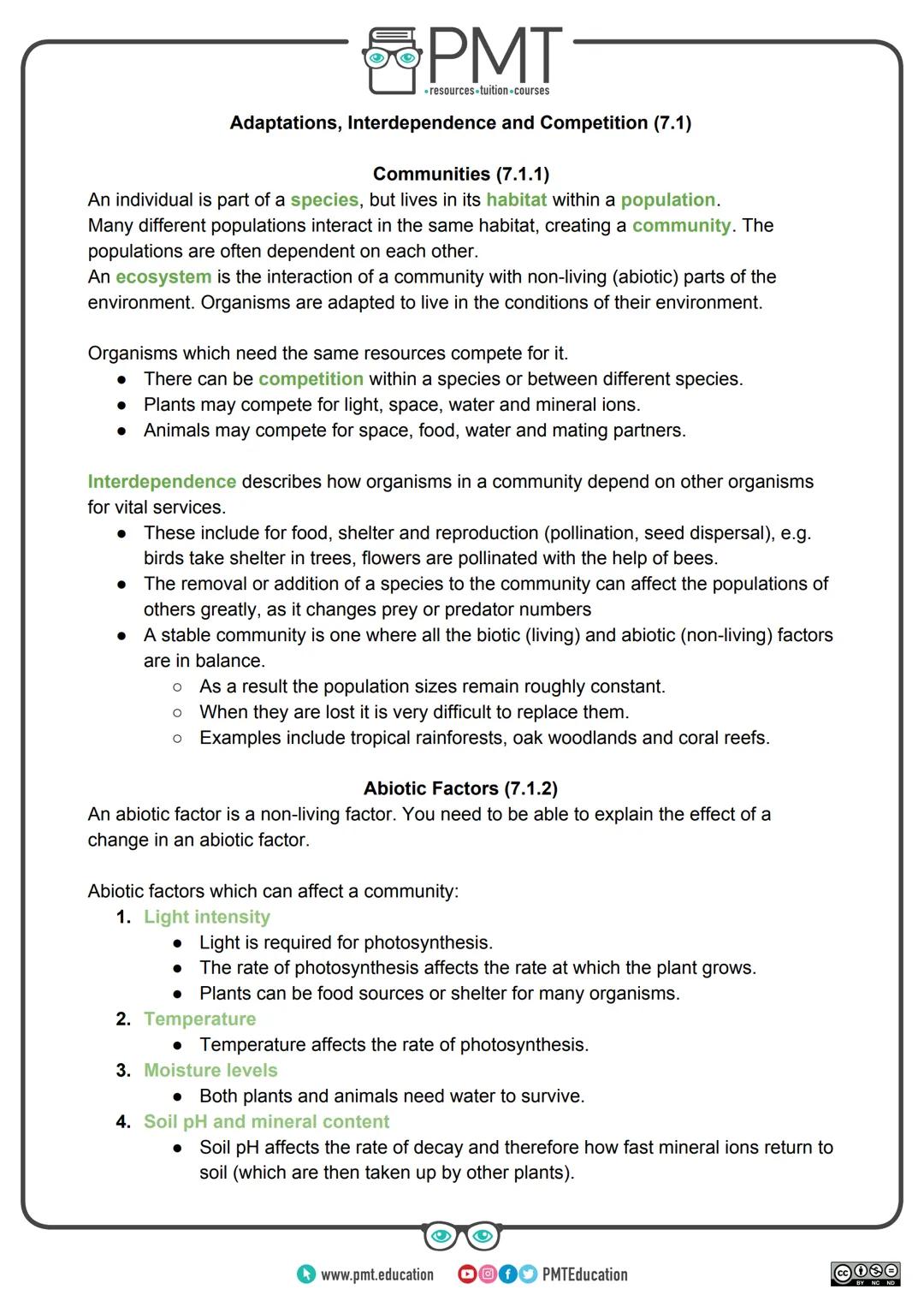
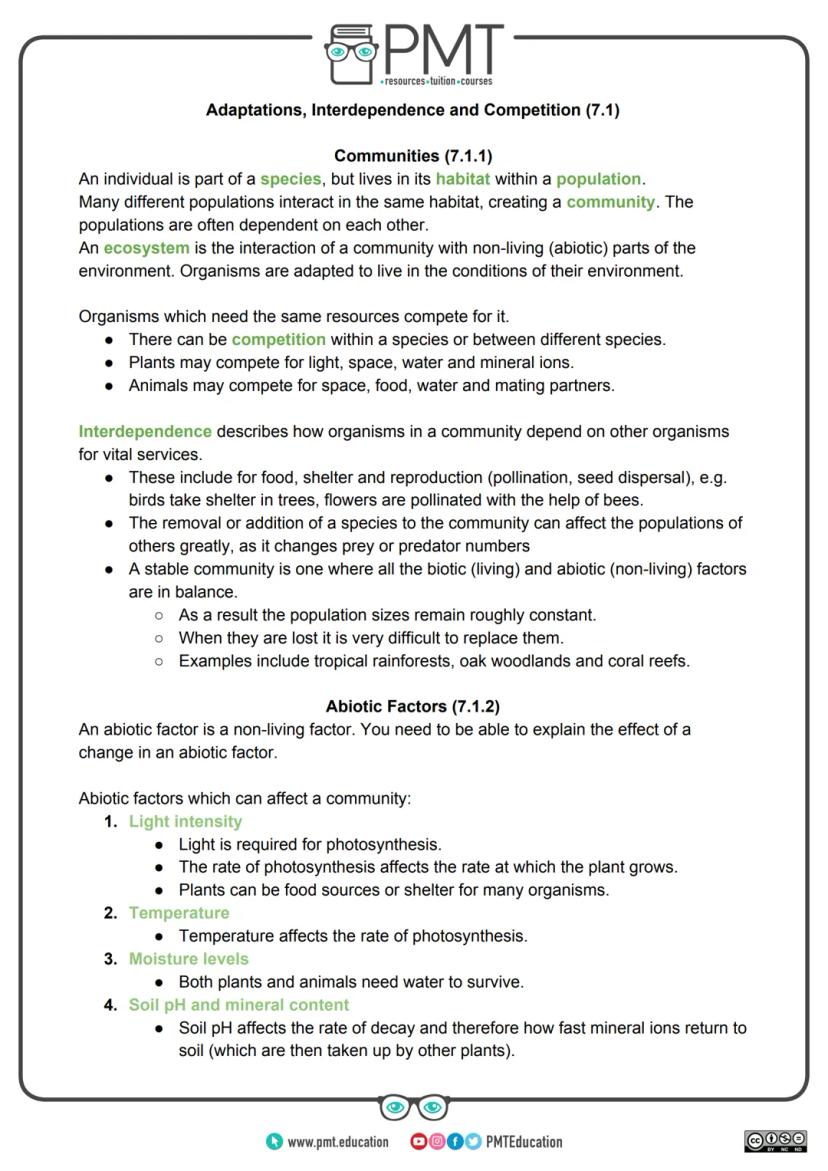
Every living thing belongs to a species and lives in a specific habitat as part of a population. When different populations share the same space, they form a community - like all the different animals and plants in a woodland.
An ecosystem takes this further by including non-living factors like temperature and rainfall. Organisms are perfectly adapted to thrive in their specific conditions, but they have to fight for what they need.
Competition happens everywhere in nature. Plants battle for sunlight, water, space and nutrients from the soil. Animals compete for food, water, territory and mates - basically everything they need to survive and reproduce.
Interdependence means organisms rely on each other for survival. Bees need flowers for nectar, whilst flowers need bees for pollination. Remove one species and the whole community can collapse like dominoes. Stable communities like rainforests and coral reefs maintain balanced populations over time, but once destroyed, they're incredibly difficult to restore.
Remember: Every organism in a community depends on others - nothing survives completely alone in nature!
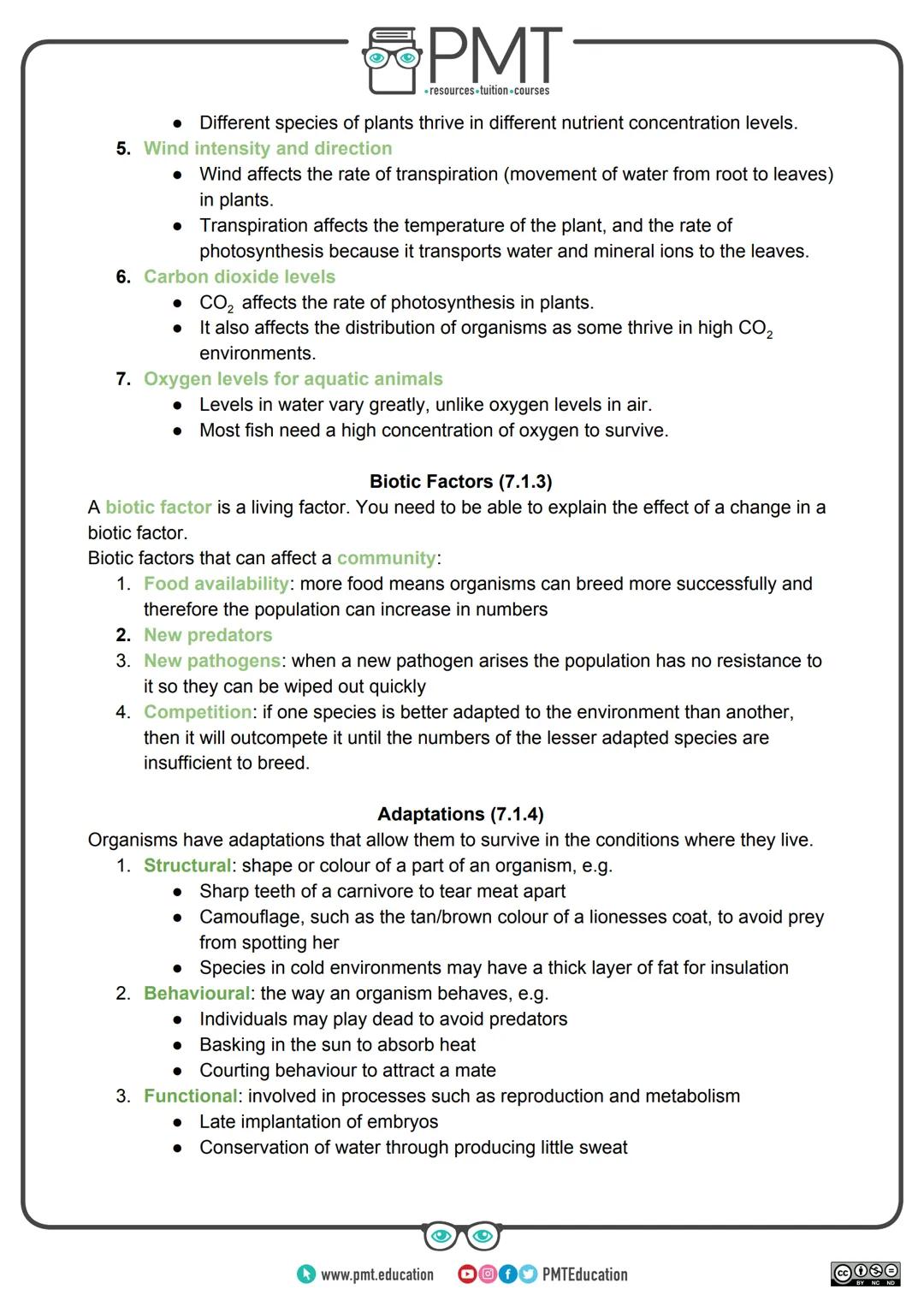
Abiotic factors are the non-living elements that shape where organisms can survive. Light intensity drives photosynthesis in plants, which affects growth rates and provides food for entire ecosystems.
Temperature also controls photosynthesis rates, whilst moisture levels determine whether plants and animals can meet their water needs. Soil pH affects how quickly dead material decomposes, releasing vital nutrients back to plants.
Wind intensity influences transpiration - how water moves from roots to leaves in plants. This affects plant temperature and photosynthesis efficiency. Carbon dioxide levels directly impact photosynthesis rates and determine which organisms thrive in different areas.
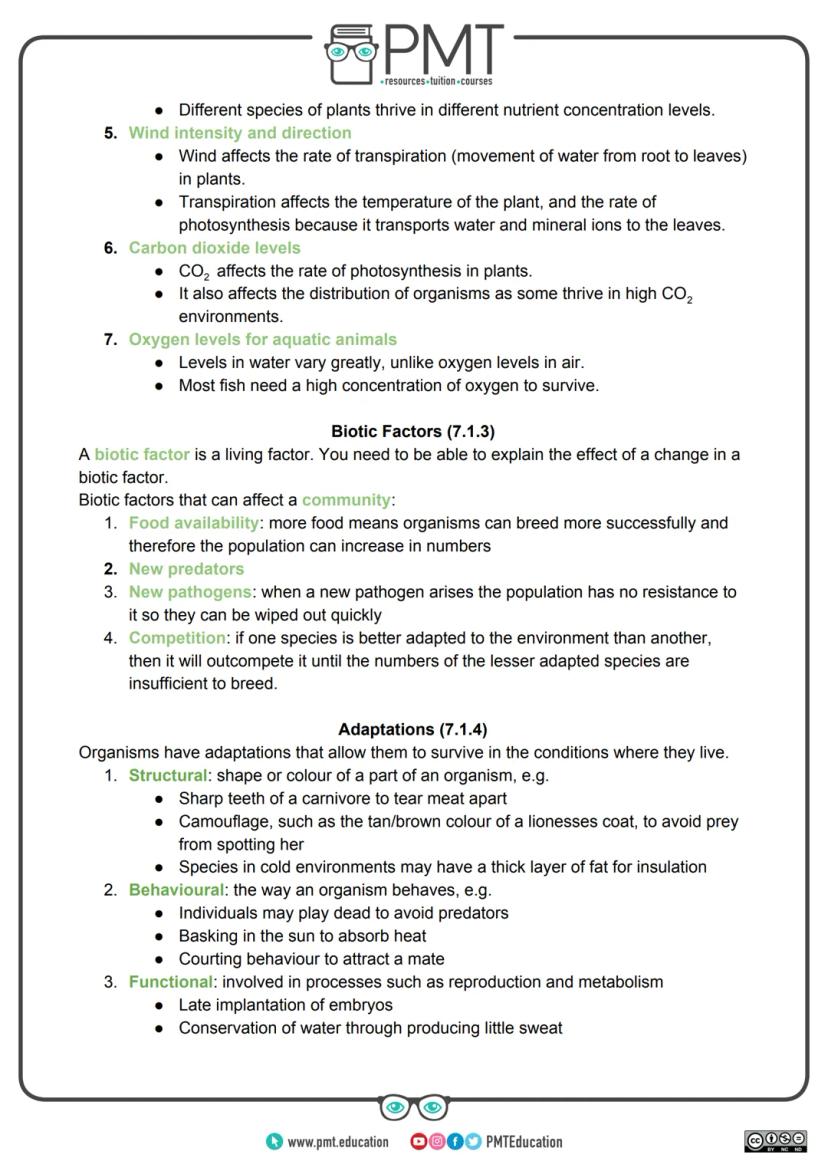
Biotic factors are the living influences on communities. Food availability controls population sizes - more food means more successful breeding. New predators or diseases can devastate populations that lack resistance. Competition between species often results in the better-adapted organism winning out, potentially driving others to local extinction.
Key Point: Both living and non-living factors constantly interact to determine which species can survive in any given ecosystem.
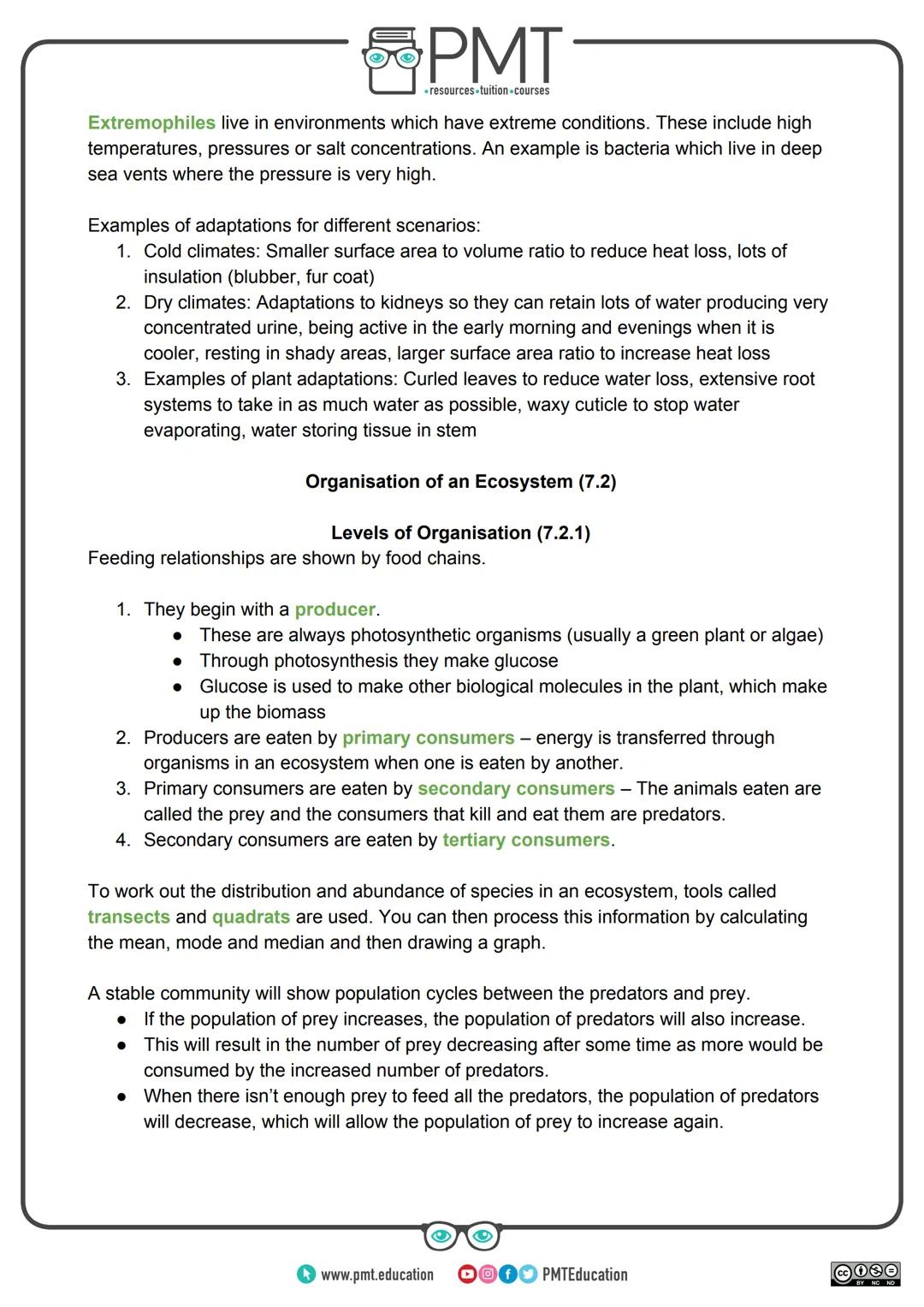
Organisms develop amazing adaptations to survive in their environments. Structural adaptations include physical features like sharp carnivore teeth for tearing meat, camouflage colours for avoiding predators, and thick fat layers for insulation in cold climates.
Behavioural adaptations involve how animals act - playing dead to avoid predators, basking in sunlight for warmth, or complex mating displays to attract partners. Functional adaptations affect internal processes like metabolism and reproduction.
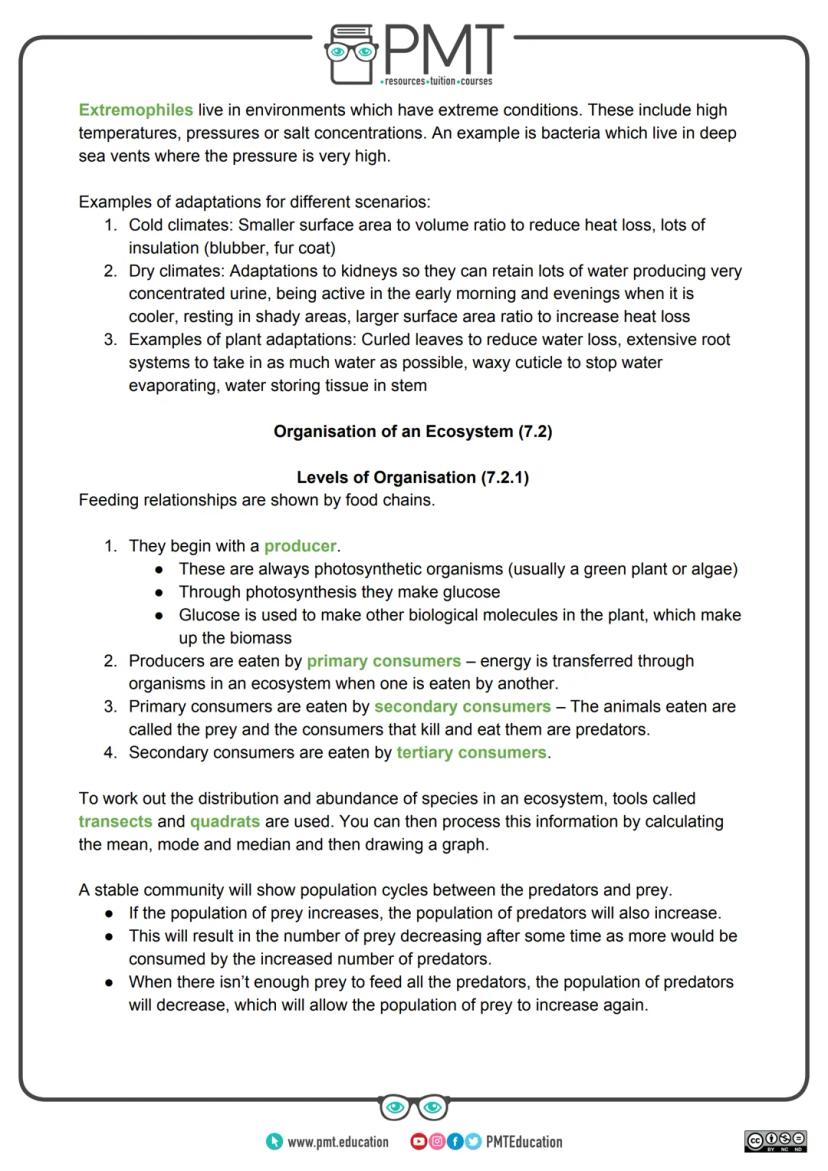
Extremophiles are organisms that thrive in harsh conditions most life couldn't tolerate - think bacteria living in scalding deep-sea vents or highly salty environments. They show just how adaptable life can be.
Different environments demand specific survival strategies. Cold-climate animals have smaller surface area to volume ratios to retain heat, plus thick insulation. Desert species have efficient kidneys to conserve water, stay active during cooler periods, and often have larger surface areas to lose heat quickly.
Amazing Fact: Extremophiles prove life can exist in conditions once thought impossible - they might even give us clues about life on other planets!
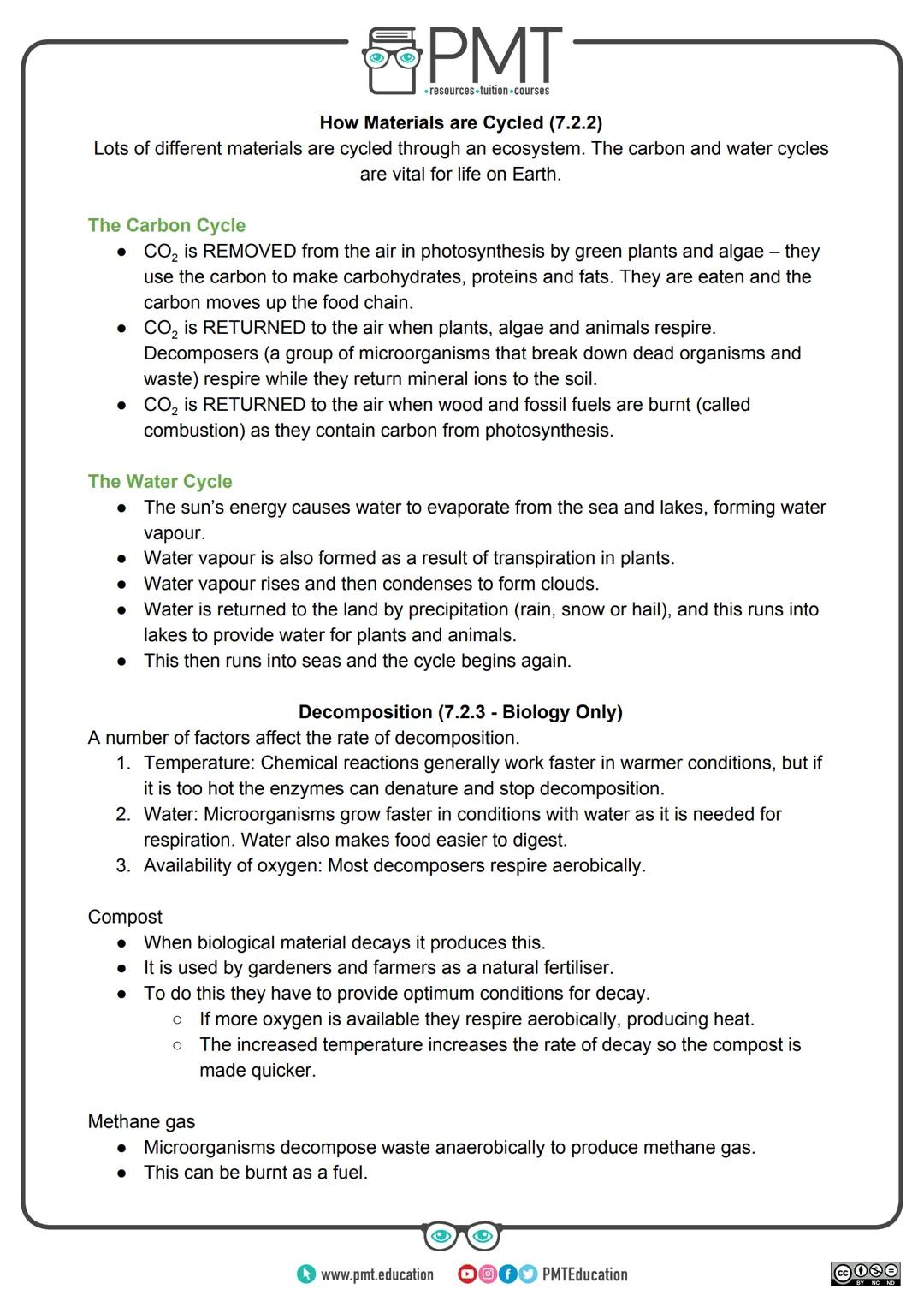
Food chains always start with producers - typically green plants or algae that make glucose through photosynthesis. This glucose creates biomass that forms the foundation of all ecosystems.
Energy flows through ecosystems as organisms eat each other: producers feed primary consumers (herbivores), which feed secondary consumers (carnivores), which may feed tertiary consumers (top predators).
Scientists use transects and quadrats to study species distribution and abundance, then analyse the data using statistical methods like calculating means and creating graphs.
Population cycles between predators and prey create fascinating patterns. When prey numbers increase, predator populations grow too. Eventually, too many predators cause prey numbers to crash, which then reduces predator numbers, allowing prey to recover and start the cycle again.
Pattern Recognition: Predator-prey cycles are like natural see-saws - when one goes up, the other eventually follows, then switches direction!
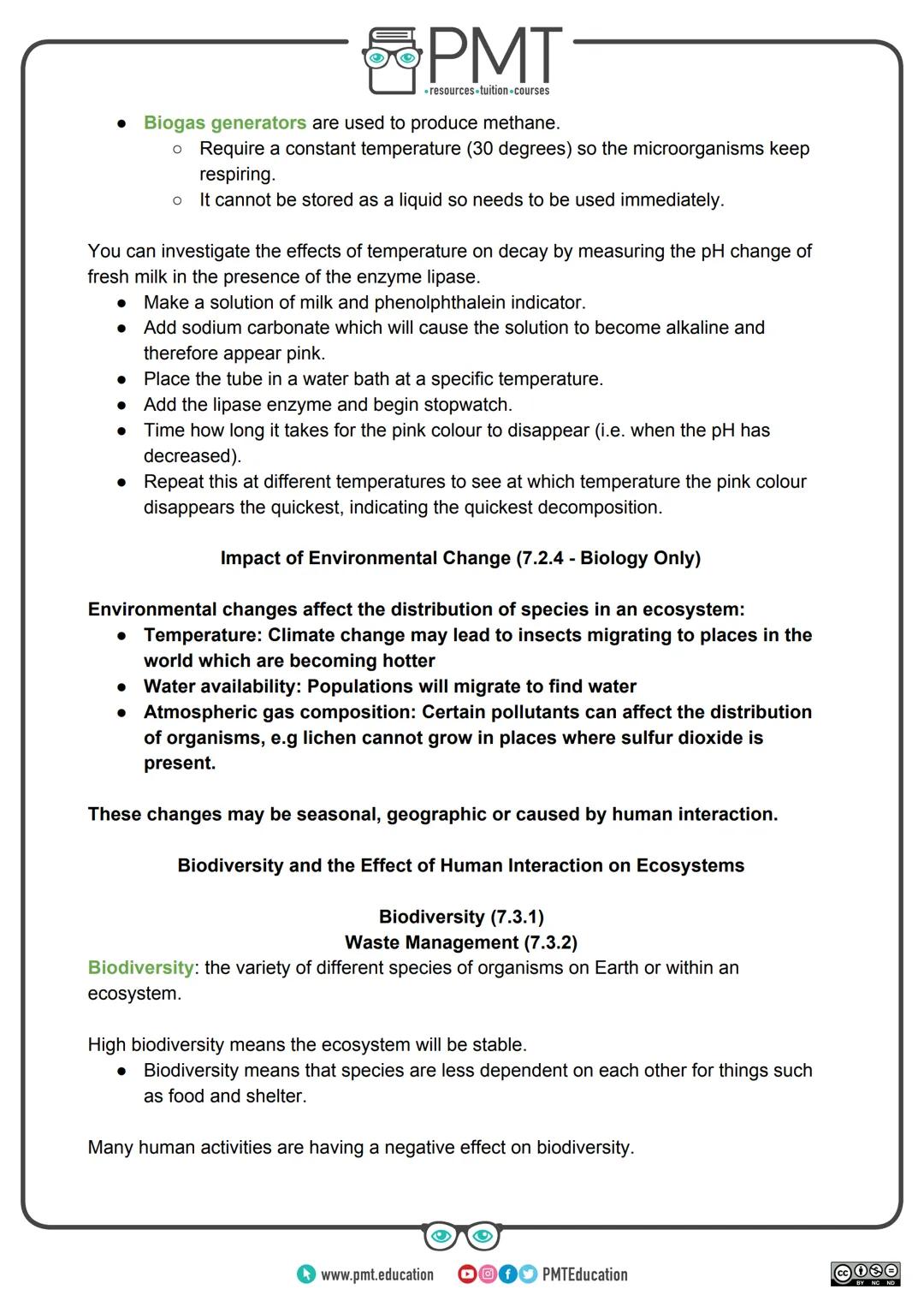
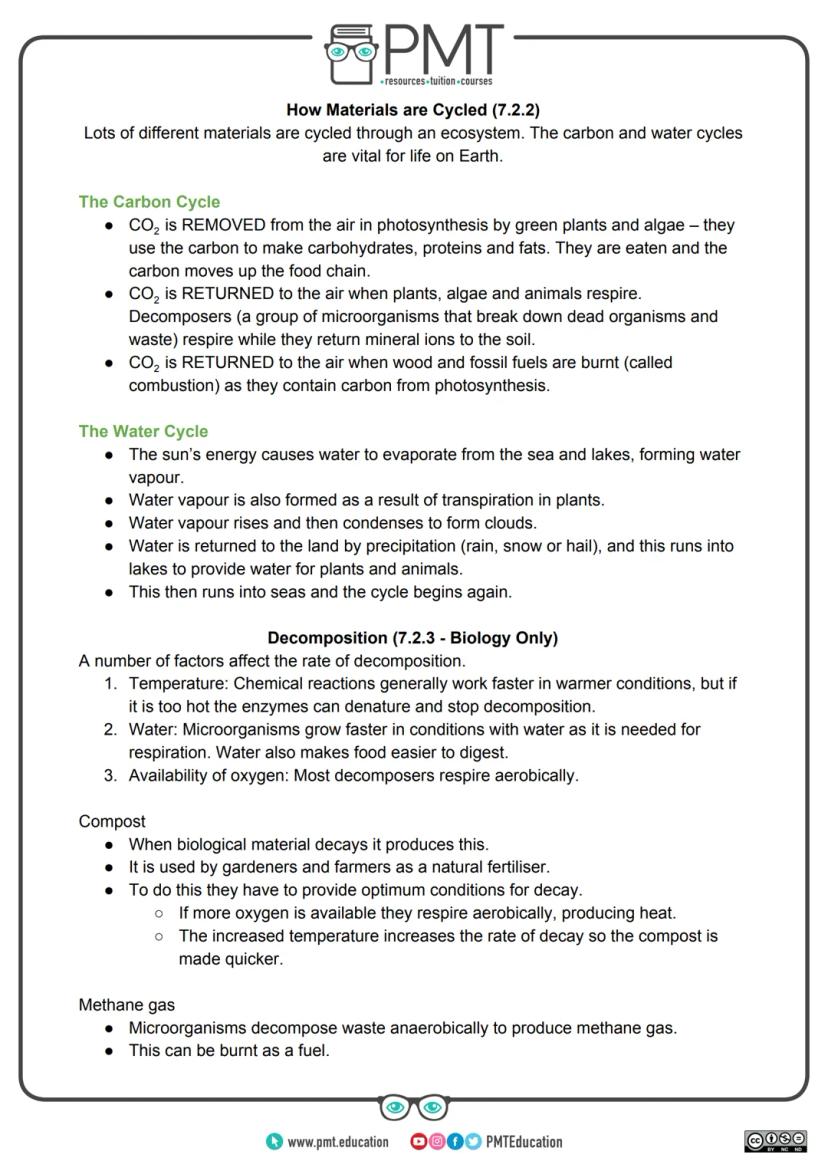
The carbon cycle and water cycle are essential for life on Earth. Carbon dioxide gets removed from the atmosphere during photosynthesis as plants convert it into carbohydrates, proteins and fats that move up food chains.
Carbon dioxide returns to the atmosphere through respiration by all living things, plus decomposition by microorganisms breaking down dead material. Combustion of wood and fossil fuels also releases stored carbon.
The water cycle uses the sun's energy to evaporate water from seas and lakes, whilst transpiration adds water vapour from plants. This vapour condenses into clouds, then returns as precipitation to complete the cycle.
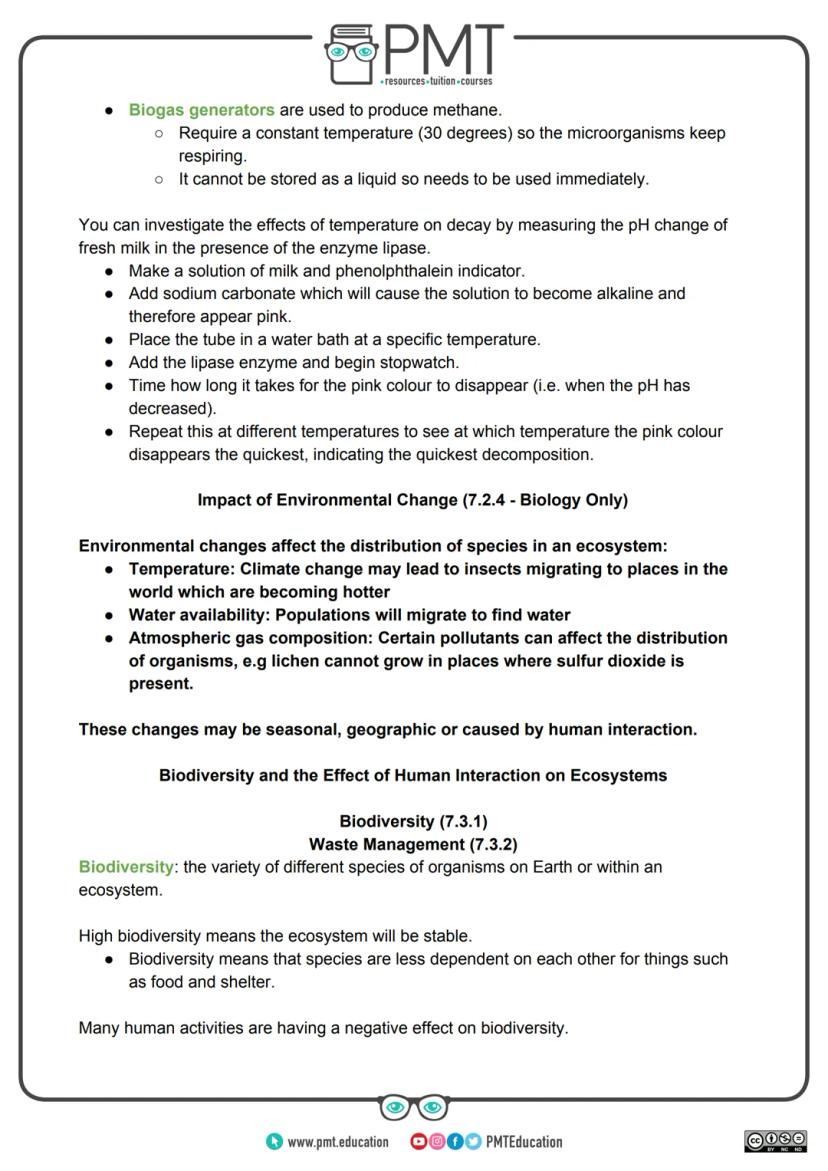
Decomposition rates depend on temperature (faster when warm but not too hot), water availability (needed for microbial growth), and oxygen levels (most decomposers need it for respiration). Gardeners use these principles to make compost quickly, whilst biogas generators use anaerobic decomposition to produce methane fuel.
Practical Application: Understanding decomposition helps farmers make better compost and engineers design more efficient biogas plants!
Biodiversity - the variety of species in ecosystems - is crucial for stability. High biodiversity means ecosystems are more resilient because species aren't overly dependent on each other for resources.
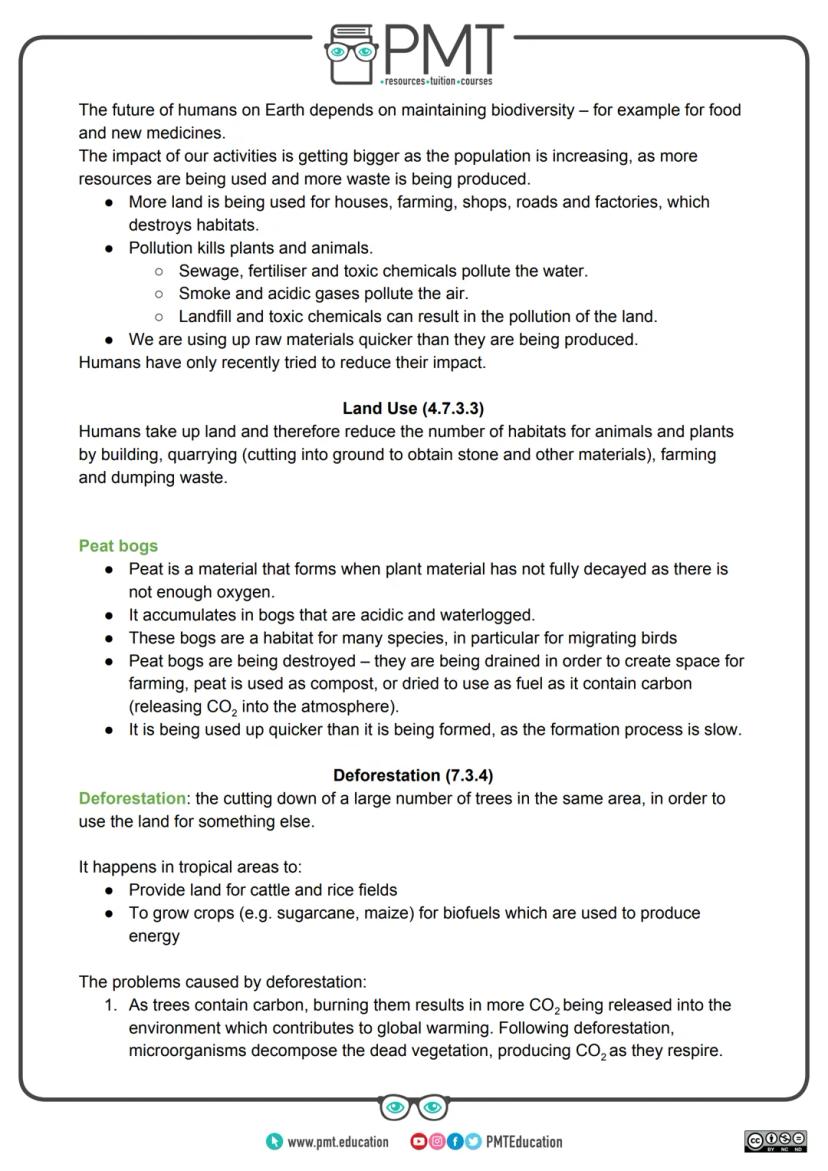
Our growing population is putting massive pressure on the planet. We're using more land for buildings, farming and infrastructure, which destroys natural habitats. Pollution from sewage, chemicals and toxic waste kills plants and animals in water, air and soil.
Peat bogs are being destroyed faster than they form. These unique habitats support many species, especially migrating birds, but are being drained for farming or harvested for compost and fuel.
Human activities like farming, building and waste disposal consume raw materials faster than they can be naturally replaced. Only recently have we started seriously trying to reduce our environmental impact through conservation efforts.
Reality Check: The future of human civilisation depends on maintaining biodiversity - we need it for food security and discovering new medicines.
Deforestation involves cutting down large forest areas, mainly in tropical regions, to create space for cattle ranching, rice fields, and crops for biofuels. This creates multiple environmental problems.
Burning trees releases stored carbon as carbon dioxide, contributing to global warming. Dead vegetation decomposed by microorganisms also produces more CO₂. Meanwhile, fewer trees means less photosynthesis to remove CO₂ from the atmosphere.
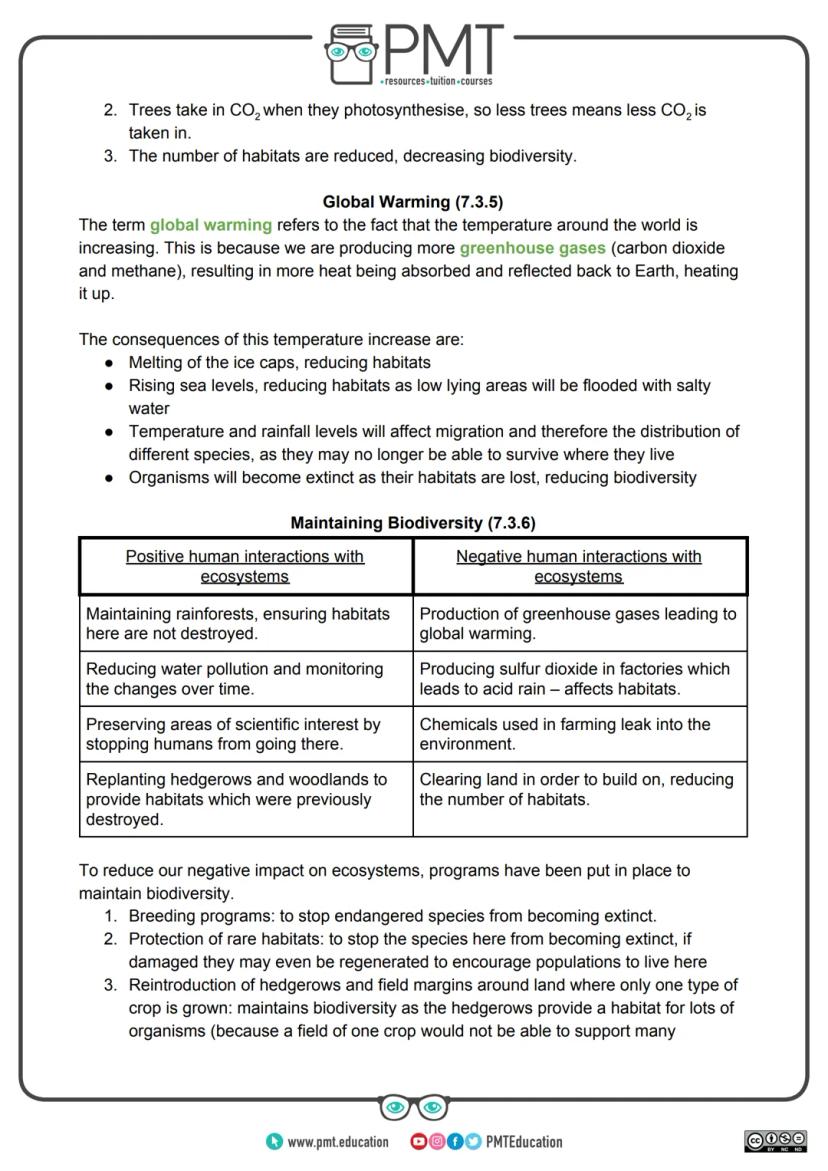
Global warming results from increased greenhouse gases trapping more heat around Earth. Consequences include melting ice caps, rising sea levels, and changing weather patterns that force species to migrate or face extinction.
The loss of forest habitats dramatically reduces biodiversity. Many species become extinct when their homes disappear, and low-lying areas flood with saltwater as sea levels rise.
Urgent Issue: Deforestation contributes to climate change in multiple ways - both by releasing stored carbon and by removing nature's carbon-capture systems.
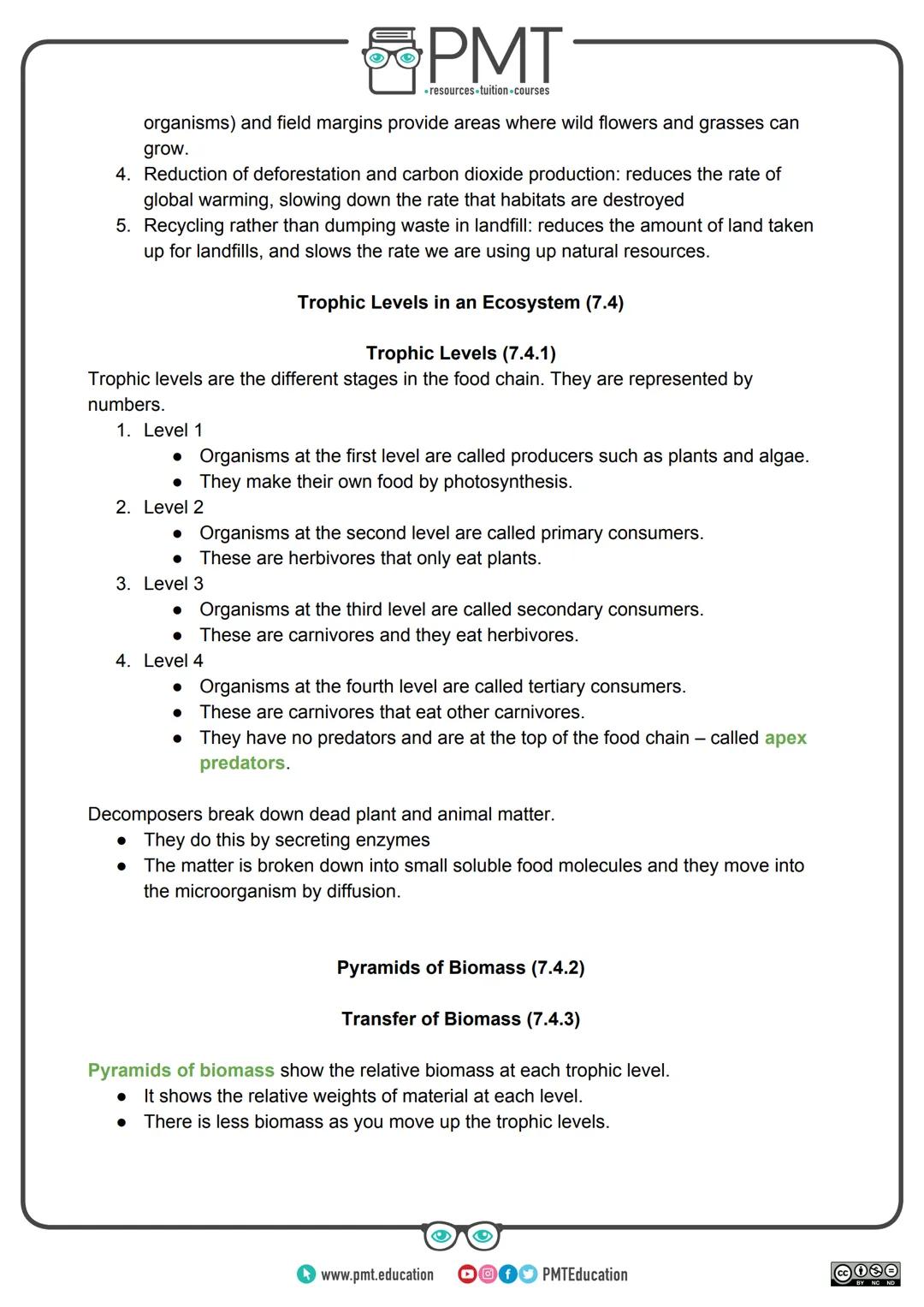
We can take positive steps to maintain biodiversity and reduce environmental damage. Breeding programmes help prevent endangered species from becoming extinct by maintaining genetic diversity in captivity.
Protecting rare habitats stops species extinction and allows damaged ecosystems to regenerate naturally. Reintroducing hedgerows and creating field margins around crop fields provides habitats for wildlife that would otherwise struggle in agricultural monocultures.
Reducing deforestation and carbon dioxide production slows global warming, giving ecosystems more time to adapt. Recycling instead of using landfills reduces land use and conserves natural resources.
Conservation efforts must balance human needs with environmental protection. This includes monitoring water quality, preserving areas of scientific interest, and replanting woodlands to restore previously destroyed habitats.
Hope for the Future: Conservation programmes are already saving species from extinction and restoring damaged ecosystems worldwide!
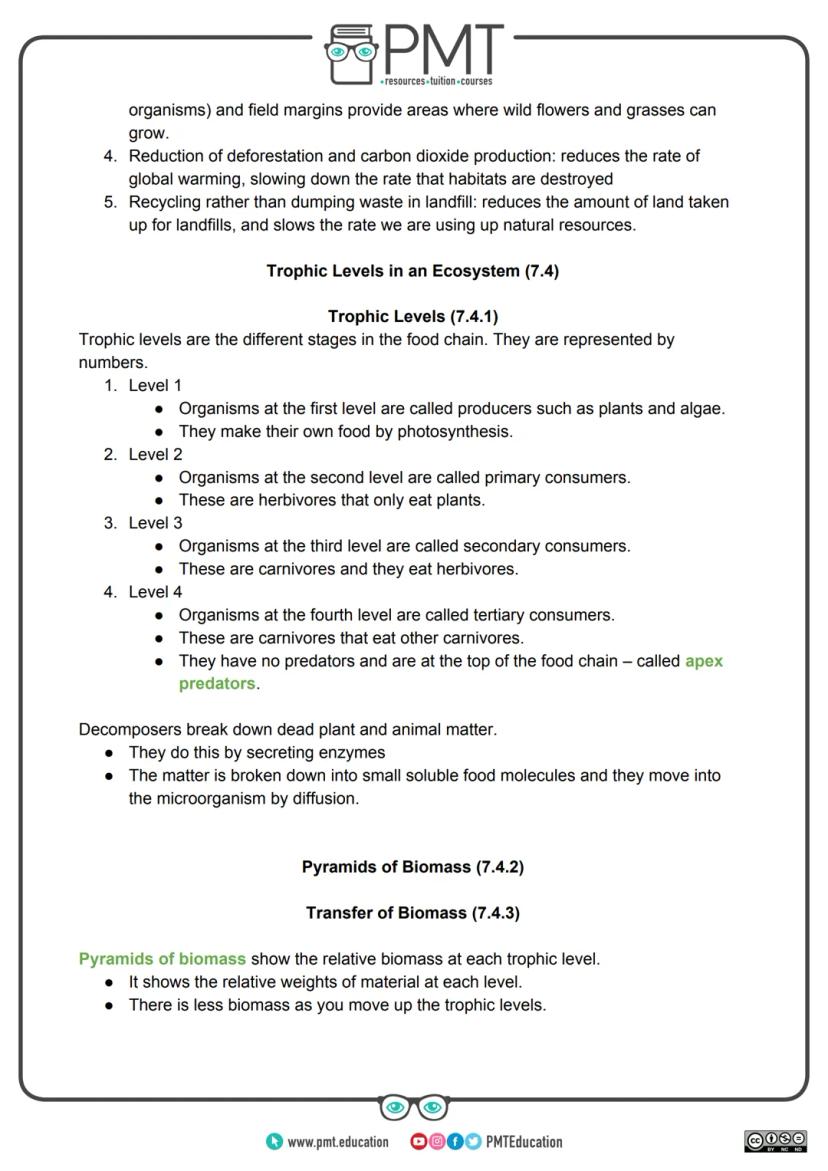
Trophic levels represent different stages in food chains, numbered from producers (level 1) through primary consumers (level 2), secondary consumers (level 3), to tertiary consumers (level 4). Apex predators at the top have no natural enemies.
Decomposers break down dead material by secreting enzymes that convert complex matter into simple molecules they can absorb. They're essential for recycling nutrients through ecosystems.
Pyramids of biomass show how much biological material exists at each trophic level. There's always less biomass higher up the pyramid because energy transfer is inefficient.
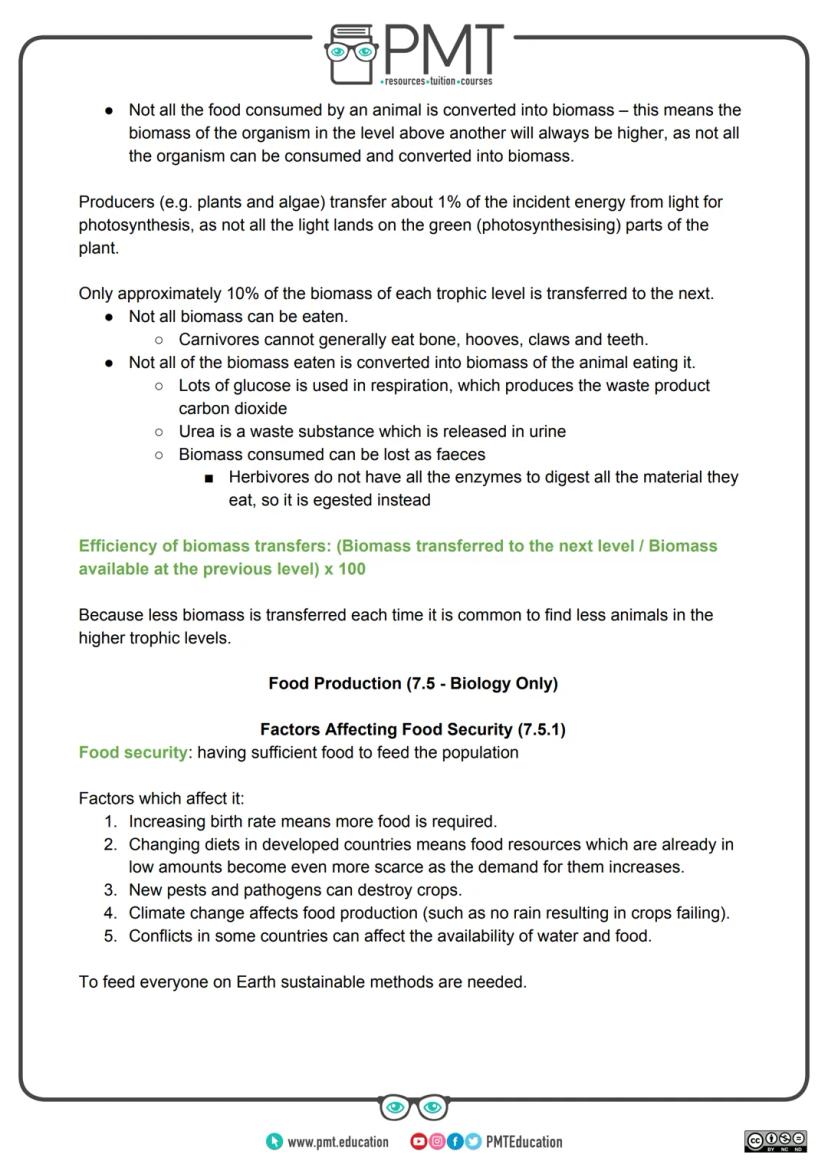
Only about 1% of light energy gets converted into plant biomass through photosynthesis. Then only 10% of biomass transfers between trophic levels because animals can't digest everything they eat (bones, hooves), lose energy through respiration, and produce waste products.
Energy Reality: The 10% rule explains why there are fewer large predators than prey animals - there simply isn't enough energy to support huge populations at the top!
Our AI Companion is a student-focused AI tool that offers more than just answers. Built on millions of Knowunity resources, it provides relevant information, personalised study plans, quizzes, and content directly in the chat, adapting to your individual learning journey.
You can download the app from Google Play Store and Apple App Store.
That's right! Enjoy free access to study content, connect with fellow students, and get instant help – all at your fingertips.
App Store
Google Play
The app is very easy to use and well designed. I have found everything I was looking for so far and have been able to learn a lot from the presentations! I will definitely use the app for a class assignment! And of course it also helps a lot as an inspiration.
Stefan S
iOS user
This app is really great. There are so many study notes and help [...]. My problem subject is French, for example, and the app has so many options for help. Thanks to this app, I have improved my French. I would recommend it to anyone.
Samantha Klich
Android user
Wow, I am really amazed. I just tried the app because I've seen it advertised many times and was absolutely stunned. This app is THE HELP you want for school and above all, it offers so many things, such as workouts and fact sheets, which have been VERY helpful to me personally.
Anna
iOS user
Best app on earth! no words because it’s too good
Thomas R
iOS user
Just amazing. Let's me revise 10x better, this app is a quick 10/10. I highly recommend it to anyone. I can watch and search for notes. I can save them in the subject folder. I can revise it any time when I come back. If you haven't tried this app, you're really missing out.
Basil
Android user
This app has made me feel so much more confident in my exam prep, not only through boosting my own self confidence through the features that allow you to connect with others and feel less alone, but also through the way the app itself is centred around making you feel better. It is easy to navigate, fun to use, and helpful to anyone struggling in absolutely any way.
David K
iOS user
The app's just great! All I have to do is enter the topic in the search bar and I get the response real fast. I don't have to watch 10 YouTube videos to understand something, so I'm saving my time. Highly recommended!
Sudenaz Ocak
Android user
In school I was really bad at maths but thanks to the app, I am doing better now. I am so grateful that you made the app.
Greenlight Bonnie
Android user
very reliable app to help and grow your ideas of Maths, English and other related topics in your works. please use this app if your struggling in areas, this app is key for that. wish I'd of done a review before. and it's also free so don't worry about that.
Rohan U
Android user
I know a lot of apps use fake accounts to boost their reviews but this app deserves it all. Originally I was getting 4 in my English exams and this time I got a grade 7. I didn’t even know about this app three days until the exam and it has helped A LOT. Please actually trust me and use it as I’m sure you too will see developments.
Xander S
iOS user
THE QUIZES AND FLASHCARDS ARE SO USEFUL AND I LOVE Knowunity AI. IT ALSO IS LITREALLY LIKE CHATGPT BUT SMARTER!! HELPED ME WITH MY MASCARA PROBLEMS TOO!! AS WELL AS MY REAL SUBJECTS ! DUHHH 😍😁😲🤑💗✨🎀😮
Elisha
iOS user
This apps acc the goat. I find revision so boring but this app makes it so easy to organize it all and then you can ask the freeeee ai to test yourself so good and you can easily upload your own stuff. highly recommend as someone taking mocks now
Paul T
iOS user
The app is very easy to use and well designed. I have found everything I was looking for so far and have been able to learn a lot from the presentations! I will definitely use the app for a class assignment! And of course it also helps a lot as an inspiration.
Stefan S
iOS user
This app is really great. There are so many study notes and help [...]. My problem subject is French, for example, and the app has so many options for help. Thanks to this app, I have improved my French. I would recommend it to anyone.
Samantha Klich
Android user
Wow, I am really amazed. I just tried the app because I've seen it advertised many times and was absolutely stunned. This app is THE HELP you want for school and above all, it offers so many things, such as workouts and fact sheets, which have been VERY helpful to me personally.
Anna
iOS user
Best app on earth! no words because it’s too good
Thomas R
iOS user
Just amazing. Let's me revise 10x better, this app is a quick 10/10. I highly recommend it to anyone. I can watch and search for notes. I can save them in the subject folder. I can revise it any time when I come back. If you haven't tried this app, you're really missing out.
Basil
Android user
This app has made me feel so much more confident in my exam prep, not only through boosting my own self confidence through the features that allow you to connect with others and feel less alone, but also through the way the app itself is centred around making you feel better. It is easy to navigate, fun to use, and helpful to anyone struggling in absolutely any way.
David K
iOS user
The app's just great! All I have to do is enter the topic in the search bar and I get the response real fast. I don't have to watch 10 YouTube videos to understand something, so I'm saving my time. Highly recommended!
Sudenaz Ocak
Android user
In school I was really bad at maths but thanks to the app, I am doing better now. I am so grateful that you made the app.
Greenlight Bonnie
Android user
very reliable app to help and grow your ideas of Maths, English and other related topics in your works. please use this app if your struggling in areas, this app is key for that. wish I'd of done a review before. and it's also free so don't worry about that.
Rohan U
Android user
I know a lot of apps use fake accounts to boost their reviews but this app deserves it all. Originally I was getting 4 in my English exams and this time I got a grade 7. I didn’t even know about this app three days until the exam and it has helped A LOT. Please actually trust me and use it as I’m sure you too will see developments.
Xander S
iOS user
THE QUIZES AND FLASHCARDS ARE SO USEFUL AND I LOVE Knowunity AI. IT ALSO IS LITREALLY LIKE CHATGPT BUT SMARTER!! HELPED ME WITH MY MASCARA PROBLEMS TOO!! AS WELL AS MY REAL SUBJECTS ! DUHHH 😍😁😲🤑💗✨🎀😮
Elisha
iOS user
This apps acc the goat. I find revision so boring but this app makes it so easy to organize it all and then you can ask the freeeee ai to test yourself so good and you can easily upload your own stuff. highly recommend as someone taking mocks now
Paul T
iOS user
Shah
@shah_zbsehbjyzq
Ecology is all about how living things interact with each other and their environment - think of it as nature's complex web of relationships. From tiny bacteria to massive whales, every organism depends on others for survival, and understanding these... Show more
Access to all documents
Improve your grades
Join milions of students
This is your complete guide to ecology for AQA GCSE Biology. You'll master everything from how organisms compete for resources to the impact humans have on ecosystems.
The content covers both foundation and higher tier material, so you'll be fully prepared regardless of which exam you're taking. Some sections are specifically for separate science students, but most applies to everyone.
Quick Tip: Focus on understanding the connections between different ecological concepts - they all link together like pieces of a puzzle!
Access to all documents
Improve your grades
Join milions of students
Every living thing belongs to a species and lives in a specific habitat as part of a population. When different populations share the same space, they form a community - like all the different animals and plants in a woodland.
An ecosystem takes this further by including non-living factors like temperature and rainfall. Organisms are perfectly adapted to thrive in their specific conditions, but they have to fight for what they need.
Competition happens everywhere in nature. Plants battle for sunlight, water, space and nutrients from the soil. Animals compete for food, water, territory and mates - basically everything they need to survive and reproduce.
Interdependence means organisms rely on each other for survival. Bees need flowers for nectar, whilst flowers need bees for pollination. Remove one species and the whole community can collapse like dominoes. Stable communities like rainforests and coral reefs maintain balanced populations over time, but once destroyed, they're incredibly difficult to restore.
Remember: Every organism in a community depends on others - nothing survives completely alone in nature!
Access to all documents
Improve your grades
Join milions of students
Abiotic factors are the non-living elements that shape where organisms can survive. Light intensity drives photosynthesis in plants, which affects growth rates and provides food for entire ecosystems.
Temperature also controls photosynthesis rates, whilst moisture levels determine whether plants and animals can meet their water needs. Soil pH affects how quickly dead material decomposes, releasing vital nutrients back to plants.
Wind intensity influences transpiration - how water moves from roots to leaves in plants. This affects plant temperature and photosynthesis efficiency. Carbon dioxide levels directly impact photosynthesis rates and determine which organisms thrive in different areas.
Biotic factors are the living influences on communities. Food availability controls population sizes - more food means more successful breeding. New predators or diseases can devastate populations that lack resistance. Competition between species often results in the better-adapted organism winning out, potentially driving others to local extinction.
Key Point: Both living and non-living factors constantly interact to determine which species can survive in any given ecosystem.
Access to all documents
Improve your grades
Join milions of students
Organisms develop amazing adaptations to survive in their environments. Structural adaptations include physical features like sharp carnivore teeth for tearing meat, camouflage colours for avoiding predators, and thick fat layers for insulation in cold climates.
Behavioural adaptations involve how animals act - playing dead to avoid predators, basking in sunlight for warmth, or complex mating displays to attract partners. Functional adaptations affect internal processes like metabolism and reproduction.
Extremophiles are organisms that thrive in harsh conditions most life couldn't tolerate - think bacteria living in scalding deep-sea vents or highly salty environments. They show just how adaptable life can be.
Different environments demand specific survival strategies. Cold-climate animals have smaller surface area to volume ratios to retain heat, plus thick insulation. Desert species have efficient kidneys to conserve water, stay active during cooler periods, and often have larger surface areas to lose heat quickly.
Amazing Fact: Extremophiles prove life can exist in conditions once thought impossible - they might even give us clues about life on other planets!
Access to all documents
Improve your grades
Join milions of students
Food chains always start with producers - typically green plants or algae that make glucose through photosynthesis. This glucose creates biomass that forms the foundation of all ecosystems.
Energy flows through ecosystems as organisms eat each other: producers feed primary consumers (herbivores), which feed secondary consumers (carnivores), which may feed tertiary consumers (top predators).
Scientists use transects and quadrats to study species distribution and abundance, then analyse the data using statistical methods like calculating means and creating graphs.
Population cycles between predators and prey create fascinating patterns. When prey numbers increase, predator populations grow too. Eventually, too many predators cause prey numbers to crash, which then reduces predator numbers, allowing prey to recover and start the cycle again.
Pattern Recognition: Predator-prey cycles are like natural see-saws - when one goes up, the other eventually follows, then switches direction!
Access to all documents
Improve your grades
Join milions of students
The carbon cycle and water cycle are essential for life on Earth. Carbon dioxide gets removed from the atmosphere during photosynthesis as plants convert it into carbohydrates, proteins and fats that move up food chains.
Carbon dioxide returns to the atmosphere through respiration by all living things, plus decomposition by microorganisms breaking down dead material. Combustion of wood and fossil fuels also releases stored carbon.
The water cycle uses the sun's energy to evaporate water from seas and lakes, whilst transpiration adds water vapour from plants. This vapour condenses into clouds, then returns as precipitation to complete the cycle.
Decomposition rates depend on temperature (faster when warm but not too hot), water availability (needed for microbial growth), and oxygen levels (most decomposers need it for respiration). Gardeners use these principles to make compost quickly, whilst biogas generators use anaerobic decomposition to produce methane fuel.
Practical Application: Understanding decomposition helps farmers make better compost and engineers design more efficient biogas plants!
Access to all documents
Improve your grades
Join milions of students
Biodiversity - the variety of species in ecosystems - is crucial for stability. High biodiversity means ecosystems are more resilient because species aren't overly dependent on each other for resources.
Our growing population is putting massive pressure on the planet. We're using more land for buildings, farming and infrastructure, which destroys natural habitats. Pollution from sewage, chemicals and toxic waste kills plants and animals in water, air and soil.
Peat bogs are being destroyed faster than they form. These unique habitats support many species, especially migrating birds, but are being drained for farming or harvested for compost and fuel.
Human activities like farming, building and waste disposal consume raw materials faster than they can be naturally replaced. Only recently have we started seriously trying to reduce our environmental impact through conservation efforts.
Reality Check: The future of human civilisation depends on maintaining biodiversity - we need it for food security and discovering new medicines.
Access to all documents
Improve your grades
Join milions of students
Deforestation involves cutting down large forest areas, mainly in tropical regions, to create space for cattle ranching, rice fields, and crops for biofuels. This creates multiple environmental problems.
Burning trees releases stored carbon as carbon dioxide, contributing to global warming. Dead vegetation decomposed by microorganisms also produces more CO₂. Meanwhile, fewer trees means less photosynthesis to remove CO₂ from the atmosphere.
Global warming results from increased greenhouse gases trapping more heat around Earth. Consequences include melting ice caps, rising sea levels, and changing weather patterns that force species to migrate or face extinction.
The loss of forest habitats dramatically reduces biodiversity. Many species become extinct when their homes disappear, and low-lying areas flood with saltwater as sea levels rise.
Urgent Issue: Deforestation contributes to climate change in multiple ways - both by releasing stored carbon and by removing nature's carbon-capture systems.
Access to all documents
Improve your grades
Join milions of students
We can take positive steps to maintain biodiversity and reduce environmental damage. Breeding programmes help prevent endangered species from becoming extinct by maintaining genetic diversity in captivity.
Protecting rare habitats stops species extinction and allows damaged ecosystems to regenerate naturally. Reintroducing hedgerows and creating field margins around crop fields provides habitats for wildlife that would otherwise struggle in agricultural monocultures.
Reducing deforestation and carbon dioxide production slows global warming, giving ecosystems more time to adapt. Recycling instead of using landfills reduces land use and conserves natural resources.
Conservation efforts must balance human needs with environmental protection. This includes monitoring water quality, preserving areas of scientific interest, and replanting woodlands to restore previously destroyed habitats.
Hope for the Future: Conservation programmes are already saving species from extinction and restoring damaged ecosystems worldwide!
Access to all documents
Improve your grades
Join milions of students
Trophic levels represent different stages in food chains, numbered from producers (level 1) through primary consumers (level 2), secondary consumers (level 3), to tertiary consumers (level 4). Apex predators at the top have no natural enemies.
Decomposers break down dead material by secreting enzymes that convert complex matter into simple molecules they can absorb. They're essential for recycling nutrients through ecosystems.
Pyramids of biomass show how much biological material exists at each trophic level. There's always less biomass higher up the pyramid because energy transfer is inefficient.
Only about 1% of light energy gets converted into plant biomass through photosynthesis. Then only 10% of biomass transfers between trophic levels because animals can't digest everything they eat (bones, hooves), lose energy through respiration, and produce waste products.
Energy Reality: The 10% rule explains why there are fewer large predators than prey animals - there simply isn't enough energy to support huge populations at the top!
Our AI Companion is a student-focused AI tool that offers more than just answers. Built on millions of Knowunity resources, it provides relevant information, personalised study plans, quizzes, and content directly in the chat, adapting to your individual learning journey.
You can download the app from Google Play Store and Apple App Store.
That's right! Enjoy free access to study content, connect with fellow students, and get instant help – all at your fingertips.
6
Smart Tools NEW
Transform this note into: ✓ 50+ Practice Questions ✓ Interactive Flashcards ✓ Full Mock Exam ✓ Essay Outlines
App Store
Google Play
The app is very easy to use and well designed. I have found everything I was looking for so far and have been able to learn a lot from the presentations! I will definitely use the app for a class assignment! And of course it also helps a lot as an inspiration.
Stefan S
iOS user
This app is really great. There are so many study notes and help [...]. My problem subject is French, for example, and the app has so many options for help. Thanks to this app, I have improved my French. I would recommend it to anyone.
Samantha Klich
Android user
Wow, I am really amazed. I just tried the app because I've seen it advertised many times and was absolutely stunned. This app is THE HELP you want for school and above all, it offers so many things, such as workouts and fact sheets, which have been VERY helpful to me personally.
Anna
iOS user
Best app on earth! no words because it’s too good
Thomas R
iOS user
Just amazing. Let's me revise 10x better, this app is a quick 10/10. I highly recommend it to anyone. I can watch and search for notes. I can save them in the subject folder. I can revise it any time when I come back. If you haven't tried this app, you're really missing out.
Basil
Android user
This app has made me feel so much more confident in my exam prep, not only through boosting my own self confidence through the features that allow you to connect with others and feel less alone, but also through the way the app itself is centred around making you feel better. It is easy to navigate, fun to use, and helpful to anyone struggling in absolutely any way.
David K
iOS user
The app's just great! All I have to do is enter the topic in the search bar and I get the response real fast. I don't have to watch 10 YouTube videos to understand something, so I'm saving my time. Highly recommended!
Sudenaz Ocak
Android user
In school I was really bad at maths but thanks to the app, I am doing better now. I am so grateful that you made the app.
Greenlight Bonnie
Android user
very reliable app to help and grow your ideas of Maths, English and other related topics in your works. please use this app if your struggling in areas, this app is key for that. wish I'd of done a review before. and it's also free so don't worry about that.
Rohan U
Android user
I know a lot of apps use fake accounts to boost their reviews but this app deserves it all. Originally I was getting 4 in my English exams and this time I got a grade 7. I didn’t even know about this app three days until the exam and it has helped A LOT. Please actually trust me and use it as I’m sure you too will see developments.
Xander S
iOS user
THE QUIZES AND FLASHCARDS ARE SO USEFUL AND I LOVE Knowunity AI. IT ALSO IS LITREALLY LIKE CHATGPT BUT SMARTER!! HELPED ME WITH MY MASCARA PROBLEMS TOO!! AS WELL AS MY REAL SUBJECTS ! DUHHH 😍😁😲🤑💗✨🎀😮
Elisha
iOS user
This apps acc the goat. I find revision so boring but this app makes it so easy to organize it all and then you can ask the freeeee ai to test yourself so good and you can easily upload your own stuff. highly recommend as someone taking mocks now
Paul T
iOS user
The app is very easy to use and well designed. I have found everything I was looking for so far and have been able to learn a lot from the presentations! I will definitely use the app for a class assignment! And of course it also helps a lot as an inspiration.
Stefan S
iOS user
This app is really great. There are so many study notes and help [...]. My problem subject is French, for example, and the app has so many options for help. Thanks to this app, I have improved my French. I would recommend it to anyone.
Samantha Klich
Android user
Wow, I am really amazed. I just tried the app because I've seen it advertised many times and was absolutely stunned. This app is THE HELP you want for school and above all, it offers so many things, such as workouts and fact sheets, which have been VERY helpful to me personally.
Anna
iOS user
Best app on earth! no words because it’s too good
Thomas R
iOS user
Just amazing. Let's me revise 10x better, this app is a quick 10/10. I highly recommend it to anyone. I can watch and search for notes. I can save them in the subject folder. I can revise it any time when I come back. If you haven't tried this app, you're really missing out.
Basil
Android user
This app has made me feel so much more confident in my exam prep, not only through boosting my own self confidence through the features that allow you to connect with others and feel less alone, but also through the way the app itself is centred around making you feel better. It is easy to navigate, fun to use, and helpful to anyone struggling in absolutely any way.
David K
iOS user
The app's just great! All I have to do is enter the topic in the search bar and I get the response real fast. I don't have to watch 10 YouTube videos to understand something, so I'm saving my time. Highly recommended!
Sudenaz Ocak
Android user
In school I was really bad at maths but thanks to the app, I am doing better now. I am so grateful that you made the app.
Greenlight Bonnie
Android user
very reliable app to help and grow your ideas of Maths, English and other related topics in your works. please use this app if your struggling in areas, this app is key for that. wish I'd of done a review before. and it's also free so don't worry about that.
Rohan U
Android user
I know a lot of apps use fake accounts to boost their reviews but this app deserves it all. Originally I was getting 4 in my English exams and this time I got a grade 7. I didn’t even know about this app three days until the exam and it has helped A LOT. Please actually trust me and use it as I’m sure you too will see developments.
Xander S
iOS user
THE QUIZES AND FLASHCARDS ARE SO USEFUL AND I LOVE Knowunity AI. IT ALSO IS LITREALLY LIKE CHATGPT BUT SMARTER!! HELPED ME WITH MY MASCARA PROBLEMS TOO!! AS WELL AS MY REAL SUBJECTS ! DUHHH 😍😁😲🤑💗✨🎀😮
Elisha
iOS user
This apps acc the goat. I find revision so boring but this app makes it so easy to organize it all and then you can ask the freeeee ai to test yourself so good and you can easily upload your own stuff. highly recommend as someone taking mocks now
Paul T
iOS user