Open the App

Subjects

195

26 Dec 2025

20 pages

Understanding the Classification of Living Organisms

user profile picture

Anna Noble

@annanoble_ipmv

Ever wondered why scientists sort living things into groups? Classification... Show more

Page 1
Page 2
Page 3
Page 4
Page 5
Page 6
Page 7
Page 8
Page 9
Page 10
1 / 10
How Do We Group
Living Things? ●
●
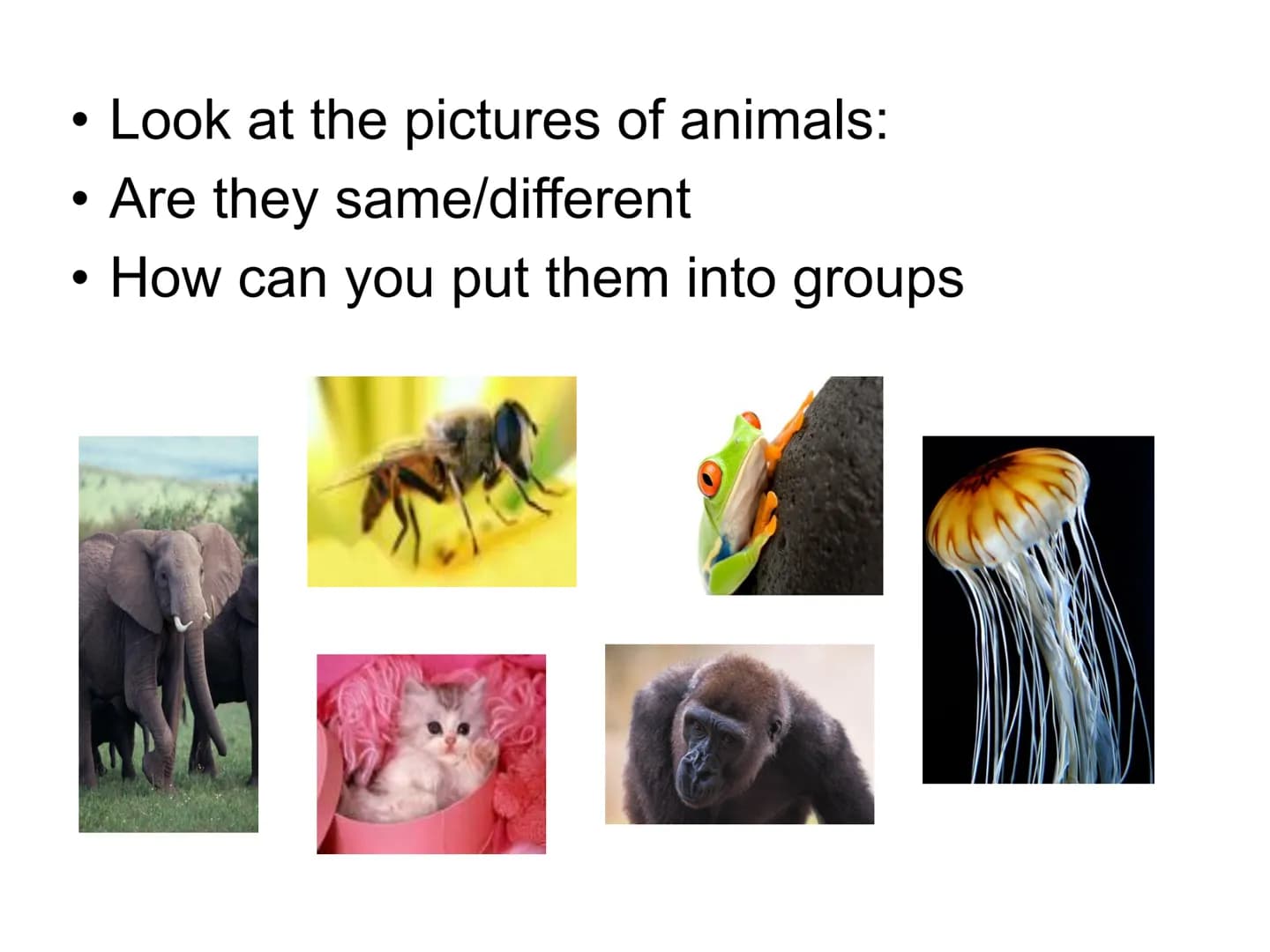
Look at the pictures of animals:
Are they same/different
How can you put them into groups ●
●
Scientific

How Do We Group Living Things?

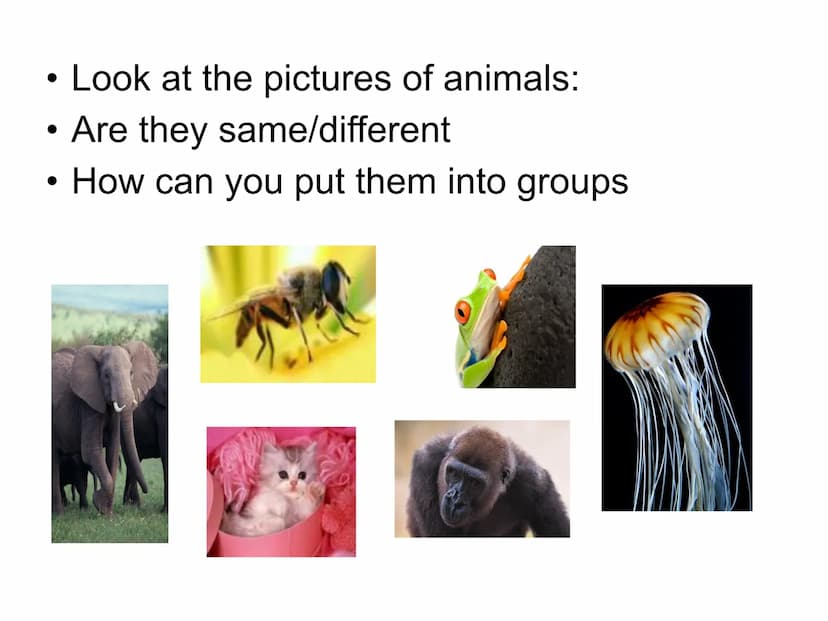
Think about how you'd sort a massive collection of photos - you'd probably group them by similar features! Scientists do exactly the same thing with living organisms.

When you look at different animals, you can spot obvious differences and similarities. Some have fur, others have scales, and some don't even have backbones. Classification is the scientific way of sorting these organisms into organised groups.

💡 Quick Tip: Start by looking for the most obvious differences - does it move? Does it have a backbone? These basic questions help scientists begin the sorting process!

How Do We Group
Living Things? ●
●
Look at the pictures of animals:
Are they same/different
How can you put them into groups ●
●
Scientific

Scientific Classification System

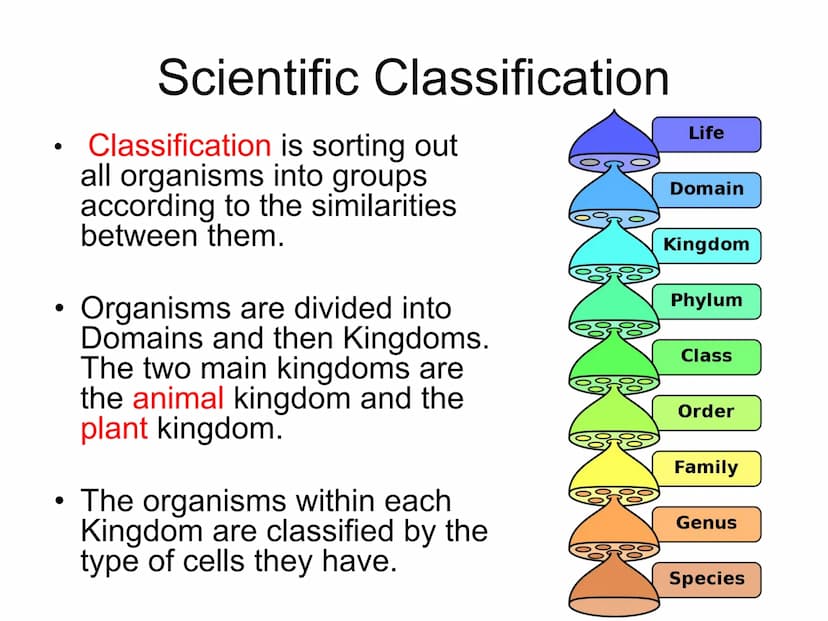
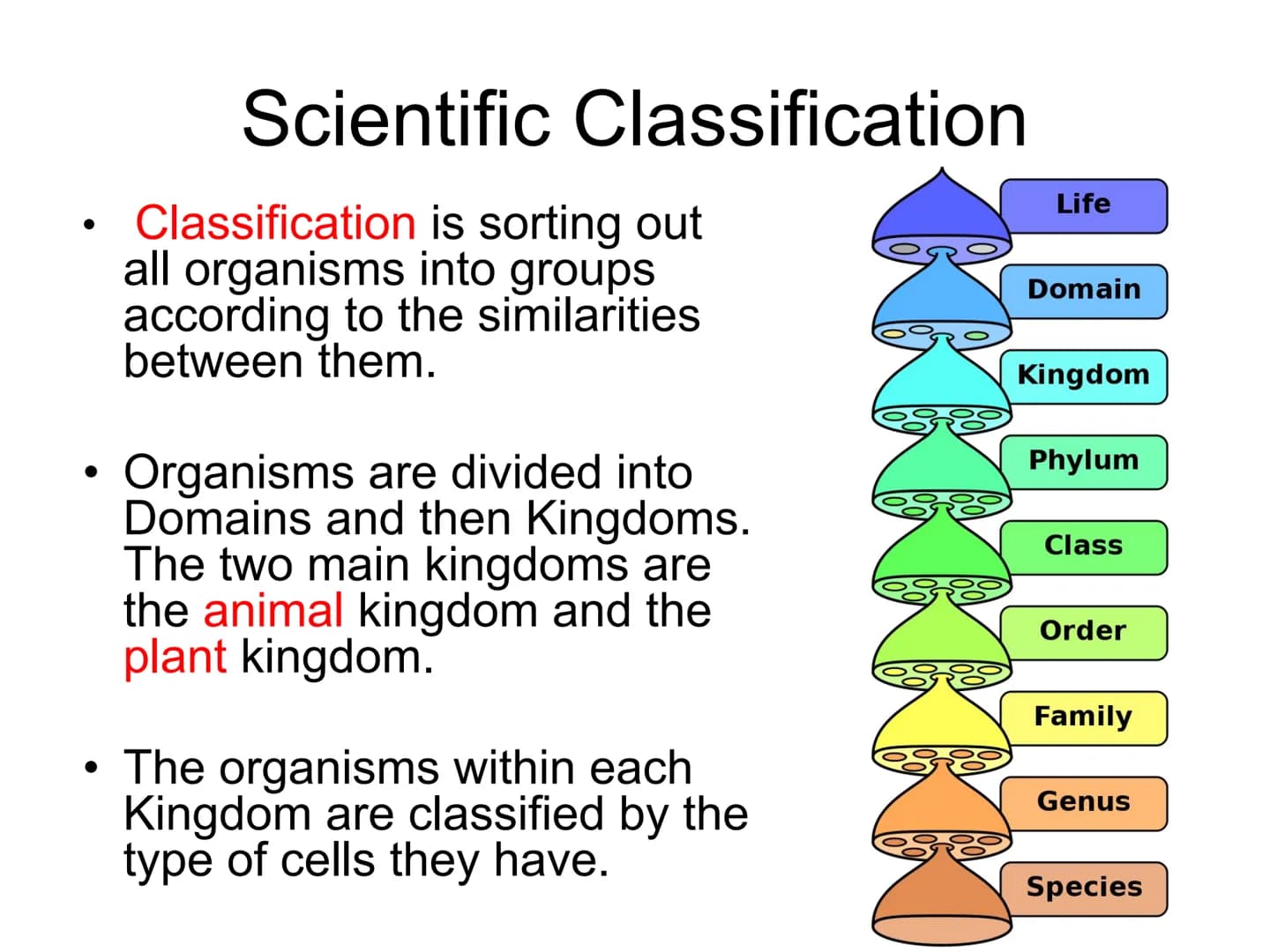
Scientific classification is like a giant filing system for all life on Earth. Scientists sort organisms into groups based on their similarities, starting with huge groups and getting more specific.

The system works like Russian dolls - each group fits inside a bigger one. It starts with massive Domains and Kingdoms, then gets more detailed through Phylum, Class, Order, Family, Genus, and finally Species.

The two main kingdoms you'll encounter most are the animal kingdom and the plant kingdom. Within each kingdom, organisms are further grouped by the types of cells they have and other shared characteristics.

💡 Remember: The more specific the group, the more similar the organisms become!

How Do We Group
Living Things? ●
●
Look at the pictures of animals:
Are they same/different
How can you put them into groups ●
●
Scientific

The Five Main Groups of Life

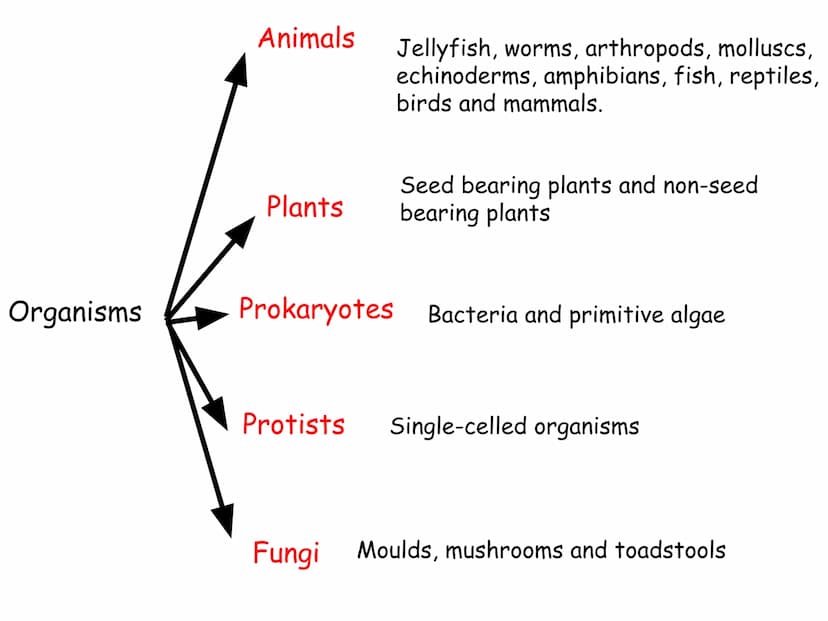
Life on Earth splits into five major groups, each with distinct characteristics. Animals include everything from jellyfish and worms to birds and mammals - basically anything that moves and eats other organisms.

Plants divide into seed-bearing plants (like oak trees) and non-seed bearing plants (like ferns). Prokaryotes are simple organisms like bacteria, whilst Protists are single-celled organisms that are more complex than bacteria.

Fungi might look like plants, but they're completely different! This group includes moulds, mushrooms, and toadstools that break down dead material.

💡 Fun Fact: Mushrooms are more closely related to you than they are to plants!

How Do We Group
Living Things? ●
●
Look at the pictures of animals:
Are they same/different
How can you put them into groups ●
●
Scientific

Remembering Classification Levels

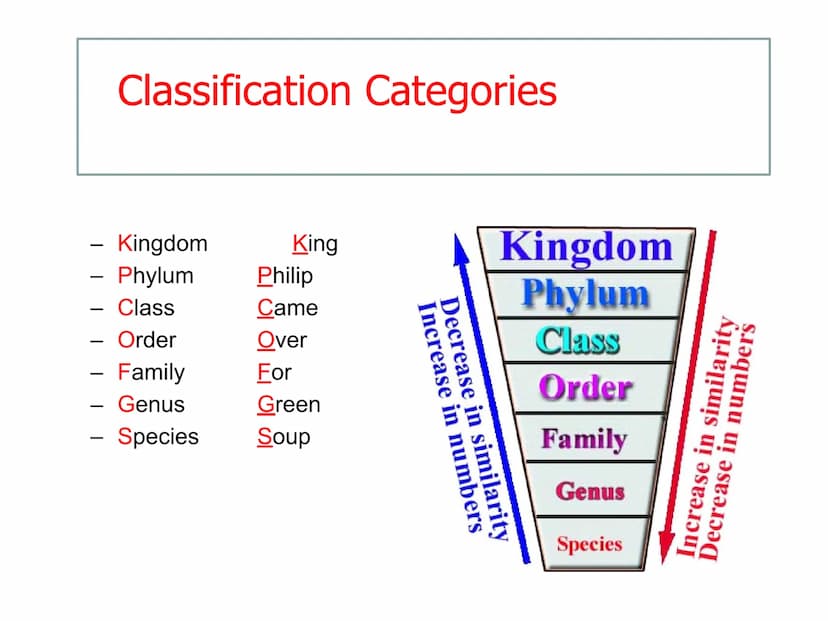
The seven levels of classification follow a specific order, and there's a brilliant memory trick to help you remember them. King Philip Came Over For Green Soup represents Kingdom, Phylum, Class, Order, Family, Genus, Species.

As you move down the levels from Kingdom to Species, the number of organisms decreases but their similarities increase. Think of it like a pyramid - broad at the top, narrow at the bottom.

For example, the Animal Kingdom contains millions of different creatures, but the species level might only contain one specific type of leopard. The closer you get to species level, the more alike the organisms become.

💡 Pro Tip: Create your own silly sentence to remember the levels - the sillier, the more memorable!


How Do We Group
Living Things? ●
●
Look at the pictures of animals:
Are they same/different
How can you put them into groups ●
●
Scientific

Classification in Action: The Leopard

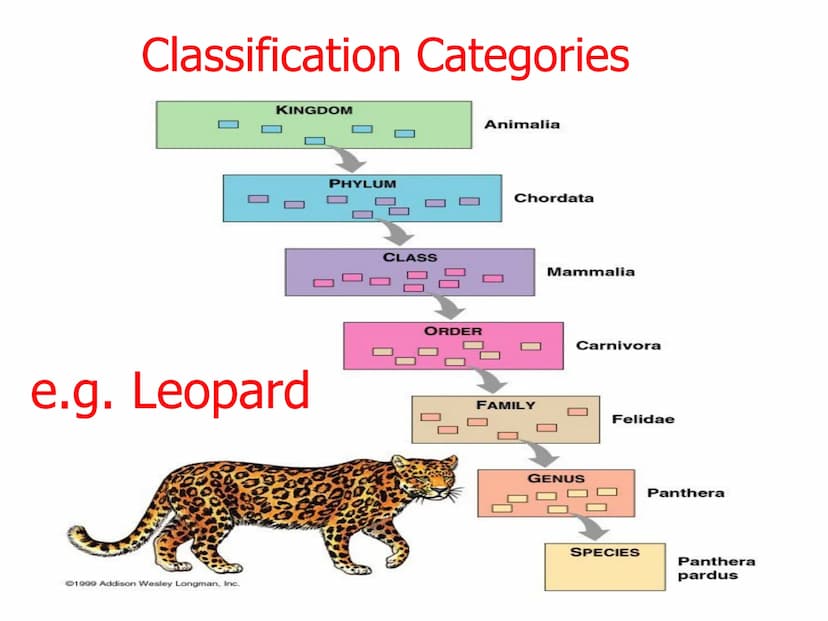
Let's see classification in action using a leopard as our example. Starting broad, it belongs to Animalia (Kingdom), then Chordata PhylummeaningithasabackbonePhylum - meaning it has a backbone.

Moving down, it's Mammalia ClassitsamammalClass - it's a mammal, Carnivora OrderiteatsmeatOrder - it eats meat, and Felidae FamilyitsacatFamily - it's a cat. Finally, its genus is Panthera and species is pardus.

This system means every scientist worldwide uses the same name - Panthera pardus - avoiding confusion between different languages. No matter where you are, this scientific name always means leopard.

💡 Cool Fact: The scientific name is like a universal passport for every living thing on Earth!

How Do We Group
Living Things? ●
●
Look at the pictures of animals:
Are they same/different
How can you put them into groups ●
●
Scientific

Vertebrates vs Invertebrates

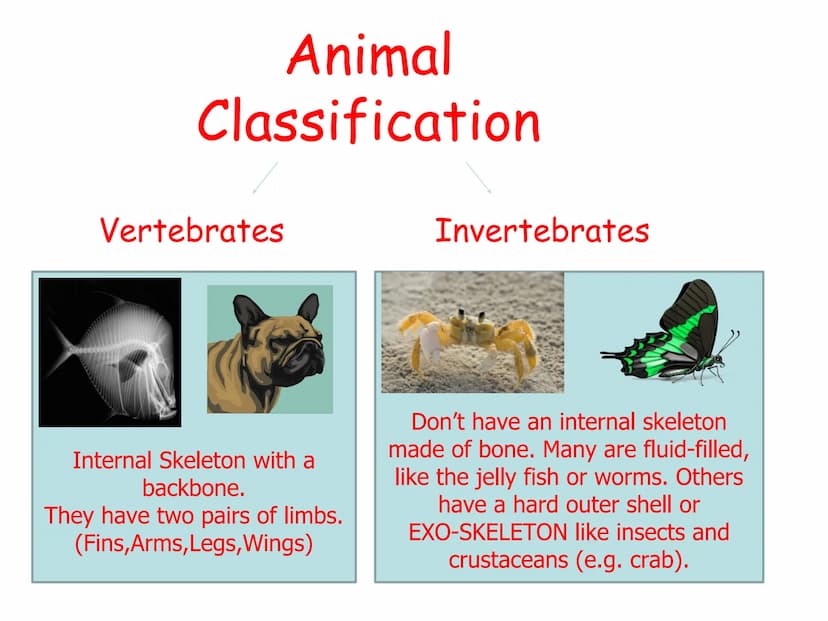
All animals split into two massive groups: vertebrates and invertebrates. Vertebrates have an internal skeleton with a backbone and typically two pairs of limbs (which could be fins, arms, legs, or wings).

Invertebrates don't have an internal skeleton made of bone. Many are fluid-filled like jellyfish and worms, making them squishy and flexible. Others protect themselves with hard outer shells called exoskeletons, like insects and crabs.

This split is huge in the animal kingdom - it's one of the first ways scientists separate different types of animals. You can often tell which group an animal belongs to just by looking at it.

💡 Quick Check: If you can feel a backbone when you touch an animal, it's definitely a vertebrate!

How Do We Group
Living Things? ●
●
Look at the pictures of animals:
Are they same/different
How can you put them into groups ●
●
Scientific

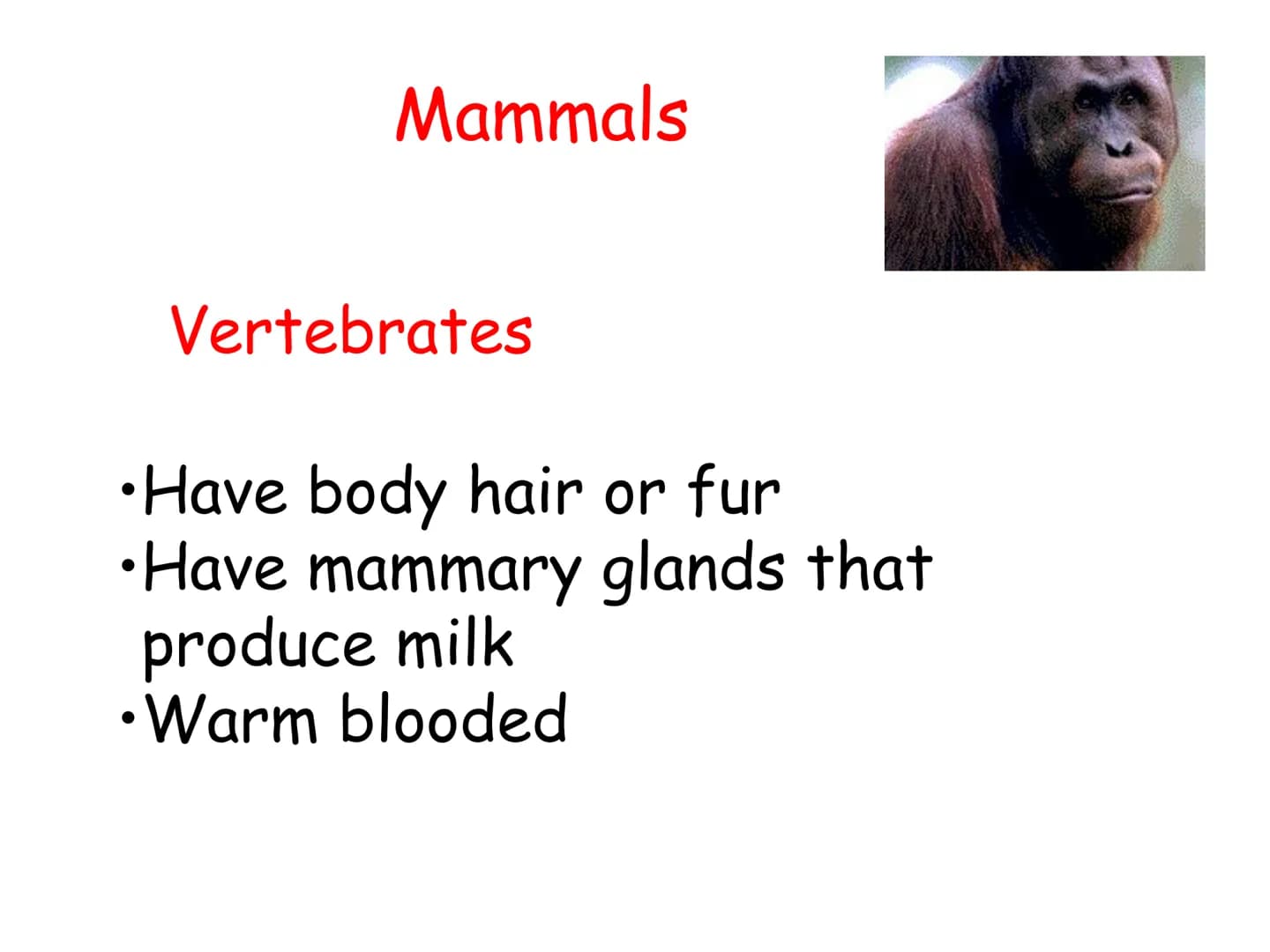
Mammals: The Warm-Blooded Gang

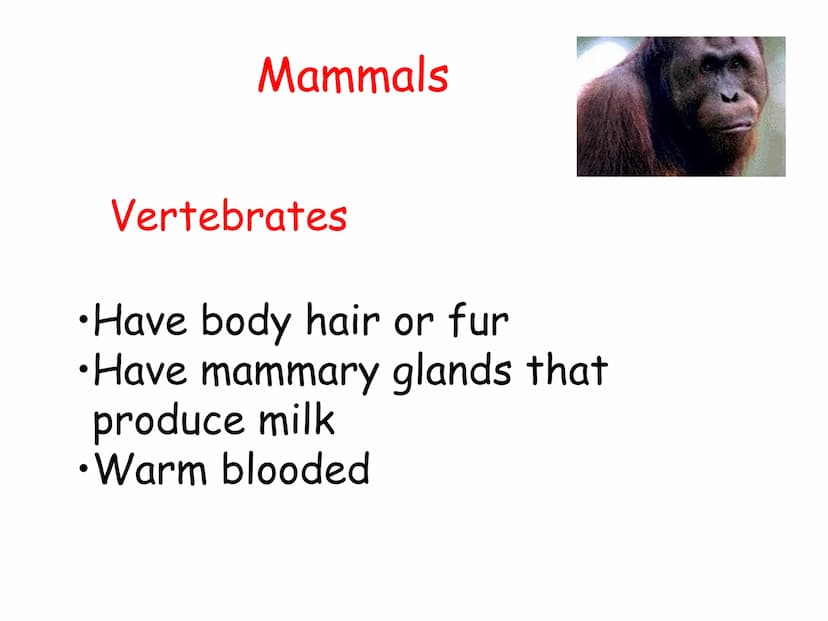
Mammals are probably the most familiar vertebrates to you since humans belong to this group! All mammals share three key features: they have body hair or fur, possess mammary glands that produce milk, and are warm-blooded.

Being warm-blooded means mammals can control their body temperature internally. This gives them a huge advantage - they can stay active in cold weather when other animals become sluggish.

The milk-producing feature is what gives mammals their name. All mammal mothers feed their babies with milk, providing perfect nutrition for growth.

💡 Amazing Fact: Even whales and dolphins have hair - they just lose most of it before they're born!

How Do We Group
Living Things? ●
●
Look at the pictures of animals:
Are they same/different
How can you put them into groups ●
●
Scientific

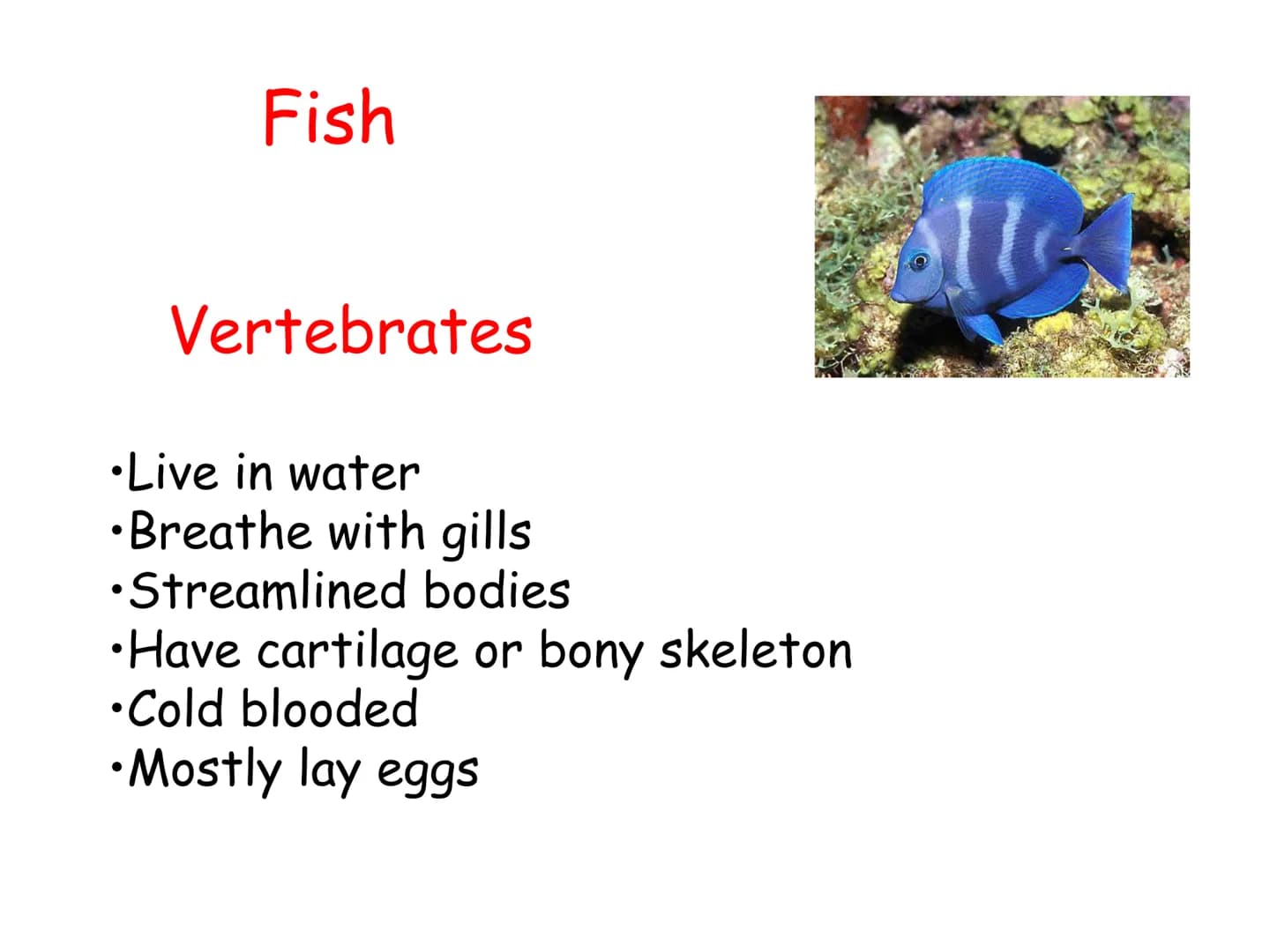
Fish: Masters of Water

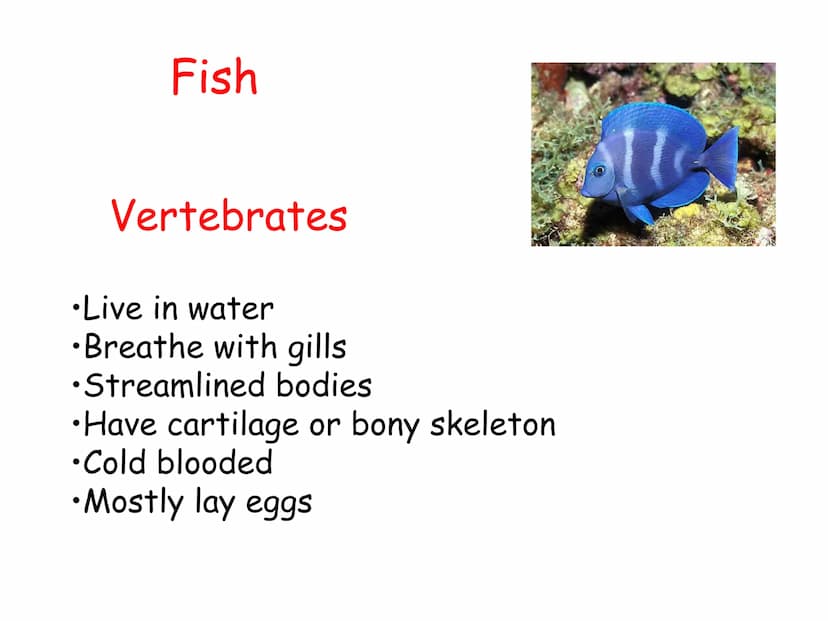
Fish are perfectly designed for aquatic life with their streamlined bodies that slice through water efficiently. They breathe using gills instead of lungs, extracting oxygen directly from water.

Most fish are cold-blooded, meaning their body temperature matches their surroundings. Their skeletons can be made of either cartilage (like sharks) or bone (like goldfish), and most reproduce by laying eggs.

Fish come in incredible variety - from tiny seahorses to massive whale sharks. Despite their differences, they all share these key aquatic adaptations.

💡 Did You Know?: Some fish can actually survive out of water for short periods, but they still need their gills to breathe!

How Do We Group
Living Things? ●
●
Look at the pictures of animals:
Are they same/different
How can you put them into groups ●
●
Scientific

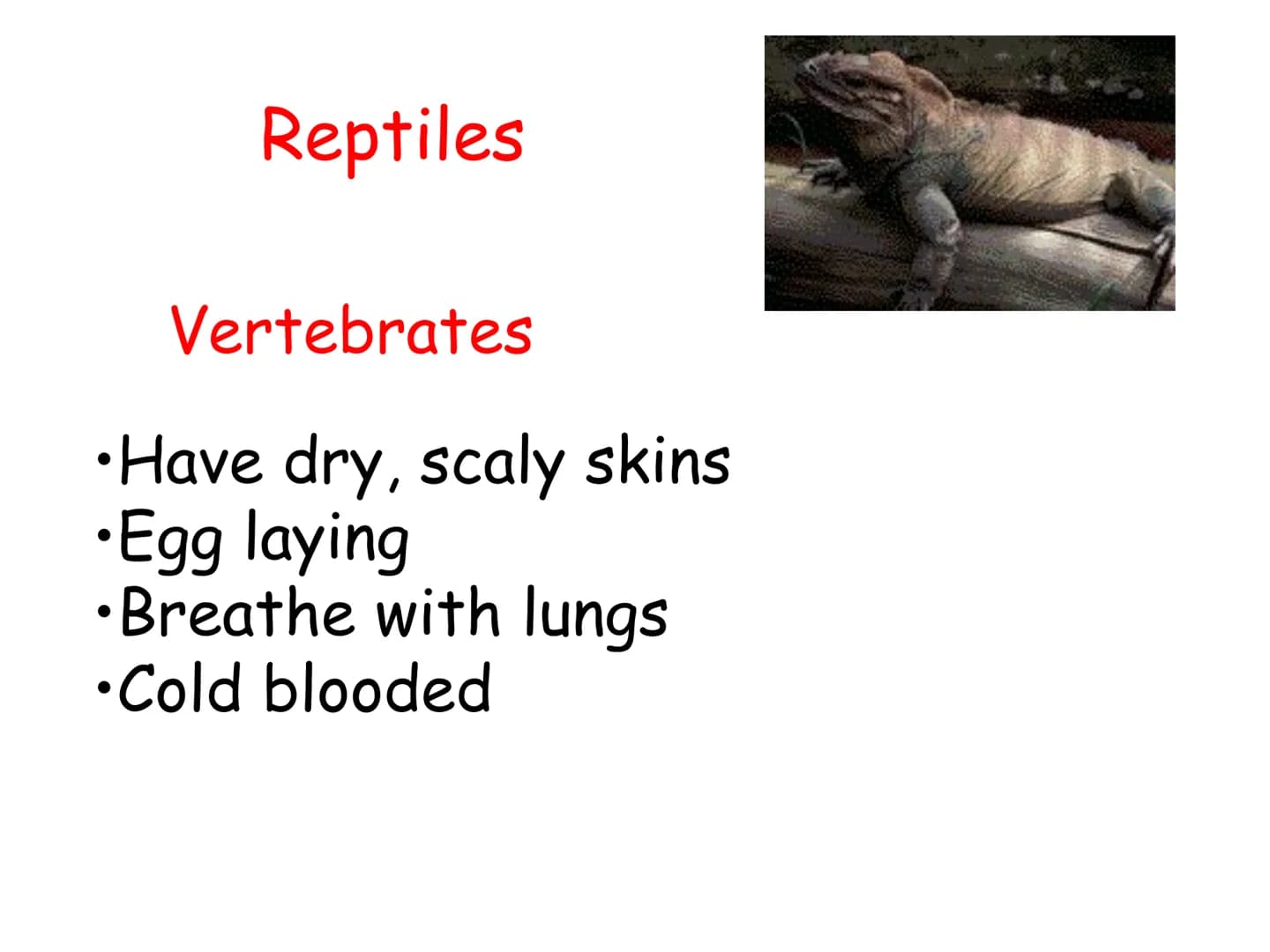
Reptiles: The Scaly Survivors

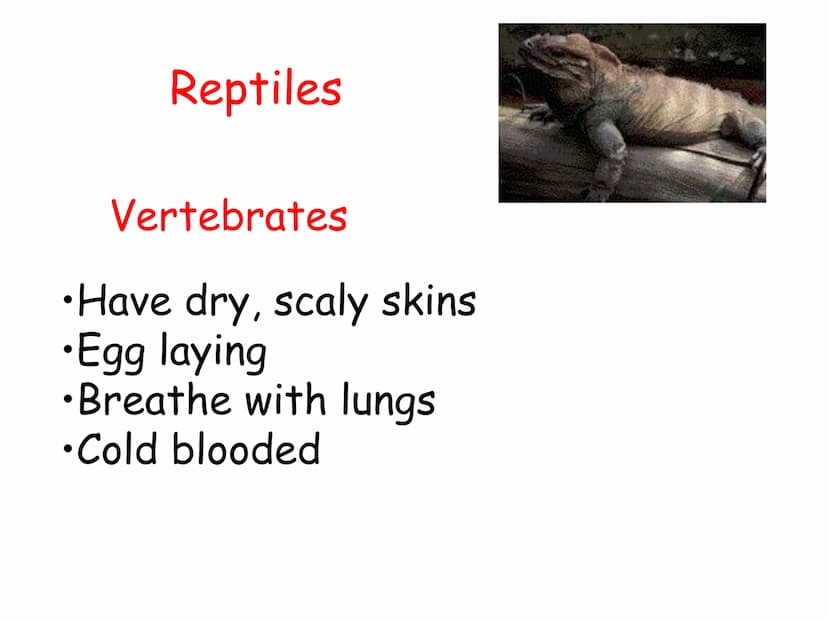
Reptiles are easily recognised by their dry, scaly skin that protects them from losing water. Unlike fish, they breathe air using lungs, even those that spend time in water like crocodiles.

Most reptiles are cold-blooded and lay eggs, though they do this on land rather than in water. Their scaly skin is actually made of the same material as your fingernails!

From tiny geckos to massive pythons, reptiles have conquered almost every habitat on Earth. Their tough skin and efficient metabolism help them survive in harsh conditions.

💡 Survival Secret: Reptiles can go much longer without food than mammals because they don't waste energy heating their bodies!

How Do We Group
Living Things? ●
●
Look at the pictures of animals:
Are they same/different
How can you put them into groups ●
●
Scientific


We thought you’d never ask...

What is the Knowunity AI companion?

Our AI Companion is a student-focused AI tool that offers more than just answers. Built on millions of Knowunity resources, it provides relevant information, personalised study plans, quizzes, and content directly in the chat, adapting to your individual learning journey.

Where can I download the Knowunity app?

You can download the app from Google Play Store and Apple App Store.

Is Knowunity really free of charge?

That's right! Enjoy free access to study content, connect with fellow students, and get instant help – all at your fingertips.

Most popular content: Classification

Most popular content in Biology

Most popular content

Can't find what you're looking for? Explore other subjects.

Students love us — and so will you.

4.9/5

App Store

4.8/5

Google Play

The app is very easy to use and well designed. I have found everything I was looking for so far and have been able to learn a lot from the presentations! I will definitely use the app for a class assignment! And of course it also helps a lot as an inspiration.

Stefan S

iOS user

This app is really great. There are so many study notes and help [...]. My problem subject is French, for example, and the app has so many options for help. Thanks to this app, I have improved my French. I would recommend it to anyone.

Samantha Klich

Android user

Wow, I am really amazed. I just tried the app because I've seen it advertised many times and was absolutely stunned. This app is THE HELP you want for school and above all, it offers so many things, such as workouts and fact sheets, which have been VERY helpful to me personally.

Anna

iOS user

Best app on earth! no words because it’s too good

Thomas R

iOS user

Just amazing. Let's me revise 10x better, this app is a quick 10/10. I highly recommend it to anyone. I can watch and search for notes. I can save them in the subject folder. I can revise it any time when I come back. If you haven't tried this app, you're really missing out.

Basil

Android user

This app has made me feel so much more confident in my exam prep, not only through boosting my own self confidence through the features that allow you to connect with others and feel less alone, but also through the way the app itself is centred around making you feel better. It is easy to navigate, fun to use, and helpful to anyone struggling in absolutely any way.

David K

iOS user

The app's just great! All I have to do is enter the topic in the search bar and I get the response real fast. I don't have to watch 10 YouTube videos to understand something, so I'm saving my time. Highly recommended!

Sudenaz Ocak

Android user

In school I was really bad at maths but thanks to the app, I am doing better now. I am so grateful that you made the app.

Greenlight Bonnie

Android user

very reliable app to help and grow your ideas of Maths, English and other related topics in your works. please use this app if your struggling in areas, this app is key for that. wish I'd of done a review before. and it's also free so don't worry about that.

Rohan U

Android user

I know a lot of apps use fake accounts to boost their reviews but this app deserves it all. Originally I was getting 4 in my English exams and this time I got a grade 7. I didn’t even know about this app three days until the exam and it has helped A LOT. Please actually trust me and use it as I’m sure you too will see developments.

Xander S

iOS user

THE QUIZES AND FLASHCARDS ARE SO USEFUL AND I LOVE THE SCHOOLGPT. IT ALSO IS LITREALLY LIKE CHATGPT BUT SMARTER!! HELPED ME WITH MY MASCARA PROBLEMS TOO!! AS WELL AS MY REAL SUBJECTS ! DUHHH 😍😁😲🤑💗✨🎀😮

Elisha

iOS user

This apps acc the goat. I find revision so boring but this app makes it so easy to organize it all and then you can ask the freeeee ai to test yourself so good and you can easily upload your own stuff. highly recommend as someone taking mocks now

Paul T

iOS user

The app is very easy to use and well designed. I have found everything I was looking for so far and have been able to learn a lot from the presentations! I will definitely use the app for a class assignment! And of course it also helps a lot as an inspiration.

Stefan S

iOS user

This app is really great. There are so many study notes and help [...]. My problem subject is French, for example, and the app has so many options for help. Thanks to this app, I have improved my French. I would recommend it to anyone.

Samantha Klich

Android user

Wow, I am really amazed. I just tried the app because I've seen it advertised many times and was absolutely stunned. This app is THE HELP you want for school and above all, it offers so many things, such as workouts and fact sheets, which have been VERY helpful to me personally.

Anna

iOS user

Best app on earth! no words because it’s too good

Thomas R

iOS user

Just amazing. Let's me revise 10x better, this app is a quick 10/10. I highly recommend it to anyone. I can watch and search for notes. I can save them in the subject folder. I can revise it any time when I come back. If you haven't tried this app, you're really missing out.

Basil

Android user

This app has made me feel so much more confident in my exam prep, not only through boosting my own self confidence through the features that allow you to connect with others and feel less alone, but also through the way the app itself is centred around making you feel better. It is easy to navigate, fun to use, and helpful to anyone struggling in absolutely any way.

David K

iOS user

The app's just great! All I have to do is enter the topic in the search bar and I get the response real fast. I don't have to watch 10 YouTube videos to understand something, so I'm saving my time. Highly recommended!

Sudenaz Ocak

Android user

In school I was really bad at maths but thanks to the app, I am doing better now. I am so grateful that you made the app.

Greenlight Bonnie

Android user

very reliable app to help and grow your ideas of Maths, English and other related topics in your works. please use this app if your struggling in areas, this app is key for that. wish I'd of done a review before. and it's also free so don't worry about that.

Rohan U

Android user

I know a lot of apps use fake accounts to boost their reviews but this app deserves it all. Originally I was getting 4 in my English exams and this time I got a grade 7. I didn’t even know about this app three days until the exam and it has helped A LOT. Please actually trust me and use it as I’m sure you too will see developments.

Xander S

iOS user

THE QUIZES AND FLASHCARDS ARE SO USEFUL AND I LOVE THE SCHOOLGPT. IT ALSO IS LITREALLY LIKE CHATGPT BUT SMARTER!! HELPED ME WITH MY MASCARA PROBLEMS TOO!! AS WELL AS MY REAL SUBJECTS ! DUHHH 😍😁😲🤑💗✨🎀😮

Elisha

iOS user

This apps acc the goat. I find revision so boring but this app makes it so easy to organize it all and then you can ask the freeeee ai to test yourself so good and you can easily upload your own stuff. highly recommend as someone taking mocks now

Paul T

iOS user


Biology

195

26 Dec 2025

20 pages

Understanding the Classification of Living Organisms

user profile picture

Anna Noble

@annanoble_ipmv

Ever wondered why scientists sort living things into groups? Classification helps us understand the millions of different organisms on Earth by organising them based on their similarities and differences.

How Do We Group
Living Things? ●
●
Look at the pictures of animals:
Are they same/different
How can you put them into groups ●
●
Scientific

Sign up to see the contentIt's free!

Access to all documents

Improve your grades

Join milions of students

By signing up you accept Terms of Service and Privacy Policy

How Do We Group Living Things?

Think about how you'd sort a massive collection of photos - you'd probably group them by similar features! Scientists do exactly the same thing with living organisms.

When you look at different animals, you can spot obvious differences and similarities. Some have fur, others have scales, and some don't even have backbones. Classification is the scientific way of sorting these organisms into organised groups.

💡 Quick Tip: Start by looking for the most obvious differences - does it move? Does it have a backbone? These basic questions help scientists begin the sorting process!

How Do We Group
Living Things? ●
●
Look at the pictures of animals:
Are they same/different
How can you put them into groups ●
●
Scientific

Sign up to see the contentIt's free!

Access to all documents

Improve your grades

Join milions of students

By signing up you accept Terms of Service and Privacy Policy

Scientific Classification System

Scientific classification is like a giant filing system for all life on Earth. Scientists sort organisms into groups based on their similarities, starting with huge groups and getting more specific.

The system works like Russian dolls - each group fits inside a bigger one. It starts with massive Domains and Kingdoms, then gets more detailed through Phylum, Class, Order, Family, Genus, and finally Species.

The two main kingdoms you'll encounter most are the animal kingdom and the plant kingdom. Within each kingdom, organisms are further grouped by the types of cells they have and other shared characteristics.

💡 Remember: The more specific the group, the more similar the organisms become!

How Do We Group
Living Things? ●
●
Look at the pictures of animals:
Are they same/different
How can you put them into groups ●
●
Scientific

Sign up to see the contentIt's free!

Access to all documents

Improve your grades

Join milions of students

By signing up you accept Terms of Service and Privacy Policy

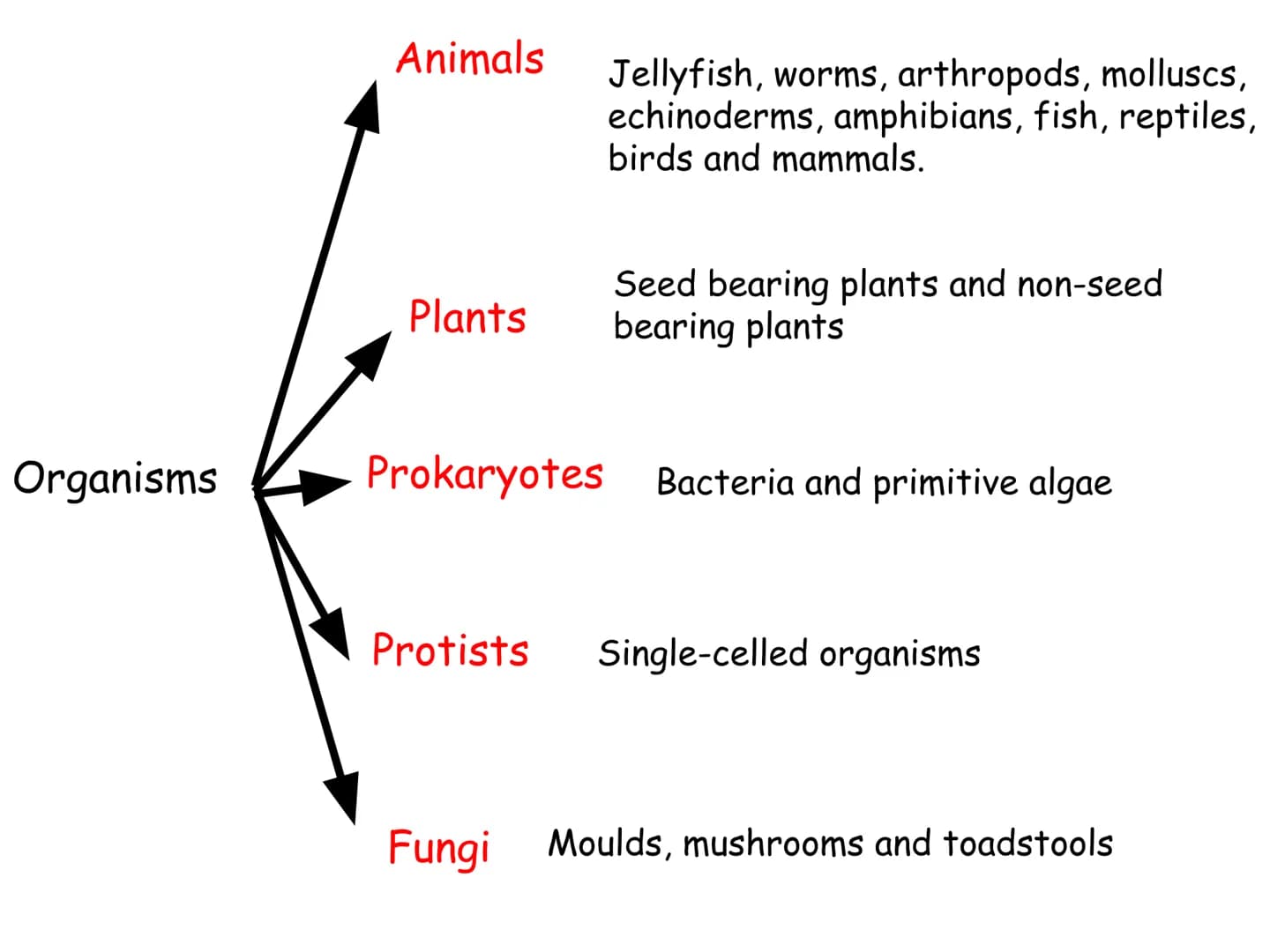
The Five Main Groups of Life

Life on Earth splits into five major groups, each with distinct characteristics. Animals include everything from jellyfish and worms to birds and mammals - basically anything that moves and eats other organisms.

Plants divide into seed-bearing plants (like oak trees) and non-seed bearing plants (like ferns). Prokaryotes are simple organisms like bacteria, whilst Protists are single-celled organisms that are more complex than bacteria.

Fungi might look like plants, but they're completely different! This group includes moulds, mushrooms, and toadstools that break down dead material.

💡 Fun Fact: Mushrooms are more closely related to you than they are to plants!

How Do We Group
Living Things? ●
●
Look at the pictures of animals:
Are they same/different
How can you put them into groups ●
●
Scientific

Sign up to see the contentIt's free!

Access to all documents

Improve your grades

Join milions of students

By signing up you accept Terms of Service and Privacy Policy

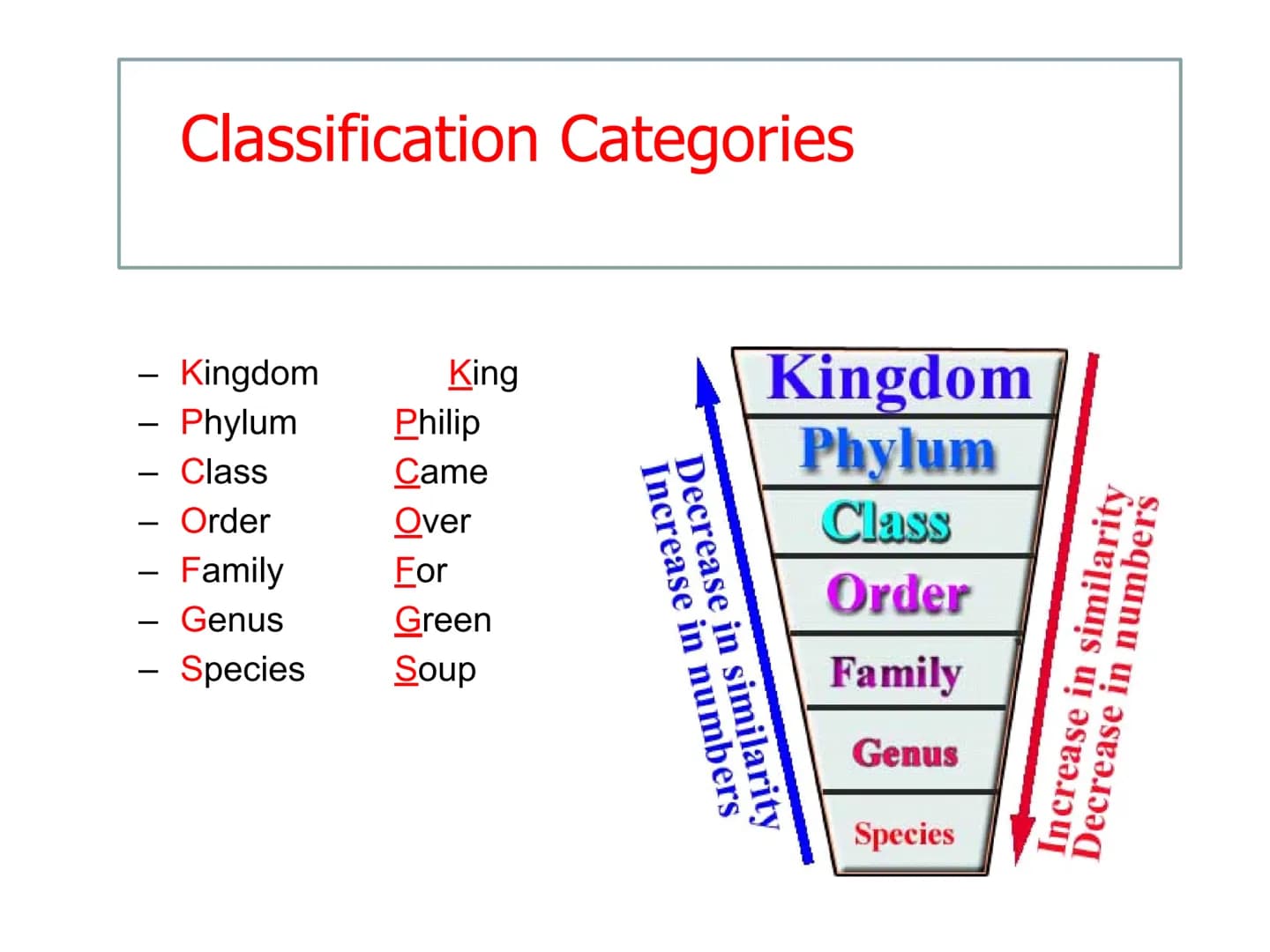
Remembering Classification Levels

The seven levels of classification follow a specific order, and there's a brilliant memory trick to help you remember them. King Philip Came Over For Green Soup represents Kingdom, Phylum, Class, Order, Family, Genus, Species.

As you move down the levels from Kingdom to Species, the number of organisms decreases but their similarities increase. Think of it like a pyramid - broad at the top, narrow at the bottom.

For example, the Animal Kingdom contains millions of different creatures, but the species level might only contain one specific type of leopard. The closer you get to species level, the more alike the organisms become.

💡 Pro Tip: Create your own silly sentence to remember the levels - the sillier, the more memorable!
How Do We Group
Living Things? ●
●
Look at the pictures of animals:
Are they same/different
How can you put them into groups ●
●
Scientific

Sign up to see the contentIt's free!

Access to all documents

Improve your grades

Join milions of students

By signing up you accept Terms of Service and Privacy Policy

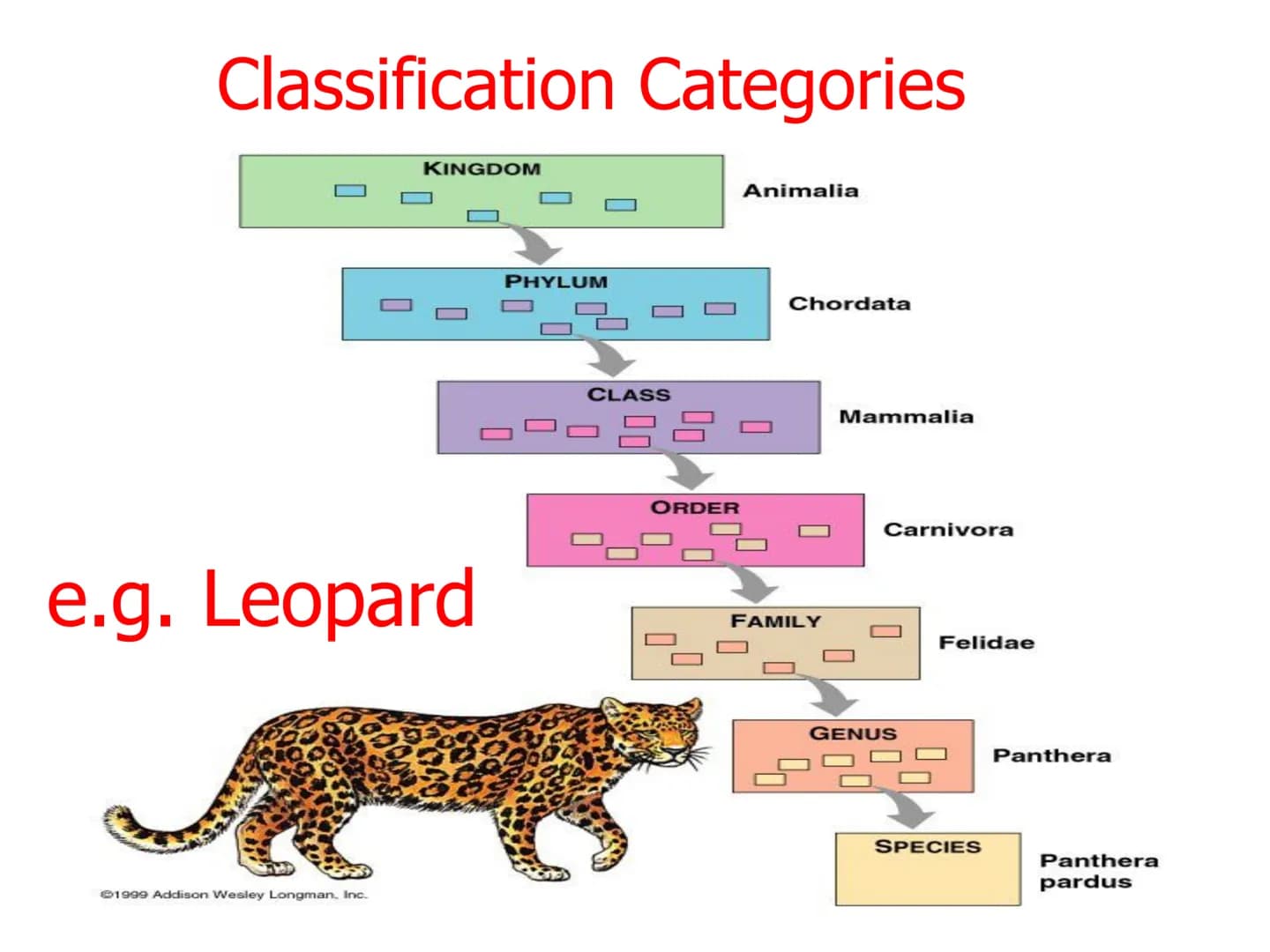
Classification in Action: The Leopard

Let's see classification in action using a leopard as our example. Starting broad, it belongs to Animalia (Kingdom), then Chordata PhylummeaningithasabackbonePhylum - meaning it has a backbone.

Moving down, it's Mammalia ClassitsamammalClass - it's a mammal, Carnivora OrderiteatsmeatOrder - it eats meat, and Felidae FamilyitsacatFamily - it's a cat. Finally, its genus is Panthera and species is pardus.

This system means every scientist worldwide uses the same name - Panthera pardus - avoiding confusion between different languages. No matter where you are, this scientific name always means leopard.

💡 Cool Fact: The scientific name is like a universal passport for every living thing on Earth!

How Do We Group
Living Things? ●
●
Look at the pictures of animals:
Are they same/different
How can you put them into groups ●
●
Scientific

Sign up to see the contentIt's free!

Access to all documents

Improve your grades

Join milions of students

By signing up you accept Terms of Service and Privacy Policy

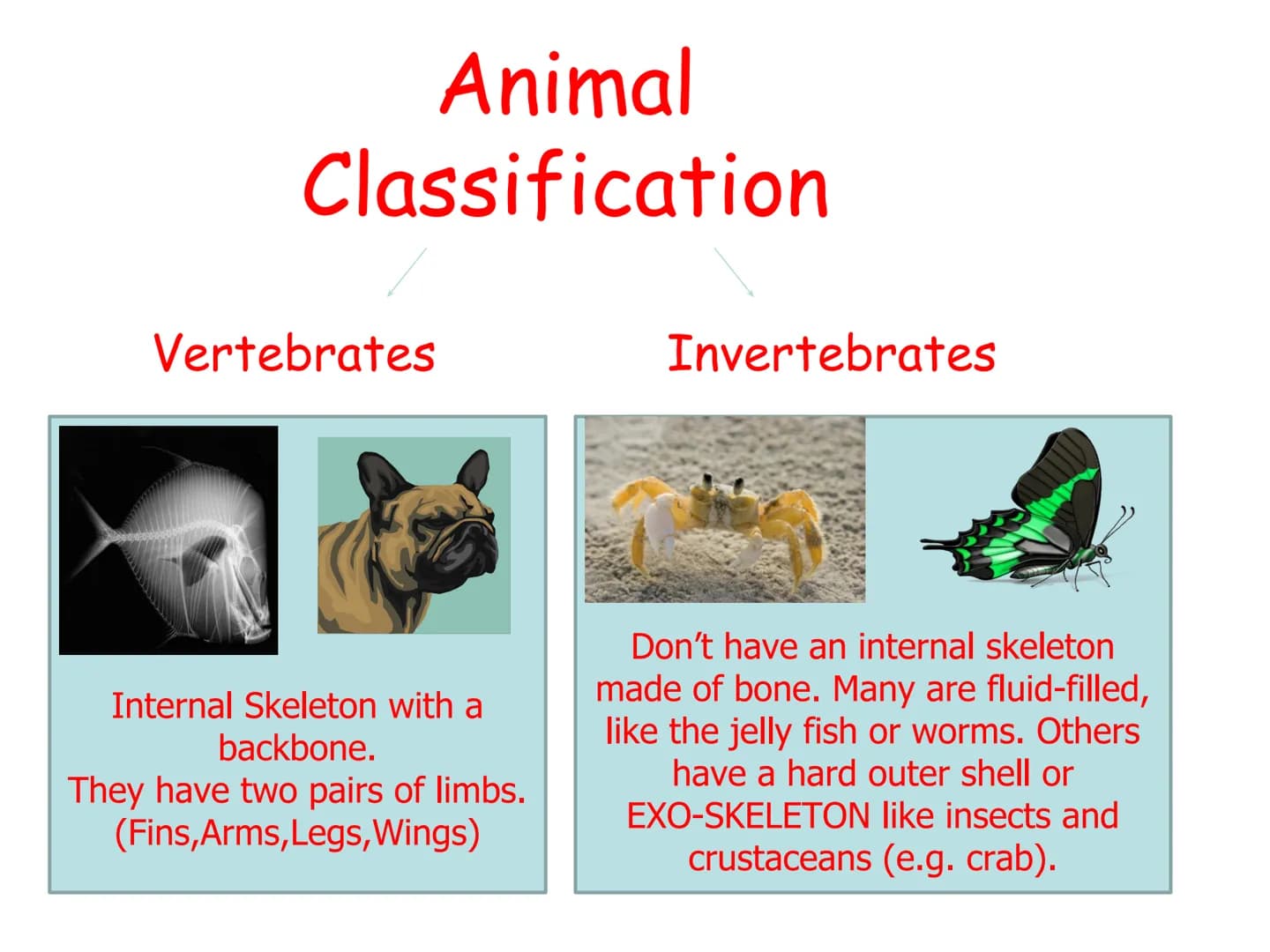
Vertebrates vs Invertebrates

All animals split into two massive groups: vertebrates and invertebrates. Vertebrates have an internal skeleton with a backbone and typically two pairs of limbs (which could be fins, arms, legs, or wings).

Invertebrates don't have an internal skeleton made of bone. Many are fluid-filled like jellyfish and worms, making them squishy and flexible. Others protect themselves with hard outer shells called exoskeletons, like insects and crabs.

This split is huge in the animal kingdom - it's one of the first ways scientists separate different types of animals. You can often tell which group an animal belongs to just by looking at it.

💡 Quick Check: If you can feel a backbone when you touch an animal, it's definitely a vertebrate!

How Do We Group
Living Things? ●
●
Look at the pictures of animals:
Are they same/different
How can you put them into groups ●
●
Scientific

Sign up to see the contentIt's free!

Access to all documents

Improve your grades

Join milions of students

By signing up you accept Terms of Service and Privacy Policy

Mammals: The Warm-Blooded Gang

Mammals are probably the most familiar vertebrates to you since humans belong to this group! All mammals share three key features: they have body hair or fur, possess mammary glands that produce milk, and are warm-blooded.

Being warm-blooded means mammals can control their body temperature internally. This gives them a huge advantage - they can stay active in cold weather when other animals become sluggish.

The milk-producing feature is what gives mammals their name. All mammal mothers feed their babies with milk, providing perfect nutrition for growth.

💡 Amazing Fact: Even whales and dolphins have hair - they just lose most of it before they're born!

How Do We Group
Living Things? ●
●
Look at the pictures of animals:
Are they same/different
How can you put them into groups ●
●
Scientific

Sign up to see the contentIt's free!

Access to all documents

Improve your grades

Join milions of students

By signing up you accept Terms of Service and Privacy Policy

Fish: Masters of Water

Fish are perfectly designed for aquatic life with their streamlined bodies that slice through water efficiently. They breathe using gills instead of lungs, extracting oxygen directly from water.

Most fish are cold-blooded, meaning their body temperature matches their surroundings. Their skeletons can be made of either cartilage (like sharks) or bone (like goldfish), and most reproduce by laying eggs.

Fish come in incredible variety - from tiny seahorses to massive whale sharks. Despite their differences, they all share these key aquatic adaptations.

💡 Did You Know?: Some fish can actually survive out of water for short periods, but they still need their gills to breathe!

How Do We Group
Living Things? ●
●
Look at the pictures of animals:
Are they same/different
How can you put them into groups ●
●
Scientific

Sign up to see the contentIt's free!

Access to all documents

Improve your grades

Join milions of students

By signing up you accept Terms of Service and Privacy Policy

Reptiles: The Scaly Survivors

Reptiles are easily recognised by their dry, scaly skin that protects them from losing water. Unlike fish, they breathe air using lungs, even those that spend time in water like crocodiles.

Most reptiles are cold-blooded and lay eggs, though they do this on land rather than in water. Their scaly skin is actually made of the same material as your fingernails!

From tiny geckos to massive pythons, reptiles have conquered almost every habitat on Earth. Their tough skin and efficient metabolism help them survive in harsh conditions.

💡 Survival Secret: Reptiles can go much longer without food than mammals because they don't waste energy heating their bodies!

How Do We Group
Living Things? ●
●
Look at the pictures of animals:
Are they same/different
How can you put them into groups ●
●
Scientific

Sign up to see the contentIt's free!

Access to all documents

Improve your grades

Join milions of students

By signing up you accept Terms of Service and Privacy Policy

We thought you’d never ask...

What is the Knowunity AI companion?

Our AI Companion is a student-focused AI tool that offers more than just answers. Built on millions of Knowunity resources, it provides relevant information, personalised study plans, quizzes, and content directly in the chat, adapting to your individual learning journey.

Where can I download the Knowunity app?

You can download the app from Google Play Store and Apple App Store.

Is Knowunity really free of charge?

That's right! Enjoy free access to study content, connect with fellow students, and get instant help – all at your fingertips.

Most popular content: Classification

Most popular content in Biology

Most popular content

Can't find what you're looking for? Explore other subjects.

Students love us — and so will you.

4.9/5

App Store

4.8/5

Google Play

The app is very easy to use and well designed. I have found everything I was looking for so far and have been able to learn a lot from the presentations! I will definitely use the app for a class assignment! And of course it also helps a lot as an inspiration.

Stefan S

iOS user

This app is really great. There are so many study notes and help [...]. My problem subject is French, for example, and the app has so many options for help. Thanks to this app, I have improved my French. I would recommend it to anyone.

Samantha Klich

Android user

Wow, I am really amazed. I just tried the app because I've seen it advertised many times and was absolutely stunned. This app is THE HELP you want for school and above all, it offers so many things, such as workouts and fact sheets, which have been VERY helpful to me personally.

Anna

iOS user

Best app on earth! no words because it’s too good

Thomas R

iOS user

Just amazing. Let's me revise 10x better, this app is a quick 10/10. I highly recommend it to anyone. I can watch and search for notes. I can save them in the subject folder. I can revise it any time when I come back. If you haven't tried this app, you're really missing out.

Basil

Android user

This app has made me feel so much more confident in my exam prep, not only through boosting my own self confidence through the features that allow you to connect with others and feel less alone, but also through the way the app itself is centred around making you feel better. It is easy to navigate, fun to use, and helpful to anyone struggling in absolutely any way.

David K

iOS user

The app's just great! All I have to do is enter the topic in the search bar and I get the response real fast. I don't have to watch 10 YouTube videos to understand something, so I'm saving my time. Highly recommended!

Sudenaz Ocak

Android user

In school I was really bad at maths but thanks to the app, I am doing better now. I am so grateful that you made the app.

Greenlight Bonnie

Android user

very reliable app to help and grow your ideas of Maths, English and other related topics in your works. please use this app if your struggling in areas, this app is key for that. wish I'd of done a review before. and it's also free so don't worry about that.

Rohan U

Android user

I know a lot of apps use fake accounts to boost their reviews but this app deserves it all. Originally I was getting 4 in my English exams and this time I got a grade 7. I didn’t even know about this app three days until the exam and it has helped A LOT. Please actually trust me and use it as I’m sure you too will see developments.

Xander S

iOS user

THE QUIZES AND FLASHCARDS ARE SO USEFUL AND I LOVE THE SCHOOLGPT. IT ALSO IS LITREALLY LIKE CHATGPT BUT SMARTER!! HELPED ME WITH MY MASCARA PROBLEMS TOO!! AS WELL AS MY REAL SUBJECTS ! DUHHH 😍😁😲🤑💗✨🎀😮

Elisha

iOS user

This apps acc the goat. I find revision so boring but this app makes it so easy to organize it all and then you can ask the freeeee ai to test yourself so good and you can easily upload your own stuff. highly recommend as someone taking mocks now

Paul T

iOS user

The app is very easy to use and well designed. I have found everything I was looking for so far and have been able to learn a lot from the presentations! I will definitely use the app for a class assignment! And of course it also helps a lot as an inspiration.

Stefan S

iOS user

This app is really great. There are so many study notes and help [...]. My problem subject is French, for example, and the app has so many options for help. Thanks to this app, I have improved my French. I would recommend it to anyone.

Samantha Klich

Android user

Wow, I am really amazed. I just tried the app because I've seen it advertised many times and was absolutely stunned. This app is THE HELP you want for school and above all, it offers so many things, such as workouts and fact sheets, which have been VERY helpful to me personally.

Anna

iOS user

Best app on earth! no words because it’s too good

Thomas R

iOS user

Just amazing. Let's me revise 10x better, this app is a quick 10/10. I highly recommend it to anyone. I can watch and search for notes. I can save them in the subject folder. I can revise it any time when I come back. If you haven't tried this app, you're really missing out.

Basil

Android user

This app has made me feel so much more confident in my exam prep, not only through boosting my own self confidence through the features that allow you to connect with others and feel less alone, but also through the way the app itself is centred around making you feel better. It is easy to navigate, fun to use, and helpful to anyone struggling in absolutely any way.

David K

iOS user

The app's just great! All I have to do is enter the topic in the search bar and I get the response real fast. I don't have to watch 10 YouTube videos to understand something, so I'm saving my time. Highly recommended!

Sudenaz Ocak

Android user

In school I was really bad at maths but thanks to the app, I am doing better now. I am so grateful that you made the app.

Greenlight Bonnie

Android user

very reliable app to help and grow your ideas of Maths, English and other related topics in your works. please use this app if your struggling in areas, this app is key for that. wish I'd of done a review before. and it's also free so don't worry about that.

Rohan U

Android user

I know a lot of apps use fake accounts to boost their reviews but this app deserves it all. Originally I was getting 4 in my English exams and this time I got a grade 7. I didn’t even know about this app three days until the exam and it has helped A LOT. Please actually trust me and use it as I’m sure you too will see developments.

Xander S

iOS user

THE QUIZES AND FLASHCARDS ARE SO USEFUL AND I LOVE THE SCHOOLGPT. IT ALSO IS LITREALLY LIKE CHATGPT BUT SMARTER!! HELPED ME WITH MY MASCARA PROBLEMS TOO!! AS WELL AS MY REAL SUBJECTS ! DUHHH 😍😁😲🤑💗✨🎀😮

Elisha

iOS user

This apps acc the goat. I find revision so boring but this app makes it so easy to organize it all and then you can ask the freeeee ai to test yourself so good and you can easily upload your own stuff. highly recommend as someone taking mocks now

Paul T

iOS user