

Your body is basically a chemistry set running on six... Show more
 Biology
 English Literature
 Sociology
Sign up to see the contentIt's free!
Access to all documents
Improve your grades
Join milions of students
Knowunity AI
Subjects
Triangle Congruence and Similarity Theorems
Triangle Properties and Classification
Linear Equations and Graphs
Geometric Angle Relationships
Trigonometric Functions and Identities
Equation Solving Techniques
Circle Geometry Fundamentals
Division Operations and Methods
Basic Differentiation Rules
Exponent and Logarithm Properties
Show all topics
Human Organ Systems
Reproductive Cell Cycles
Biological Sciences Subdisciplines
Cellular Energy Metabolism
Autotrophic Energy Processes
Inheritance Patterns and Principles
Biomolecular Structure and Organization
Cell Cycle and Division Mechanics
Cellular Organization and Development
Biological Structural Organization
Show all topics
Chemical Sciences and Applications
Atomic Structure and Composition
Molecular Electron Structure Representation
Atomic Electron Behavior
Matter Properties and Water
Mole Concept and Calculations
Gas Laws and Behavior
Periodic Table Organization
Chemical Thermodynamics Fundamentals
Chemical Bond Types and Properties
Show all topics
European Renaissance and Enlightenment
European Cultural Movements 800-1920
American Revolution Era 1763-1797
American Civil War 1861-1865
Global Imperial Systems
Mongol and Chinese Dynasties
U.S. Presidents and World Leaders
Historical Sources and Documentation
World Wars Era and Impact
World Religious Systems
Show all topics
Classic and Contemporary Novels
Literary Character Analysis
Rhetorical Theory and Practice
Classic Literary Narratives
Reading Analysis and Interpretation
Narrative Structure and Techniques
English Language Components
Influential English-Language Authors
Basic Sentence Structure
Narrative Voice and Perspective
Show all topics
1,128
•
Updated Mar 14, 2026
•
Your body is basically a chemistry set running on six... Show more
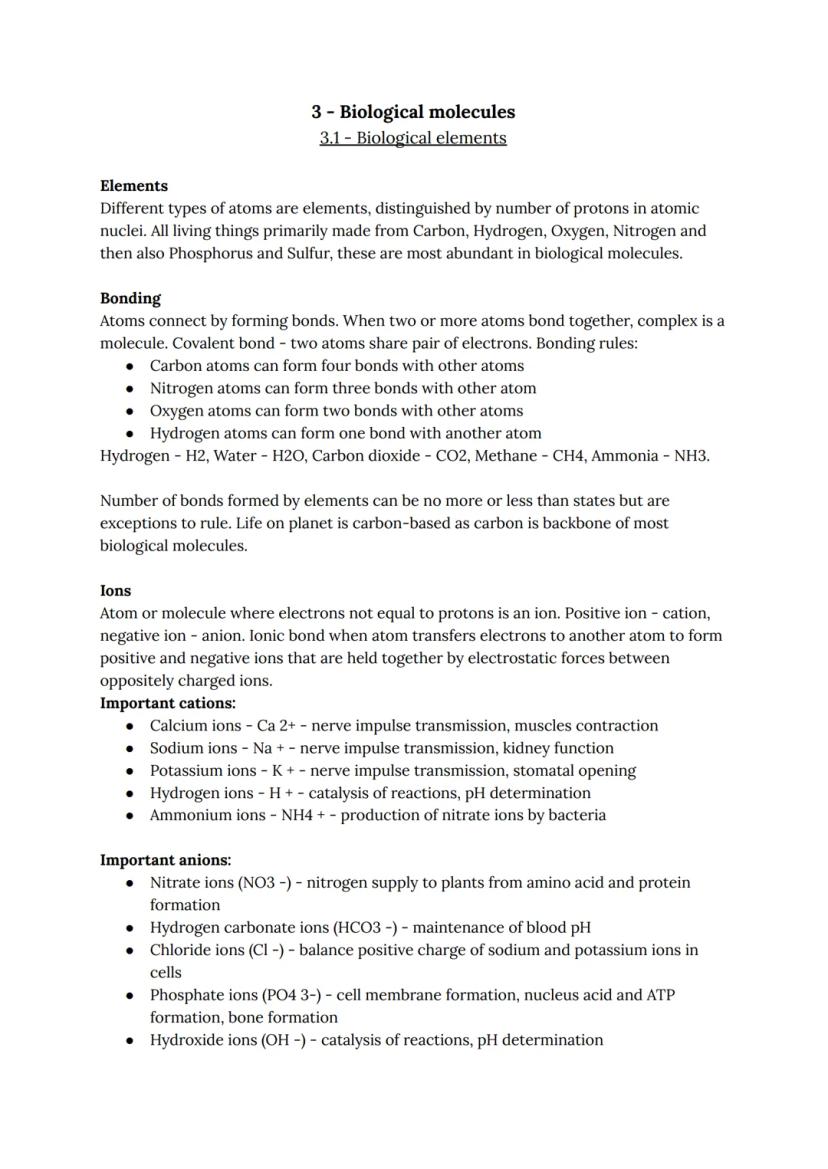
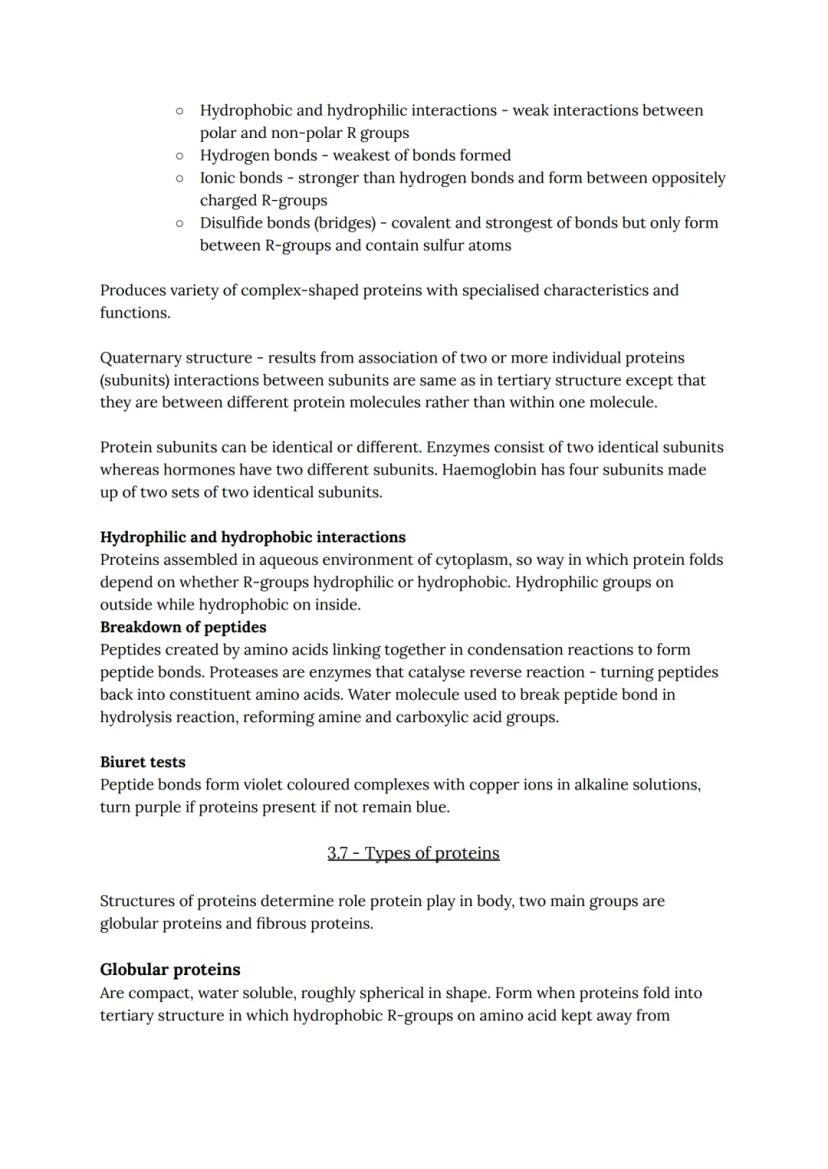
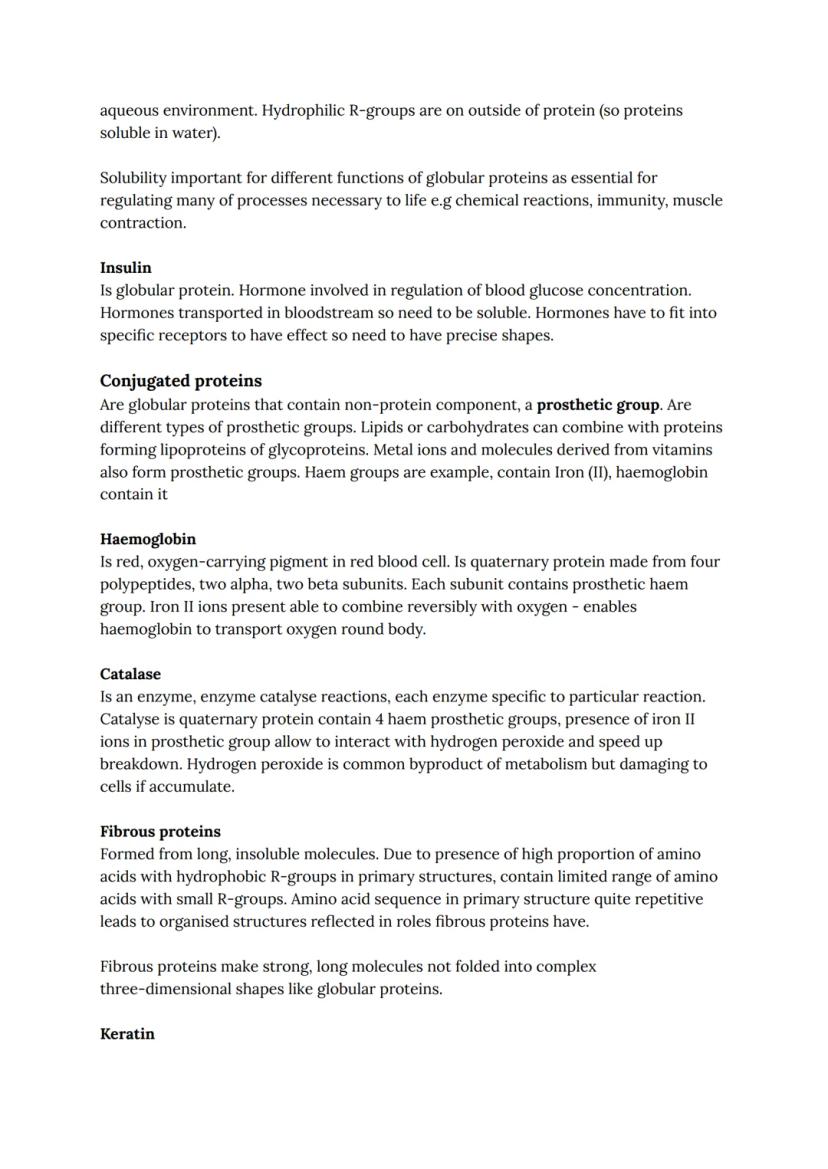
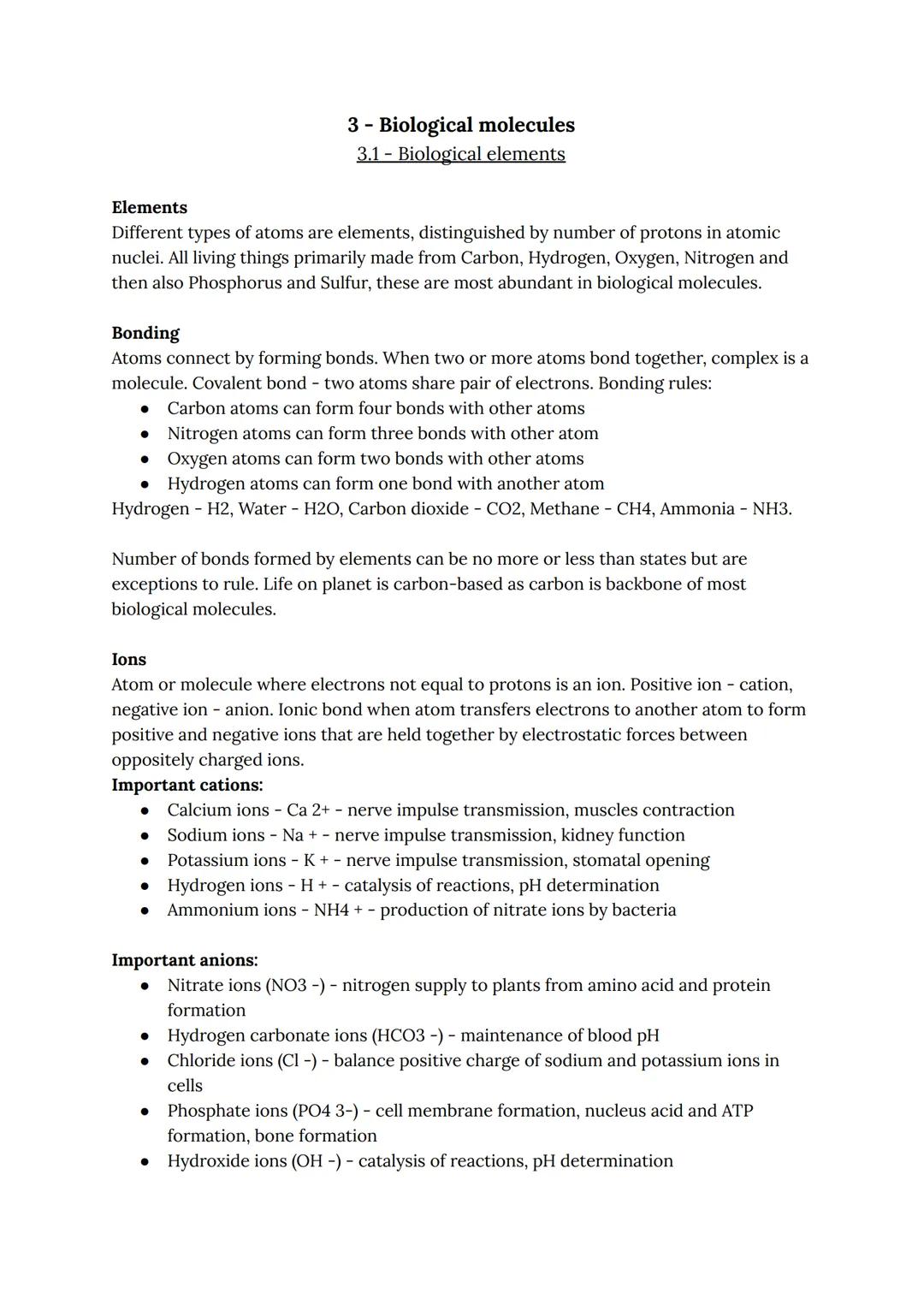
Think of elements as the basic building blocks of life - they're different types of atoms that combine to make everything in your body. Carbon, hydrogen, oxygen, and nitrogen are the main players, with phosphorus and sulfur playing supporting roles.
Covalent bonding is like atoms sharing their stuff - they share pairs of electrons to stick together. Carbon can form four bonds (making it the ultimate connector), nitrogen forms three, oxygen forms two, and hydrogen forms just one. This is why carbon is the backbone of most biological molecules.
Ions are atoms that have lost or gained electrons, making them either positive (cations) or negative (anions). Important cations like calcium ions help your muscles contract and nerves fire, whilst sodium and potassium ions keep your kidneys working and help nerve signals travel.
Quick tip: Remember the bonding numbers - Carbon 4, Nitrogen 3, Oxygen 2, Hydrogen 1. This pattern explains why molecules like water (H₂O) and methane (CH₄) have their specific shapes.
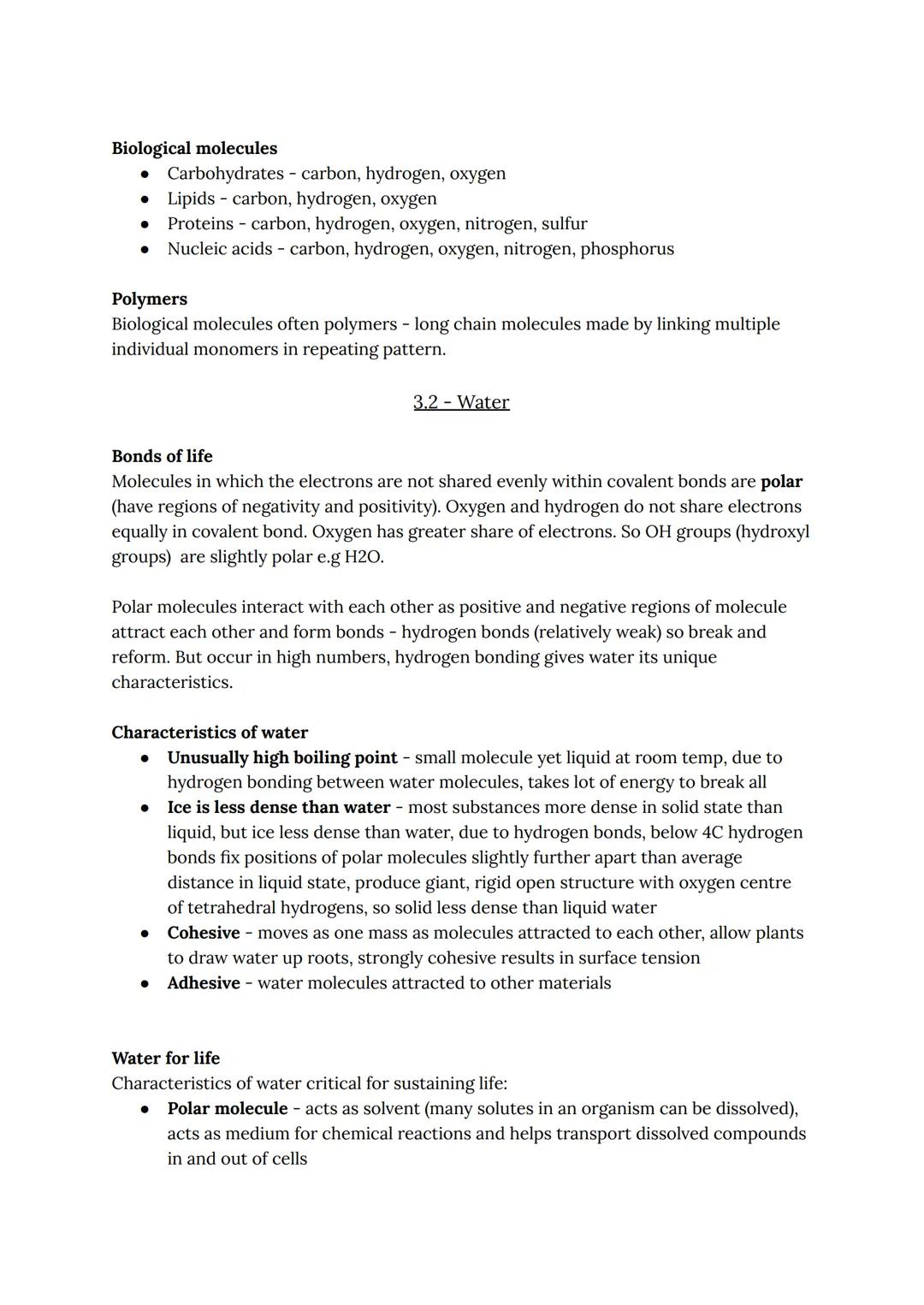
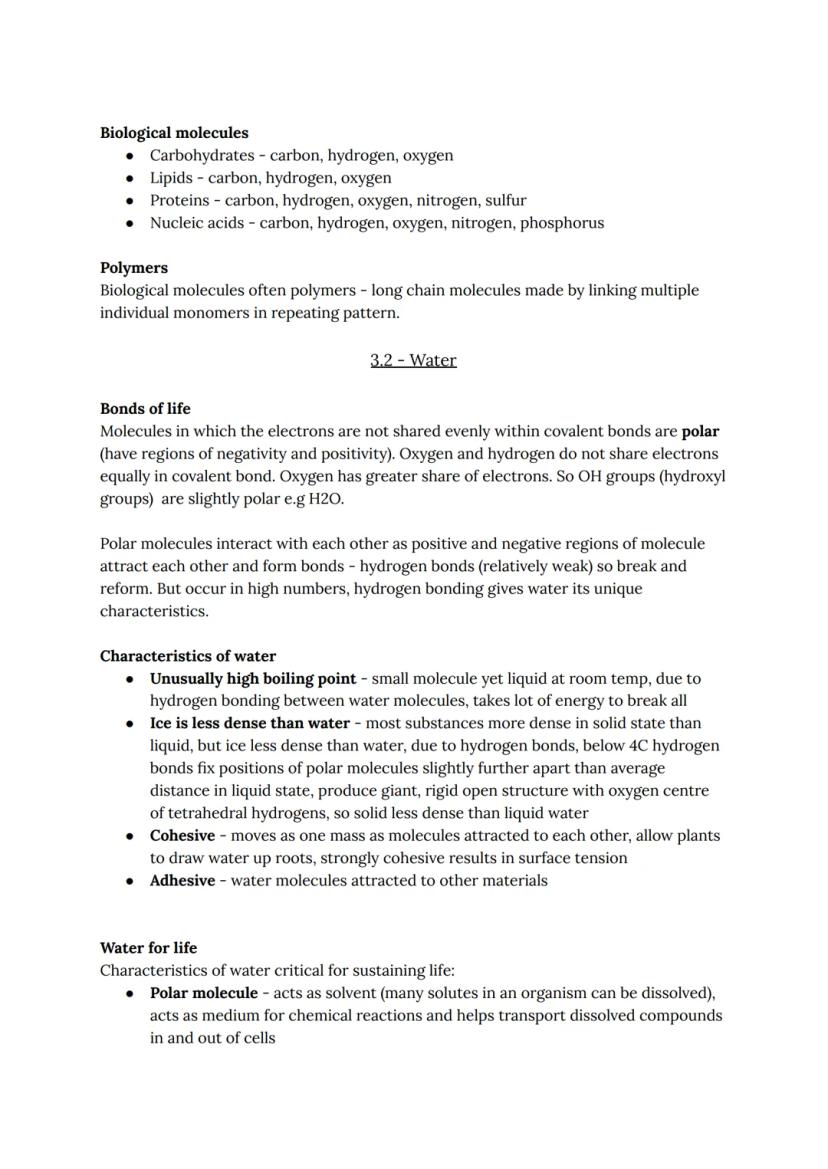
Water isn't just H₂O - it's the reason life exists on Earth. Polar molecules like water have regions that are slightly positive and negative because oxygen doesn't share electrons equally with hydrogen. This creates hydrogen bonds between water molecules.
These hydrogen bonds give water some amazing properties. Water has an unusually high boiling point for such a small molecule, and weirdly, ice is less dense than liquid water (which is why ice floats and doesn't crush aquatic life in winter).
Water's cohesive nature means molecules stick together, allowing plants to suck water up from their roots to their leaves. It's also adhesive, sticking to other surfaces. This combination creates capillary action - water defying gravity.
Real-world connection: Water's properties as a polar solvent mean it can dissolve loads of substances in your body, making it perfect for transporting nutrients and waste products around your cells.
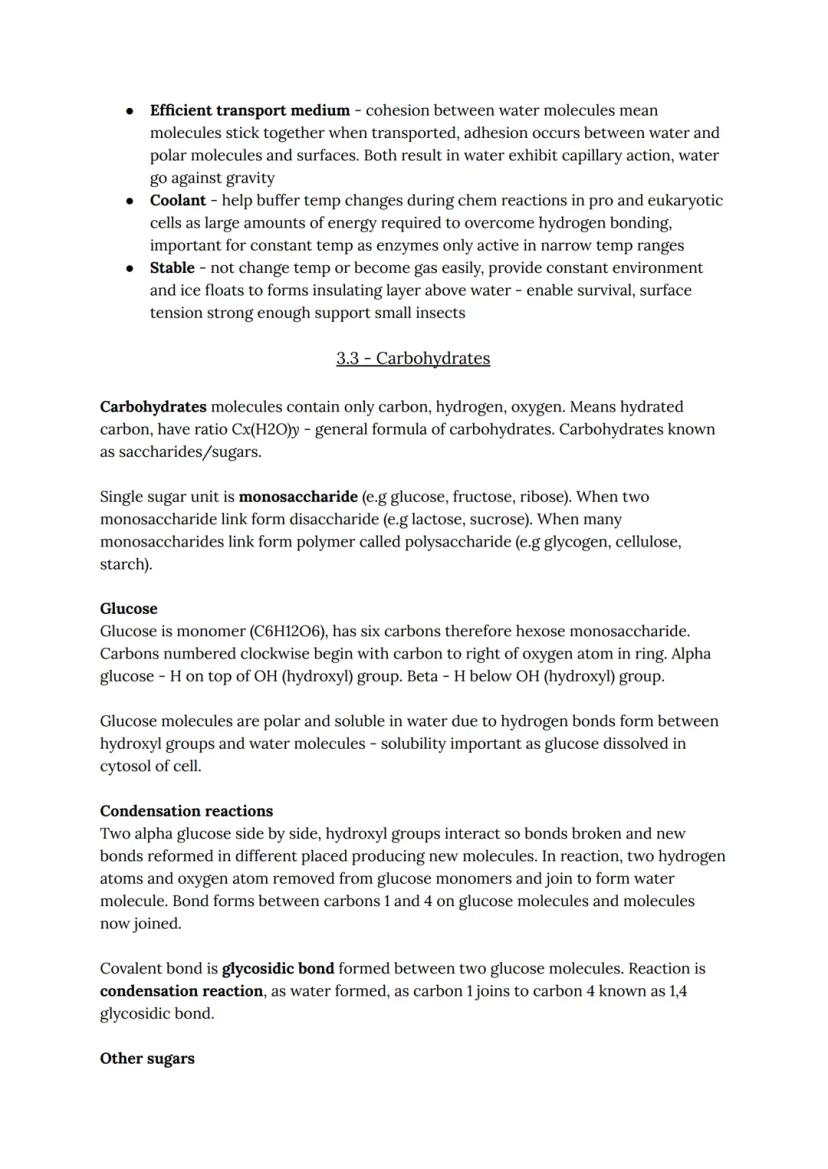
Carbohydrates are basically hydrated carbon - they contain carbon, hydrogen, and oxygen in the ratio Cx(H₂O)y. Think of them as nature's energy currency, from simple sugars to complex starches.
Glucose (C₆H₁₂O₆) is the star of the show - a hexose monosaccharide that comes in two forms. Alpha glucose has the OH group pointing up, whilst beta glucose has it pointing down. This tiny difference creates massive changes in the final molecules they form.
Condensation reactions join glucose molecules together by removing water and forming glycosidic bonds. When two alpha glucose molecules join via carbons 1 and 4, you get a 1,4-glycosidic bond. It's like molecular Lego - simple pieces creating complex structures.
Exam insight: Remember that condensation reactions remove water to form bonds, whilst hydrolysis reactions add water to break bonds. This pattern appears throughout biology.
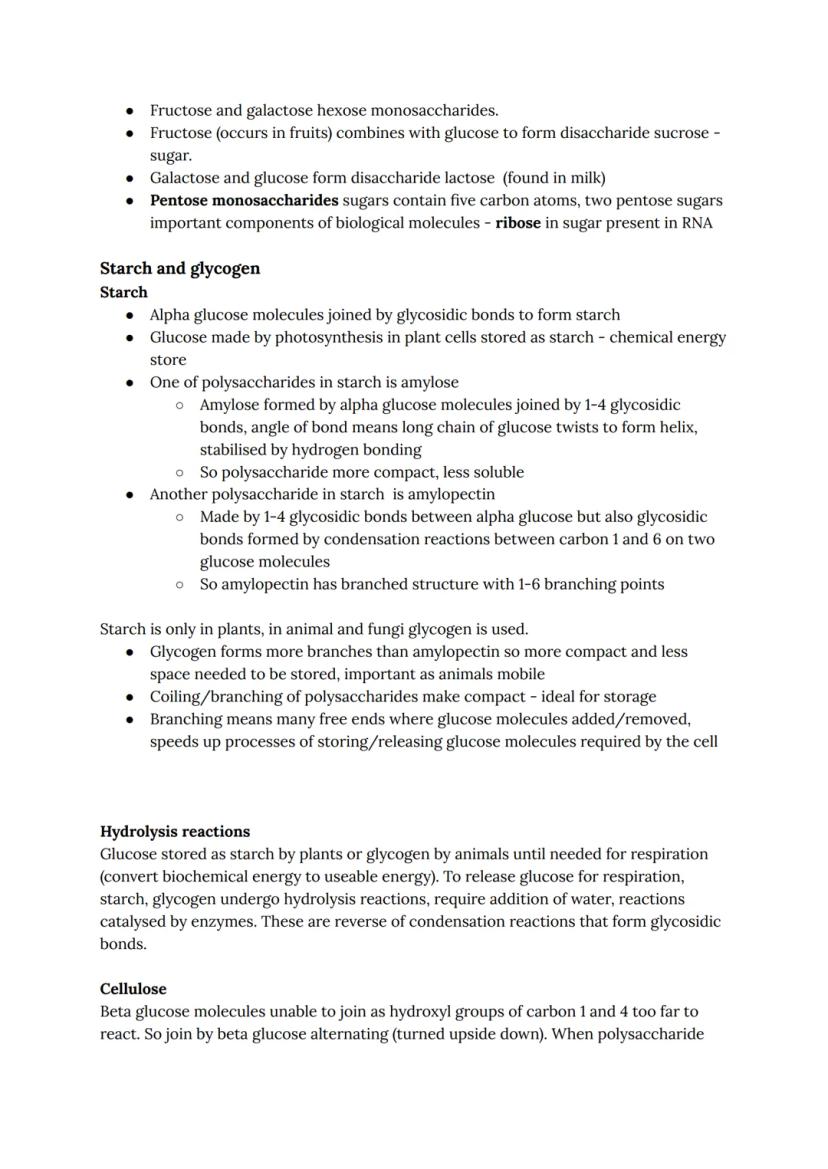
Starch is how plants store energy - it's made of alpha glucose molecules linked together. Amylose forms long helical chains through 1,4-glycosidic bonds, whilst amylopectin adds 1,6-glycosidic bonds to create branches. Think of it like a tree - a main trunk with branches coming off.
Animals use glycogen instead of starch. It's more branched than amylopectin, making it more compact and perfect for storage in your liver and muscles. The branching creates loads of free ends where glucose can be quickly added or removed when you need energy.
Cellulose is completely different - it's made from beta glucose molecules that alternate orientation. This creates straight, unbranched chains that form microfibrils, then macrofibrils, then fibres. These fibres are incredibly strong and make up plant cell walls.
Memory trick: Alpha glucose makes energy storage molecules (starch, glycogen), whilst beta glucose makes structural molecules (cellulose). Same building blocks, completely different jobs.
Benedict's test is your go-to method for detecting reducing sugars. The blue copper ions in Benedict's reagent get reduced to brick-red copper ions when reducing sugars are present. Heat your sample with equal amounts of Benedict's reagent in a boiling water bath for five minutes.
All monosaccharides and some disaccharides are reducing sugars because they can donate electrons. Non-reducing sugars like sucrose won't react with Benedict's solution unless you first boil them with hydrochloric acid to break them down.
The iodine test detects starch specifically. Add a few drops of iodine solution to your sample - if starch is present, the solution changes from yellow-brown to purple-black. It's that simple.
Practical tip: Reagent strips can give you quantitative results for glucose concentration using colour-coded charts, making them more useful than basic Benedict's tests in real-world applications.
Lipids are the rebels of biological molecules - they're non-polar and hate water. They contain carbon, hydrogen, and oxygen, but in different ratios than carbohydrates. Fats are solid at room temperature, oils are liquid.
Triglycerides are made from one glycerol molecule bonded to three fatty acids via ester bonds in a condensation reaction called esterification. The structure determines the properties - saturated fatty acids have no double bonds and pack tightly (making solid fats), whilst unsaturated fatty acids have double bonds that create kinks and stay liquid.
Phospholipids are modified triglycerides where one fatty acid is replaced with a phosphate group. This creates molecules with hydrophilic heads and hydrophobic tails - perfect for forming cell membranes as bilayers.
Health connection: Plant oils (usually unsaturated) are generally healthier than animal fats (usually saturated), though the evidence on saturated fats and heart disease is still being debated.
Sterols like cholesterol have a four-ring carbon structure with both hydrophilic and hydrophobic parts. Cholesterol sits between phospholipids in cell membranes, regulating fluidity and adding stability.
Lipids serve crucial roles: membrane formation, hormone production, electrical insulation, waterproofing, and long-term energy storage. They also provide thermal insulation and cushioning around vital organs.
Proteins are polymers made from amino acids, containing carbon, hydrogen, oxygen, and nitrogen. All amino acids share the same basic structure but have different R-groups that determine their properties. Your body can make some amino acids but must obtain nine essential amino acids from food.
Key insight: The sequence of amino acids in a protein (determined by DNA) controls how it folds, which determines its function. Structure always determines function in biology.
Primary structure is simply the sequence of amino acids joined by peptide bonds in condensation reactions. This sequence, directed by DNA, determines everything else about the protein.
Secondary structure forms when hydrogen bonds develop between the backbone atoms of amino acids, creating alpha helices (coils) or beta pleated sheets. Think of it as the protein starting to take shape.
Tertiary structure is the final 3D shape, formed when R-groups interact through various bonds: hydrophobic/hydrophilic interactions, hydrogen bonds, ionic bonds, and strong disulfide bonds. The type and strength of these bonds determine the protein's stability and function.
Understanding tip: Proteins fold with hydrophilic R-groups on the outside (facing water) and hydrophobic R-groups tucked inside, just like how oil drops form in water.
Globular proteins are compact, water-soluble, and roughly spherical. They're the workhorses of your body - enzymes, hormones like insulin, and transport proteins like haemoglobin. Their solubility makes them perfect for regulation and transport roles.
Conjugated proteins contain non-protein components called prosthetic groups. Haemoglobin has four haem groups containing iron ions that reversibly bind oxygen. Catalase breaks down harmful hydrogen peroxide using its haem groups.
Fibrous proteins are long, insoluble molecules made from repetitive amino acid sequences. They form structural components like keratin in your hair and nails. Unlike globular proteins, they don't fold into complex 3D shapes.
Exam focus: Remember that globular proteins are functional (enzymes, hormones) whilst fibrous proteins are structural (hair, nails, tendons). The Biuret test detects proteins by turning purple in the presence of peptide bonds.
Our AI Companion is a student-focused AI tool that offers more than just answers. Built on millions of Knowunity resources, it provides relevant information, personalised study plans, quizzes, and content directly in the chat, adapting to your individual learning journey.
You can download the app from Google Play Store and Apple App Store.
That's right! Enjoy free access to study content, connect with fellow students, and get instant help – all at your fingertips.
App Store
Google Play
The app is very easy to use and well designed. I have found everything I was looking for so far and have been able to learn a lot from the presentations! I will definitely use the app for a class assignment! And of course it also helps a lot as an inspiration.
Stefan S
iOS user
This app is really great. There are so many study notes and help [...]. My problem subject is French, for example, and the app has so many options for help. Thanks to this app, I have improved my French. I would recommend it to anyone.
Samantha Klich
Android user
Wow, I am really amazed. I just tried the app because I've seen it advertised many times and was absolutely stunned. This app is THE HELP you want for school and above all, it offers so many things, such as workouts and fact sheets, which have been VERY helpful to me personally.
Anna
iOS user
Best app on earth! no words because it’s too good
Thomas R
iOS user
Just amazing. Let's me revise 10x better, this app is a quick 10/10. I highly recommend it to anyone. I can watch and search for notes. I can save them in the subject folder. I can revise it any time when I come back. If you haven't tried this app, you're really missing out.
Basil
Android user
This app has made me feel so much more confident in my exam prep, not only through boosting my own self confidence through the features that allow you to connect with others and feel less alone, but also through the way the app itself is centred around making you feel better. It is easy to navigate, fun to use, and helpful to anyone struggling in absolutely any way.
David K
iOS user
The app's just great! All I have to do is enter the topic in the search bar and I get the response real fast. I don't have to watch 10 YouTube videos to understand something, so I'm saving my time. Highly recommended!
Sudenaz Ocak
Android user
In school I was really bad at maths but thanks to the app, I am doing better now. I am so grateful that you made the app.
Greenlight Bonnie
Android user
very reliable app to help and grow your ideas of Maths, English and other related topics in your works. please use this app if your struggling in areas, this app is key for that. wish I'd of done a review before. and it's also free so don't worry about that.
Rohan U
Android user
I know a lot of apps use fake accounts to boost their reviews but this app deserves it all. Originally I was getting 4 in my English exams and this time I got a grade 7. I didn’t even know about this app three days until the exam and it has helped A LOT. Please actually trust me and use it as I’m sure you too will see developments.
Xander S
iOS user
THE QUIZES AND FLASHCARDS ARE SO USEFUL AND I LOVE Knowunity AI. IT ALSO IS LITREALLY LIKE CHATGPT BUT SMARTER!! HELPED ME WITH MY MASCARA PROBLEMS TOO!! AS WELL AS MY REAL SUBJECTS ! DUHHH 😍😁😲🤑💗✨🎀😮
Elisha
iOS user
This apps acc the goat. I find revision so boring but this app makes it so easy to organize it all and then you can ask the freeeee ai to test yourself so good and you can easily upload your own stuff. highly recommend as someone taking mocks now
Paul T
iOS user
The app is very easy to use and well designed. I have found everything I was looking for so far and have been able to learn a lot from the presentations! I will definitely use the app for a class assignment! And of course it also helps a lot as an inspiration.
Stefan S
iOS user
This app is really great. There are so many study notes and help [...]. My problem subject is French, for example, and the app has so many options for help. Thanks to this app, I have improved my French. I would recommend it to anyone.
Samantha Klich
Android user
Wow, I am really amazed. I just tried the app because I've seen it advertised many times and was absolutely stunned. This app is THE HELP you want for school and above all, it offers so many things, such as workouts and fact sheets, which have been VERY helpful to me personally.
Anna
iOS user
Best app on earth! no words because it’s too good
Thomas R
iOS user
Just amazing. Let's me revise 10x better, this app is a quick 10/10. I highly recommend it to anyone. I can watch and search for notes. I can save them in the subject folder. I can revise it any time when I come back. If you haven't tried this app, you're really missing out.
Basil
Android user
This app has made me feel so much more confident in my exam prep, not only through boosting my own self confidence through the features that allow you to connect with others and feel less alone, but also through the way the app itself is centred around making you feel better. It is easy to navigate, fun to use, and helpful to anyone struggling in absolutely any way.
David K
iOS user
The app's just great! All I have to do is enter the topic in the search bar and I get the response real fast. I don't have to watch 10 YouTube videos to understand something, so I'm saving my time. Highly recommended!
Sudenaz Ocak
Android user
In school I was really bad at maths but thanks to the app, I am doing better now. I am so grateful that you made the app.
Greenlight Bonnie
Android user
very reliable app to help and grow your ideas of Maths, English and other related topics in your works. please use this app if your struggling in areas, this app is key for that. wish I'd of done a review before. and it's also free so don't worry about that.
Rohan U
Android user
I know a lot of apps use fake accounts to boost their reviews but this app deserves it all. Originally I was getting 4 in my English exams and this time I got a grade 7. I didn’t even know about this app three days until the exam and it has helped A LOT. Please actually trust me and use it as I’m sure you too will see developments.
Xander S
iOS user
THE QUIZES AND FLASHCARDS ARE SO USEFUL AND I LOVE Knowunity AI. IT ALSO IS LITREALLY LIKE CHATGPT BUT SMARTER!! HELPED ME WITH MY MASCARA PROBLEMS TOO!! AS WELL AS MY REAL SUBJECTS ! DUHHH 😍😁😲🤑💗✨🎀😮
Elisha
iOS user
This apps acc the goat. I find revision so boring but this app makes it so easy to organize it all and then you can ask the freeeee ai to test yourself so good and you can easily upload your own stuff. highly recommend as someone taking mocks now
Paul T
iOS user
Your body is basically a chemistry set running on six key elements - carbon, hydrogen, oxygen, nitrogen, phosphorus, and sulfur. These elements bond together to create everything from the water in your cells to the proteins in your muscles, forming... Show more
Access to all documents
Improve your grades
Join milions of students
Think of elements as the basic building blocks of life - they're different types of atoms that combine to make everything in your body. Carbon, hydrogen, oxygen, and nitrogen are the main players, with phosphorus and sulfur playing supporting roles.
Covalent bonding is like atoms sharing their stuff - they share pairs of electrons to stick together. Carbon can form four bonds (making it the ultimate connector), nitrogen forms three, oxygen forms two, and hydrogen forms just one. This is why carbon is the backbone of most biological molecules.
Ions are atoms that have lost or gained electrons, making them either positive (cations) or negative (anions). Important cations like calcium ions help your muscles contract and nerves fire, whilst sodium and potassium ions keep your kidneys working and help nerve signals travel.
Quick tip: Remember the bonding numbers - Carbon 4, Nitrogen 3, Oxygen 2, Hydrogen 1. This pattern explains why molecules like water (H₂O) and methane (CH₄) have their specific shapes.
Access to all documents
Improve your grades
Join milions of students
Water isn't just H₂O - it's the reason life exists on Earth. Polar molecules like water have regions that are slightly positive and negative because oxygen doesn't share electrons equally with hydrogen. This creates hydrogen bonds between water molecules.
These hydrogen bonds give water some amazing properties. Water has an unusually high boiling point for such a small molecule, and weirdly, ice is less dense than liquid water (which is why ice floats and doesn't crush aquatic life in winter).
Water's cohesive nature means molecules stick together, allowing plants to suck water up from their roots to their leaves. It's also adhesive, sticking to other surfaces. This combination creates capillary action - water defying gravity.
Real-world connection: Water's properties as a polar solvent mean it can dissolve loads of substances in your body, making it perfect for transporting nutrients and waste products around your cells.
Access to all documents
Improve your grades
Join milions of students
Carbohydrates are basically hydrated carbon - they contain carbon, hydrogen, and oxygen in the ratio Cx(H₂O)y. Think of them as nature's energy currency, from simple sugars to complex starches.
Glucose (C₆H₁₂O₆) is the star of the show - a hexose monosaccharide that comes in two forms. Alpha glucose has the OH group pointing up, whilst beta glucose has it pointing down. This tiny difference creates massive changes in the final molecules they form.
Condensation reactions join glucose molecules together by removing water and forming glycosidic bonds. When two alpha glucose molecules join via carbons 1 and 4, you get a 1,4-glycosidic bond. It's like molecular Lego - simple pieces creating complex structures.
Exam insight: Remember that condensation reactions remove water to form bonds, whilst hydrolysis reactions add water to break bonds. This pattern appears throughout biology.
Access to all documents
Improve your grades
Join milions of students
Starch is how plants store energy - it's made of alpha glucose molecules linked together. Amylose forms long helical chains through 1,4-glycosidic bonds, whilst amylopectin adds 1,6-glycosidic bonds to create branches. Think of it like a tree - a main trunk with branches coming off.
Animals use glycogen instead of starch. It's more branched than amylopectin, making it more compact and perfect for storage in your liver and muscles. The branching creates loads of free ends where glucose can be quickly added or removed when you need energy.
Cellulose is completely different - it's made from beta glucose molecules that alternate orientation. This creates straight, unbranched chains that form microfibrils, then macrofibrils, then fibres. These fibres are incredibly strong and make up plant cell walls.
Memory trick: Alpha glucose makes energy storage molecules (starch, glycogen), whilst beta glucose makes structural molecules (cellulose). Same building blocks, completely different jobs.
Access to all documents
Improve your grades
Join milions of students
Benedict's test is your go-to method for detecting reducing sugars. The blue copper ions in Benedict's reagent get reduced to brick-red copper ions when reducing sugars are present. Heat your sample with equal amounts of Benedict's reagent in a boiling water bath for five minutes.
All monosaccharides and some disaccharides are reducing sugars because they can donate electrons. Non-reducing sugars like sucrose won't react with Benedict's solution unless you first boil them with hydrochloric acid to break them down.
The iodine test detects starch specifically. Add a few drops of iodine solution to your sample - if starch is present, the solution changes from yellow-brown to purple-black. It's that simple.
Practical tip: Reagent strips can give you quantitative results for glucose concentration using colour-coded charts, making them more useful than basic Benedict's tests in real-world applications.
Access to all documents
Improve your grades
Join milions of students
Lipids are the rebels of biological molecules - they're non-polar and hate water. They contain carbon, hydrogen, and oxygen, but in different ratios than carbohydrates. Fats are solid at room temperature, oils are liquid.
Triglycerides are made from one glycerol molecule bonded to three fatty acids via ester bonds in a condensation reaction called esterification. The structure determines the properties - saturated fatty acids have no double bonds and pack tightly (making solid fats), whilst unsaturated fatty acids have double bonds that create kinks and stay liquid.
Phospholipids are modified triglycerides where one fatty acid is replaced with a phosphate group. This creates molecules with hydrophilic heads and hydrophobic tails - perfect for forming cell membranes as bilayers.
Health connection: Plant oils (usually unsaturated) are generally healthier than animal fats (usually saturated), though the evidence on saturated fats and heart disease is still being debated.
Access to all documents
Improve your grades
Join milions of students
Sterols like cholesterol have a four-ring carbon structure with both hydrophilic and hydrophobic parts. Cholesterol sits between phospholipids in cell membranes, regulating fluidity and adding stability.
Lipids serve crucial roles: membrane formation, hormone production, electrical insulation, waterproofing, and long-term energy storage. They also provide thermal insulation and cushioning around vital organs.
Proteins are polymers made from amino acids, containing carbon, hydrogen, oxygen, and nitrogen. All amino acids share the same basic structure but have different R-groups that determine their properties. Your body can make some amino acids but must obtain nine essential amino acids from food.
Key insight: The sequence of amino acids in a protein (determined by DNA) controls how it folds, which determines its function. Structure always determines function in biology.
Access to all documents
Improve your grades
Join milions of students
Primary structure is simply the sequence of amino acids joined by peptide bonds in condensation reactions. This sequence, directed by DNA, determines everything else about the protein.
Secondary structure forms when hydrogen bonds develop between the backbone atoms of amino acids, creating alpha helices (coils) or beta pleated sheets. Think of it as the protein starting to take shape.
Tertiary structure is the final 3D shape, formed when R-groups interact through various bonds: hydrophobic/hydrophilic interactions, hydrogen bonds, ionic bonds, and strong disulfide bonds. The type and strength of these bonds determine the protein's stability and function.
Understanding tip: Proteins fold with hydrophilic R-groups on the outside (facing water) and hydrophobic R-groups tucked inside, just like how oil drops form in water.
Access to all documents
Improve your grades
Join milions of students
Globular proteins are compact, water-soluble, and roughly spherical. They're the workhorses of your body - enzymes, hormones like insulin, and transport proteins like haemoglobin. Their solubility makes them perfect for regulation and transport roles.
Conjugated proteins contain non-protein components called prosthetic groups. Haemoglobin has four haem groups containing iron ions that reversibly bind oxygen. Catalase breaks down harmful hydrogen peroxide using its haem groups.
Fibrous proteins are long, insoluble molecules made from repetitive amino acid sequences. They form structural components like keratin in your hair and nails. Unlike globular proteins, they don't fold into complex 3D shapes.
Exam focus: Remember that globular proteins are functional (enzymes, hormones) whilst fibrous proteins are structural (hair, nails, tendons). The Biuret test detects proteins by turning purple in the presence of peptide bonds.
Access to all documents
Improve your grades
Join milions of students
Our AI Companion is a student-focused AI tool that offers more than just answers. Built on millions of Knowunity resources, it provides relevant information, personalised study plans, quizzes, and content directly in the chat, adapting to your individual learning journey.
You can download the app from Google Play Store and Apple App Store.
That's right! Enjoy free access to study content, connect with fellow students, and get instant help – all at your fingertips.
27
Smart Tools NEW
Transform this note into: ✓ 50+ Practice Questions ✓ Interactive Flashcards ✓ Full Mock Exam ✓ Essay Outlines
App Store
Google Play
The app is very easy to use and well designed. I have found everything I was looking for so far and have been able to learn a lot from the presentations! I will definitely use the app for a class assignment! And of course it also helps a lot as an inspiration.
Stefan S
iOS user
This app is really great. There are so many study notes and help [...]. My problem subject is French, for example, and the app has so many options for help. Thanks to this app, I have improved my French. I would recommend it to anyone.
Samantha Klich
Android user
Wow, I am really amazed. I just tried the app because I've seen it advertised many times and was absolutely stunned. This app is THE HELP you want for school and above all, it offers so many things, such as workouts and fact sheets, which have been VERY helpful to me personally.
Anna
iOS user
Best app on earth! no words because it’s too good
Thomas R
iOS user
Just amazing. Let's me revise 10x better, this app is a quick 10/10. I highly recommend it to anyone. I can watch and search for notes. I can save them in the subject folder. I can revise it any time when I come back. If you haven't tried this app, you're really missing out.
Basil
Android user
This app has made me feel so much more confident in my exam prep, not only through boosting my own self confidence through the features that allow you to connect with others and feel less alone, but also through the way the app itself is centred around making you feel better. It is easy to navigate, fun to use, and helpful to anyone struggling in absolutely any way.
David K
iOS user
The app's just great! All I have to do is enter the topic in the search bar and I get the response real fast. I don't have to watch 10 YouTube videos to understand something, so I'm saving my time. Highly recommended!
Sudenaz Ocak
Android user
In school I was really bad at maths but thanks to the app, I am doing better now. I am so grateful that you made the app.
Greenlight Bonnie
Android user
very reliable app to help and grow your ideas of Maths, English and other related topics in your works. please use this app if your struggling in areas, this app is key for that. wish I'd of done a review before. and it's also free so don't worry about that.
Rohan U
Android user
I know a lot of apps use fake accounts to boost their reviews but this app deserves it all. Originally I was getting 4 in my English exams and this time I got a grade 7. I didn’t even know about this app three days until the exam and it has helped A LOT. Please actually trust me and use it as I’m sure you too will see developments.
Xander S
iOS user
THE QUIZES AND FLASHCARDS ARE SO USEFUL AND I LOVE Knowunity AI. IT ALSO IS LITREALLY LIKE CHATGPT BUT SMARTER!! HELPED ME WITH MY MASCARA PROBLEMS TOO!! AS WELL AS MY REAL SUBJECTS ! DUHHH 😍😁😲🤑💗✨🎀😮
Elisha
iOS user
This apps acc the goat. I find revision so boring but this app makes it so easy to organize it all and then you can ask the freeeee ai to test yourself so good and you can easily upload your own stuff. highly recommend as someone taking mocks now
Paul T
iOS user
The app is very easy to use and well designed. I have found everything I was looking for so far and have been able to learn a lot from the presentations! I will definitely use the app for a class assignment! And of course it also helps a lot as an inspiration.
Stefan S
iOS user
This app is really great. There are so many study notes and help [...]. My problem subject is French, for example, and the app has so many options for help. Thanks to this app, I have improved my French. I would recommend it to anyone.
Samantha Klich
Android user
Wow, I am really amazed. I just tried the app because I've seen it advertised many times and was absolutely stunned. This app is THE HELP you want for school and above all, it offers so many things, such as workouts and fact sheets, which have been VERY helpful to me personally.
Anna
iOS user
Best app on earth! no words because it’s too good
Thomas R
iOS user
Just amazing. Let's me revise 10x better, this app is a quick 10/10. I highly recommend it to anyone. I can watch and search for notes. I can save them in the subject folder. I can revise it any time when I come back. If you haven't tried this app, you're really missing out.
Basil
Android user
This app has made me feel so much more confident in my exam prep, not only through boosting my own self confidence through the features that allow you to connect with others and feel less alone, but also through the way the app itself is centred around making you feel better. It is easy to navigate, fun to use, and helpful to anyone struggling in absolutely any way.
David K
iOS user
The app's just great! All I have to do is enter the topic in the search bar and I get the response real fast. I don't have to watch 10 YouTube videos to understand something, so I'm saving my time. Highly recommended!
Sudenaz Ocak
Android user
In school I was really bad at maths but thanks to the app, I am doing better now. I am so grateful that you made the app.
Greenlight Bonnie
Android user
very reliable app to help and grow your ideas of Maths, English and other related topics in your works. please use this app if your struggling in areas, this app is key for that. wish I'd of done a review before. and it's also free so don't worry about that.
Rohan U
Android user
I know a lot of apps use fake accounts to boost their reviews but this app deserves it all. Originally I was getting 4 in my English exams and this time I got a grade 7. I didn’t even know about this app three days until the exam and it has helped A LOT. Please actually trust me and use it as I’m sure you too will see developments.
Xander S
iOS user
THE QUIZES AND FLASHCARDS ARE SO USEFUL AND I LOVE Knowunity AI. IT ALSO IS LITREALLY LIKE CHATGPT BUT SMARTER!! HELPED ME WITH MY MASCARA PROBLEMS TOO!! AS WELL AS MY REAL SUBJECTS ! DUHHH 😍😁😲🤑💗✨🎀😮
Elisha
iOS user
This apps acc the goat. I find revision so boring but this app makes it so easy to organize it all and then you can ask the freeeee ai to test yourself so good and you can easily upload your own stuff. highly recommend as someone taking mocks now
Paul T
iOS user