
Ever wondered how your body gets energy from food, or... Show more
 English Literature
 Sociology
Sign up to see the contentIt's free!
Access to all documents
Improve your grades
Join milions of students
By signing up you accept Terms of Service and Privacy Policy
Subjects
Classic Dramatic Literature
Modern Lyric Poetry
Influential English-Language Authors
Classic and Contemporary Novels
Literary Character Analysis
Romantic and Love Poetry
Reading Analysis and Interpretation
Evidence Analysis and Integration
Author's Stylistic Elements
Figurative Language and Rhetoric
Show all topics
Human Organ Systems
Cellular Organization and Development
Biomolecular Structure and Organization
Enzyme Structure and Regulation
Cellular Organization Types
Biological Homeostatic Processes
Cellular Membrane Structure
Autotrophic Energy Processes
Environmental Sustainability and Impact
Neural Communication Systems
Show all topics
Social Sciences Research & Practice
Social Structure and Mobility
Classic Social Influence Experiments
Social Systems Theories
Family and Relationship Dynamics
Memory Systems and Processes
Neural Bases of Behavior
Social Influence and Attraction
Psychotherapeutic Approaches
Human Agency and Responsibility
Show all topics
Chemical Sciences and Applications
Chemical Bond Types and Properties
Organic Functional Groups
Atomic Structure and Composition
Chromatographic Separation Principles
Chemical Compound Classifications
Electrochemical Cell Systems
Periodic Table Organization
Chemical Reaction Kinetics
Chemical Equation Conservation
Show all topics
Nazi Germany and Holocaust 1933-1945
World Wars and Peace Treaties
European Monarchs and Statesmen
Cold War Global Tensions
Medieval Institutions and Systems
European Renaissance and Enlightenment
Modern Global Environmental-Health Challenges
Modern Military Conflicts
Medieval Migration and Invasions
World Wars Era and Impact
Show all topics
228
•
Updated 25 Feb 2026
•
gem_keysie
@gem_keysie
Ever wondered how your body gets energy from food, or... Show more
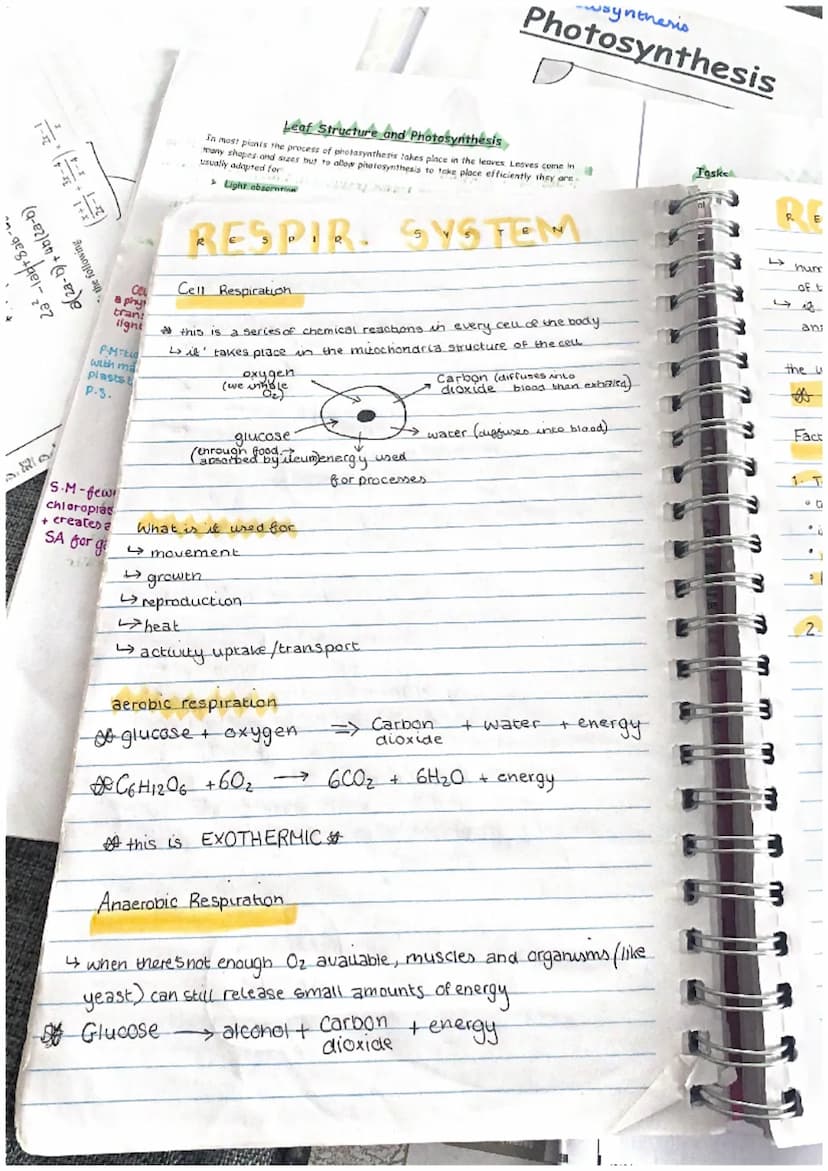

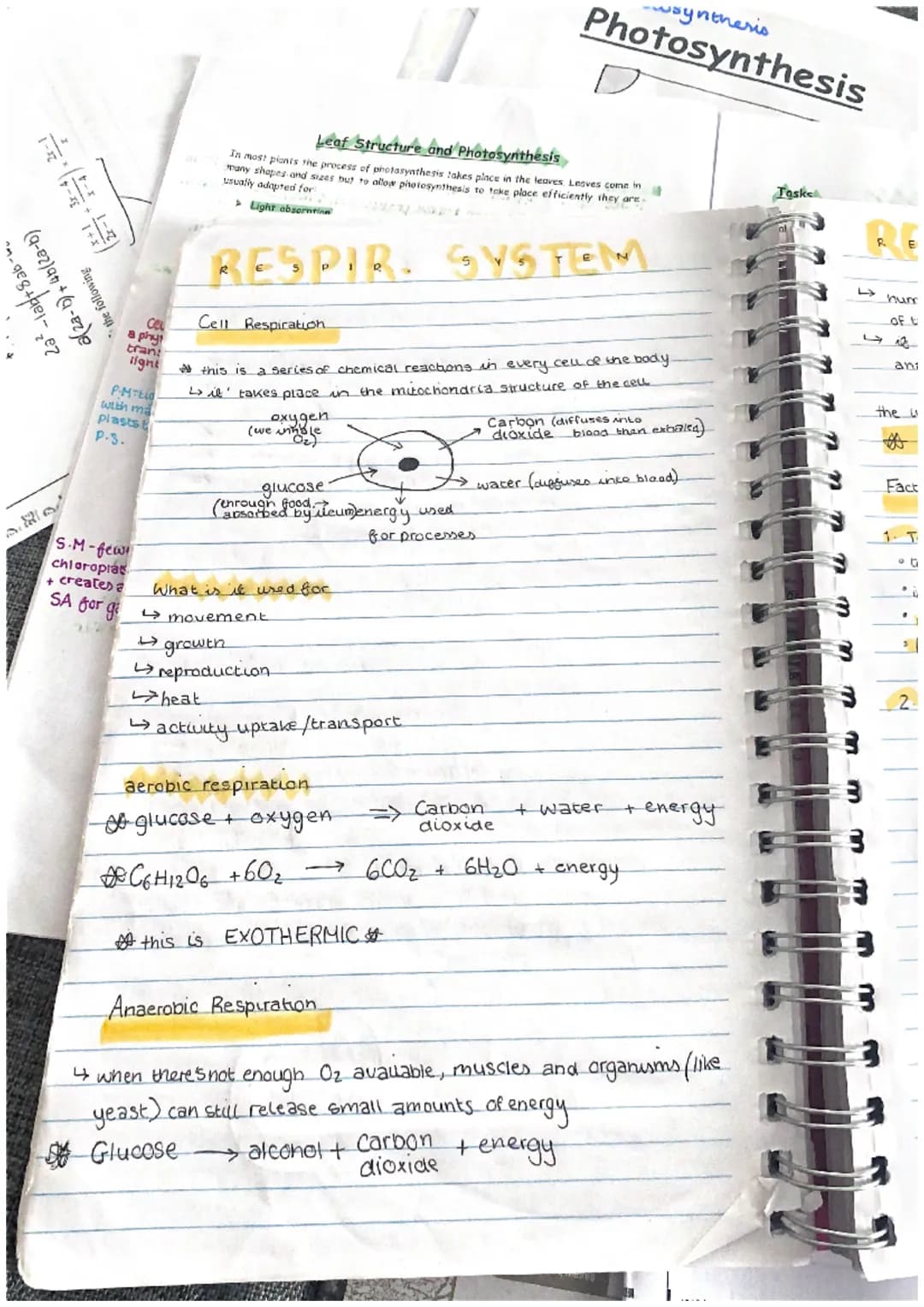
Your body is constantly making energy through cellular respiration - a series of chemical reactions happening in every single cell. This process takes place in the mitochondria, the cell's powerhouse structures.
Aerobic respiration is the main way cells make energy when oxygen is available. The equation is simple: glucose + oxygen → carbon dioxide + water + energy . This reaction is exothermic, meaning it releases heat energy.
When oxygen runs short, cells switch to anaerobic respiration. In yeast, this produces alcohol and carbon dioxide - which is why bread rises! In human muscles, it creates lactic acid, which causes that burning feeling during intense exercise.
Key Point: Your cells use energy for movement, growth, reproduction, heat production, and transporting substances around your body.
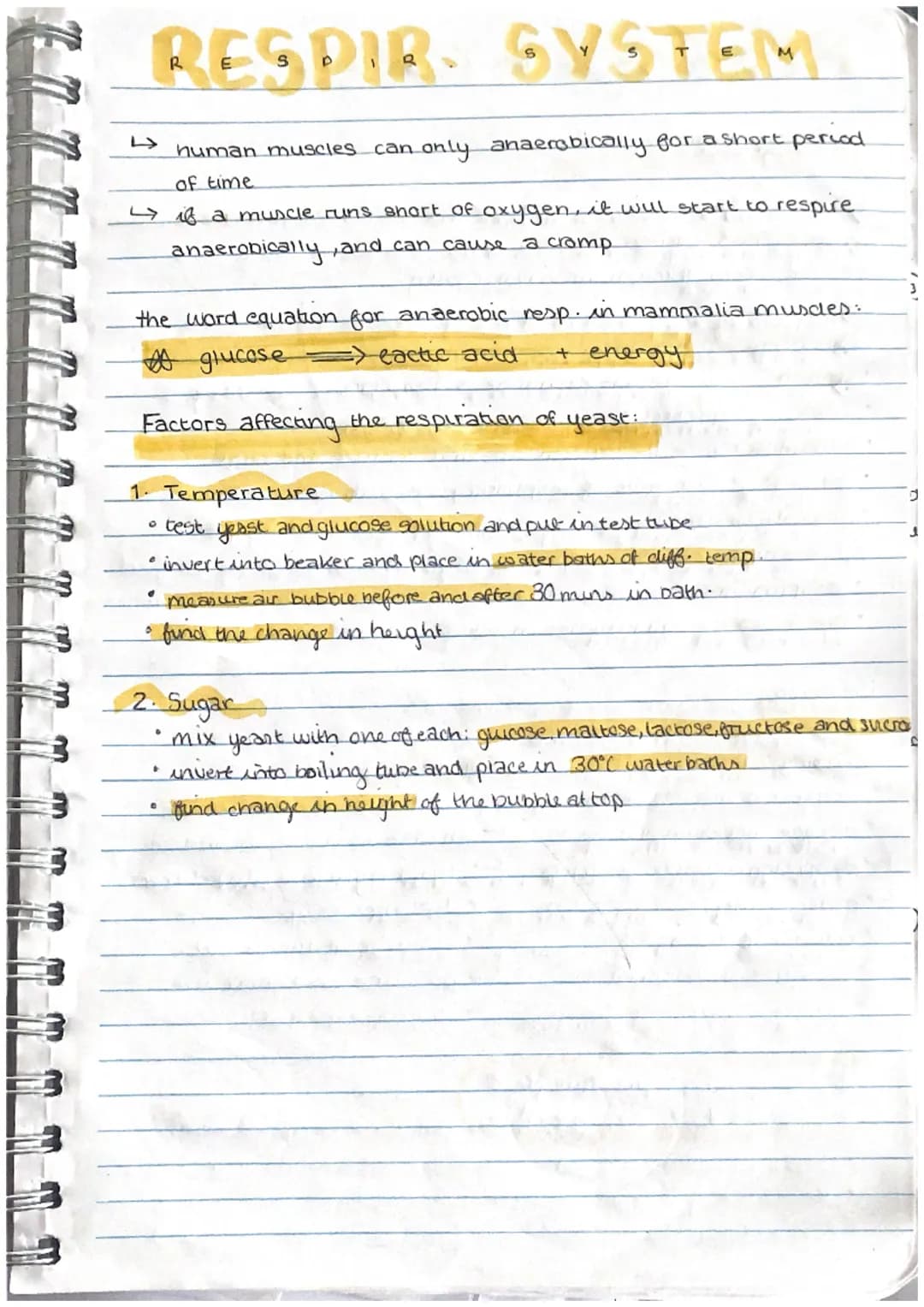
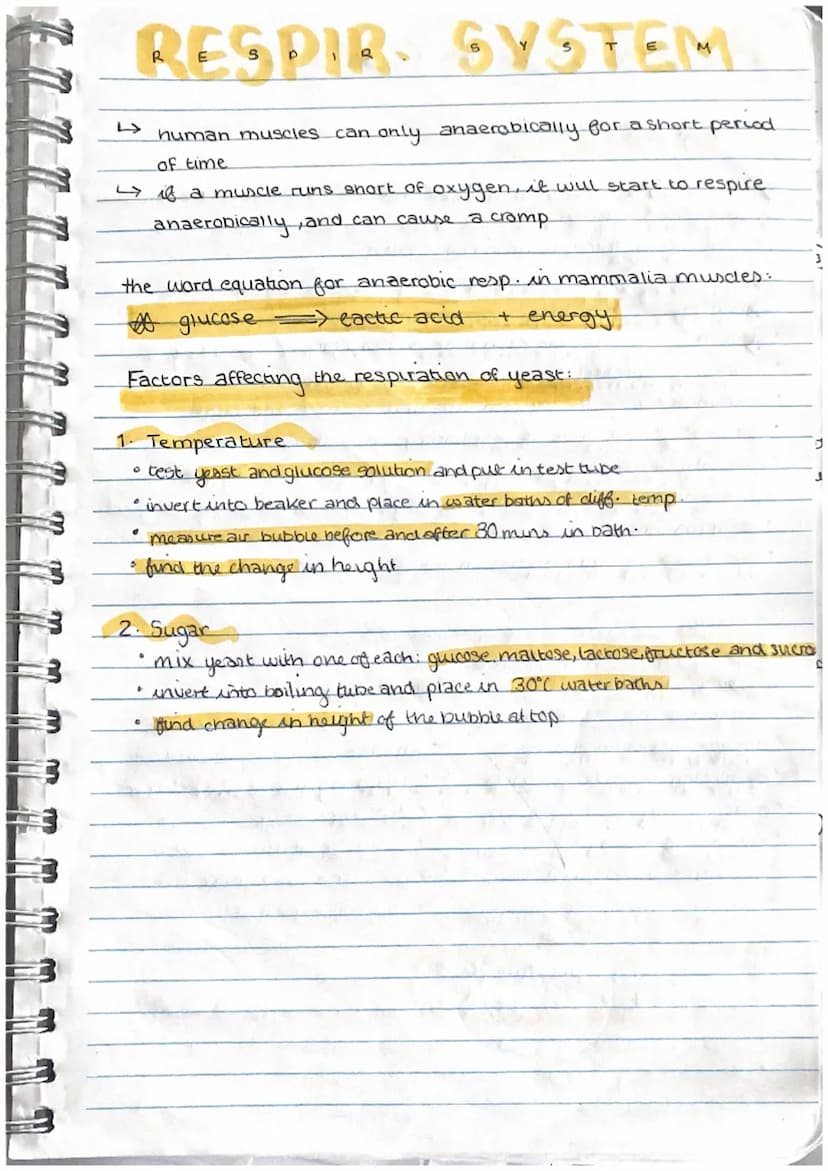
Human muscles can only survive on anaerobic respiration for short periods. When muscles run out of oxygen during intense activity, they produce lactic acid, which can cause cramps - that's your body telling you to slow down!
Scientists test how different factors affect yeast respiration through simple experiments. Temperature affects how quickly yeast works - they mix yeast with glucose, place it in water baths at different temperatures, and measure gas bubble changes over 30 minutes.
Sugar type also matters for yeast activity. Researchers test different sugars (glucose, maltose, lactose, fructose, and sucrose) with yeast at 30°C to see which ones produce the most gas bubbles.
Remember: Anaerobic respiration produces much less energy than aerobic respiration, which is why you can't sprint forever!
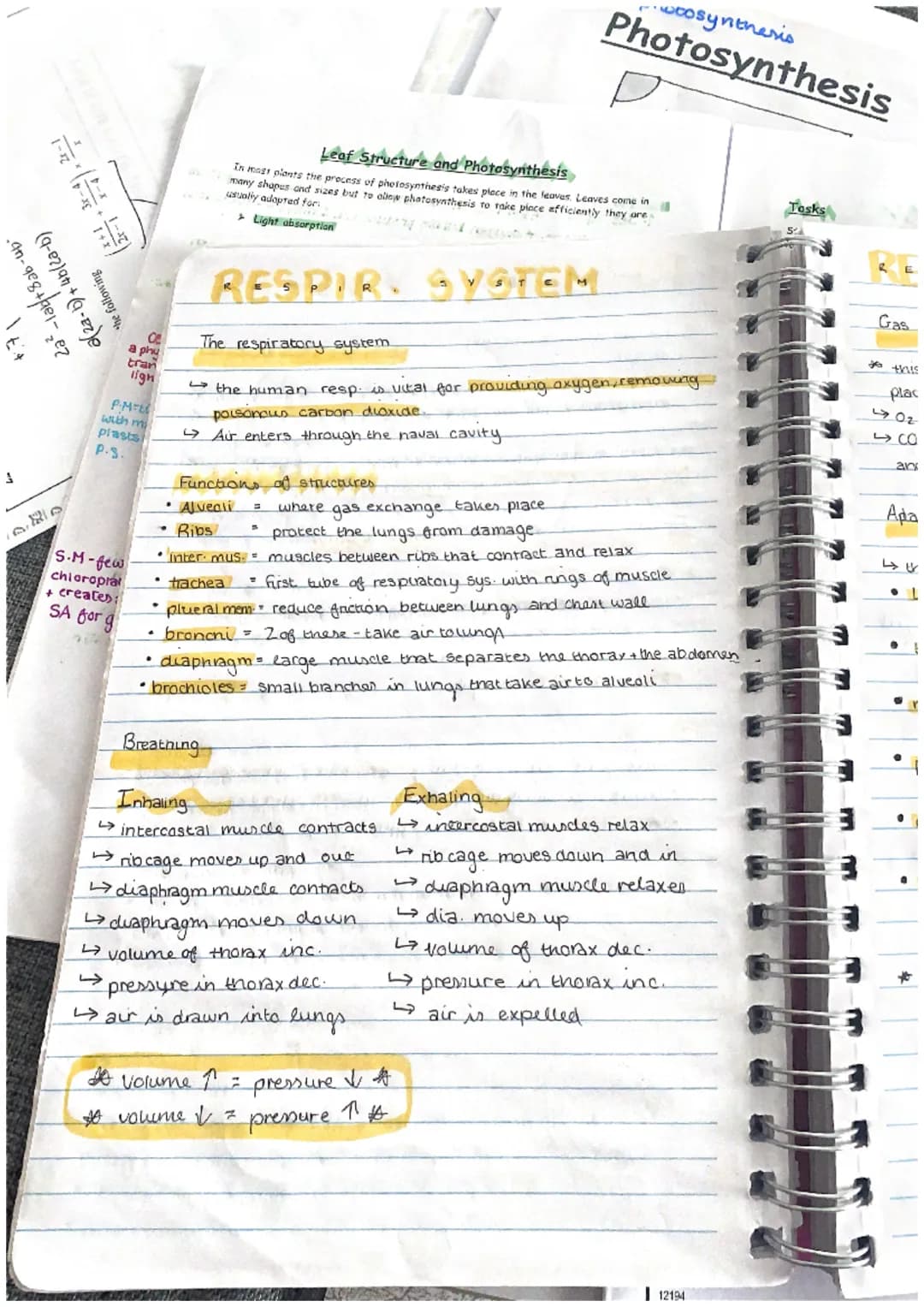
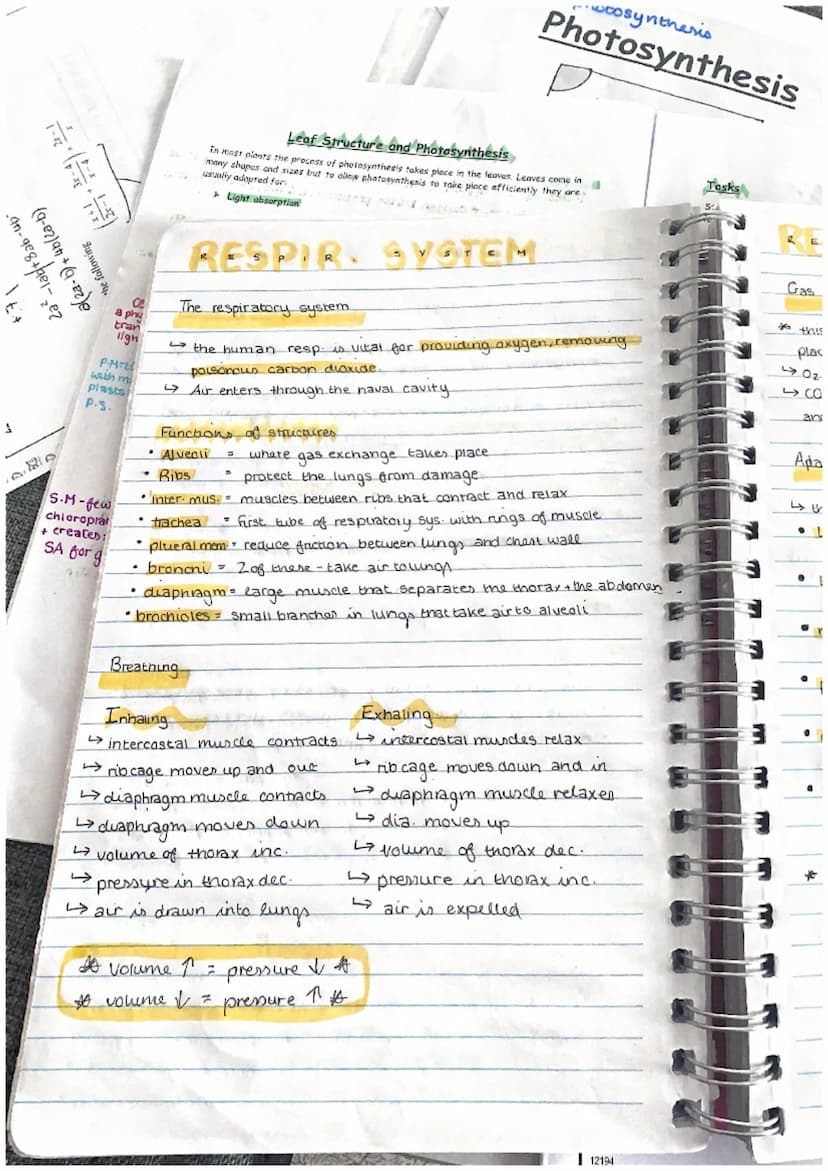
Your respiratory system is vital for getting oxygen in and removing poisonous carbon dioxide. Air enters through your nasal cavity and travels through a network of specialised structures, each with important jobs.
Key structures include the trachea (windpipe with muscle rings), bronchi (two main tubes to each lung), and bronchioles (smaller branches leading to air sacs). The alveoli are where gas exchange actually happens, whilst intercostal muscles between your ribs help you breathe.
Breathing mechanics work like a pump system. When you inhale, intercostal muscles contract, your rib cage moves up and out, and your diaphragm moves down. This increases chest volume and decreases pressure, drawing air into your lungs.
Physics Connection: Volume ↑ = Pressure ↓. This relationship drives all breathing movements!
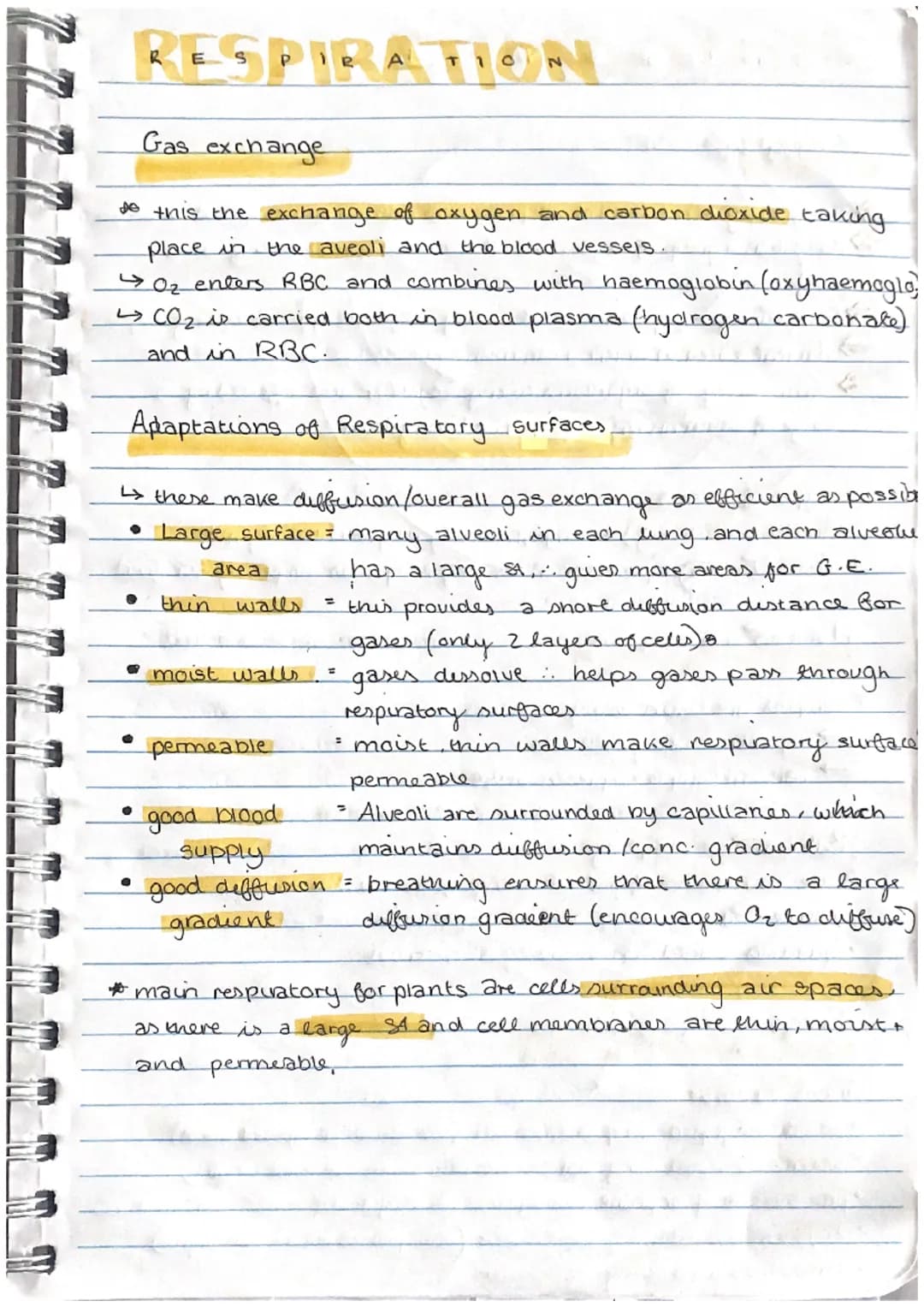
Gas exchange happens in the alveoli where oxygen enters red blood cells and combines with haemoglobin to form oxyhaemoglobin. Meanwhile, carbon dioxide travels in blood plasma and red blood cells to be expelled.
Respiratory surfaces have amazing adaptations for efficient gas exchange. They have a large surface area (millions of alveoli), thin walls (only 2 cell layers), and moist, permeable surfaces that help gases dissolve and pass through easily.
The system maintains a good blood supply through capillaries surrounding alveoli, creating concentration gradients that encourage oxygen to diffuse in and carbon dioxide to diffuse out. Continuous breathing keeps these gradients strong.
Plant Connection: Plants use cells around air spaces for gas exchange - they follow the same principles of thin, moist, permeable surfaces!
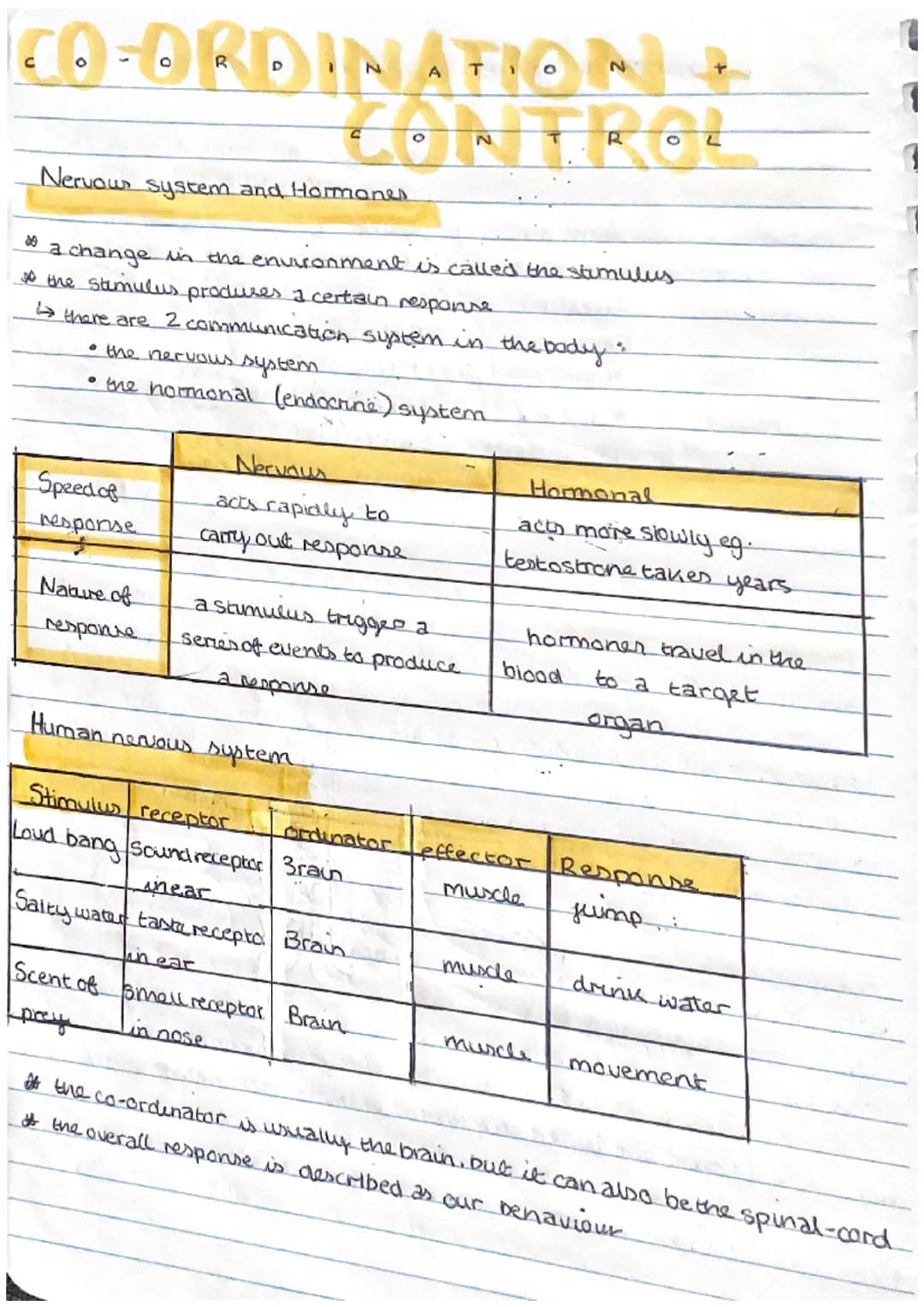
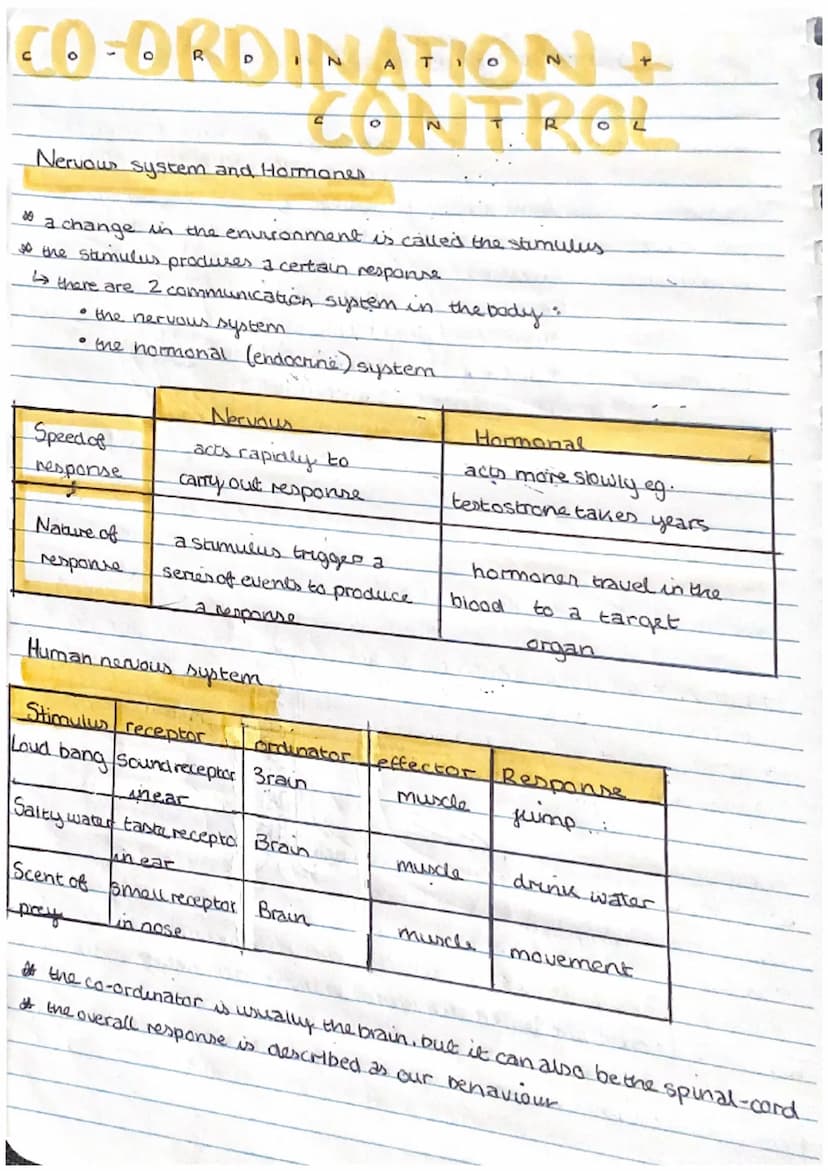
Your body has two communication systems working together: the nervous system (acts rapidly) and the hormonal system (acts slowly, like testosterone taking years to work). Both help you respond to stimuli - changes in your environment.
The basic response pathway is: stimulus → receptor → coordinator → effector → response. For example, a loud bang triggers sound receptors, your brain coordinates, and muscles make you jump. Your behaviour is the overall pattern of these responses.
The nervous system splits into the central nervous system and peripheral nervous system (nerves connecting your body to the CNS). This organisation allows rapid communication throughout your body.
Speed Matters: Nervous responses happen in milliseconds, whilst hormonal responses can take hours, days, or even years!
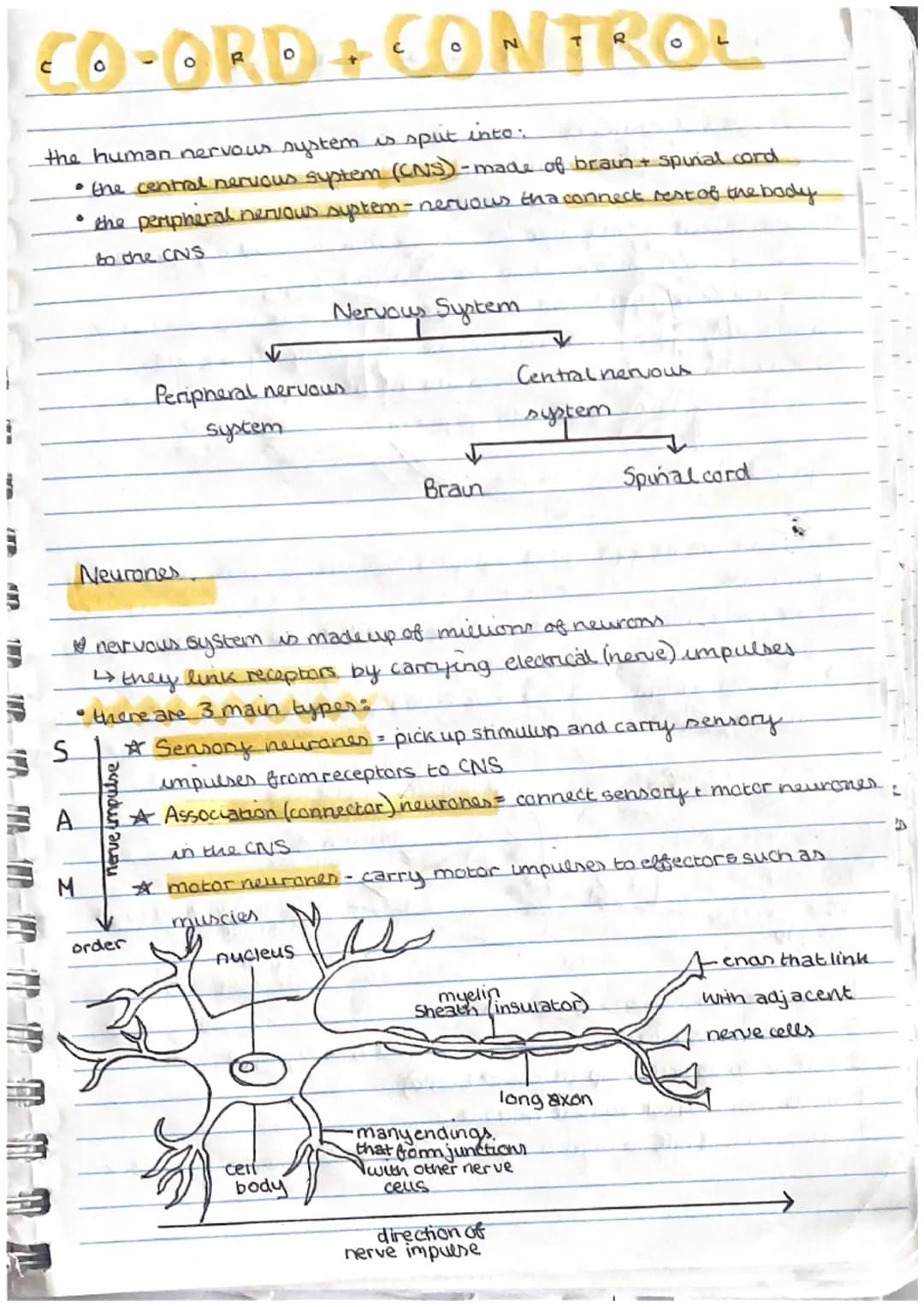
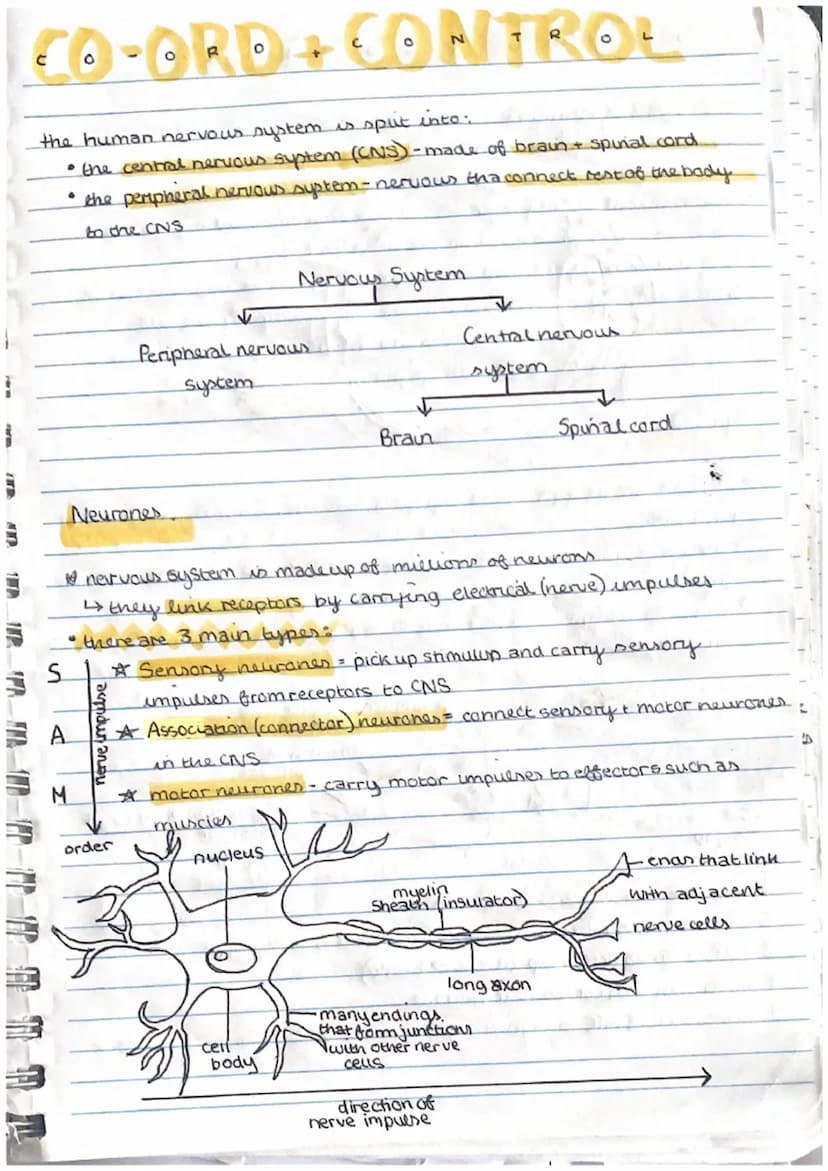
Your nervous system contains millions of neurones that carry electrical nerve impulses. There are three main types: sensory neurones (carry signals from receptors to CNS), motor neurones (carry signals to muscles), and association neurones (connect sensory and motor neurones in the CNS).
Neurones have special adaptations for their job. The myelin sheath acts like electrical insulation, speeding up impulses. Long axons let single cells transmit signals across large distances, whilst branched endings allow connections with other nerve cells.
The cell body contains the nucleus and most cytoplasm, controlling the neurone's activities. These adaptations make neurones incredibly efficient at rapid, long-distance communication within your body.
Engineering Marvel: A single motor neurone can stretch from your spinal cord to your toes - that's nearly a metre in one cell!
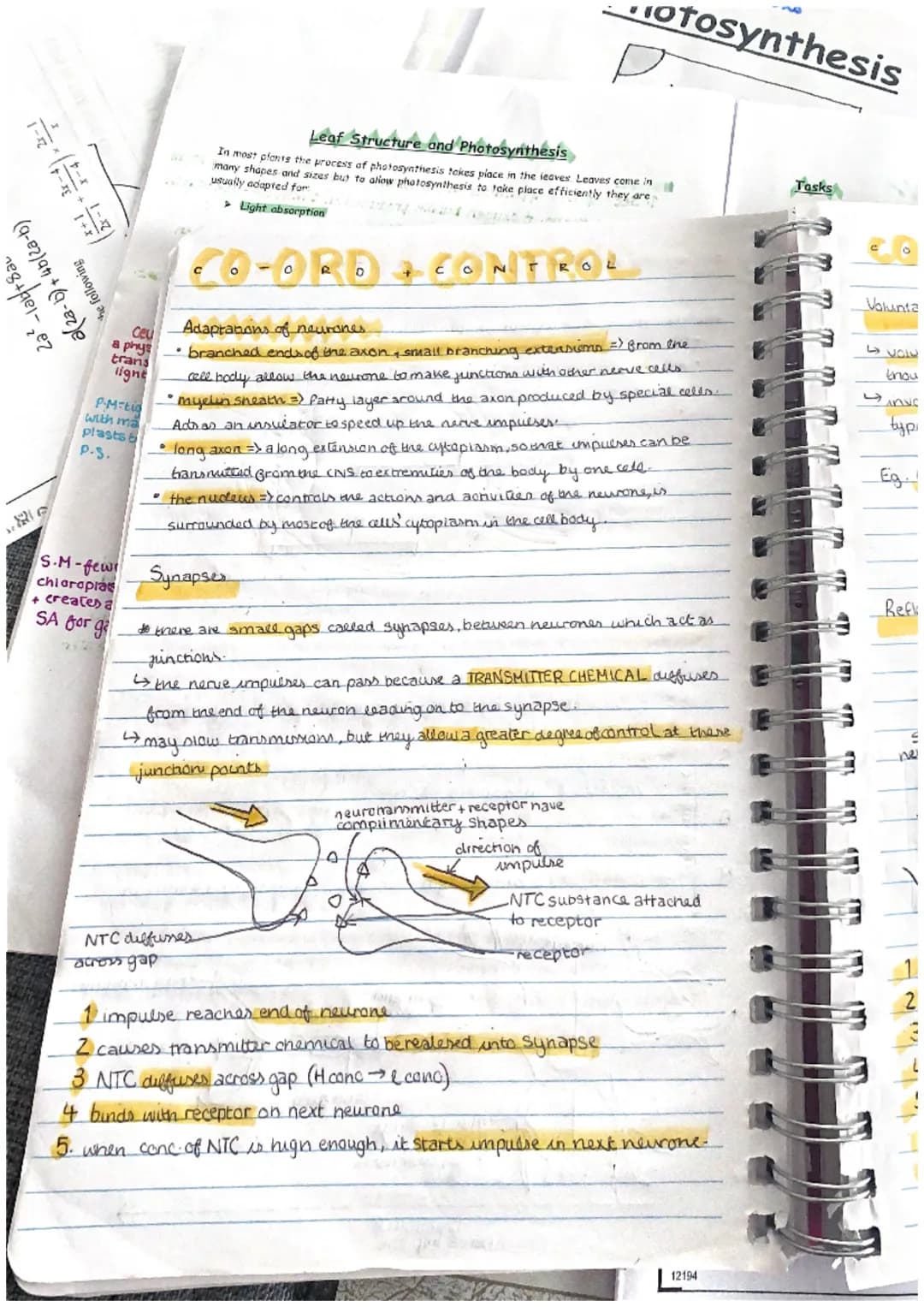
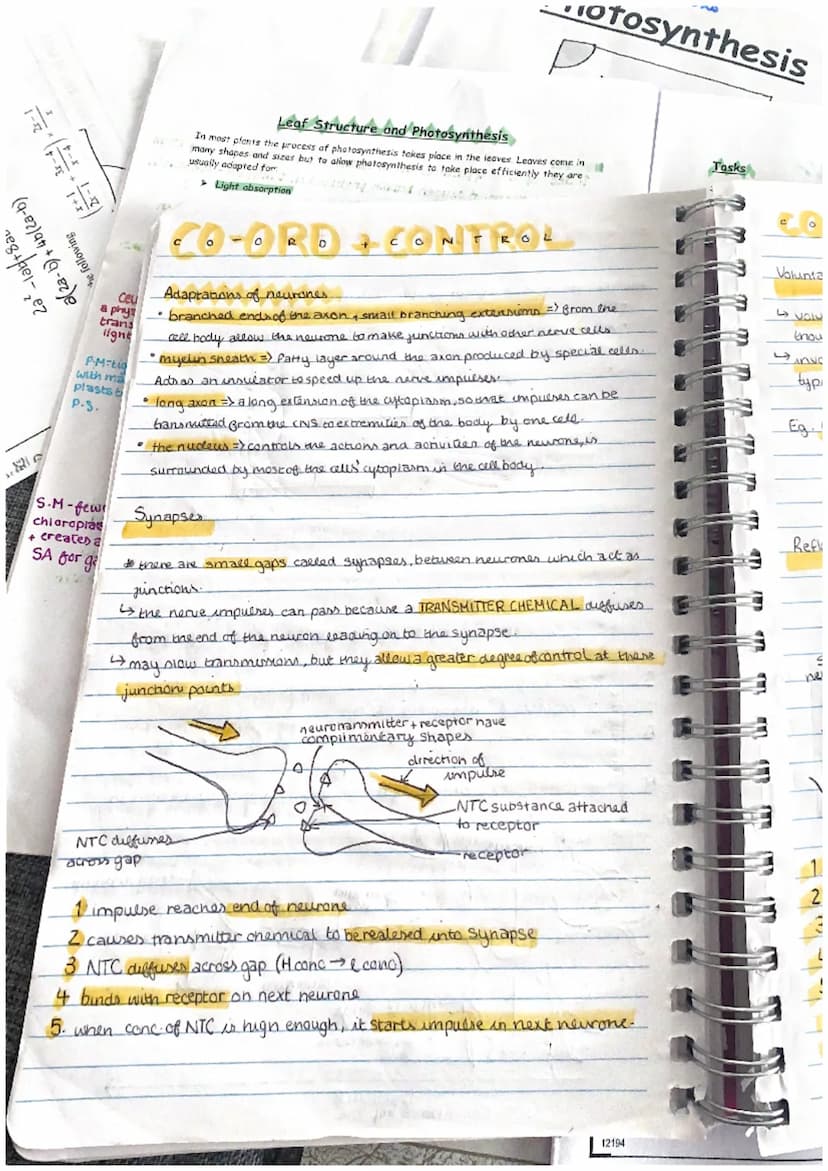
Synapses are tiny gaps between neurones that act as junctions. When a nerve impulse reaches a synapse, it triggers the release of neurotransmitter chemicals (NTC) that diffuse across the gap to the next neurone.
The process works in five steps: impulse reaches neurone end → transmitter chemical released → NTC diffuses across gap → binds with receptors → starts impulse in next neurone. The neurotransmitter and receptor have complementary shapes, like a lock and key.
Synapses might slow transmission slightly, but they provide crucial control points in the nervous system. This allows your brain to filter and process information rather than just passing everything through automatically.
Chemical Precision: Neurotransmitters must have exactly the right shape to fit their receptors - even tiny changes can stop signals completely!
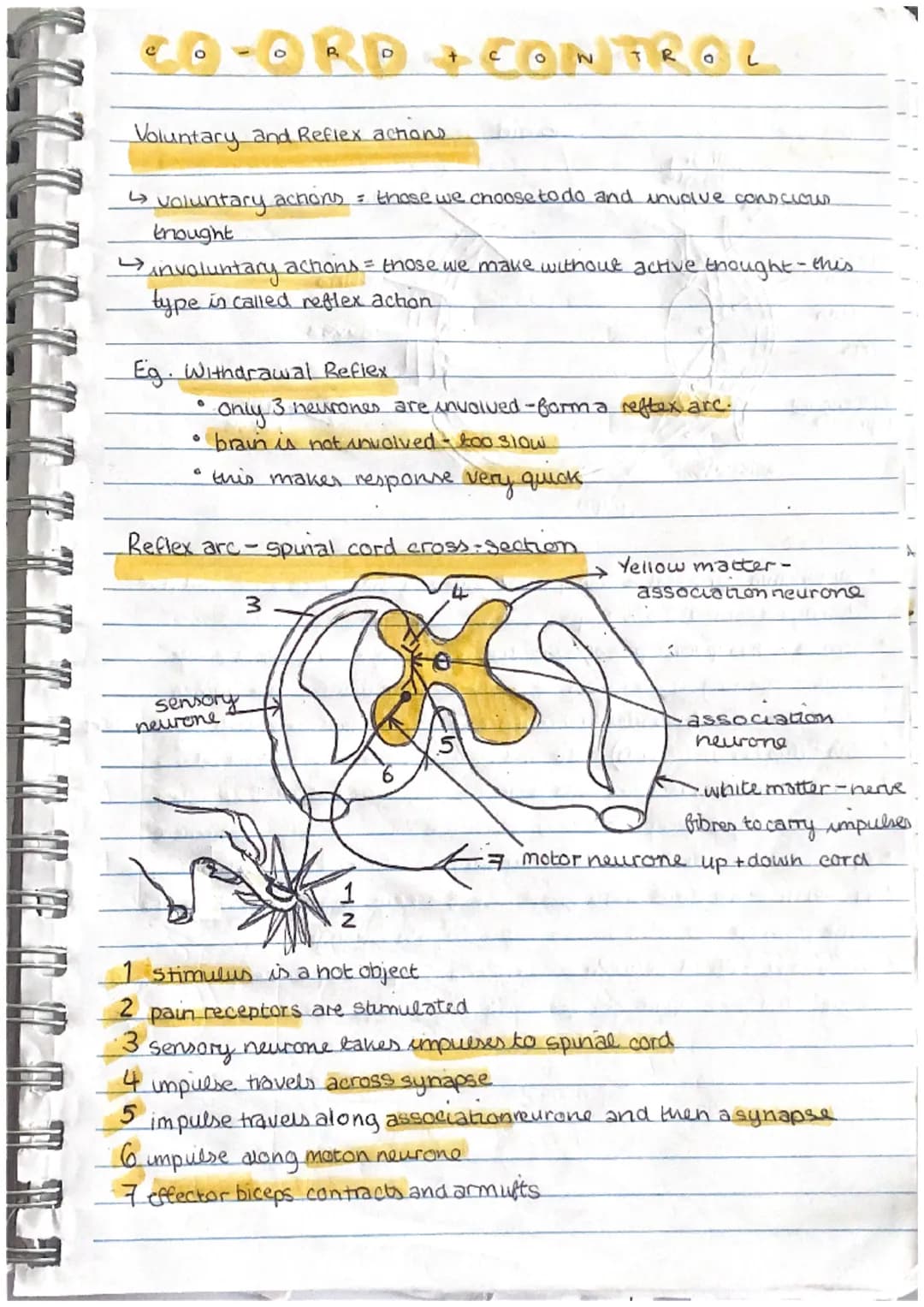
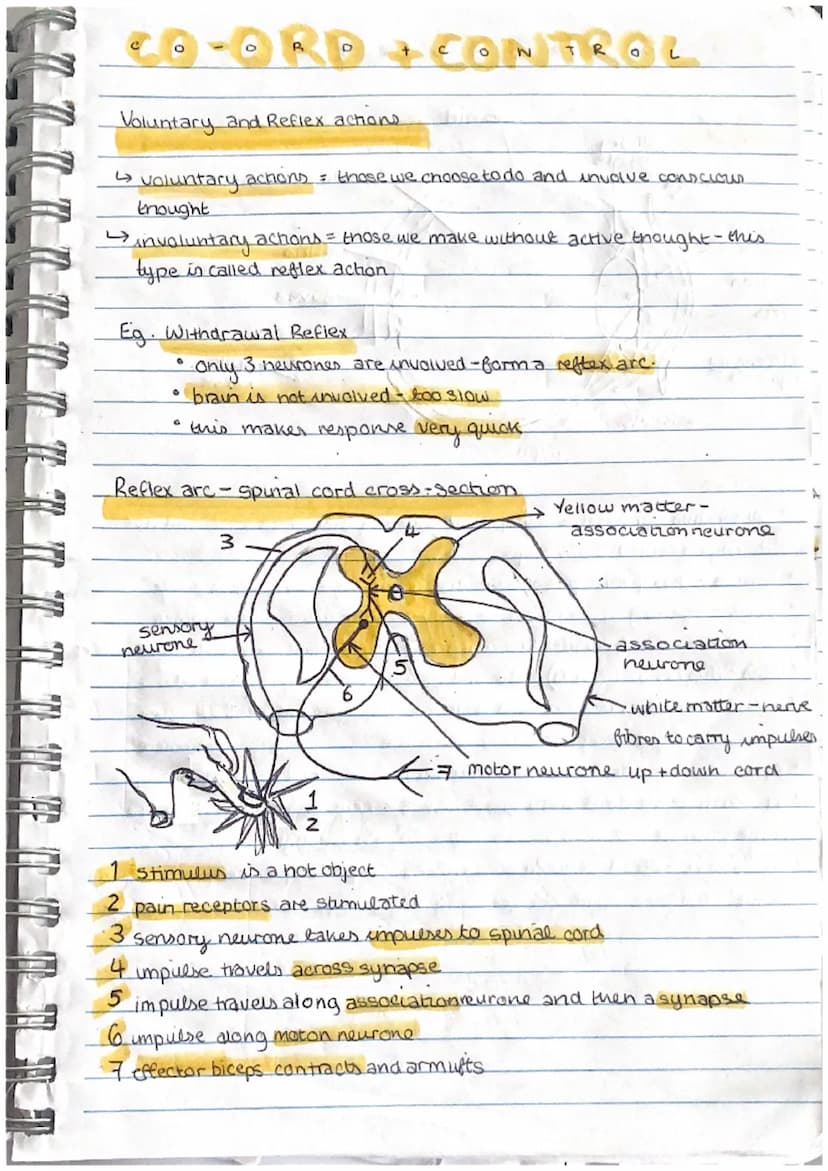
Voluntary actions are movements you choose to make involving conscious thought, whilst reflex actions happen automatically without thinking. Reflexes are much faster because they bypass the brain entirely.
The withdrawal reflex demonstrates this perfectly. When you touch something hot, pain receptors trigger a reflex arc involving only three neurones through the spinal cord. The pathway goes: stimulus → sensory neurone → association neurone → motor neurone → muscle contraction.
This reflex system uses the spinal cord's grey matter (containing association neurones) and white matter (nerve fibres carrying impulses up and down). The brain isn't involved because it would be too slow for emergency responses.
Speed Advantage: Reflexes can happen in just 0.2 seconds - much faster than voluntary movements that need brain processing!
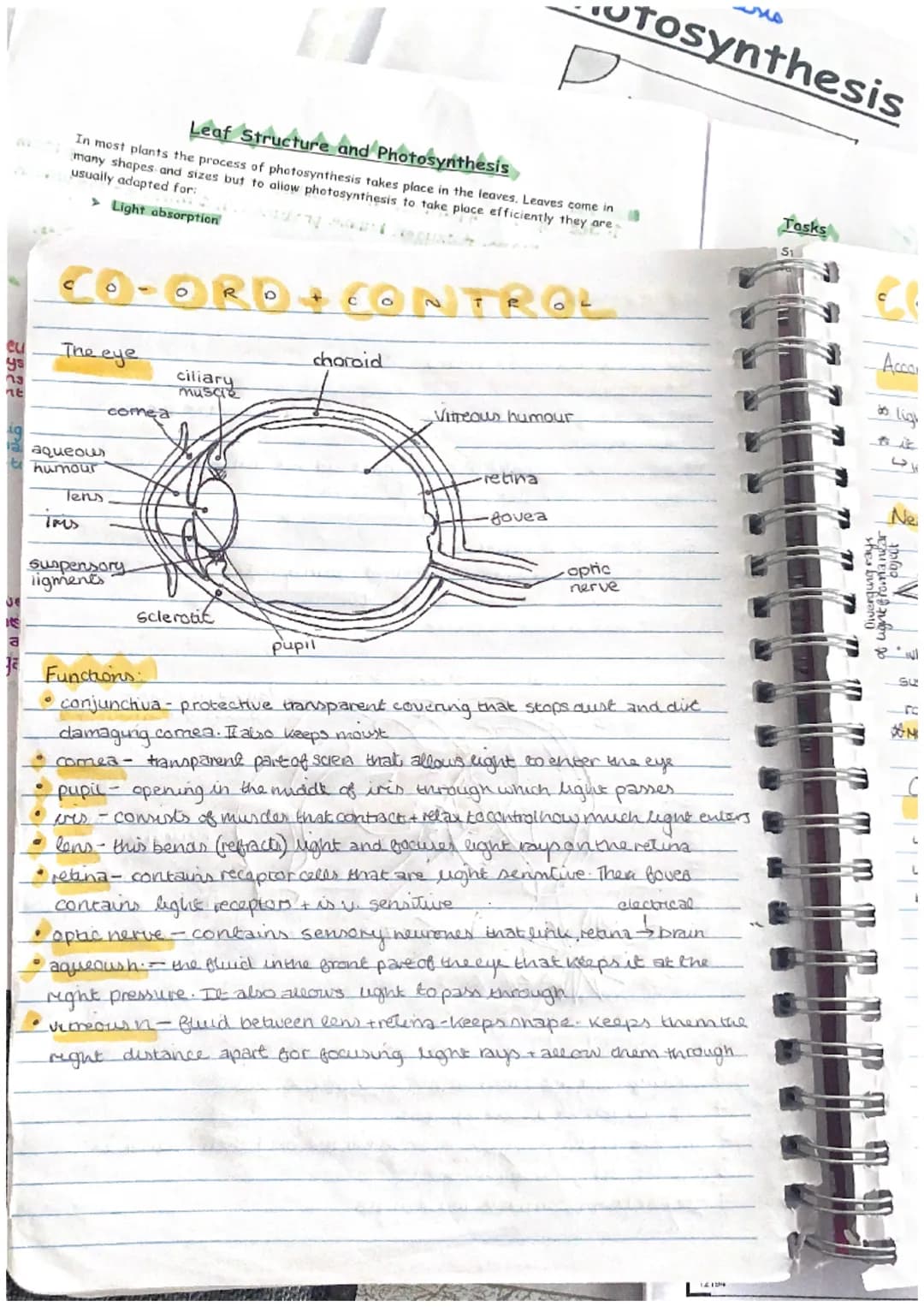
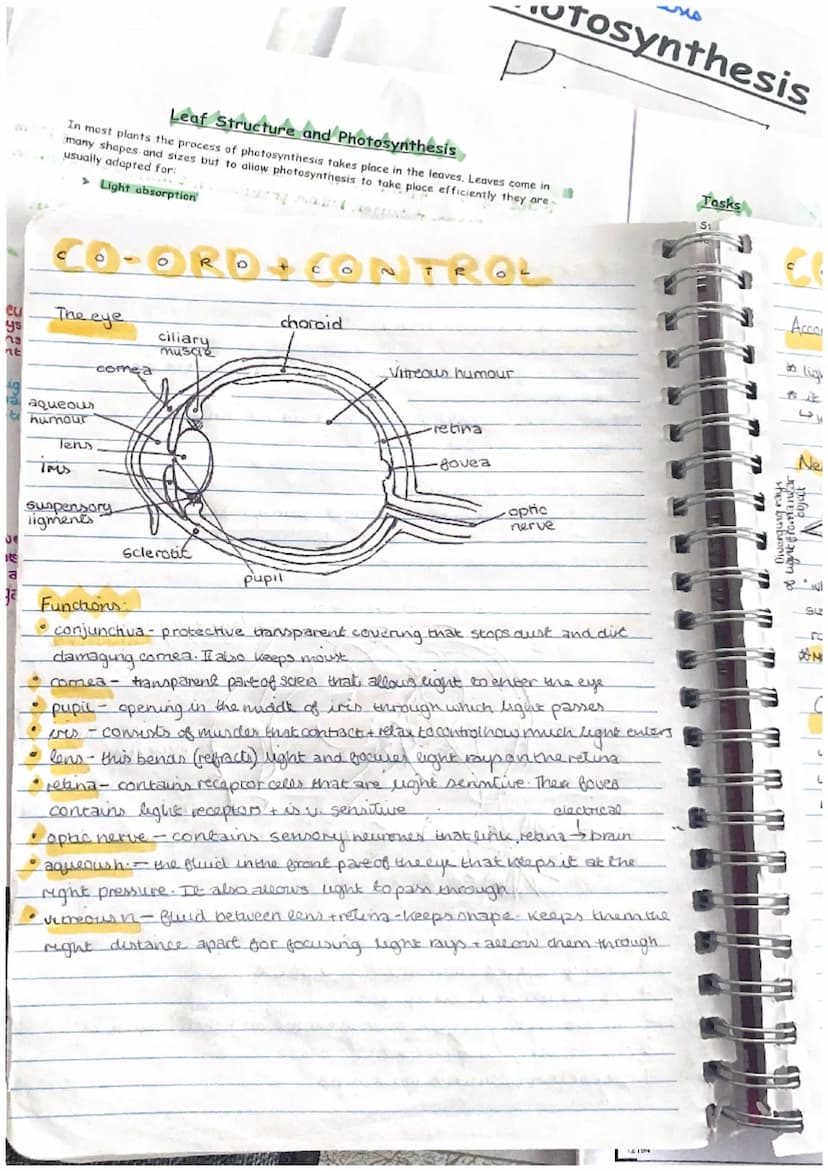
Your eye is an incredible biological camera with specialised parts for detecting and focusing light. The cornea is the transparent front layer that lets light in, whilst the pupil is the opening controlled by the iris muscles.
Key structures include the lens (bends light rays), retina , and optic nerve (carries electrical signals to your brain). The aqueous humour and vitreous humour are fluids that maintain eye pressure and shape.
The conjunctiva provides protection, keeping dust and dirt away from the delicate cornea. The choroid and sclera form the eye's outer layers, whilst the fovea is the retina's most sensitive spot for detailed vision.
Amazing Fact: Your retina contains over 120 million light receptor cells working together to create your vision!
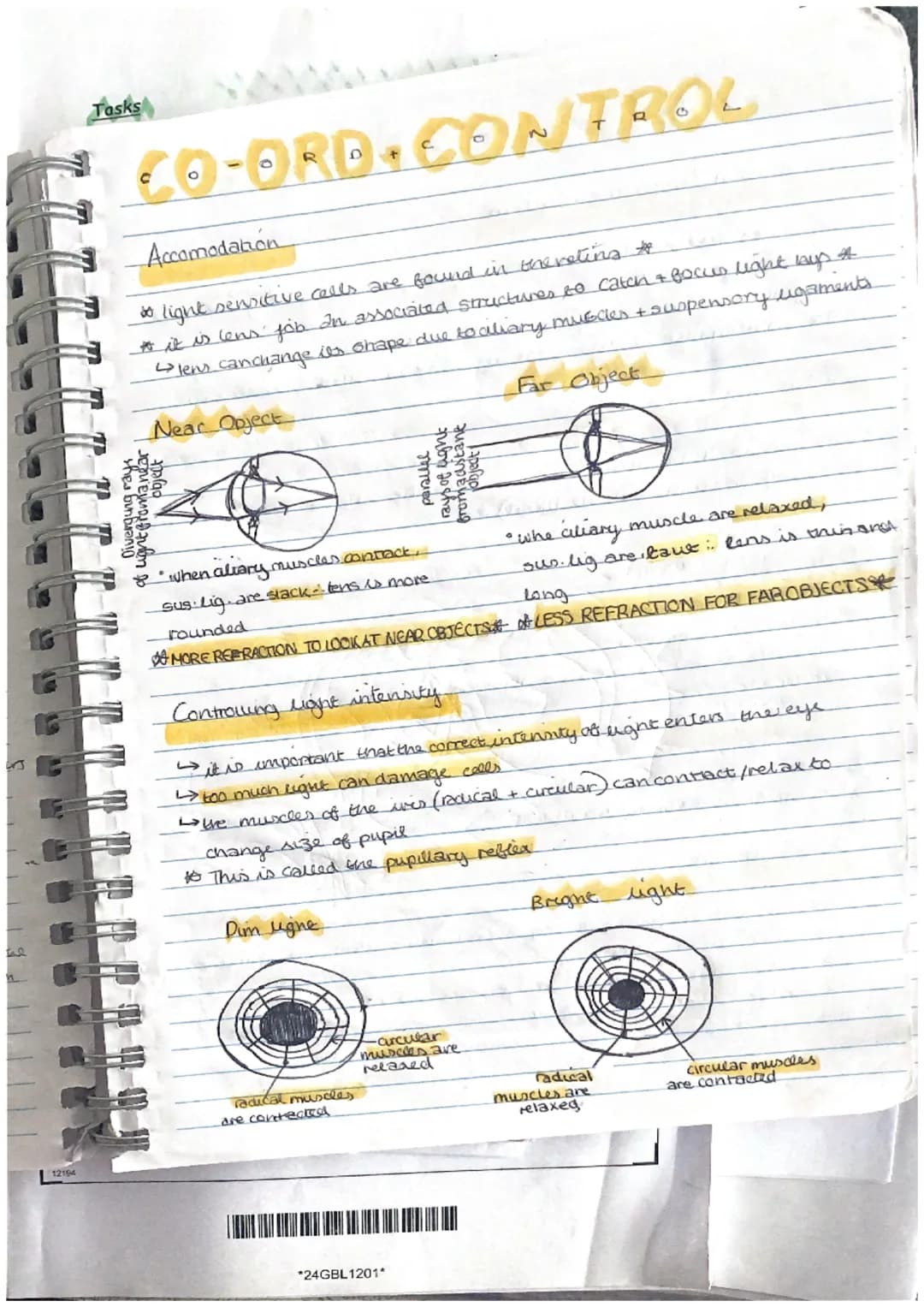
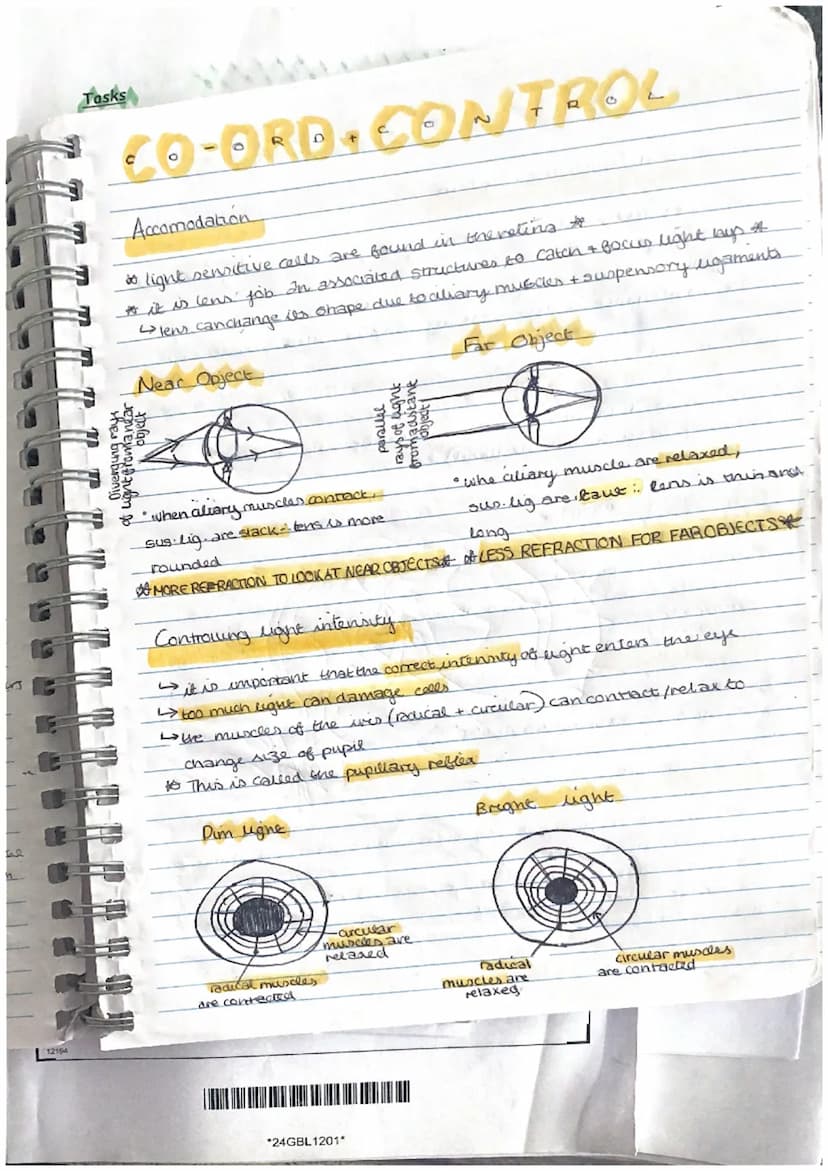
Accommodation is how your eye focuses on objects at different distances by changing the lens shape. Ciliary muscles and suspensory ligaments work together like an automatic focusing system.
For near objects, ciliary muscles contract, suspensory ligaments go slack, and the lens becomes more rounded for greater refraction. For far objects, ciliary muscles relax, suspensory ligaments tighten, and the lens becomes thinner for less refraction.
The pupillary reflex controls light intensity entering your eye. In dim light, radial muscles contract to widen the pupil. In bright light, circular muscles contract to narrow the pupil, protecting delicate retinal cells from damage.
Smart Design: Your eyes automatically adjust focus and light levels in milliseconds - no conscious thought required!
Our AI Companion is a student-focused AI tool that offers more than just answers. Built on millions of Knowunity resources, it provides relevant information, personalised study plans, quizzes, and content directly in the chat, adapting to your individual learning journey.
You can download the app from Google Play Store and Apple App Store.
That's right! Enjoy free access to study content, connect with fellow students, and get instant help – all at your fingertips.
App Store
Google Play
The app is very easy to use and well designed. I have found everything I was looking for so far and have been able to learn a lot from the presentations! I will definitely use the app for a class assignment! And of course it also helps a lot as an inspiration.
Stefan S
iOS user
This app is really great. There are so many study notes and help [...]. My problem subject is French, for example, and the app has so many options for help. Thanks to this app, I have improved my French. I would recommend it to anyone.
Samantha Klich
Android user
Wow, I am really amazed. I just tried the app because I've seen it advertised many times and was absolutely stunned. This app is THE HELP you want for school and above all, it offers so many things, such as workouts and fact sheets, which have been VERY helpful to me personally.
Anna
iOS user
Best app on earth! no words because it’s too good
Thomas R
iOS user
Just amazing. Let's me revise 10x better, this app is a quick 10/10. I highly recommend it to anyone. I can watch and search for notes. I can save them in the subject folder. I can revise it any time when I come back. If you haven't tried this app, you're really missing out.
Basil
Android user
This app has made me feel so much more confident in my exam prep, not only through boosting my own self confidence through the features that allow you to connect with others and feel less alone, but also through the way the app itself is centred around making you feel better. It is easy to navigate, fun to use, and helpful to anyone struggling in absolutely any way.
David K
iOS user
The app's just great! All I have to do is enter the topic in the search bar and I get the response real fast. I don't have to watch 10 YouTube videos to understand something, so I'm saving my time. Highly recommended!
Sudenaz Ocak
Android user
In school I was really bad at maths but thanks to the app, I am doing better now. I am so grateful that you made the app.
Greenlight Bonnie
Android user
very reliable app to help and grow your ideas of Maths, English and other related topics in your works. please use this app if your struggling in areas, this app is key for that. wish I'd of done a review before. and it's also free so don't worry about that.
Rohan U
Android user
I know a lot of apps use fake accounts to boost their reviews but this app deserves it all. Originally I was getting 4 in my English exams and this time I got a grade 7. I didn’t even know about this app three days until the exam and it has helped A LOT. Please actually trust me and use it as I’m sure you too will see developments.
Xander S
iOS user
THE QUIZES AND FLASHCARDS ARE SO USEFUL AND I LOVE Knowunity AI. IT ALSO IS LITREALLY LIKE CHATGPT BUT SMARTER!! HELPED ME WITH MY MASCARA PROBLEMS TOO!! AS WELL AS MY REAL SUBJECTS ! DUHHH 😍😁😲🤑💗✨🎀😮
Elisha
iOS user
This apps acc the goat. I find revision so boring but this app makes it so easy to organize it all and then you can ask the freeeee ai to test yourself so good and you can easily upload your own stuff. highly recommend as someone taking mocks now
Paul T
iOS user
The app is very easy to use and well designed. I have found everything I was looking for so far and have been able to learn a lot from the presentations! I will definitely use the app for a class assignment! And of course it also helps a lot as an inspiration.
Stefan S
iOS user
This app is really great. There are so many study notes and help [...]. My problem subject is French, for example, and the app has so many options for help. Thanks to this app, I have improved my French. I would recommend it to anyone.
Samantha Klich
Android user
Wow, I am really amazed. I just tried the app because I've seen it advertised many times and was absolutely stunned. This app is THE HELP you want for school and above all, it offers so many things, such as workouts and fact sheets, which have been VERY helpful to me personally.
Anna
iOS user
Best app on earth! no words because it’s too good
Thomas R
iOS user
Just amazing. Let's me revise 10x better, this app is a quick 10/10. I highly recommend it to anyone. I can watch and search for notes. I can save them in the subject folder. I can revise it any time when I come back. If you haven't tried this app, you're really missing out.
Basil
Android user
This app has made me feel so much more confident in my exam prep, not only through boosting my own self confidence through the features that allow you to connect with others and feel less alone, but also through the way the app itself is centred around making you feel better. It is easy to navigate, fun to use, and helpful to anyone struggling in absolutely any way.
David K
iOS user
The app's just great! All I have to do is enter the topic in the search bar and I get the response real fast. I don't have to watch 10 YouTube videos to understand something, so I'm saving my time. Highly recommended!
Sudenaz Ocak
Android user
In school I was really bad at maths but thanks to the app, I am doing better now. I am so grateful that you made the app.
Greenlight Bonnie
Android user
very reliable app to help and grow your ideas of Maths, English and other related topics in your works. please use this app if your struggling in areas, this app is key for that. wish I'd of done a review before. and it's also free so don't worry about that.
Rohan U
Android user
I know a lot of apps use fake accounts to boost their reviews but this app deserves it all. Originally I was getting 4 in my English exams and this time I got a grade 7. I didn’t even know about this app three days until the exam and it has helped A LOT. Please actually trust me and use it as I’m sure you too will see developments.
Xander S
iOS user
THE QUIZES AND FLASHCARDS ARE SO USEFUL AND I LOVE Knowunity AI. IT ALSO IS LITREALLY LIKE CHATGPT BUT SMARTER!! HELPED ME WITH MY MASCARA PROBLEMS TOO!! AS WELL AS MY REAL SUBJECTS ! DUHHH 😍😁😲🤑💗✨🎀😮
Elisha
iOS user
This apps acc the goat. I find revision so boring but this app makes it so easy to organize it all and then you can ask the freeeee ai to test yourself so good and you can easily upload your own stuff. highly recommend as someone taking mocks now
Paul T
iOS user
gem_keysie
@gem_keysie
Ever wondered how your body gets energy from food, or how your eyes automatically adjust to bright light? This study guide covers three essential biological systems: cellular respiration (how cells make energy), the respiratory system (how you breathe), and the... Show more
Access to all documents
Improve your grades
Join milions of students
By signing up you accept Terms of Service and Privacy Policy
Your body is constantly making energy through cellular respiration - a series of chemical reactions happening in every single cell. This process takes place in the mitochondria, the cell's powerhouse structures.
Aerobic respiration is the main way cells make energy when oxygen is available. The equation is simple: glucose + oxygen → carbon dioxide + water + energy . This reaction is exothermic, meaning it releases heat energy.
When oxygen runs short, cells switch to anaerobic respiration. In yeast, this produces alcohol and carbon dioxide - which is why bread rises! In human muscles, it creates lactic acid, which causes that burning feeling during intense exercise.
Key Point: Your cells use energy for movement, growth, reproduction, heat production, and transporting substances around your body.
Access to all documents
Improve your grades
Join milions of students
By signing up you accept Terms of Service and Privacy Policy
Human muscles can only survive on anaerobic respiration for short periods. When muscles run out of oxygen during intense activity, they produce lactic acid, which can cause cramps - that's your body telling you to slow down!
Scientists test how different factors affect yeast respiration through simple experiments. Temperature affects how quickly yeast works - they mix yeast with glucose, place it in water baths at different temperatures, and measure gas bubble changes over 30 minutes.
Sugar type also matters for yeast activity. Researchers test different sugars (glucose, maltose, lactose, fructose, and sucrose) with yeast at 30°C to see which ones produce the most gas bubbles.
Remember: Anaerobic respiration produces much less energy than aerobic respiration, which is why you can't sprint forever!
Access to all documents
Improve your grades
Join milions of students
By signing up you accept Terms of Service and Privacy Policy
Your respiratory system is vital for getting oxygen in and removing poisonous carbon dioxide. Air enters through your nasal cavity and travels through a network of specialised structures, each with important jobs.
Key structures include the trachea (windpipe with muscle rings), bronchi (two main tubes to each lung), and bronchioles (smaller branches leading to air sacs). The alveoli are where gas exchange actually happens, whilst intercostal muscles between your ribs help you breathe.
Breathing mechanics work like a pump system. When you inhale, intercostal muscles contract, your rib cage moves up and out, and your diaphragm moves down. This increases chest volume and decreases pressure, drawing air into your lungs.
Physics Connection: Volume ↑ = Pressure ↓. This relationship drives all breathing movements!
Access to all documents
Improve your grades
Join milions of students
By signing up you accept Terms of Service and Privacy Policy
Gas exchange happens in the alveoli where oxygen enters red blood cells and combines with haemoglobin to form oxyhaemoglobin. Meanwhile, carbon dioxide travels in blood plasma and red blood cells to be expelled.
Respiratory surfaces have amazing adaptations for efficient gas exchange. They have a large surface area (millions of alveoli), thin walls (only 2 cell layers), and moist, permeable surfaces that help gases dissolve and pass through easily.
The system maintains a good blood supply through capillaries surrounding alveoli, creating concentration gradients that encourage oxygen to diffuse in and carbon dioxide to diffuse out. Continuous breathing keeps these gradients strong.
Plant Connection: Plants use cells around air spaces for gas exchange - they follow the same principles of thin, moist, permeable surfaces!
Access to all documents
Improve your grades
Join milions of students
By signing up you accept Terms of Service and Privacy Policy
Your body has two communication systems working together: the nervous system (acts rapidly) and the hormonal system (acts slowly, like testosterone taking years to work). Both help you respond to stimuli - changes in your environment.
The basic response pathway is: stimulus → receptor → coordinator → effector → response. For example, a loud bang triggers sound receptors, your brain coordinates, and muscles make you jump. Your behaviour is the overall pattern of these responses.
The nervous system splits into the central nervous system and peripheral nervous system (nerves connecting your body to the CNS). This organisation allows rapid communication throughout your body.
Speed Matters: Nervous responses happen in milliseconds, whilst hormonal responses can take hours, days, or even years!
Access to all documents
Improve your grades
Join milions of students
By signing up you accept Terms of Service and Privacy Policy
Your nervous system contains millions of neurones that carry electrical nerve impulses. There are three main types: sensory neurones (carry signals from receptors to CNS), motor neurones (carry signals to muscles), and association neurones (connect sensory and motor neurones in the CNS).
Neurones have special adaptations for their job. The myelin sheath acts like electrical insulation, speeding up impulses. Long axons let single cells transmit signals across large distances, whilst branched endings allow connections with other nerve cells.
The cell body contains the nucleus and most cytoplasm, controlling the neurone's activities. These adaptations make neurones incredibly efficient at rapid, long-distance communication within your body.
Engineering Marvel: A single motor neurone can stretch from your spinal cord to your toes - that's nearly a metre in one cell!
Access to all documents
Improve your grades
Join milions of students
By signing up you accept Terms of Service and Privacy Policy
Synapses are tiny gaps between neurones that act as junctions. When a nerve impulse reaches a synapse, it triggers the release of neurotransmitter chemicals (NTC) that diffuse across the gap to the next neurone.
The process works in five steps: impulse reaches neurone end → transmitter chemical released → NTC diffuses across gap → binds with receptors → starts impulse in next neurone. The neurotransmitter and receptor have complementary shapes, like a lock and key.
Synapses might slow transmission slightly, but they provide crucial control points in the nervous system. This allows your brain to filter and process information rather than just passing everything through automatically.
Chemical Precision: Neurotransmitters must have exactly the right shape to fit their receptors - even tiny changes can stop signals completely!
Access to all documents
Improve your grades
Join milions of students
By signing up you accept Terms of Service and Privacy Policy
Voluntary actions are movements you choose to make involving conscious thought, whilst reflex actions happen automatically without thinking. Reflexes are much faster because they bypass the brain entirely.
The withdrawal reflex demonstrates this perfectly. When you touch something hot, pain receptors trigger a reflex arc involving only three neurones through the spinal cord. The pathway goes: stimulus → sensory neurone → association neurone → motor neurone → muscle contraction.
This reflex system uses the spinal cord's grey matter (containing association neurones) and white matter (nerve fibres carrying impulses up and down). The brain isn't involved because it would be too slow for emergency responses.
Speed Advantage: Reflexes can happen in just 0.2 seconds - much faster than voluntary movements that need brain processing!
Access to all documents
Improve your grades
Join milions of students
By signing up you accept Terms of Service and Privacy Policy
Your eye is an incredible biological camera with specialised parts for detecting and focusing light. The cornea is the transparent front layer that lets light in, whilst the pupil is the opening controlled by the iris muscles.
Key structures include the lens (bends light rays), retina , and optic nerve (carries electrical signals to your brain). The aqueous humour and vitreous humour are fluids that maintain eye pressure and shape.
The conjunctiva provides protection, keeping dust and dirt away from the delicate cornea. The choroid and sclera form the eye's outer layers, whilst the fovea is the retina's most sensitive spot for detailed vision.
Amazing Fact: Your retina contains over 120 million light receptor cells working together to create your vision!
Access to all documents
Improve your grades
Join milions of students
By signing up you accept Terms of Service and Privacy Policy
Accommodation is how your eye focuses on objects at different distances by changing the lens shape. Ciliary muscles and suspensory ligaments work together like an automatic focusing system.
For near objects, ciliary muscles contract, suspensory ligaments go slack, and the lens becomes more rounded for greater refraction. For far objects, ciliary muscles relax, suspensory ligaments tighten, and the lens becomes thinner for less refraction.
The pupillary reflex controls light intensity entering your eye. In dim light, radial muscles contract to widen the pupil. In bright light, circular muscles contract to narrow the pupil, protecting delicate retinal cells from damage.
Smart Design: Your eyes automatically adjust focus and light levels in milliseconds - no conscious thought required!
Our AI Companion is a student-focused AI tool that offers more than just answers. Built on millions of Knowunity resources, it provides relevant information, personalised study plans, quizzes, and content directly in the chat, adapting to your individual learning journey.
You can download the app from Google Play Store and Apple App Store.
That's right! Enjoy free access to study content, connect with fellow students, and get instant help – all at your fingertips.
4
Smart Tools NEW
Transform this note into: ✓ 50+ Practice Questions ✓ Interactive Flashcards ✓ Full Mock Exam ✓ Essay Outlines
Explore the intricate workings of the Nervous and Endocrine Systems in this comprehensive summary. Understand key concepts such as homeostasis, reflex arcs, synaptic transmission, and hormonal control. This resource covers the roles of the Central Nervous System, the importance of blood glucose regulation, and the fight or flight response, making it essential for biology students preparing for exams.
 Biology
Explore the intricate systems of homeostasis and hormonal control in this comprehensive study note. Covering key concepts such as the menstrual cycle, nervous and endocrine systems, negative feedback mechanisms, and blood glucose regulation, this resource is essential for GCSE AQA Biology students. Understand how the body maintains stability through hormonal coordination and reflex actions.
BiologyVery detailed notes on homeostasis from Biology paper 2 AQA (Combined higher)
BiologyExplore key concepts in biology focusing on homeostasis, hormonal coordination, and the structure and function of the eye. This comprehensive summary covers essential topics such as the nervous and endocrine systems, blood glucose regulation, and plant responses. Ideal for higher-tier students preparing for exams.
BiologyExplore the key functions and components of the endocrine system, including hormone production by glands such as the pituitary, thyroid, and adrenal glands. Understand the differences between hormonal and nervous responses, and learn how hormones like adrenaline and insulin regulate vital body processes. This summary is ideal for biology students preparing for exams.
BiologyExplore the key functions and components of the endocrine system, including major glands like the pituitary, thyroid, and adrenal glands. Understand hormone regulation, the role of insulin and glucagon in blood sugar control, and the impact of hormones on growth, metabolism, and reproduction. This summary provides essential insights for GCSE Biology students.
BiologyApp Store
Google Play
The app is very easy to use and well designed. I have found everything I was looking for so far and have been able to learn a lot from the presentations! I will definitely use the app for a class assignment! And of course it also helps a lot as an inspiration.
Stefan S
iOS user
This app is really great. There are so many study notes and help [...]. My problem subject is French, for example, and the app has so many options for help. Thanks to this app, I have improved my French. I would recommend it to anyone.
Samantha Klich
Android user
Wow, I am really amazed. I just tried the app because I've seen it advertised many times and was absolutely stunned. This app is THE HELP you want for school and above all, it offers so many things, such as workouts and fact sheets, which have been VERY helpful to me personally.
Anna
iOS user
Best app on earth! no words because it’s too good
Thomas R
iOS user
Just amazing. Let's me revise 10x better, this app is a quick 10/10. I highly recommend it to anyone. I can watch and search for notes. I can save them in the subject folder. I can revise it any time when I come back. If you haven't tried this app, you're really missing out.
Basil
Android user
This app has made me feel so much more confident in my exam prep, not only through boosting my own self confidence through the features that allow you to connect with others and feel less alone, but also through the way the app itself is centred around making you feel better. It is easy to navigate, fun to use, and helpful to anyone struggling in absolutely any way.
David K
iOS user
The app's just great! All I have to do is enter the topic in the search bar and I get the response real fast. I don't have to watch 10 YouTube videos to understand something, so I'm saving my time. Highly recommended!
Sudenaz Ocak
Android user
In school I was really bad at maths but thanks to the app, I am doing better now. I am so grateful that you made the app.
Greenlight Bonnie
Android user
very reliable app to help and grow your ideas of Maths, English and other related topics in your works. please use this app if your struggling in areas, this app is key for that. wish I'd of done a review before. and it's also free so don't worry about that.
Rohan U
Android user
I know a lot of apps use fake accounts to boost their reviews but this app deserves it all. Originally I was getting 4 in my English exams and this time I got a grade 7. I didn’t even know about this app three days until the exam and it has helped A LOT. Please actually trust me and use it as I’m sure you too will see developments.
Xander S
iOS user
THE QUIZES AND FLASHCARDS ARE SO USEFUL AND I LOVE Knowunity AI. IT ALSO IS LITREALLY LIKE CHATGPT BUT SMARTER!! HELPED ME WITH MY MASCARA PROBLEMS TOO!! AS WELL AS MY REAL SUBJECTS ! DUHHH 😍😁😲🤑💗✨🎀😮
Elisha
iOS user
This apps acc the goat. I find revision so boring but this app makes it so easy to organize it all and then you can ask the freeeee ai to test yourself so good and you can easily upload your own stuff. highly recommend as someone taking mocks now
Paul T
iOS user
The app is very easy to use and well designed. I have found everything I was looking for so far and have been able to learn a lot from the presentations! I will definitely use the app for a class assignment! And of course it also helps a lot as an inspiration.
Stefan S
iOS user
This app is really great. There are so many study notes and help [...]. My problem subject is French, for example, and the app has so many options for help. Thanks to this app, I have improved my French. I would recommend it to anyone.
Samantha Klich
Android user
Wow, I am really amazed. I just tried the app because I've seen it advertised many times and was absolutely stunned. This app is THE HELP you want for school and above all, it offers so many things, such as workouts and fact sheets, which have been VERY helpful to me personally.
Anna
iOS user
Best app on earth! no words because it’s too good
Thomas R
iOS user
Just amazing. Let's me revise 10x better, this app is a quick 10/10. I highly recommend it to anyone. I can watch and search for notes. I can save them in the subject folder. I can revise it any time when I come back. If you haven't tried this app, you're really missing out.
Basil
Android user
This app has made me feel so much more confident in my exam prep, not only through boosting my own self confidence through the features that allow you to connect with others and feel less alone, but also through the way the app itself is centred around making you feel better. It is easy to navigate, fun to use, and helpful to anyone struggling in absolutely any way.
David K
iOS user
The app's just great! All I have to do is enter the topic in the search bar and I get the response real fast. I don't have to watch 10 YouTube videos to understand something, so I'm saving my time. Highly recommended!
Sudenaz Ocak
Android user
In school I was really bad at maths but thanks to the app, I am doing better now. I am so grateful that you made the app.
Greenlight Bonnie
Android user
very reliable app to help and grow your ideas of Maths, English and other related topics in your works. please use this app if your struggling in areas, this app is key for that. wish I'd of done a review before. and it's also free so don't worry about that.
Rohan U
Android user
I know a lot of apps use fake accounts to boost their reviews but this app deserves it all. Originally I was getting 4 in my English exams and this time I got a grade 7. I didn’t even know about this app three days until the exam and it has helped A LOT. Please actually trust me and use it as I’m sure you too will see developments.
Xander S
iOS user
THE QUIZES AND FLASHCARDS ARE SO USEFUL AND I LOVE Knowunity AI. IT ALSO IS LITREALLY LIKE CHATGPT BUT SMARTER!! HELPED ME WITH MY MASCARA PROBLEMS TOO!! AS WELL AS MY REAL SUBJECTS ! DUHHH 😍😁😲🤑💗✨🎀😮
Elisha
iOS user
This apps acc the goat. I find revision so boring but this app makes it so easy to organize it all and then you can ask the freeeee ai to test yourself so good and you can easily upload your own stuff. highly recommend as someone taking mocks now
Paul T
iOS user