

Wave-particle duality and quantum physicsfundamentally explains how matter and... Show more
 Physics228 views·Updated May 11, 2026·6 pages
Discovering Wave-Particle Duality and Cool Quantum Facts for Kids

1 / 6
1
of 6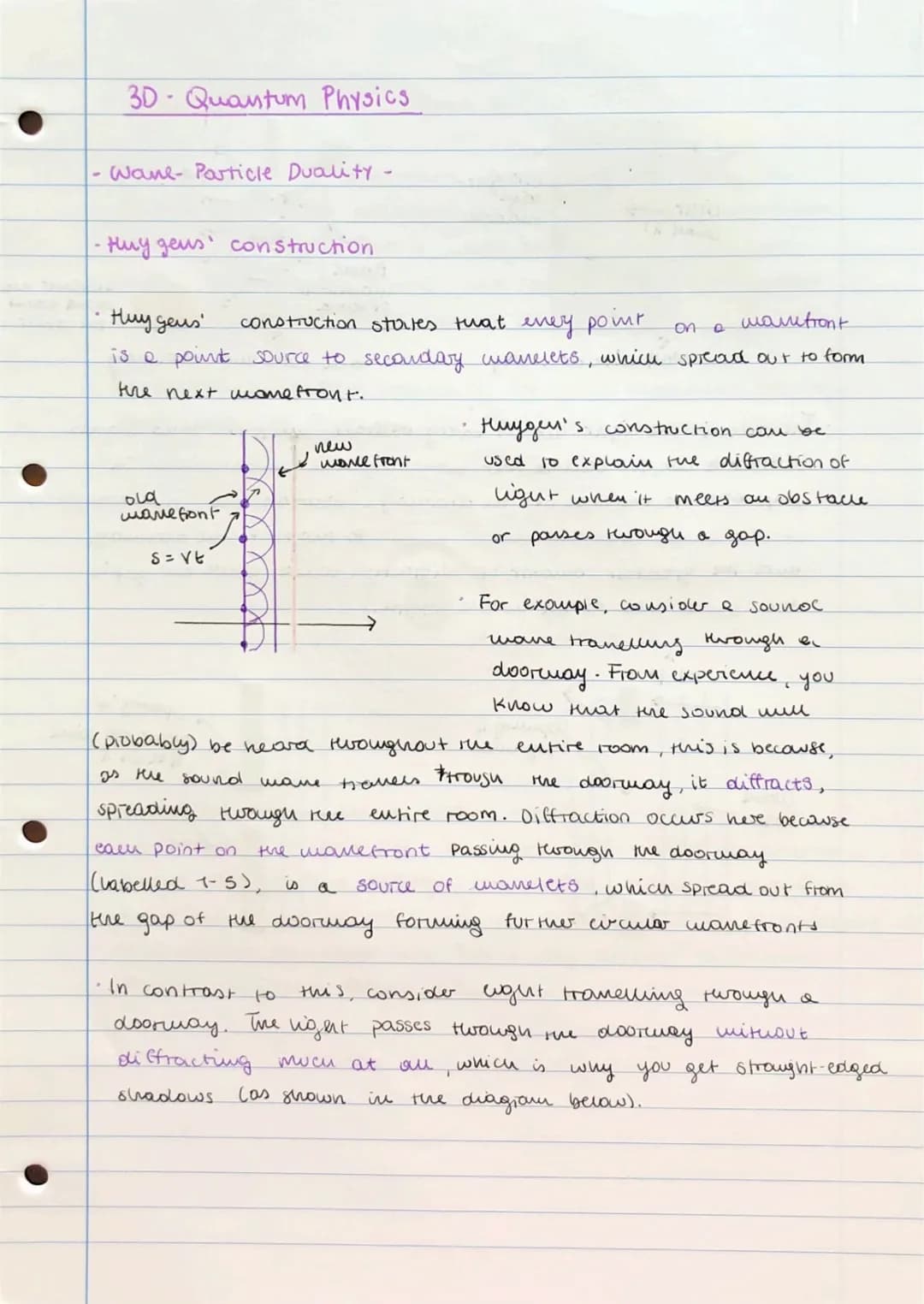
Electron Diffraction and Wave Nature of Electrons
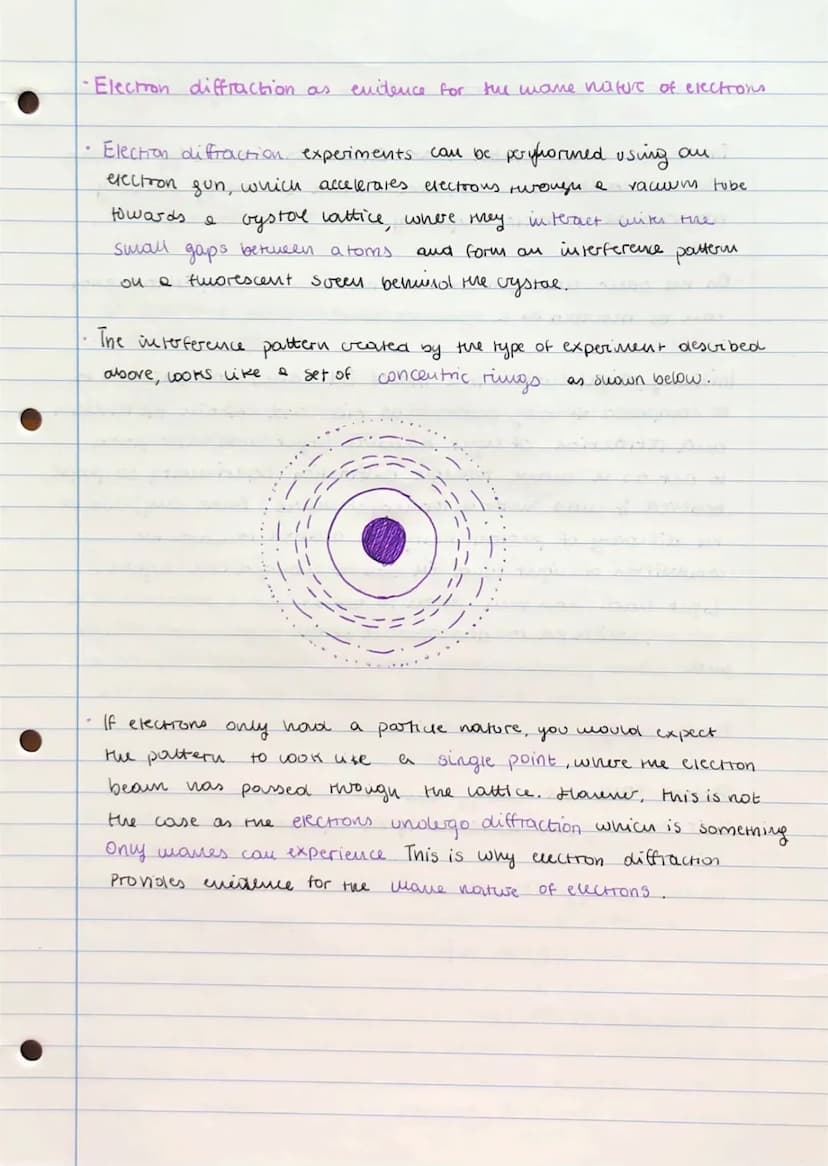
Electron diffraction experiments provide compelling evidence for the wave nature of electrons, challenging the traditional view of electrons as purely particle-like entities. These experiments typically use an electron gun to accelerate electrons through a vacuum tube towards a crystal lattice.
Vocabulary: An electron gun is a device that accelerates electrons through a vacuum tube.
When electrons interact with the gaps between atoms in the crystal lattice, they produce an interference pattern on a fluorescent screen. This pattern appears as a set of concentric rings, similar to the patterns observed in wave interference experiments.
Highlight: The observation of interference patterns in electron diffraction experiments suggests that electrons possess wave-like properties.
If electrons behaved solely as particles, one would expect to see a single point where the electron beam passed through the lattice. However, the observed diffraction pattern is a characteristic of wave behavior, providing strong evidence for the wave-particle duality of electrons.
2
of 6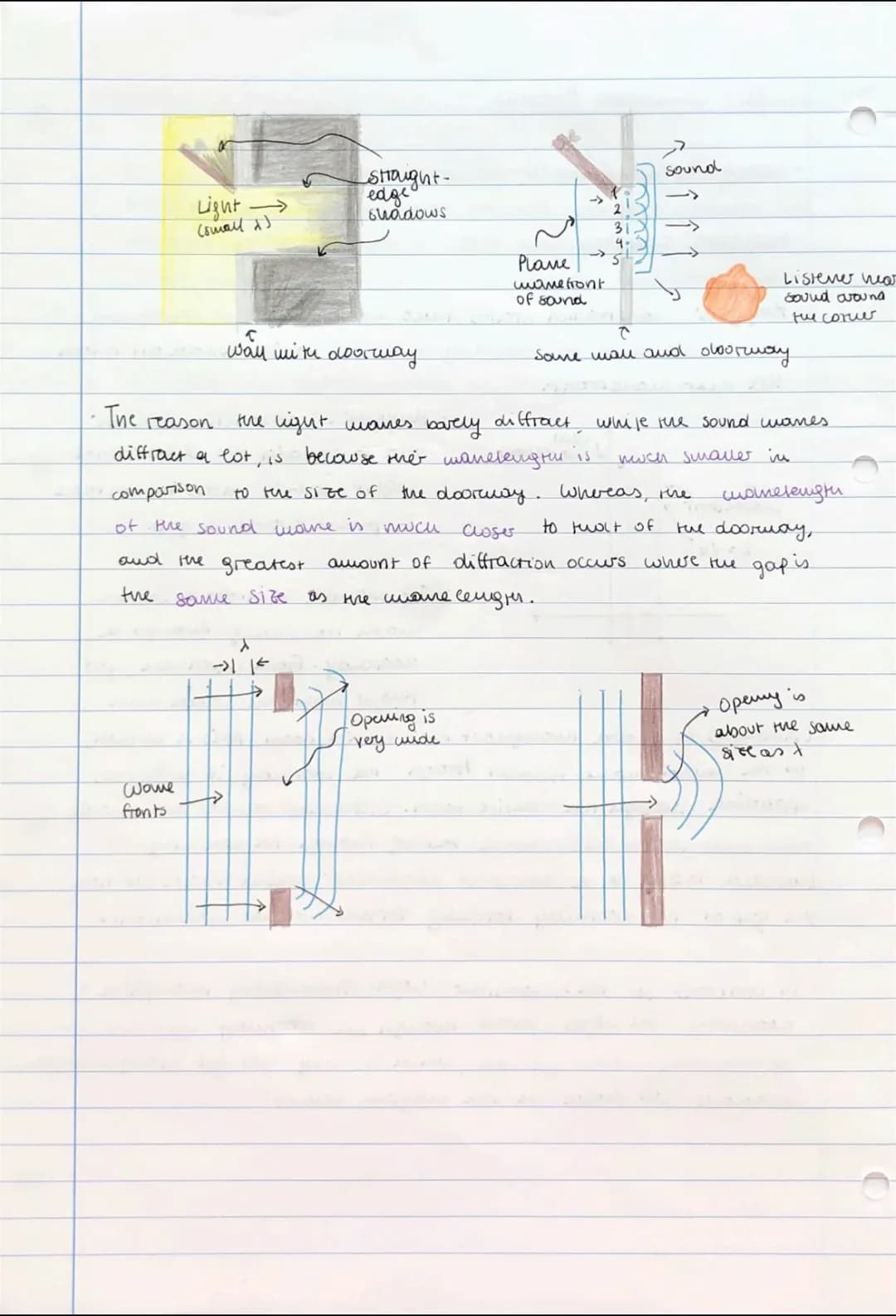
Wave and Photon Models of Electromagnetic Radiation
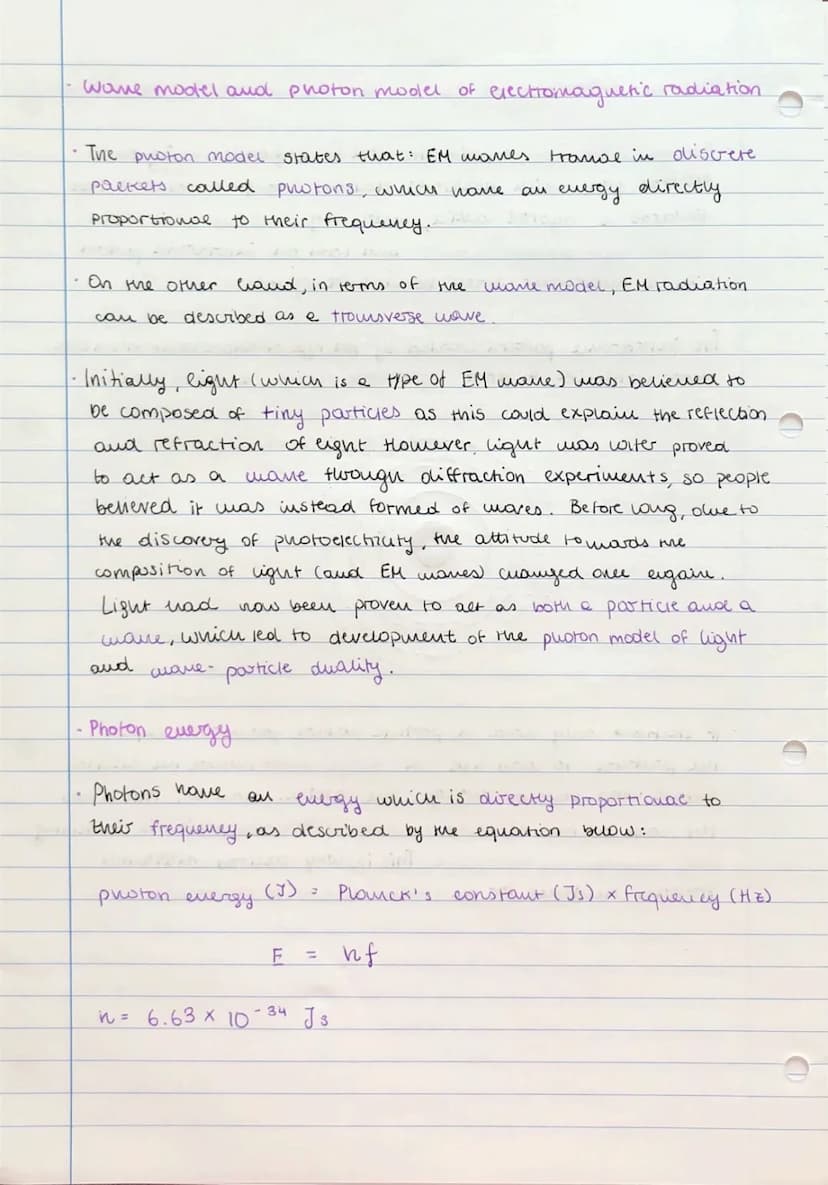
The dual nature of electromagnetic radiation is described by two complementary models: the wave model and the photon model. These models help explain the various behaviors of light and other forms of electromagnetic radiation.
The photon model states that electromagnetic radiation travels in discrete packets called photons, which carry energy directly proportional to their frequency. This model is expressed by the equation E = hf, where E is the photon energy, h is Planck's constant, and f is the frequency.
Definition: The photon model describes electromagnetic radiation as discrete packets of energy called photons, with energy proportional to frequency.
On the other hand, the wave model describes electromagnetic radiation as a transverse wave. This model explains phenomena such as diffraction and interference.
Highlight: The wave-particle duality of light was established through various experiments, including diffraction and the photoelectric effect.
The development of these models reflects the historical progression in understanding the nature of light. Initially believed to be composed of particles, light was later shown to exhibit wave-like behavior through diffraction experiments. The discovery of the photoelectric effect then led to the realization that light could act as both a wave and a particle, culminating in the concept of wave-particle duality.
3
of 6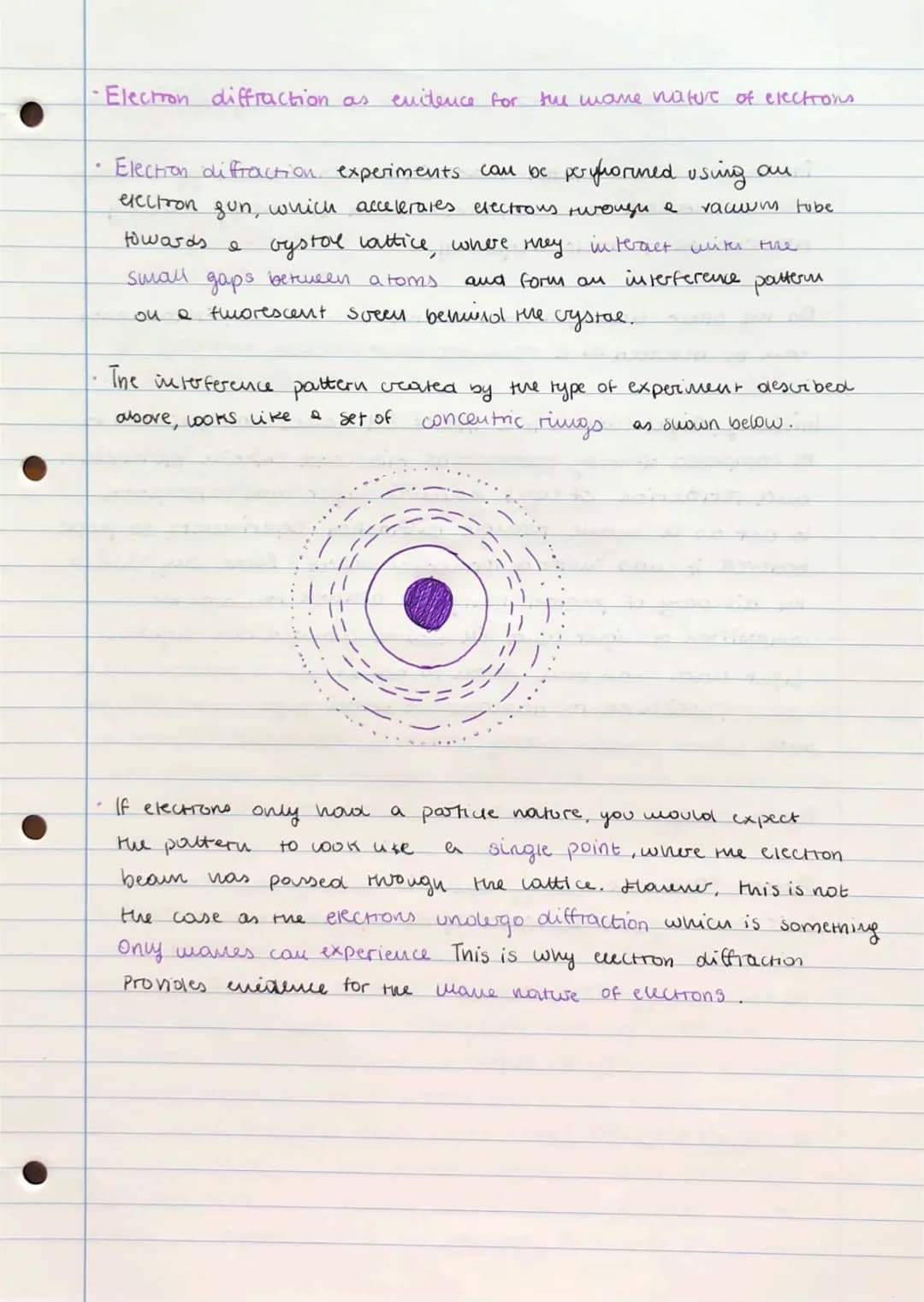
Practical Applications and Calculations
Understanding wave-particle duality and the properties of electromagnetic radiation has practical applications in various fields. Here are some examples and calculations related to these concepts:
-
Demonstrating wave-particle duality:
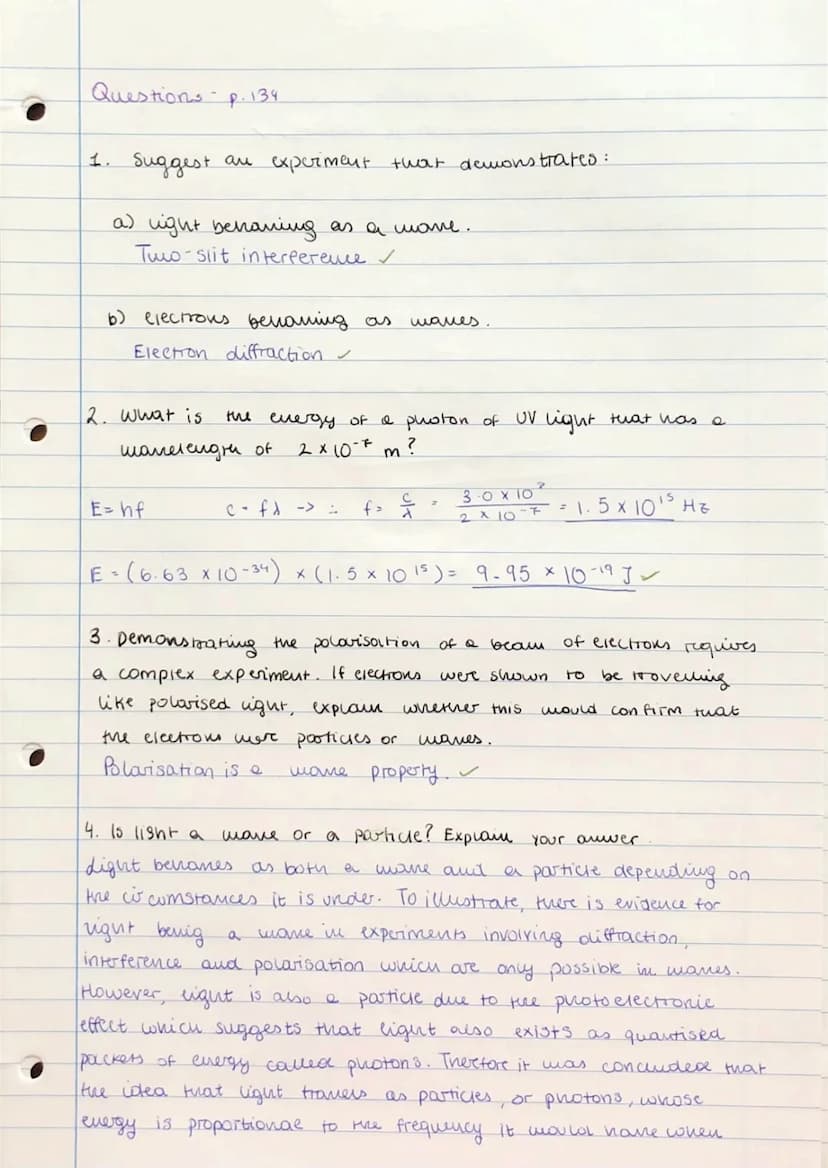
- Light behaving as a wave: Two-slit interference experiment
- Electrons behaving as waves: Electron diffraction experiment
-
Calculating photon energy: For light with a wavelength of 2 x 10^-7 m:
- Frequency: f = c / λ = 3 x 10^8 / = 1.5 x 10^15 Hz
- Energy: E = hf = × = 9.95 × 10^-19 J
Example: The energy of a photon of light with a wavelength of 2 x 10^-7 m is calculated to be 9.95 × 10^-19 J.
-
Polarization of electrons: Demonstrating the polarization of electrons would require complex experiments. If electrons could be polarized like light, it would confirm their wave-like nature, as polarization is a wave property.
-
The nature of light: Light behaves as both a wave and a particle depending on the circumstances. Wave-like properties are evident in diffraction and interference experiments, while particle-like properties are demonstrated in the photoelectric effect.
Highlight: The concept of wave-particle duality explains that light travels as particles (photons) whose energy is proportional to the frequency of the wave they would be if considered as a wave.
These examples and calculations illustrate the practical applications of wave-particle duality in understanding the behavior of light and matter at the quantum level.
4
of 6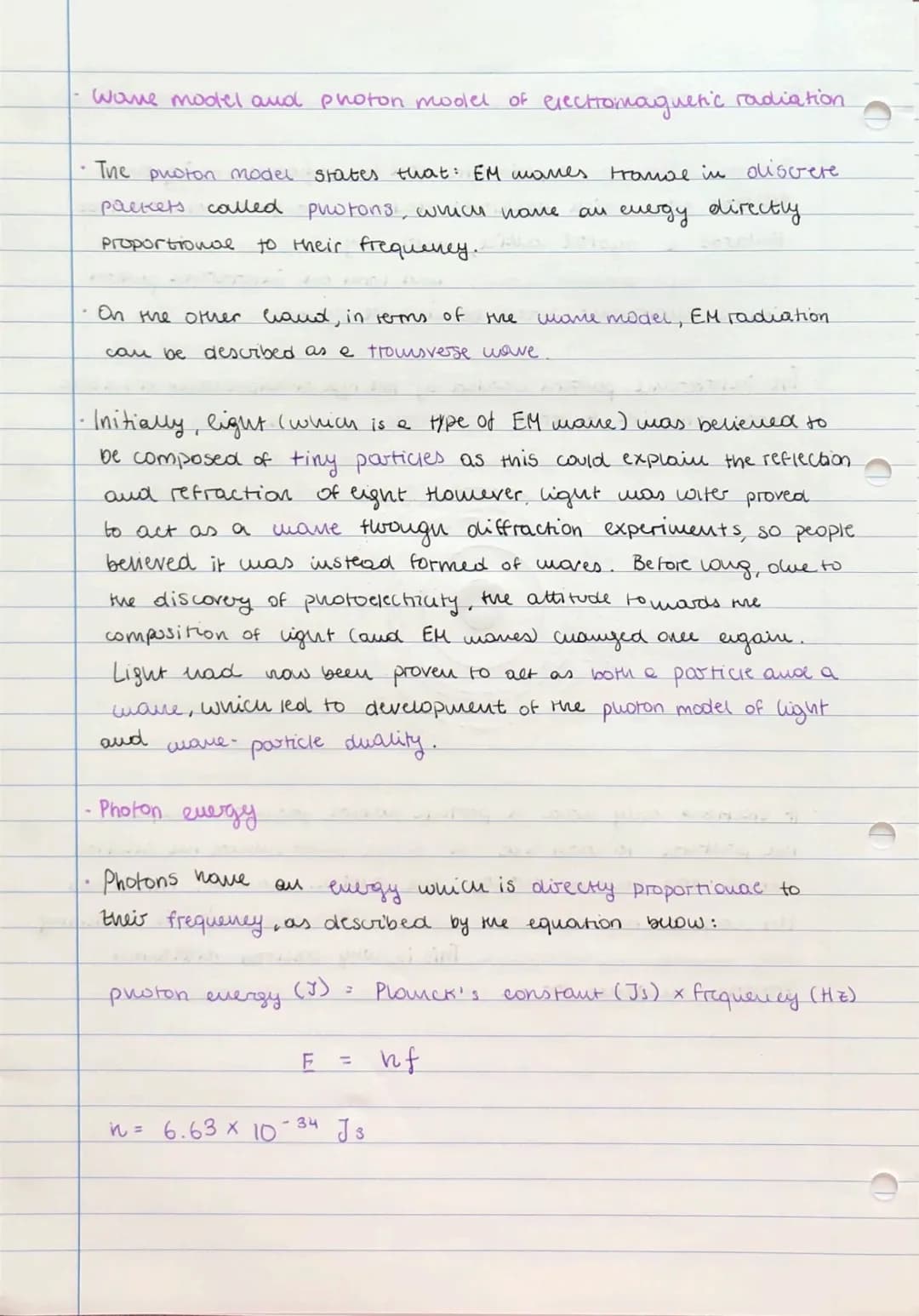
Practical Applications and Further Considerations
The concepts of 3D quantum physics and particle wave duality have numerous practical applications and implications in modern science and technology.
Experiments demonstrating these principles include:
- Two-slit interference for showing light behaving as a wave
- Electron diffraction experiments for demonstrating the wave nature of electrons
Example: The energy of a photon can be calculated using E = hf. For light with a wavelength of 2 x 10^-7 m, the energy is approximately 9.95 x 10^-19 J.
The polarization of waves is another property that distinguishes wave behavior from particle behavior. Experiments showing electron polarization would provide further evidence for the wave nature of electrons.
Highlight: Light behaves as both a wave and a particle depending on the circumstances, exhibiting properties like diffraction and interference as well as the photoelectric effect .
This wave-particle duality is a fundamental principle in quantum mechanics, explaining how entities like light and electrons can exhibit both wave and particle properties. It underpins our understanding of quantum phenomena and has far-reaching implications in fields such as quantum computing, nanotechnology, and advanced materials science.
5
of 6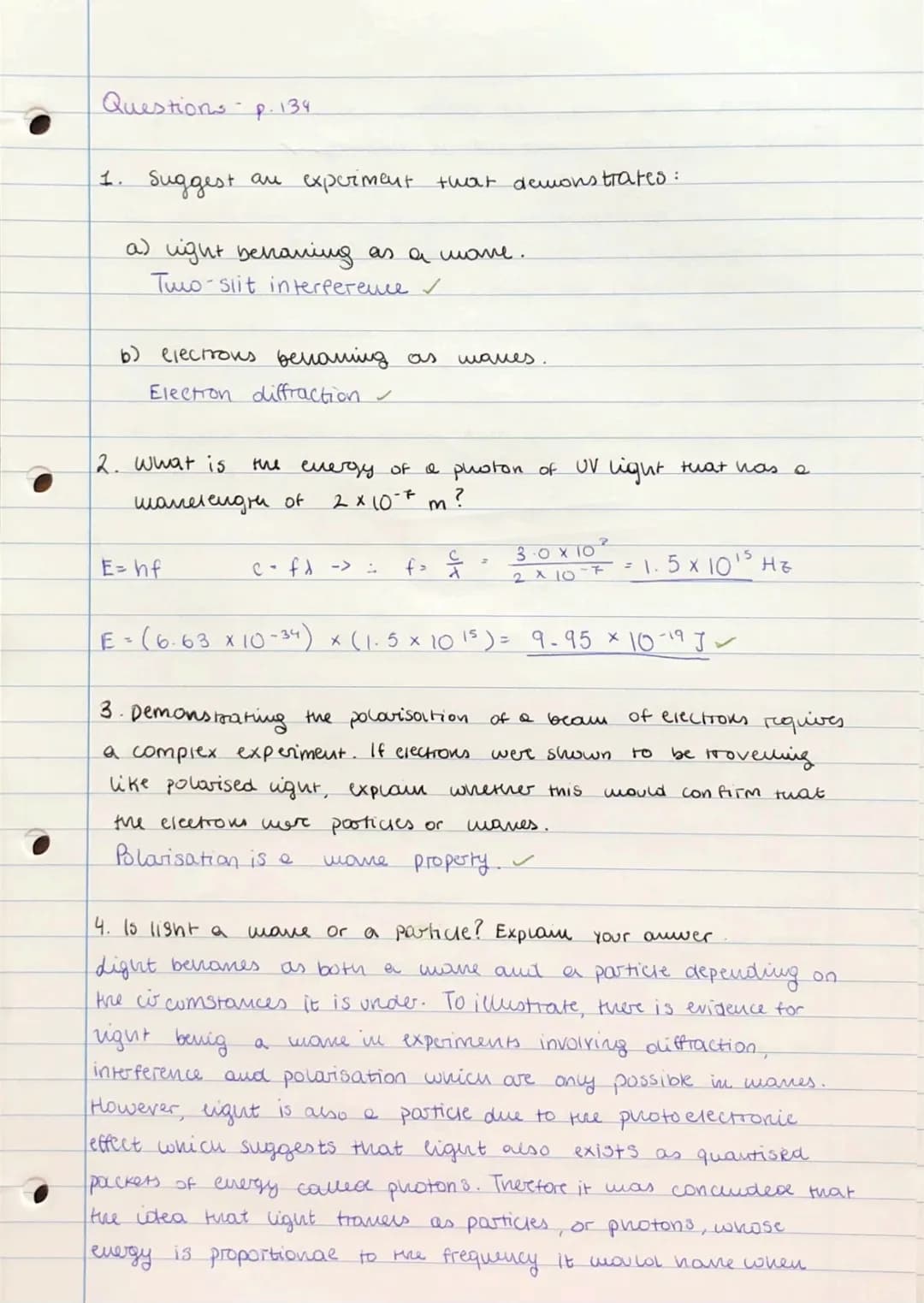
Page 6: Wave-Particle Duality Conclusion
The final page summarizes the fundamental concept of wave-particle duality.
Definition: Wave-particle duality describes how matter and energy can exhibit properties of both waves and particles, depending on the circumstances of observation.
Highlight: This principle represents a cornerstone of modern quantum physics, successfully explaining all observed phenomena.
6
of 6
Huygens' Principle and Wave Propagation
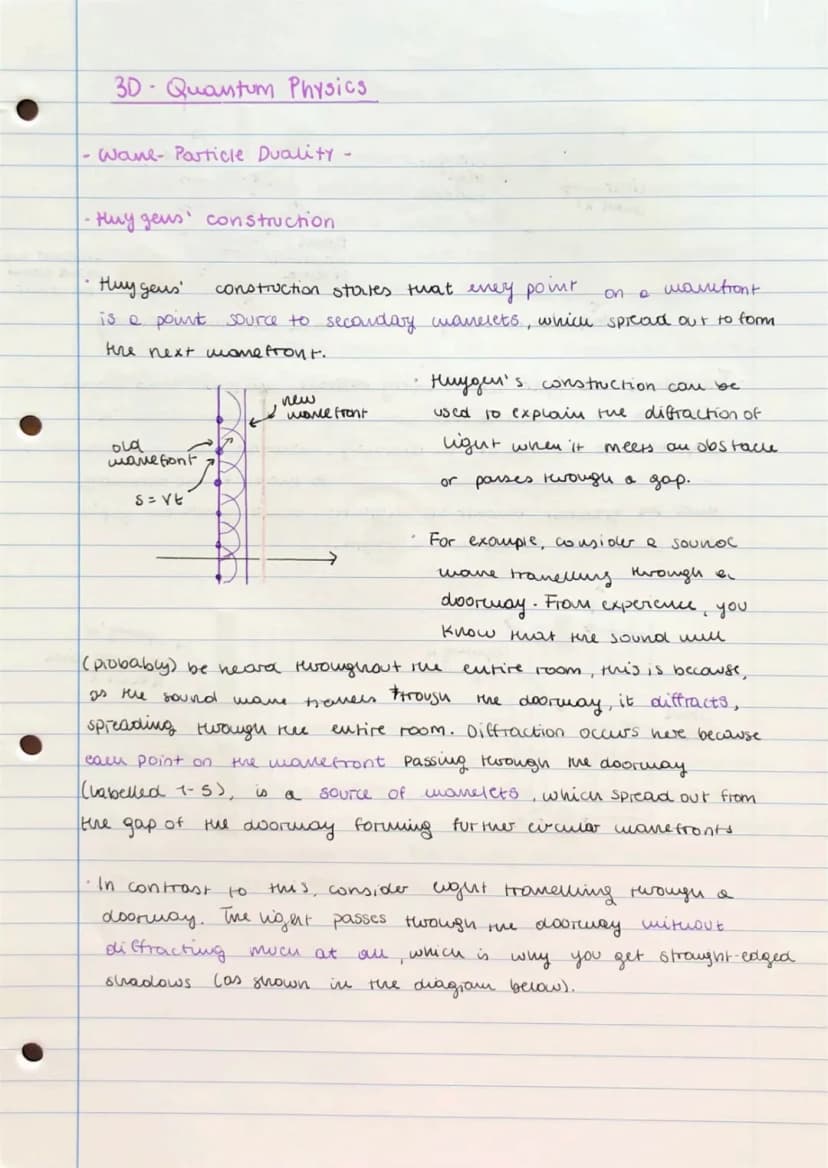
Huygens' principle is a fundamental concept in wave theory that explains how waves propagate and diffract. This principle states that every point on a wavefront acts as a source of secondary wavelets, which spread out to form the next wavefront.
Definition: Huygens' principle states that every point on a wavefront is a source of secondary wavelets that spread out to form the next wavefront.
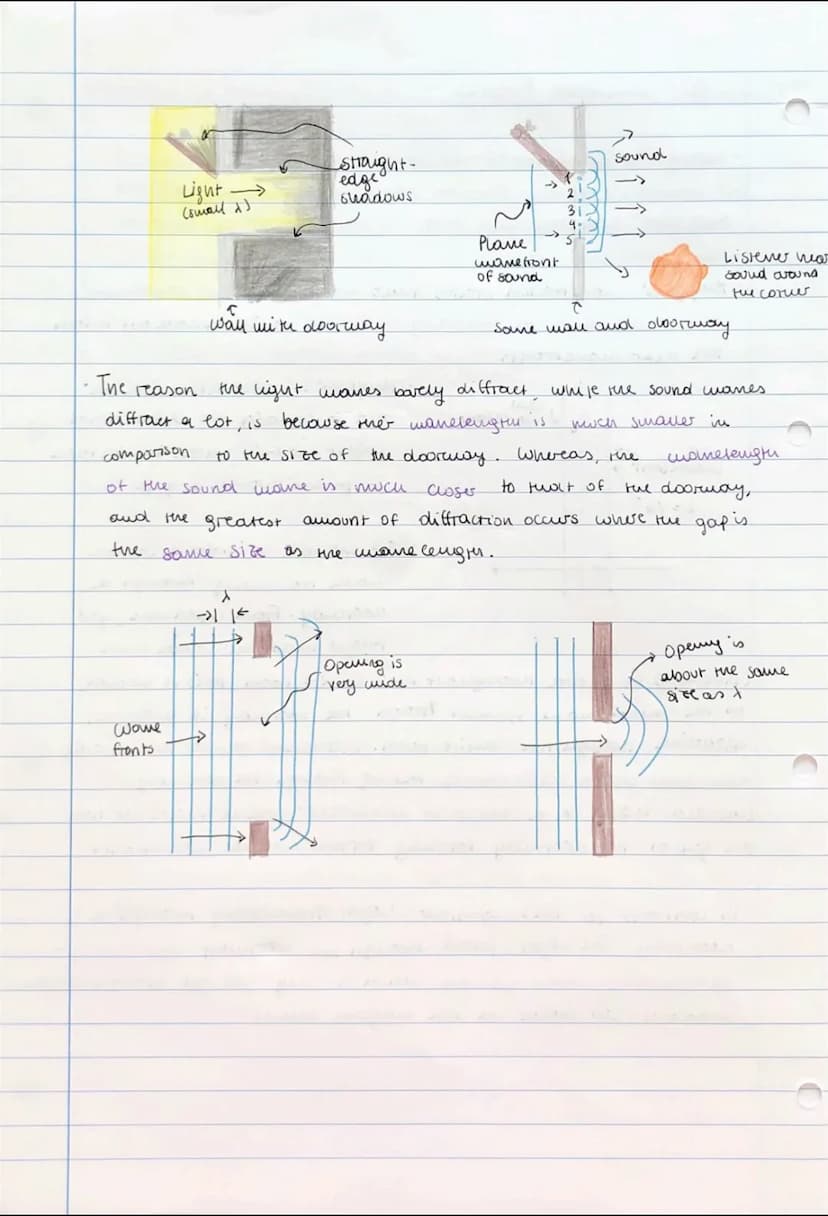
Huygens' construction can be used to explain the diffraction of waves when they encounter obstacles or openings. This phenomenon is particularly noticeable with sound waves, which can be heard throughout a room even when the source is in another room.
Example: Sound waves passing through a doorway diffract and spread out, allowing the sound to be heard throughout the entire room.
In contrast, light waves typically produce straight-edged shadows when passing through openings. This difference in behavior is due to the wavelength of light being much smaller compared to the size of typical openings.
Highlight: The amount of diffraction depends on the relationship between the wavelength and the size of the opening. Greater diffraction occurs when the wavelength is closer to the size of the opening.
We thought you’d never ask...
What is the Knowunity AI companion?
Our AI Companion is a student-focused AI tool that offers more than just answers. Built on millions of Knowunity resources, it provides relevant information, personalised study plans, quizzes, and content directly in the chat, adapting to your individual learning journey.
Where can I download the Knowunity app?
You can download the app from Google Play Store and Apple App Store.
Is Knowunity really free of charge?
That's right! Enjoy free access to study content, connect with fellow students, and get instant help – all at your fingertips.
Similar content
Most popular content: Wave-particle Duality
1Most popular content in Physics
9PhysicsForces and Motion Overview
Explore key concepts in Forces and Motion, including Hooke's Law, velocity, acceleration, and the principles of moments. This summary covers essential topics such as the relationship between force and extension, terminal velocity, and the impact of safety devices in physics. Ideal for AQA Physics Unit 5 revision.
108,767859
PhysicsPhysics Paper 2 Essentials
Master key concepts for AQA Combined Physics Paper 2, including electromagnetic waves, mechanics, forces, and motion. This comprehensive summary covers essential topics like wave properties, Newton's laws, and the motor effect, ensuring you're well-prepared for your exam.
1115,718934
Physicsphysics paper 1 notes
notes for all of physics paper q
102,30454
PhysicsGCSE Physics Practical Experiments
Explore essential GCSE Physics practicals for AQA, covering key concepts such as Hooke's Law, wave properties, thermal insulation, and electrical circuits. This comprehensive guide includes step-by-step procedures, variables, and safety considerations for each experiment, ensuring a thorough understanding of practical applications in physics.
1011,063475
 Chemistry
BTEC Applied Science Unit 1 Overview
Comprehensive resource for Year 12 students pursuing a Level 3 Diploma in Applied Science. This booklet covers essential topics including cell structure, chemical properties, and wave theory, providing clear explanations and key concepts to aid in your studies and exam preparation.
125,332122
C
PhysicsConservation of energy- energy types and stores
Build a strong foundation in physics with these easy flashcards covering key concepts and principles.
93191
Physicsphysics paper 2 foundation notes
aqa combined science physics paper 2 foundation notes
1097126
PhysicsEnergy Flow Systems
Explore the fundamentals of energy flow diagrams, including energy stores, pathways, and transfers. This summary covers key concepts such as heating, electrical transfer, and the eight energy stores, providing a clear understanding of how energy is measured and transformed in various systems. Ideal for students studying energy principles in physics.
92,542247
G
PhysicsGCSE Physics - Energy stores and Systems
Pl-Energy topic to revise for GCSE
107332
Most popular content
9 Sociology
Sociology of Education Overview
Explore comprehensive A-Level Sociology notes on the education system, covering key theories, policies, and sociological perspectives. This resource includes insights on marketisation, gender roles, cultural deprivation, and educational inequalities, providing a thorough understanding of how education shapes social stratification and individual achievement. Ideal for exam preparation and in-depth study.
12101,9683,036
SociologySociology of Families: Comprehensive Revision
Dive into an extensive overview of family dynamics, perspectives, and patterns in sociology. This resource covers key concepts such as family diversity, gender roles, marriage, and the impact of social policies on family structures. Perfect for A-Level Sociology students preparing for Paper 2.
1271,7372,285
 English Literature
An Inspector Calls: Character Insights
Explore in-depth analysis and key quotes for characters in J.B. Priestley's 'An Inspector Calls'. This resource covers Gerald Croft, Inspector Goole, Sheila Birling, Mrs. Birling, Eric Birling, and Eva Smith, focusing on themes of class, gender roles, and social responsibility. Ideal for students aiming for Grade 8 and above.
1025,053896
CriminologyCriminology: Crime & Punishment Overview
Comprehensive mindmaps covering key concepts in the Crime and Punishment topic for WJEC Criminology Unit 4. This resource includes detailed insights into the Criminal Justice System, crime prevention strategies, sentencing models, and the roles of various agencies. Ideal for A-Level revision, ensuring you grasp essential theories and legislative processes to excel in your exams.
1251,8151,028
CriminologyWJEC Unit 4 Criminology
Criminology unit 4 detailed revision note
126,399119
CriminologyCriminology Theories Overview
Explore key criminology theories and their implications on crime and deviance. This comprehensive summary covers biological, psychological, and sociological perspectives, including labelling theory, right realism, and the impact of social campaigns on policy development. Ideal for A-Level criminology students seeking to understand the complexities of criminal behaviour and the factors influencing crime prevention strategies.
129,732211
English LiteratureRomeo and Juliet: Key themes
Key Romeo and Juliet themes and analysed quotes
106,565193
English LiteratureMacbeth: Guilt and Ambition
Explore the complex themes of guilt and ambition in Shakespeare's 'Macbeth'. This analysis covers key characters, including Macbeth and Lady Macbeth, their moral dilemmas, and the tragic consequences of their ambition. Ideal for students studying character motivations, thematic elements, and the psychological impact of power. Includes insights on the natural order, manipulation, and the descent into madness.
918,672387
 Biology
AQA Biology: Key Concepts
Explore essential AQA Biology topics including Photosynthesis, Respiration, Homeostasis, Genetics, and Ecology. This comprehensive knowledge organizer covers key concepts such as energy transfer, hormonal control, and genetic variation, providing a solid foundation for your studies. Ideal for exam preparation and understanding biological processes.
108,326296
Can't find what you're looking for? Explore other subjects.
Students love us — and so will you.
4.6/5App Store
4.7/5Google Play
The app is very easy to use and well designed. I have found everything I was looking for so far and have been able to learn a lot from the presentations! I will definitely use the app for a class assignment! And of course it also helps a lot as an inspiration.
Stefan SiOS user
This app is really great. There are so many study notes and help [...]. My problem subject is French, for example, and the app has so many options for help. Thanks to this app, I have improved my French. I would recommend it to anyone.
Samantha KlichAndroid user
Wow, I am really amazed. I just tried the app because I've seen it advertised many times and was absolutely stunned. This app is THE HELP you want for school and above all, it offers so many things, such as workouts and fact sheets, which have been VERY helpful to me personally.
AnnaiOS user
Physics228 views·Updated May 11, 2026·6 pagesDiscovering Wave-Particle Duality and Cool Quantum Facts for Kids
Wave-particle duality and quantum physics fundamentally explains how matter and energy exhibit both wave and particle characteristics. This comprehensive guide explores Huygens' principle, electron diffraction, and electromagnetic radiation through quantum mechanics.
Key aspects covered:
- Wave-particle duality theoryand its experimental... Show more
1
of 6Sign up to see the content. It's free!
- Access to all documents
- Improve your grades
- Join milions of students
Electron Diffraction and Wave Nature of Electrons
Electron diffraction experiments provide compelling evidence for the wave nature of electrons, challenging the traditional view of electrons as purely particle-like entities. These experiments typically use an electron gun to accelerate electrons through a vacuum tube towards a crystal lattice.
Vocabulary: An electron gun is a device that accelerates electrons through a vacuum tube.
When electrons interact with the gaps between atoms in the crystal lattice, they produce an interference pattern on a fluorescent screen. This pattern appears as a set of concentric rings, similar to the patterns observed in wave interference experiments.
Highlight: The observation of interference patterns in electron diffraction experiments suggests that electrons possess wave-like properties.
If electrons behaved solely as particles, one would expect to see a single point where the electron beam passed through the lattice. However, the observed diffraction pattern is a characteristic of wave behavior, providing strong evidence for the wave-particle duality of electrons.
2
of 6Sign up to see the content. It's free!
- Access to all documents
- Improve your grades
- Join milions of students
Wave and Photon Models of Electromagnetic Radiation
The dual nature of electromagnetic radiation is described by two complementary models: the wave model and the photon model. These models help explain the various behaviors of light and other forms of electromagnetic radiation.
The photon model states that electromagnetic radiation travels in discrete packets called photons, which carry energy directly proportional to their frequency. This model is expressed by the equation E = hf, where E is the photon energy, h is Planck's constant, and f is the frequency.
Definition: The photon model describes electromagnetic radiation as discrete packets of energy called photons, with energy proportional to frequency.
On the other hand, the wave model describes electromagnetic radiation as a transverse wave. This model explains phenomena such as diffraction and interference.
Highlight: The wave-particle duality of light was established through various experiments, including diffraction and the photoelectric effect.
The development of these models reflects the historical progression in understanding the nature of light. Initially believed to be composed of particles, light was later shown to exhibit wave-like behavior through diffraction experiments. The discovery of the photoelectric effect then led to the realization that light could act as both a wave and a particle, culminating in the concept of wave-particle duality.
3
of 6Sign up to see the content. It's free!
- Access to all documents
- Improve your grades
- Join milions of students
Practical Applications and Calculations
Understanding wave-particle duality and the properties of electromagnetic radiation has practical applications in various fields. Here are some examples and calculations related to these concepts:
-
Demonstrating wave-particle duality:
- Light behaving as a wave: Two-slit interference experiment
- Electrons behaving as waves: Electron diffraction experiment
-
Calculating photon energy: For light with a wavelength of 2 x 10^-7 m:
- Frequency: f = c / λ = 3 x 10^8 / = 1.5 x 10^15 Hz
- Energy: E = hf = × = 9.95 × 10^-19 J
Example: The energy of a photon of light with a wavelength of 2 x 10^-7 m is calculated to be 9.95 × 10^-19 J.
-
Polarization of electrons: Demonstrating the polarization of electrons would require complex experiments. If electrons could be polarized like light, it would confirm their wave-like nature, as polarization is a wave property.
-
The nature of light: Light behaves as both a wave and a particle depending on the circumstances. Wave-like properties are evident in diffraction and interference experiments, while particle-like properties are demonstrated in the photoelectric effect.
Highlight: The concept of wave-particle duality explains that light travels as particles (photons) whose energy is proportional to the frequency of the wave they would be if considered as a wave.
These examples and calculations illustrate the practical applications of wave-particle duality in understanding the behavior of light and matter at the quantum level.
4
of 6Sign up to see the content. It's free!
- Access to all documents
- Improve your grades
- Join milions of students
Practical Applications and Further Considerations
The concepts of 3D quantum physics and particle wave duality have numerous practical applications and implications in modern science and technology.
Experiments demonstrating these principles include:
- Two-slit interference for showing light behaving as a wave
- Electron diffraction experiments for demonstrating the wave nature of electrons
Example: The energy of a photon can be calculated using E = hf. For light with a wavelength of 2 x 10^-7 m, the energy is approximately 9.95 x 10^-19 J.
The polarization of waves is another property that distinguishes wave behavior from particle behavior. Experiments showing electron polarization would provide further evidence for the wave nature of electrons.
Highlight: Light behaves as both a wave and a particle depending on the circumstances, exhibiting properties like diffraction and interference as well as the photoelectric effect .
This wave-particle duality is a fundamental principle in quantum mechanics, explaining how entities like light and electrons can exhibit both wave and particle properties. It underpins our understanding of quantum phenomena and has far-reaching implications in fields such as quantum computing, nanotechnology, and advanced materials science.
5
of 6Sign up to see the content. It's free!
- Access to all documents
- Improve your grades
- Join milions of students
Page 6: Wave-Particle Duality Conclusion
The final page summarizes the fundamental concept of wave-particle duality.
Definition: Wave-particle duality describes how matter and energy can exhibit properties of both waves and particles, depending on the circumstances of observation.
Highlight: This principle represents a cornerstone of modern quantum physics, successfully explaining all observed phenomena.
6
of 6Sign up to see the content. It's free!
- Access to all documents
- Improve your grades
- Join milions of students
Huygens' Principle and Wave Propagation
Huygens' principle is a fundamental concept in wave theory that explains how waves propagate and diffract. This principle states that every point on a wavefront acts as a source of secondary wavelets, which spread out to form the next wavefront.
Definition: Huygens' principle states that every point on a wavefront is a source of secondary wavelets that spread out to form the next wavefront.
Huygens' construction can be used to explain the diffraction of waves when they encounter obstacles or openings. This phenomenon is particularly noticeable with sound waves, which can be heard throughout a room even when the source is in another room.
Example: Sound waves passing through a doorway diffract and spread out, allowing the sound to be heard throughout the entire room.
In contrast, light waves typically produce straight-edged shadows when passing through openings. This difference in behavior is due to the wavelength of light being much smaller compared to the size of typical openings.
Highlight: The amount of diffraction depends on the relationship between the wavelength and the size of the opening. Greater diffraction occurs when the wavelength is closer to the size of the opening.
We thought you’d never ask...
What is the Knowunity AI companion?
Our AI Companion is a student-focused AI tool that offers more than just answers. Built on millions of Knowunity resources, it provides relevant information, personalised study plans, quizzes, and content directly in the chat, adapting to your individual learning journey.
Where can I download the Knowunity app?
You can download the app from Google Play Store and Apple App Store.
Is Knowunity really free of charge?
That's right! Enjoy free access to study content, connect with fellow students, and get instant help – all at your fingertips.
Similar content
Most popular content: Wave-particle Duality
1Most popular content in Physics
9PhysicsForces and Motion Overview
Explore key concepts in Forces and Motion, including Hooke's Law, velocity, acceleration, and the principles of moments. This summary covers essential topics such as the relationship between force and extension, terminal velocity, and the impact of safety devices in physics. Ideal for AQA Physics Unit 5 revision.
108,767859
PhysicsPhysics Paper 2 Essentials
Master key concepts for AQA Combined Physics Paper 2, including electromagnetic waves, mechanics, forces, and motion. This comprehensive summary covers essential topics like wave properties, Newton's laws, and the motor effect, ensuring you're well-prepared for your exam.
1115,718934
Physicsphysics paper 1 notes
notes for all of physics paper q
102,30454
PhysicsGCSE Physics Practical Experiments
Explore essential GCSE Physics practicals for AQA, covering key concepts such as Hooke's Law, wave properties, thermal insulation, and electrical circuits. This comprehensive guide includes step-by-step procedures, variables, and safety considerations for each experiment, ensuring a thorough understanding of practical applications in physics.
1011,063475
ChemistryBTEC Applied Science Unit 1 Overview
Comprehensive resource for Year 12 students pursuing a Level 3 Diploma in Applied Science. This booklet covers essential topics including cell structure, chemical properties, and wave theory, providing clear explanations and key concepts to aid in your studies and exam preparation.
125,332122
C
PhysicsConservation of energy- energy types and stores
Build a strong foundation in physics with these easy flashcards covering key concepts and principles.
93191
Physicsphysics paper 2 foundation notes
aqa combined science physics paper 2 foundation notes
1097126
PhysicsEnergy Flow Systems
Explore the fundamentals of energy flow diagrams, including energy stores, pathways, and transfers. This summary covers key concepts such as heating, electrical transfer, and the eight energy stores, providing a clear understanding of how energy is measured and transformed in various systems. Ideal for students studying energy principles in physics.
92,542247
G
PhysicsGCSE Physics - Energy stores and Systems
Pl-Energy topic to revise for GCSE
107332
Most popular content
9SociologySociology of Education Overview
Explore comprehensive A-Level Sociology notes on the education system, covering key theories, policies, and sociological perspectives. This resource includes insights on marketisation, gender roles, cultural deprivation, and educational inequalities, providing a thorough understanding of how education shapes social stratification and individual achievement. Ideal for exam preparation and in-depth study.
12101,9683,036
SociologySociology of Families: Comprehensive Revision
Dive into an extensive overview of family dynamics, perspectives, and patterns in sociology. This resource covers key concepts such as family diversity, gender roles, marriage, and the impact of social policies on family structures. Perfect for A-Level Sociology students preparing for Paper 2.
1271,7372,285
English LiteratureAn Inspector Calls: Character Insights
Explore in-depth analysis and key quotes for characters in J.B. Priestley's 'An Inspector Calls'. This resource covers Gerald Croft, Inspector Goole, Sheila Birling, Mrs. Birling, Eric Birling, and Eva Smith, focusing on themes of class, gender roles, and social responsibility. Ideal for students aiming for Grade 8 and above.
1025,053896
CriminologyCriminology: Crime & Punishment Overview
Comprehensive mindmaps covering key concepts in the Crime and Punishment topic for WJEC Criminology Unit 4. This resource includes detailed insights into the Criminal Justice System, crime prevention strategies, sentencing models, and the roles of various agencies. Ideal for A-Level revision, ensuring you grasp essential theories and legislative processes to excel in your exams.
1251,8151,028
CriminologyWJEC Unit 4 Criminology
Criminology unit 4 detailed revision note
126,399119
CriminologyCriminology Theories Overview
Explore key criminology theories and their implications on crime and deviance. This comprehensive summary covers biological, psychological, and sociological perspectives, including labelling theory, right realism, and the impact of social campaigns on policy development. Ideal for A-Level criminology students seeking to understand the complexities of criminal behaviour and the factors influencing crime prevention strategies.
129,732211
English LiteratureRomeo and Juliet: Key themes
Key Romeo and Juliet themes and analysed quotes
106,565193
English LiteratureMacbeth: Guilt and Ambition
Explore the complex themes of guilt and ambition in Shakespeare's 'Macbeth'. This analysis covers key characters, including Macbeth and Lady Macbeth, their moral dilemmas, and the tragic consequences of their ambition. Ideal for students studying character motivations, thematic elements, and the psychological impact of power. Includes insights on the natural order, manipulation, and the descent into madness.
918,672387
BiologyAQA Biology: Key Concepts
Explore essential AQA Biology topics including Photosynthesis, Respiration, Homeostasis, Genetics, and Ecology. This comprehensive knowledge organizer covers key concepts such as energy transfer, hormonal control, and genetic variation, providing a solid foundation for your studies. Ideal for exam preparation and understanding biological processes.
108,326296
Can't find what you're looking for? Explore other subjects.
Students love us — and so will you.
4.6/5App Store
4.7/5Google Play
The app is very easy to use and well designed. I have found everything I was looking for so far and have been able to learn a lot from the presentations! I will definitely use the app for a class assignment! And of course it also helps a lot as an inspiration.
Stefan SiOS user
This app is really great. There are so many study notes and help [...]. My problem subject is French, for example, and the app has so many options for help. Thanks to this app, I have improved my French. I would recommend it to anyone.
Samantha KlichAndroid user
Wow, I am really amazed. I just tried the app because I've seen it advertised many times and was absolutely stunned. This app is THE HELP you want for school and above all, it offers so many things, such as workouts and fact sheets, which have been VERY helpful to me personally.
AnnaiOS user