Forces and Spring Behaviour
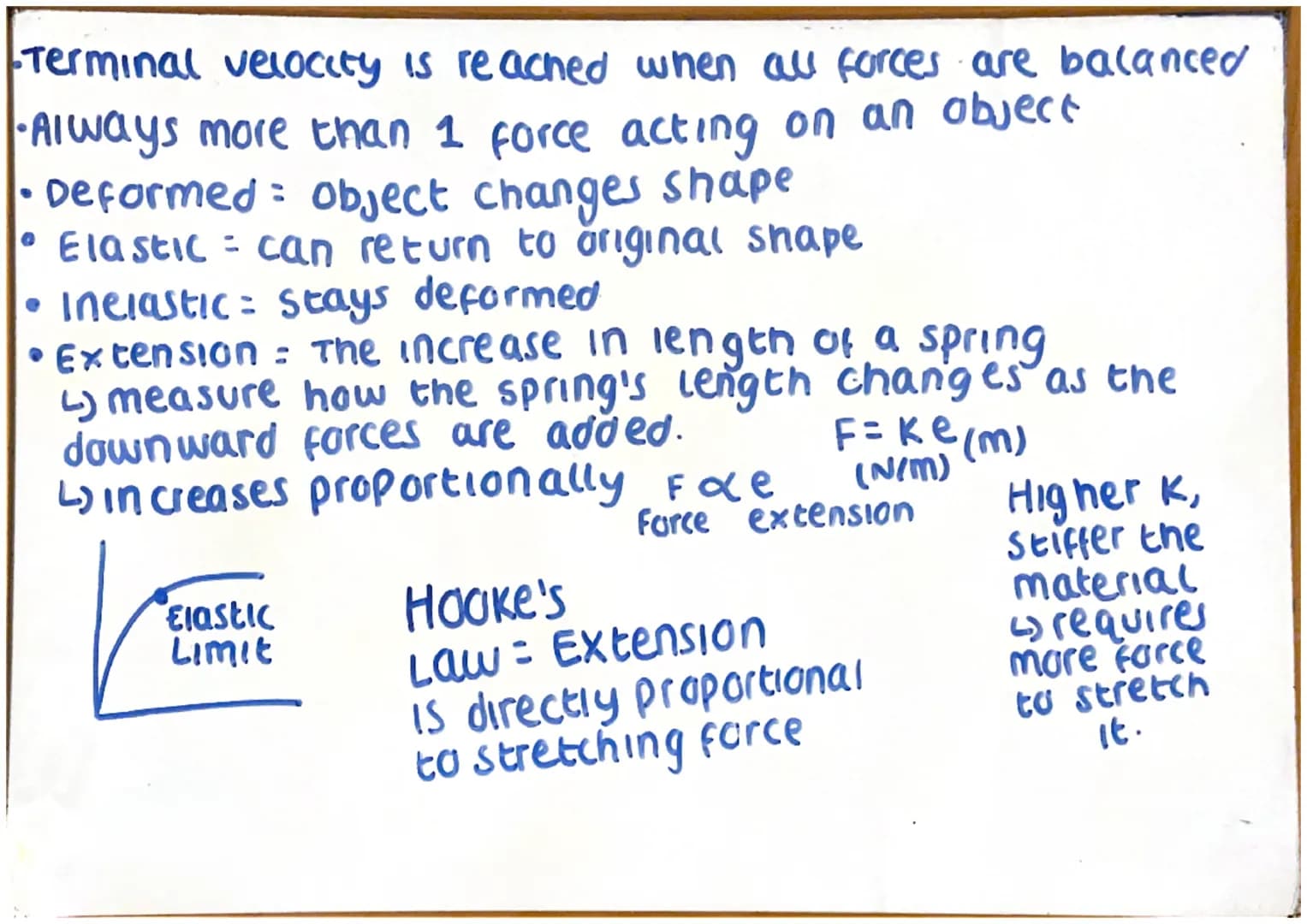
Ever wondered why a skydiver doesn't just keep getting faster and faster? Terminal velocity happens when all the forces acting on a falling object become perfectly balanced - the downward pull of gravity equals the upward push of air resistance.
Here's something important to remember: there's always more than one force acting on any object. When you drop your phone, gravity pulls it down whilst air resistance pushes back up. Eventually, these forces balance out, and your phone falls at a constant speed.
When materials get squashed or stretched, they become deformed. Some materials are elastic (like rubber bands) and snap back to their original shape when you let go. Others are inelastic (like plasticine) and stay permanently changed. The extension simply means how much longer a spring gets when you stretch it.
Hooke's Law shows us that the extension of a spring is directly proportional to the stretching force: F = ke. The 'k' value tells us how stiff the material is - a higher k means you need more force to stretch it. However, this only works up to the elastic limit - stretch too far and the spring won't bounce back!
Quick Tip: Remember F = ke where F is force (Newtons), k is stiffness N/m, and e is extension (metres). This formula only works before you reach the elastic limit!


 Physics
 Chemistry
 English Literature
 Sociology
 Biology